No products in the cart.



You're at the bench with a lyophilized peptide vial in front of you, a syringe ready, and a vial labeled Aqua Science bacteriostatic water within reach. The immediate questions are practical: Why use this diluent instead of sterile water for injection? What does the benzyl alcohol do? How should the peptide be reconstituted, stored, and documented? This guide translates the product label and multi-dose workflow into clear laboratory language, while also addressing the sourcing problems researchers face when preferred vial formats are unavailable.
A peptide vial may be ready for reconstitution while the lab's preferred diluent is not. The researcher then has to make two decisions at once: whether the water is compatible with the planned work and whether its container format fits the day's handling schedule. Aqua Science bacteriostatic water is relevant because it combines injectable water with a preservative and a multi-dose container, while plain sterile water for injection is preservative-free and intended for single use according to FDA and DailyMed product labeling.
The distinction becomes practical when several preparations are scheduled across a research workflow. A multi-dose vial can reduce the need to stage a fresh single-use container for each preparation. That convenience still depends on compatibility, aseptic technique, and the product's labeled handling instructions. The vial format supports repeated withdrawals, but it does not make every peptide suitable for the same diluent.
At the bench, researchers generally value four features:
That last distinction prevents a common mistake. Multi-dose describes the intended container use, not an unlimited storage license. Every puncture introduces another contamination opportunity, and the preservative cannot correct poor handling or restore a compromised vial.
A useful bench record starts at the first puncture. Mark that date, document withdrawals, inspect the vial before use, and apply the product's in-use directions rather than relying on memory.
Supply interruptions add another layer. If the preferred vial size or brand is unavailable, researchers may need to check an alternative product's label, preservative content, container format, and compatibility before changing the workflow. The product definition and labeling details provide that starting point.
A peptide researcher opens a vial at the bench and needs a diluent that matches the protocol, container format, and intended use. Aqua Science bacteriostatic water belongs to the defined category of injectable diluents labeled as sterile, nonpyrogenic water for injection containing benzyl alcohol as a bacteriostatic preservative. A commonly labeled formulation contains 0.9% benzyl alcohol, or 9 mg/mL, and is supplied in a 30 mL vial designed for multiple-dose use.
The product is water prepared for injectable-drug dilution, with a preservative that supports repeated withdrawals when the label and handling conditions permit. It is not a peptide, active compound, or treatment. In a research workflow, it is the liquid used to reconstitute a lyophilized peptide or another compatible compound for laboratory work. The formulation details should be verified against the current DailyMed labeling for bacteriostatic water.
Several terms describe different properties, so they should not be treated as interchangeable:
Label strength also varies by product. Another FDA and DailyMed-labeled formulation contains 1.1% benzyl alcohol, or 11 mg/mL, while serving the same general bacteriostatic-water function (DailyMed labeling for a 1.1% formulation). A protocol should therefore identify the required diluent rather than treating all bacteriostatic water as identical.
Researchers should also distinguish bacteriostatic water from preservative-free sterile water. Before substituting products, check the compound documentation, applicable protocol, and manufacturer labeling. For related background on organisms such as Pseudomonas aeruginosa, see these Pseudomonas aeruginosa control tips.
At the bench, the preservative has a specific job: benzyl alcohol helps inhibit microbial growth while a properly handled vial supports repeated withdrawals. Its effect is limited once organisms are established or contamination has entered. Clean handling, a new sterile needle, and disposal within the labeled time frame therefore remain part of the workflow.
Label strength can differ between products. One formulation contains 0.9%, or 9 mg/mL, benzyl alcohol, while another contains 1.1%, or 11 mg/mL. The protocol should identify the required diluent and match it to the product label. A higher concentration is not automatically the better choice for every peptide or application.
| Property | Bacteriostatic Water, Aqua Science | Sterile Water for Injection |
|---|---|---|
| Preservative | Benzyl alcohol present | No preservative |
| Labeled strength | Commonly 0.9%, or 9 mg/mL. Some products use 1.1%, or 11 mg/mL | Not applicable |
| In-use format | Multiple-dose container, subject to labeled handling and discard instructions | Single-use container |
| Typical research role | Repeated diluent withdrawals when the protocol permits preserved water | Preservative-free reconstitution or admixture when specified |
The comparison matters because the container format changes the practical workflow. Bacteriostatic water is designed for repeated punctures under appropriate handling conditions, whereas preservative-free sterile water is supplied for single-use situations.
For a punctured multiple-dose vial, the 28-day in-use window begins with the first needle puncture (bacteriostatic water shelf-life guidance). Benzyl alcohol can support a controlled multi-dose process, but it does not replace aseptic technique, inspection, or a documented discard date. That date should be recorded when the vial is first entered, so the vial's status remains clear during later peptide preparation.
Reconstitution should be deliberate rather than rushed. The exact diluent volume, target concentration, and handling requirements must come from the compound's research protocol or product documentation. The following workflow describes general bench technique, not a clinical dosing instruction.
Draw the calculated volume of bacteriostatic water without touching the needle or syringe tip. Insert the needle into the peptide vial and direct the liquid against the inside wall rather than onto the dry peptide cake. This reduces the mechanical force applied directly to the lyophilized material.
Let the liquid move into the vial slowly. Once the diluent has been added, swirl gently until the material dissolves. Avoid vigorous shaking or vortexing unless the specific protocol explicitly permits it, because harsh agitation can create foaming and may affect sensitive compounds.
| Vial Mass | Diluent Volume | Concentration per 0.1 mL |
|---|---|---|
| 2 mg | 2 mL | 0.1 mg |
| 5 mg | 2 mL | 0.25 mg |
| 10 mg | 2 mL | 0.5 mg |
| 15 mg | 3 mL | 0.5 mg |
| 20 mg | 4 mL | 0.5 mg |
These are arithmetic examples for planning workable research volumes, not universal preparation instructions. A protocol may specify a different volume based on solubility, assay design, container capacity, or analytical requirements.
The reconstituted material should be assessed against the applicable product and protocol expectations. Check for unexpected cloudiness, color change, precipitate, floating particles, or incomplete dissolution. If anything looks inconsistent, stop and consult the responsible laboratory lead or manufacturer documentation rather than trying to filter or rescue the preparation.
For a concise reference on storage rules for bacteriostatic water, review the handling points before placing the vial back into storage.
The most important storage detail is the starting point of the in-use period. For a punctured multiple-dose vial, the standard window is 28 days, and the clock starts at the first needle puncture, not at a later date when the vial is first used for a peptide preparation (bacteriostatic water shelf-life guidance).
That rule prevents an easy documentation error. A vial may appear untouched after the first puncture, but the stopper has already been breached. Write the puncture date directly on the vial or its laboratory record immediately after the first withdrawal, then assign the discard date according to the governing label and institutional procedure.
The product's printed expiration date still matters for an unopened vial. Once the vial is punctured, the in-use window becomes a separate control point. If the solution develops unexpected particles, haze, discoloration, or other visible changes before the discard date, quarantine it and follow the laboratory's disposal and investigation procedure.
Documentation rule: A vial without a reliable first-puncture date should be treated as an undocumented vial, not as a vial with extra usable time.
A researcher may reach for bacteriostatic water when a protocol specifies sterile water for injection, then assume the two products are interchangeable. They are not interchangeable by default. Adding benzyl alcohol changes the formulation, so a protocol calling for preservative-free water requires a deliberate compatibility review. FDA and DailyMed labeling also includes a neonatal warning, showing that benzyl alcohol is not suitable for every population or application. See the DailyMed bacteriostatic-water labeling.
Benzyl alcohol functions as an antimicrobial preservative under labeled conditions. It cannot compensate for a contaminated needle, a touched stopper, poor storage, or an uncertain handling history. The vial still needs controlled aseptic technique at every withdrawal.
A DailyMed recall involving a Hospira 30 mL bacteriostatic-water multi-dose vial warned that contamination could raise the risk of invasive bacterial infection, including bacterial meningitis and septicemia. The DailyMed recall notice reinforces the practical lesson: preserve lot traceability, document handling, and treat preservative chemistry as one control among several.
Bacteriostatic water can become difficult to source when manufacturing delays combine with limited supplier capacity. The American Society of Health-System Pharmacists shortage detail records insufficient supply and limited availability reported by Pfizer in mid-2025 (ASHP drug shortage detail).
That shortage pattern affects more than a retail shopping list. Hospitals, pharmacies, compounding operations, and research users can all face ordering uncertainty when a familiar 30 mL multi-dose vial isn't available. The wrong response is to stretch a punctured vial beyond its labeled window or to switch to an unlabeled product solely because a reseller has inventory.
| Brand or manufacturer | Typical vial size | Benzyl alcohol percentage | Availability notes |
|---|---|---|---|
| Aqua Science | 30 mL format may be offered by research suppliers | Verify the current product label | Availability can vary by supplier |
| Hospira | 30 mL multi-dose format is documented in recall labeling | Verify the specific lot label | Supply may be affected during shortage periods |
| Pfizer | Product availability has been described as limited in the ASHP shortage record | Verify the specific formulation | Insufficient supply was reported in mid-2025 |
| Fresenius Kabi | Confirm the current labeled presentation | Verify the specific product label | Check authorized distribution channels |
The table isn't a substitute for current inventory or regulatory review. Before purchasing, verify the manufacturer, lot number, NDC-coded configuration where applicable, intact tamper-evident packaging, preservative concentration, expiration date, and intended use.
Supply-chain safeguard: A lower-quality substitute can create more documentation and sterility risk than a short delay while the approved format is verified.
If the preferred product is unavailable, ask the responsible pharmacist, procurement team, or laboratory compliance lead about a pharmacy-compounded bacteriostatic-water option or another properly labeled multi-dose format. Don't make household water, filtered water, or improvised diluent part of an injectable research workflow. For broader background on home water system advice, remember that household filtration guidance doesn't establish injectable sterility or suitability.
A smooth workflow turns the label, bench technique, records, and supply plan into one system. Before starting, confirm the vial is the intended sterile diluent, inspect its packaging, and compare the labeled formulation with the research protocol. Treat the label as the product's identity card, not as a substitute for your laboratory's approval process.
Use the protocol's specified volume. Transfer the diluent slowly against the vial wall, then swirl gently rather than shaking. Record the supplier, manufacturer, lot information, expiration date, preparation time, and any unusual observation. Those details make a later review possible if the solution's appearance or the peptide's behavior changes.
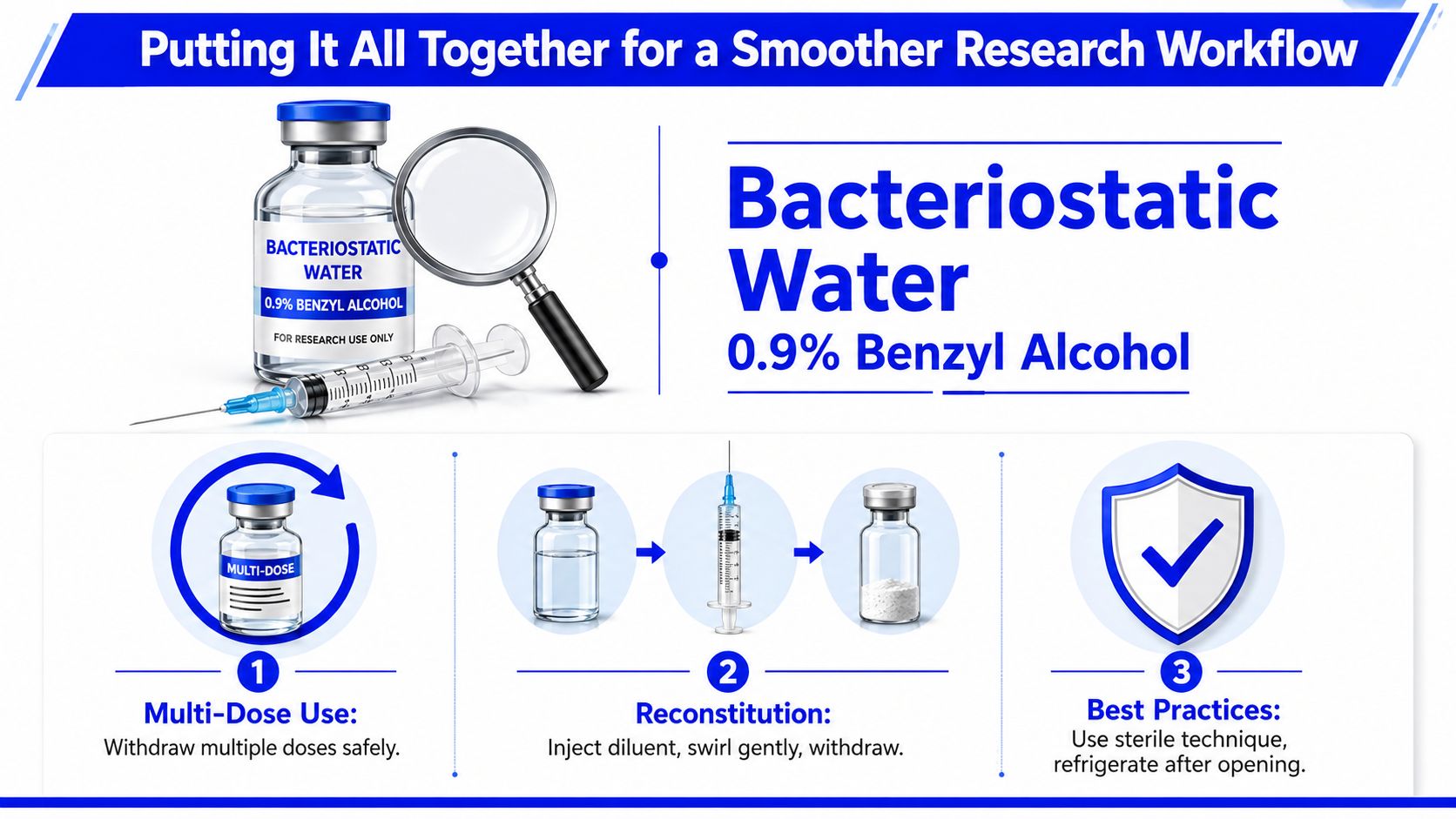
Keep a decision checklist beside the workspace:
Peptide Warehouse USA lists research peptides and related compounds, along with a 30 mL bacteriostatic water product labeled for research use only. Its catalog provides lot documentation and supporting laboratory records. Visit Peptide Warehouse USA to review the product and related reconstitution supplies.