No products in the cart.



You've got a lyophilized peptide vial on the bench, a vial labeled bacteriostatic water, and a syringe ready to draw. The setup looks simple, but the result depends on decisions made before the first puncture: the peptide mass, target concentration, solvent compatibility, handling window, and storage plan.
A reliable bac water peptide workflow is a calculation problem first and a technique problem second. This guide explains what bacteriostatic water contains, how it differs from sterile water, how to calculate the correct reconstitution volume, and how to recognize situations where bac water may be the wrong solvent. It also covers practical bench handling, storage limits, troubleshooting, and the documentation that makes research-grade peptide work traceable.
A freeze-dried peptide cake and a bacteriostatic water vial can look ready for immediate use. They aren't. Before touching either stopper, confirm the amount of peptide in the vial, the target final concentration, the intended research application, and whether the peptide's formulation notes permit benzyl alcohol.
Reconstitution is not a matter of filling a vial with liquid. The volume you add determines concentration, while the preservative affects compatibility and the handling plan. Repeated withdrawals create a different workflow from single-use aliquoting, and a conventional beyond-use window isn't a universal expiration date for every peptide sequence.
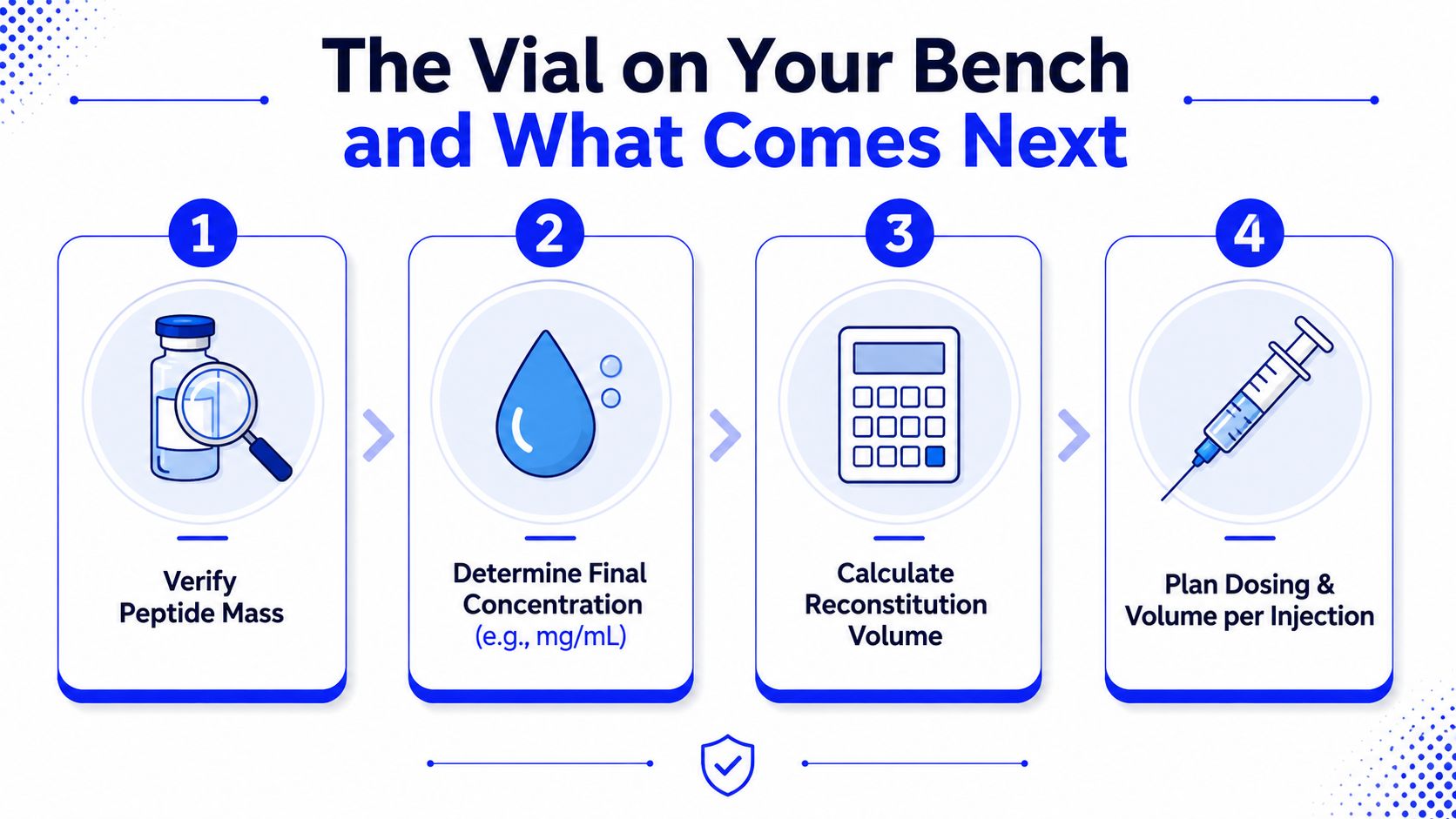
A good record starts before mixing. Write down the peptide name, labeled mass, lot number, diluent name and lot, desired concentration, calculated volume, reconstitution date, storage condition, and planned use window. If the supplier provides a sequence-specific solubility note or handling requirement, keep it with the record rather than relying on memory.
Practical rule: If you can't explain the final concentration on paper, don't add liquid to the vial yet.
The cleanest process also includes suitable controls and conservative discard criteria. Cloudiness, visible particles, unexpected color, damaged vial closures, uncertain identity, or an unexplained concentration discrepancy should stop the workflow. A preservative can help inhibit microbial growth, but it doesn't repair poor handling or validate an unknown sample.
Bacteriostatic water for injection is sterile water containing 0.9% benzyl alcohol, equivalent to 9 mg/mL, as a preservative. The official DailyMed bacteriostatic water product record identifies the product and its benzyl alcohol concentration.
Benzyl alcohol helps inhibit microbial growth after repeated vial punctures, supporting a multi-dose workflow. It does not sterilize a contaminated vial, replace aseptic technique, or confirm that every peptide will remain stable in solution.
Sterile water has no antimicrobial preservative and is generally handled as a single-use diluent. Bac water fits protocols that specify a preservative-containing diluent and repeated withdrawals under controlled conditions. The peptide, method, and planned handling schedule determine whether that choice is appropriate.
The 0.9% benzyl alcohol standard has a long pharmaceutical history, with its roots in 1940s work on benzyl alcohol's bacteriostatic properties, as described in this historical account of bac water standardization.
Its practical benefit is compatibility with multiple withdrawals. Its limitation is equally important: preservative-based protection does not equal sterility. Each puncture still requires clean handling, and the vial remains subject to product labeling, storage requirements, and peptide-specific stability concerns.
The preservative also creates a compatibility question before any volume calculation. Some peptide sequences or formulations may require another diluent because benzyl alcohol can affect solubility, stability, or the intended assay conditions. Confirm the peptide-specific method first, then calculate the volume. Bac water cannot correct a peptide that has already precipitated, degraded, or been exposed to contamination.
Benzyl alcohol has age-related safety limitations. Medical labeling highlights neonatal contraindication concerns because exposure in newborns has been associated with severe toxicity. Research teams should treat that restriction as a firm safety boundary rather than a minor formulation preference.
The calculation comes before the syringe. Use the relationship:
Reconstitution volume in milliliters = peptide mass in milligrams ÷ target concentration in milligrams per milliliter
For a vial labeled 5 mg, the calculated volume changes with the target:
These examples use simple labeled values, but the label doesn't necessarily tell you the exact net peptide content. Residual moisture, salts, counter-ions, purity, and vial overfill can affect the relationship between gross material and the active peptide amount. Treat the result as a calculated working concentration unless the source documentation and analytical method support greater certainty.
Record the labeled mass and target concentration first. Then document the calculated volume and check whether the vial can physically accommodate that volume without creating an impractical concentration or handling arrangement.
Many small peptide vials are reconstituted with 1–2 mL in common laboratory workflows, although the appropriate volume depends on the target concentration and the vial's capacity, as outlined in this peptide reconstitution research guide. Don't select a volume because it is familiar. Select it because the math fits the protocol.
For broader dilution concepts, researchers may also find this guide to dilution of chemicals for airports useful as a general reference on dilution logic. It doesn't replace peptide-specific calculations or protocol review.
A precise-looking number can still hide uncertain inputs. If a vial says “5 mg,” note whether that means net peptide, peptide salt, or total filled material. Preserve the original calculation in the batch record and update it if the target concentration changes.
Once the volume is calculated, transfer the diluent slowly down the inner vial wall. Don't aim the stream at the powder cake. The liquid should wet the cake gradually, after which gentle swirling can help dissolve the material without the turbulence created by vigorous shaking or vortexing.
Temperature differences can create condensation around vial surfaces and complicate clean handling. Bring the lyophilized peptide vial and bacteriostatic water to room temperature before beginning, allowing roughly 15–20 minutes for equilibration according to commonly used laboratory workflows.
Prepare a clean working area and inspect both containers. Confirm the labels, closures, visible condition, and calculated volume. Use a fresh 70% isopropyl alcohol pad on each rubber septum, then allow the alcohol to flash off rather than puncturing a wet surface.
Use a sterile insulin or tuberculin syringe with a 25–29 gauge needle when that equipment fits the validated workflow. Draw the calculated volume of bac water without touching the needle to surrounding surfaces.
Insert the needle through the peptide vial stopper and direct the liquid down the inside wall. Aiming straight at the lyophilized cake can create turbulence, foam, or mechanical stress, especially with fragile sequences. Slow wall injection gives the solvent time to spread across the material.
After withdrawing the needle, let the vial sit briefly, then use gentle swirling or slow inversion. Many peptides dissolve within 30–90 seconds under common bench conditions, but that timeframe is a practical observation, not a guarantee for every sequence. Don't shake, vortex, or repeatedly invert a vial just to force a faster result.
A cleanly reconstituted solution should appear clear and free of visible particles when the formulation supports a clear solution. Fine haze, persistent foam, undissolved material, or discoloration needs investigation rather than a casual assumption that the peptide is usable.
Label the vial immediately with:
Sterile technique remains central because bacteriostatic water only inhibits the growth of certain microorganisms. A broader overview of how controlled facilities manage contamination risks appears in this discussion of market trends in hospital sterilization, but facility-level practices don't replace vial-specific aseptic handling.
Despite its ubiquity, bac water is unsuitable for certain formulations and assays. The 0.9% benzyl alcohol that permits repeated withdrawals can interfere with an assay, cell system, or peptide formulation with limited aqueous stability.
Compatibility becomes more difficult with hydrophobic assemblies, certain acetate or palmitoylated peptides, and larger proteins. The preservative may contribute to aggregation, activity loss, or unpredictable behavior when it interacts with a folded or assembled structure. General guidance rarely resolves sequence-specific questions, so supplier stability data should take priority over routine bench practice.
For an in-vitro receptor-binding assay or cell-culture experiment known to be sensitive to benzyl alcohol, sterile water with single-use aliquots may fit better. Removing the preservative reduces one assay variable, while requiring stricter handling and a shorter practical use plan.
Repeated puncture introduces a separate trade-off. Each withdrawal creates another opportunity for contamination, even with careful technique, and some peptide chemistries may degrade more quickly after repeated access. Multi-dose convenience must be weighed against assay sensitivity and documented peptide stability.
If a certificate of analysis flags low aqueous solubility, avoid improvising a formulation from internet advice. A small-volume compatibility trial, followed by validated dilution, may suit some research designs. Acetic acid or mannitol can appear in peptide-specific formulations, yet suitability depends on the compound, assay, concentration, and downstream use.
Choose an alternative solvent when the peptide's documented formulation, assay conditions, or solubility profile requires it. Record the rationale and validate the final concentration before preparing the full working batch.
Decision rule: Reserve bac water for workflows that require a preservative and repeated withdrawals. Use a validated alternative when the peptide or assay cannot tolerate benzyl alcohol.
Write storage conditions into the reconstitution record before the vial enters routine use. The official DailyMed storage information for bacteriostatic water specifies controlled storage at 20–25°C, or 68–77°F, for the labeled product. Use that product label when it conflicts with general laboratory practice.
For a reconstituted peptide intended for short-term active use, research workflows commonly use 2–8°C storage and a 28-day multi-dose handling convention. Treat that period as a working limit, not proof of stability for every sequence or formulation. The FDA-reviewed chemistry and manufacturing documentation highlights the effects of formulation, storage, and handling conditions. Bac water does not make an unstable peptide stable.
For longer storage, divide the working solution into suitable single-use containers under a validated protocol. Freeze aliquots at −20°C when that temperature is supported by the peptide's stability data. Thaw one aliquot at a time, use it within the documented working window, and do not refreeze it. Repeated freeze-thaw cycles add a preventable degradation variable.
Keep lyophilized material protected from moisture and stored according to the supplier's documentation until use. The dry state often provides a more stable starting point than an unvalidated liquid formulation, but each compound still requires its own handling record.
As noted above, bac water is contraindicated in neonates and infants because of benzyl alcohol toxicity. Apply the vial rejection standards established in Section 1 rather than judging acceptability by calendar age alone.
Good reconstitution math depends on good input data. Before buying a lyophilized peptide, ask whether the supplier can provide a current Certificate of Analysis, HPLC purity data, mass-spectrometry identity confirmation, and peptide-specific information about residual solvents, counter-ion, and net peptide content.
An endotoxin or LAL report also matters when the material will enter a sensitive analytical or preclinical workflow. Acceptable thresholds vary by application, so the useful document is one that identifies the method and batch rather than offering an unsupported general assurance.
A purity percentage doesn't tell you the full mass in the vial. A material described as 99% pure at 5 mg net peptide behaves differently in the reconstitution calculation from material described as 99% pure at 9.5 mg net peptide in a 10 mg vial. The purity figure and the net content answer different questions.
Ask for records that connect the vial to a specific lot. Useful documentation may include:
Peptide Warehouse USA lists research peptides and related compounds with batch documentation that includes COAs, microbial and endotoxin reports, and stated purity information. The company identifies its products for research, laboratory, or analytical use, not human consumption, so researchers should still review the product documentation and their own institutional requirements before selecting a material.
A documented supply chain makes the bench work easier. When the lot record provides the actual peptide mass and formulation details, you can write the concentration calculation correctly before opening the vial, choose a more suitable solvent when needed, and maintain a traceable research file.
Peptide Warehouse USA offers research-grade lyophilized peptides and related compounds with batch documentation designed to support traceable reconstitution planning. Visit Peptide Warehouse USA to explore the catalog, review available COA and testing documentation, and choose materials that give your lab the information needed to start with defensible math.