No products in the cart.



You've got a lyophilized peptide vial on the bench, the cap is still sealed, and the question is simple, which diluent should you reach for? In research settings, bacteriostatic water often comes up because it looks familiar, sounds practical, and sits between sterile water and other options in a way that can be easy to misread. The useful answer starts with the formulation itself, then moves to handling, storage, compatibility, and the-world issue most articles skip, how procurement risk can shape the choice as much as the label on the vial. If you're comparing options for laboratory work, this guide will help you sort the basics from the assumptions.
A researcher opens a shipment, inspects the vial, and sees a familiar label. The important question is what that label permits in the planned workflow. Bacteriostatic water is a preserved, multi-dose preparation intended for controlled handling, so the choice affects how a reagent is accessed, stored, and replaced.
Clear liquids can look interchangeable on a bench, but their formulations serve different purposes. Plain sterile water provides a sterile diluent without a preservative. Distilled water is defined by how it is produced, not by suitability for a research reconstitution step. Bacteriostatic water includes a preservative, and that feature matters only when the research material is compatible with it and the vial can be handled aseptically.
Practical rule: read the complete label, then match the diluent to the workflow. The decisive factor is how the vial will be used, how often it will be accessed, and whether the research material is compatible with a preserved diluent.
Procurement is part of that decision. A properly labeled product from a reliable laboratory source supports planning, while uncertain sourcing can introduce avoidable questions about identity, packaging, and handling history. A preserved option may fit a controlled, repeated-access workflow. Sterile water may be the cleaner choice when the formulation cannot tolerate the preservative or when single-use handling better suits the work. In either case, aseptic technique remains the practical guardrail. The preservative can slow microbial growth, but it cannot correct contaminated equipment, poor access technique, or unsuitable storage.
A vial can look like an ordinary clear liquid on a research bench, yet its formulation determines how it should be procured, accessed, and stored. Bacteriostatic water for injection, USP is a sterile, nonpyrogenic preparation of water for injection containing benzyl alcohol as the bacteriostatic preservative. FDA labeling describes formulations with 0.9% (9 mg/mL) benzyl alcohol, while some current U.S. labels list a 1.1% (11 mg/mL) version. The preservative gives the product a multi-dose role that plain sterile water does not have. FDA labeling for bacteriostatic water
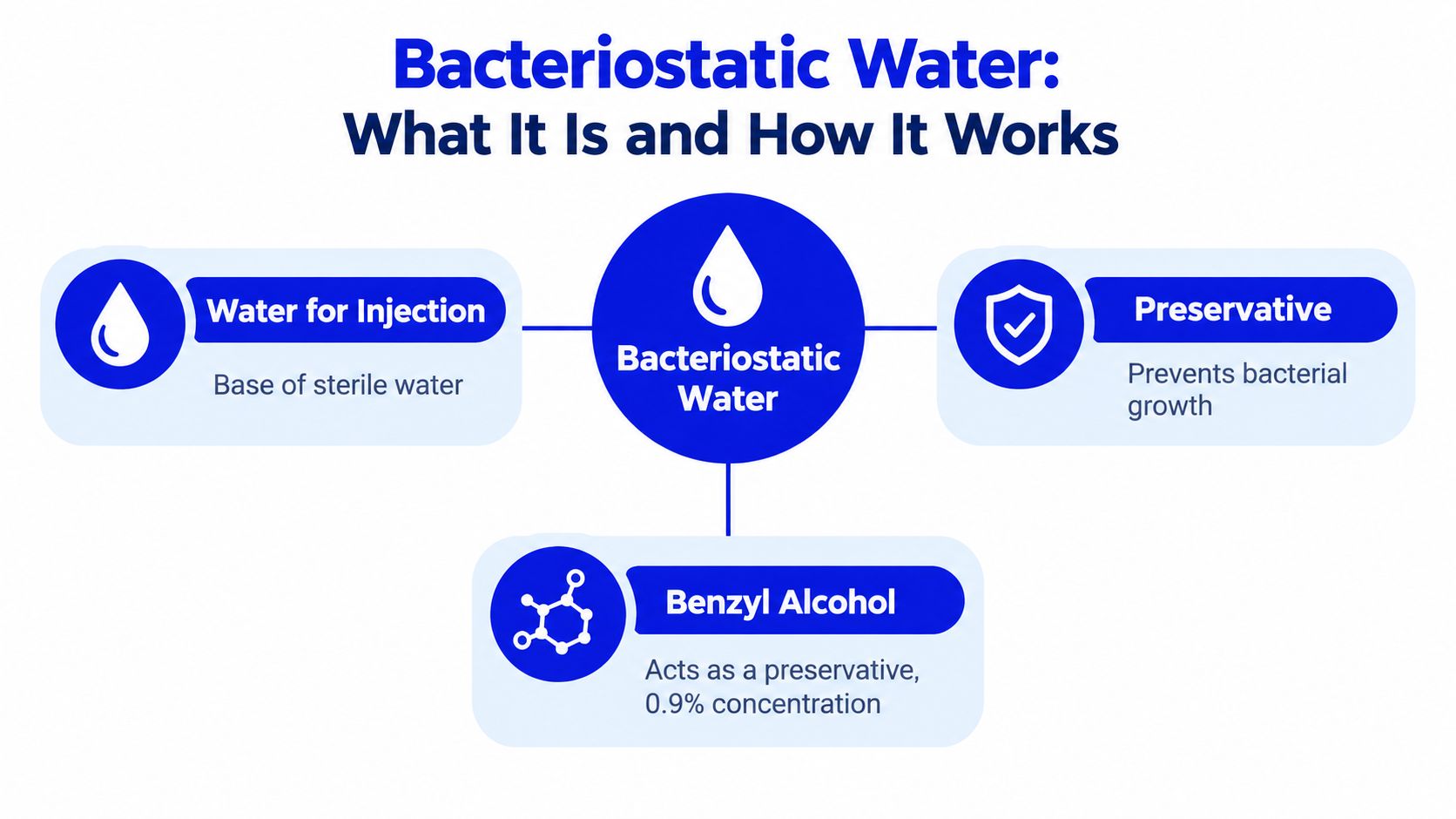
The formulation works like a clean container with a built-in guardrail. The water for injection provides the sterile starting material, while benzyl alcohol slows microbial growth after the vial has been entered. That protection supports repeated access, provided the vial is handled correctly.
Bacteriostatic water differs from plain sterile water because it contains a preservative. Both may provide a sterile, nonpyrogenic base, but only the preserved formulation is designed around multi-dose access. Procurement therefore matters: a clearly labeled product from a reliable laboratory source gives the researcher a defined formulation and handling record to evaluate.
A pantry lock offers a useful comparison. It limits casual access, but it cannot prevent mold if the door stays open or repair a contaminated jar. Benzyl alcohol works in a similar way. It inhibits bacterial growth, yet it cannot remove contamination introduced by an unclean stopper, equipment, or work area.
A preserved label describes the contents, not universal suitability. The research material must tolerate benzyl alcohol, and the workflow must support aseptic access. If compatibility is uncertain, or if single-use handling better fits the work, preservative-free sterile water may be the more appropriate choice.
Separate the label into four practical details:
One current U.S. label specifies a 30 mL multi-dose vial and a 2026 marketing start date. That record reinforces the product's defined role as a preserved diluent rather than a universal water source. Current DailyMed label record
In peptide work, the usual reason people reach for a preserved diluent is simple, the reagent arrives as a lyophilized powder and needs a liquid base for research use. Bacteriostatic water is often chosen because it fits workflows where a vial may be entered more than once. That convenience is real, but it only helps when the handling stays disciplined.
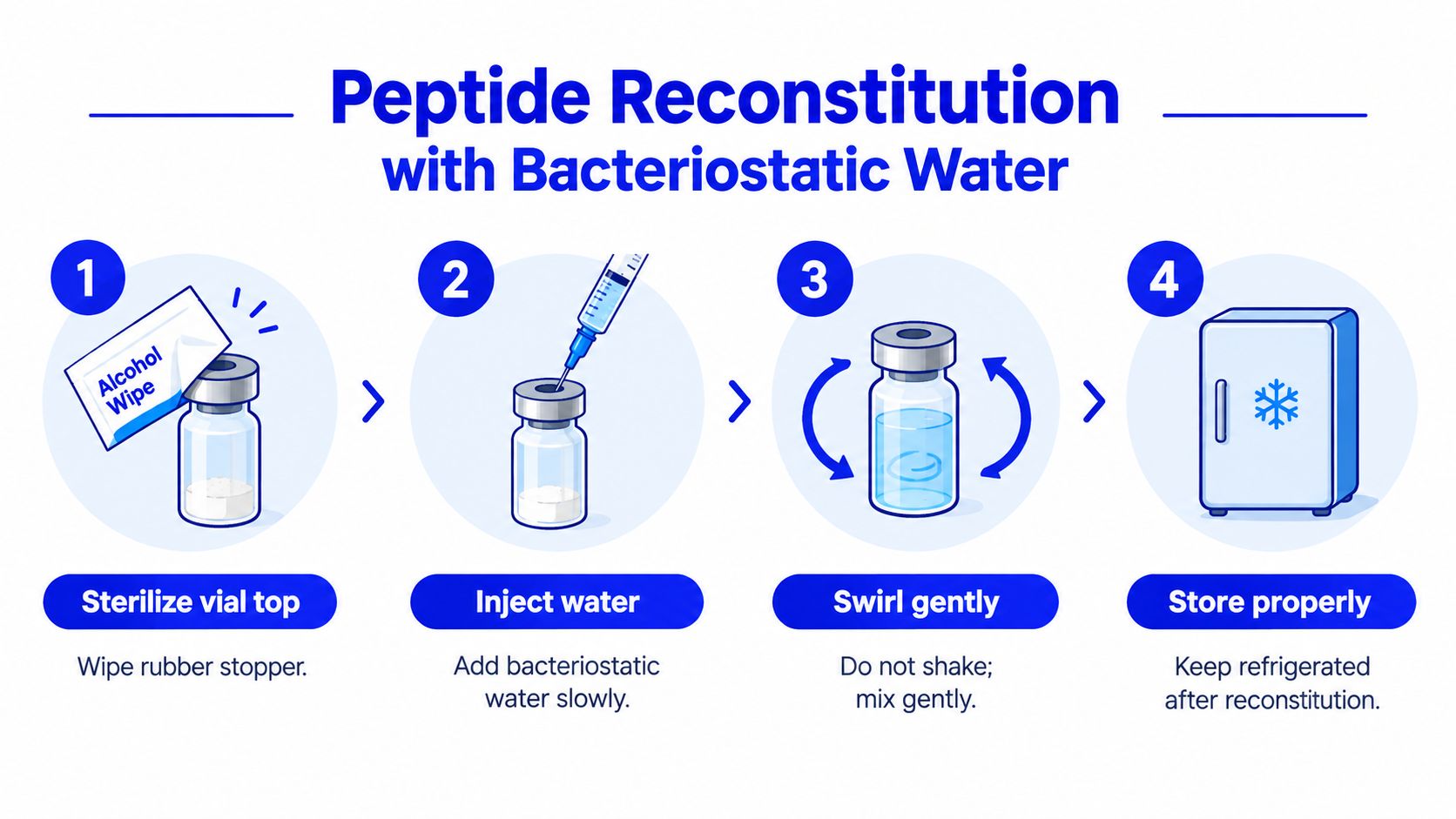
The biggest mistake is assuming the preservative does the whole job. It doesn't. A preserved diluent can reduce growth risk, but the dominant variable is still what happens at the bench, whether the stopper is disinfected, whether a clean needle is used, and whether the vial is treated like a protected reagent or a casual accessory.
Practical rule: if the handling is sloppy, the preservative can't rescue the vial.
That is why researchers usually think in terms of aseptic handling, not just formulation. The label tells you what's in the bottle. Your technique determines whether the contents stay usable.
A sensible workflow keeps the steps narrow and controlled:
Each of those steps sounds basic, but basic is the point. The preservative slows bacterial growth, yet it doesn't cancel out contamination from repeated punctures, dirty hands, or poor storage. That's why many users get better outcomes when they treat the vial as a controlled reagent instead of a general-purpose liquid.
Don't assume “multi-dose” means “anything goes.” It doesn't. Reusing needles, skipping septum cleaning, or stretching the in-use period beyond reason all work against the product's design.
For peptide reconstitution, the preserved diluent is best understood as a support tool. It can make a workflow more practical, but only if the rest of the handling stays clean and deliberate.
Not every preparation belongs with a preserved diluent. The clearest boundary comes from the long-standing warning tied to benzyl alcohol exposure in neonates, which is why preservative-free sterile water is recommended for neonates and infants. FDA-related labeling also notes that adults may tolerate an estimated intravenous dose up to 30 mL without toxic effects in experimental studies, but that does not turn bacteriostatic water into a universal option. FDA-related labeling on benzyl alcohol warning
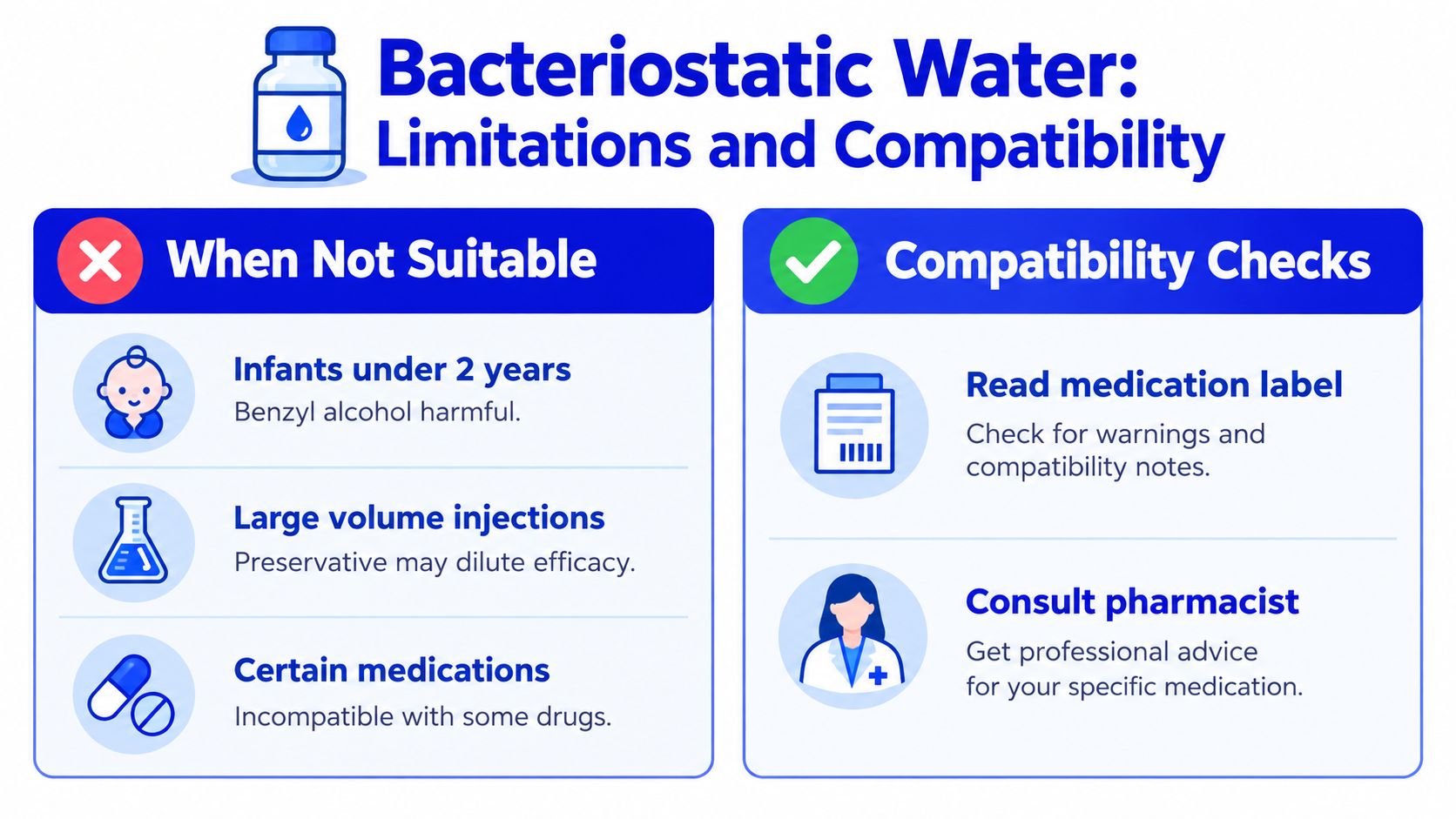
The formulation itself creates the limitation. A preserved diluent is useful when the additive is acceptable, but it is the wrong choice when the final preparation needs to stay preservative-free. That's why readers sometimes get tripped up by the assumption that preserved automatically means better.
A simple way to think about it is this. Bacteriostatic water is a compatibility choice, not a default upgrade. If the application needs a purely sterile medium without preservative, another water source is the better fit.
For research use, the label on the target material should come first. If a preparation is sensitive to preservatives, the vial choice needs to match that sensitivity. The same goes for any workflow where the final preparation shouldn't carry benzyl alcohol into the mix.
Read the target material's documentation before choosing the diluent.
That's the cleanest filter. It stops people from treating one preserved liquid as interchangeable with every other aqueous option on the shelf.
Procurement enters the picture here. If your preferred preserved vial is unavailable, the decision isn't just whether to keep waiting, it's whether a sterile alternative fits the target material and the workflow. Many articles stop at the chemistry, but the better question is whether the lab can keep moving without forcing a compatibility mismatch.
The product is useful when the formulation matches the task. It's not suitable when the preservative is the very thing the application can't tolerate.
Once a vial is opened, handling becomes the main control point. A widely cited practical rule is that after first puncture, bacteriostatic water should be refrigerated at 2–8°C (36–46°F) and used within 28 days. That in-use window is there because preservation reduces growth risk, it doesn't make the vial invincible. Practical in-use window guidance
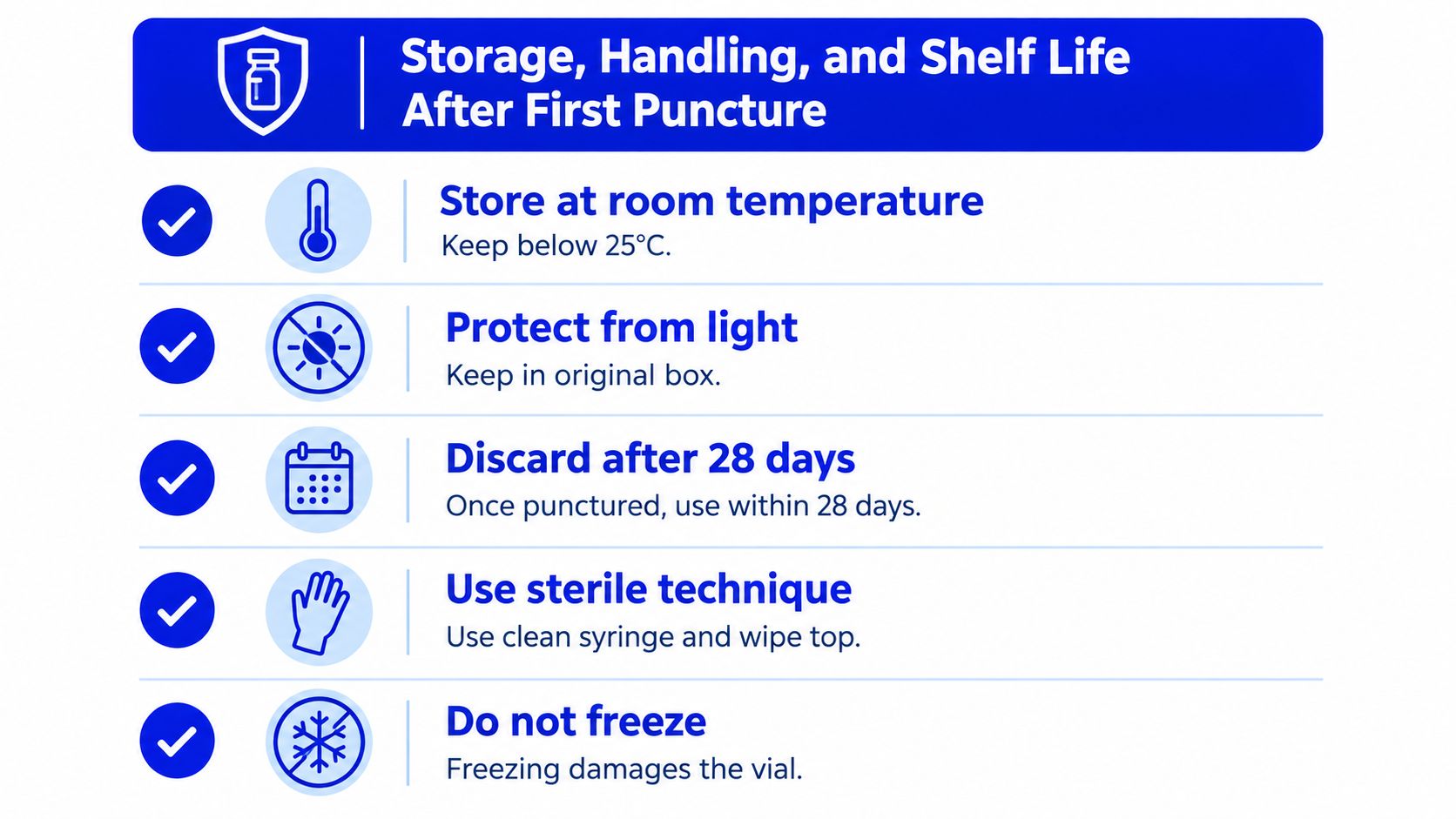
Cold storage slows problems, but it doesn't replace aseptic technique. A punctured vial still needs clean handling every time it's entered, and the septum still needs disinfection before access. The preservative helps, but it can't compensate for a vial that's been treated carelessly.
The “28 days” guidance is often repeated without the reason behind it. The reason is straightforward, the first puncture changes the risk profile, and the preservative can only do so much after that point. That is why discard timing matters as much as storage temperature.
The preservative slows growth. It doesn't forgive poor technique.
That sentence captures the whole storage question. If the vial is handled well, it can serve its intended role. If it's handled badly, the label doesn't protect the contents.
Many people focus on the bottle and forget the human factor. Repeated punctures, poor stopper cleaning, and inconsistent storage all shorten the practical life of the vial. The product may be designed for multi-dose use, but the actual outcome depends on the person who opens it and the way it's handled afterward.
For lab users, the safest habit is to decide on discard timing before the vial is ever entered. That keeps the workflow clean, predictable, and easier to document.
A lab receives a peptide that needs reconstitution, but the preferred preserved diluent is unavailable. The correct substitute depends on formulation and handling, not on the product label alone. Bacteriostatic water contains a preservative and supports repeated access. Sterile water for injection contains no preservative and fits single-use situations or preparations that must remain preservative-free. Distilled water is different again. The term describes a purification process, not an injectable presentation.
| Diluent Type | Preservative | Use Case | Key Limitation |
|---|---|---|---|
| Bacteriostatic water | Yes, benzyl alcohol | Multi-dose research workflows and preserved diluent use | Not suitable when preservative-free water is required |
| Sterile water for injection | No | Single-use applications and preservative-sensitive preparations | No bacteriostatic protection after entry |
| Distilled water | No | Purification reference, not a substitute for injectable water | Not an injectable presentation |
| Sterile saline | No preservative in plain form | Situations where sodium chloride is needed instead of plain water | Different composition, not interchangeable with water |
Start with the target material's compatibility requirements. A preserved diluent may suit a workflow that allows benzyl alcohol and requires repeated access. Sterile water for injection is the better route when the preparation must remain preservative-free. If the material requires a saline base, sterile saline may be appropriate, but its sodium chloride content means it cannot be treated as plain water.
The vial is only one part of the system. Formulation is like matching a solvent to a material: a liquid can be sterile and still be unsuitable for the intended preparation. Repeated entry also increases dependence on careful aseptic technique, regardless of which diluent is selected.
Availability is separate from formulation. Supply and access context in 2026 describes constrained access to bacteriostatic water in some channels, including backorders or allocation at established suppliers, with market pressure rather than a formal shortage.
If the preserved vial is difficult to obtain, the lab must check whether sterile water fits the application or whether another supplier can meet the specification. That decision should happen before the workflow begins, since an unavailable diluent can delay preparation and encourage unsuitable substitutions.
Procurement therefore involves two questions: which liquid is technically appropriate, and which approved product can be obtained with adequate documentation. A substitute is useful only when it meets both requirements.
Some suppliers stock bacteriostatic water alongside peptide research products, including Peptide Warehouse USA. This catalog arrangement may help labs source related research items together. It does not replace compatibility checks, product verification, or aseptic handling. The target material and the documented workflow should determine the final choice.
Bacteriostatic water is best understood as a preserved, sterile water-for-injection product built for multi-dose use. The benzyl alcohol is the key feature, not just a label decoration, and that preservative is what separates it from plain sterile water. At the same time, the preservative does not override compatibility rules or fix careless handling.
The most important judgment calls are practical. Use the preserved option when the workflow supports it, switch to sterile water for injection when the application needs a preservative-free medium, and treat aseptic technique as the key safety variable after the vial is opened. Storage discipline also matters, especially after first puncture, because the in-use window and refrigeration guidance are there to support the product's intended role.
For research planning, that leads to a simple checklist:
If you're sourcing research materials and want to compare preserved diluents, sterile alternatives, and related peptide supplies in one place, learn more and explore options that fit your workflow.
Peptide Warehouse USA supplies research peptides and related laboratory items for research use only, including products that sit alongside bacteriostatic water in common peptide workflows. If you're comparing diluent options for laboratory planning, visit Peptide Warehouse USA to review available research-grade materials and see how their catalog fits your sourcing needs.