No products in the cart.



A research lab receives an eagerly anticipated peptide lot, but the certificate of analysis only shows a purity result. The batch number on the vial is difficult to match to the shipment, the underlying production record isn't available, and one approval signature appears to be missing. The analytical team can test the material again, but it can't easily establish how the lot was made, which raw materials entered it, or whether an unresolved deviation affected release.
That situation turns a routine procurement decision into a quality investigation. Batch production records provide the operational evidence behind a peptide's identity, purity, and traceability. For research directors, they're not administrative files that sit behind a COA. They're the record that connects a finished compound to its synthesis, purification, lyophilization, packaging, testing, and release decisions.
Peptide quality begins long before HPLC or mass spectrometry produces a result. Consider a lot of BPC-157, GHK-Cu, or another research peptide arriving at a laboratory. The vial may have a lot number and the COA may report a strong purity result, but the result has limited practical value if the supplier can't connect it to the executed manufacturing history.
A missing signature can delay release because quality assurance can't confirm who performed or checked a significant step. An unexplained difference between the expected and actual yield can raise questions about material loss, processing conditions, or reconciliation. A disconnected raw-material lot can make it difficult to determine whether other batches were exposed to the same input.
The FDA's guidance for active pharmaceutical ingredients describes batch records as a core cGMP control. It calls for records to be prepared for each intermediate and API, contain complete production and control information, and carry a unique batch or identification number with dating and signatures when issued. The guidance also explains that production, control, and distribution records should be retained for the applicable period, including at least one year after batch expiry or at least three years after complete distribution when retest dates apply. FDA's Q7A GMP guidance provides the underlying framework.
Practical rule: A purity result tells you what was found in a tested sample. A complete batch record helps establish what the sample represents.
This distinction matters in preclinical and analytical work. Researchers may compare peptide lots, investigate unexpected assay behavior, assess stability, or repeat an experiment months after procurement. Without a dependable production history, the lab has fewer ways to determine whether an unexpected result came from the experimental model, the analytical method, storage, or the compound itself.
The benefits of peptides in research depend on consistent identity and characterization, not on marketing language. Documentation doesn't guarantee that every experiment will produce the expected outcome, and it isn't a substitute for independent scientific judgment. It does, however, give research teams a defensible basis for evaluating the material they use.
A batch production record, also called a batch manufacturing record or batch production and control record, documents what happened during one specific manufacturing run. It isn't the recipe for a peptide. It's the completed, contemporaneous record of how a particular lot followed the approved process.
The distinction is important:
The master record describes what should happen. The batch record demonstrates what did happen. FDA regulations for drug products require the executed record to be an accurate reproduction of the applicable master record, with contemporaneous documentation of significant manufacturing steps. 21 CFR 211.188 sets out the required batch production and control record framework.
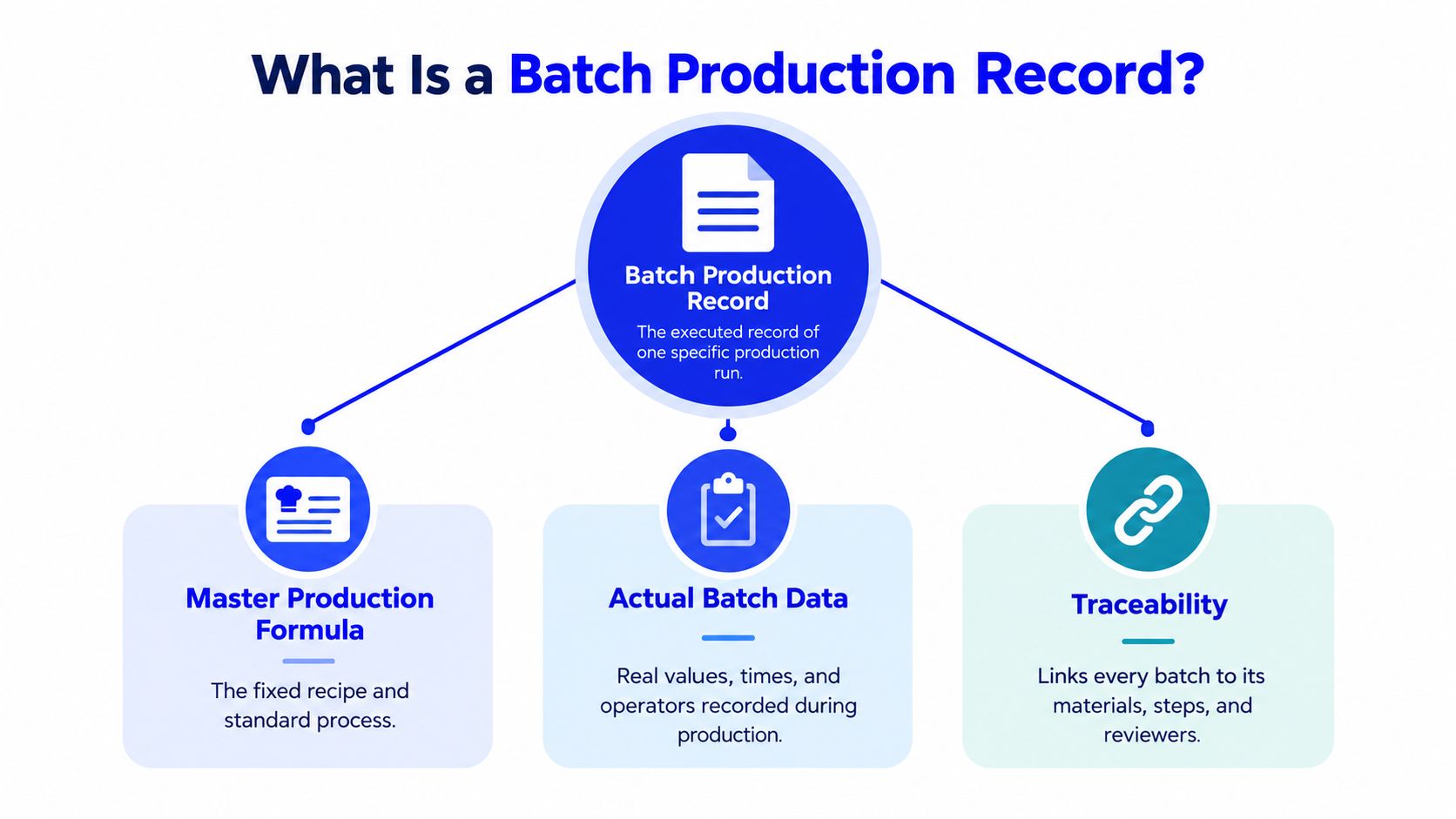
A useful batch record follows the lot through its operational life. It starts with batch identification and the approved instructions, then records the actual weighing of components, synthesis steps, processing conditions, purification, sampling, analytical testing, yield, packaging, labeling, and release.
The record also connects actions to people and equipment. A reviewer should be able to determine which operator performed a step, who supervised or checked it, which major equipment was used, and whether the recorded results support the batch disposition.
That makes batch production records a traceability system, not merely a form. A single file can reconstruct a manufacturing history from raw materials through final release. It can also support investigations in both directions, from a finished vial back to its inputs and from a suspect input forward to affected batches.
Historically, GMP systems moved from general manufacturing notes toward lot-level accountability. FDA inspection guidance describes records that document each significant step in manufacturing, labeling, packaging, and control of specific batches. International GMP development further embedded unique batch numbers, quality-unit review, release decisions, and record retention into the manufacturing lifecycle. A useful plain-language overview for managers who need to connect documentation with facility operations is this GMP guide for AU managers.
A compliant batch record should answer a straightforward question: Can the finished lot be connected to every important material, action, result, and decision that produced it? If the answer depends on memory, informal messages, or documents stored in separate locations, the record is weaker than it appears.
FDA requirements for drug products identify a detailed set of expected entries. These include actual yield and theoretical-yield percentage, equipment and line identities, in-process and laboratory results, packaging-area inspection, and the identities of people who performed or checked the work. EU GMP documentation likewise calls for product and batch identification, dates and times, operator initials, starting-material batch numbers and actual quantities, processing operations, equipment, in-process results, yields, authorized deviations, and final approval by the responsible person. EU GMP Chapter 4 provides the European documentation reference.
| Data Field | Traceability Purpose |
|---|---|
| Product name and unique batch number | Separates one lot from every other production run and ties the record to the vial, label, COA, and release decision. |
| Dates and times | Establishes when major manufacturing and control activities occurred and supports chronological review. |
| Component lot numbers and actual weights | Connects the finished peptide to the specific raw-material inputs actually used, not merely the planned formula. |
| Equipment identity | Shows which reactors, purification systems, lyophilizers, filling equipment, or other major units handled the batch. |
| Critical process parameters | Records the operating conditions that can influence process consistency and investigation outcomes. |
| Sampling and test results | Links in-process observations and laboratory data to the batch under review. |
| Operator, supervisor, and checker identities | Establishes who performed, supervised, or verified each significant step. |
| Actual yield and reconciliation | Helps explain material usage, losses, rejects, and differences between expected and finished quantities. |
| Packaging and label details | Connects the manufactured material to its final container, label, quantity, and distribution status. |
| Deviations and approvals | Shows whether departures from approved instructions were documented, assessed, and authorized. |
For a lab evaluating a peptide supplier, the practical review starts with the lot number. The number should match across the product label, invoice, shipping documentation, COA, and any available supporting reports. A COA that belongs to a different lot isn't evidence for the material in the laboratory's possession.
The same principle applies to custody. A useful explanation of chain of custody for legal evidence helps clarify why each transfer, identifier, and record relationship matters, even when the material is intended for research rather than courtroom use.
Dietary supplement rules also illustrate the operational breadth of batch documentation. FDA requirements in that area include lot numbers, equipment cleaning and sanitizing times, component identifiers and weights, monitoring results, test results, and quality-control review before release. Across regulated settings, missing one of these links can weaken batch disposition, complaint investigation, or recall scope determination.
Quality control generates data. Quality assurance determines whether the complete body of evidence supports release. Batch production records sit at the handoff between those functions.
A QC laboratory may perform HPLC purity testing, mass spectrometry, identity testing, microbial testing, or other analyses defined by the applicable specification. Those results must be associated with the correct sample and lot. QA then reviews whether the sample was taken from the right batch, whether the manufacturing steps were completed, whether in-process controls were acceptable, and whether deviations were resolved before the lot was approved.
A COA therefore shouldn't be treated as an isolated promise. It summarizes selected analytical results, while the batch record provides the surrounding context. If a result is outside expectation, the record may show a sampling issue, a process deviation, a material substitution, an equipment event, or a reconciliation problem that changes how the result should be investigated.
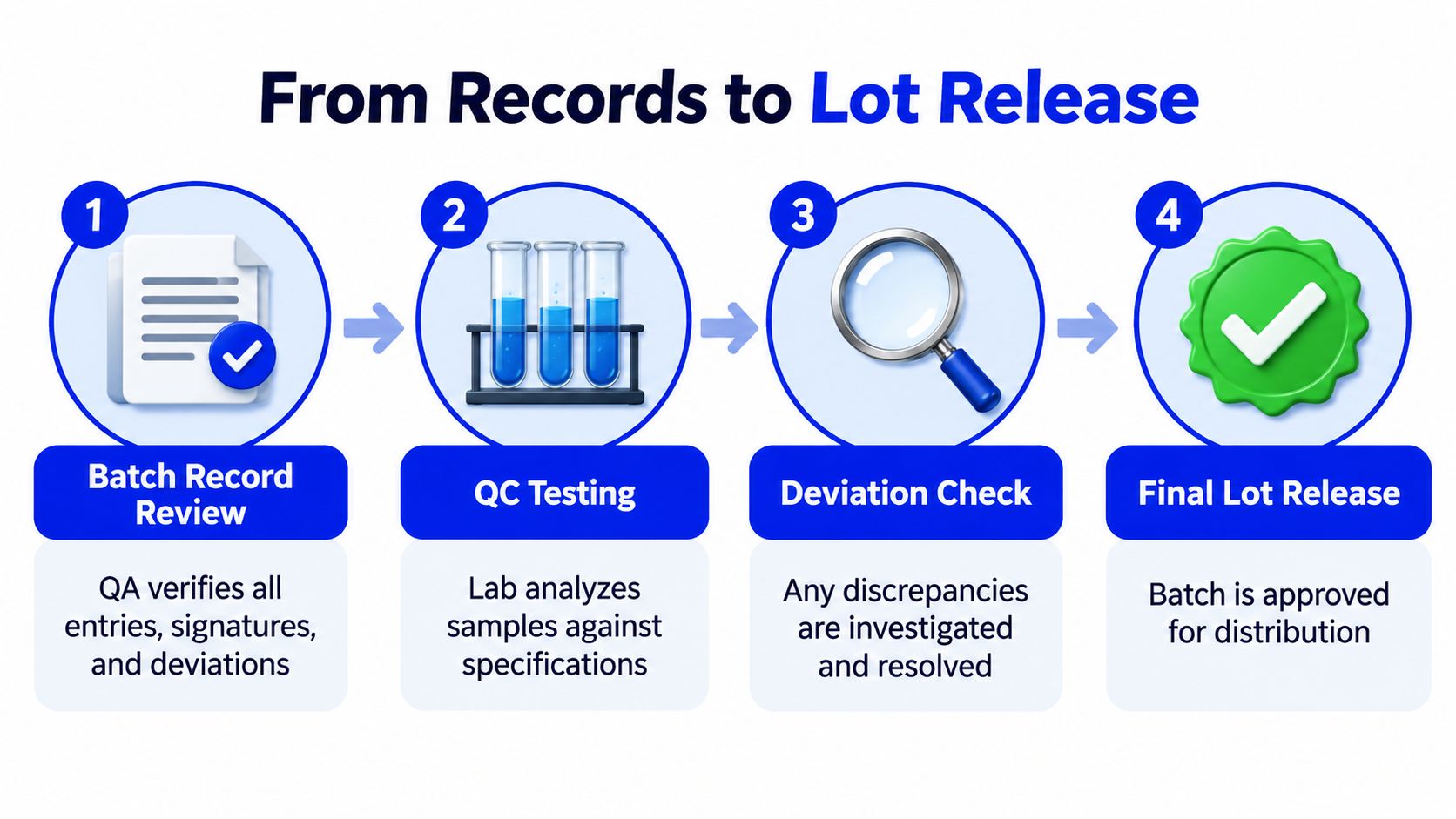
A strong review isn't limited to checking whether a form exists. The quality unit examines whether entries are complete, legible, internally consistent, and supported by referenced records.
Typical review questions include:
FDA's API guidance states that batch records should contain granular production and control information, including dates, equipment, component quantities, critical process parameters, sampling, signatures, laboratory results, actual yield, and packaging details. That granularity is what allows QA to evaluate whether a stated purity result belongs to a properly controlled manufacturing history.
Peptide purity is especially dependent on context because the reported result describes a tested sample, not every possible risk in the production lifecycle. Documentation can't replace analytical testing, but analytical testing without dependable documentation leaves the research team with an incomplete quality picture.
A release decision is stronger when the record shows not only that the batch passed a test, but also that the right batch was made, sampled, reviewed, and approved under controlled conditions.
The most persistent batch-record problems aren't exotic chemistry failures. They're ordinary handoff failures that occur when operators, supervisors, document control, laboratories, and QA each handle part of the same record.
A technician may complete a weighing step but omit an initial. An attachment may be generated by the laboratory but never placed in the batch file. A raw material may have passed incoming review but reached its expiry or retest date before use. The finished quantity may not reconcile with the component quantities, samples, documented losses, and packaging inventory.

Quality reviewers typically look for patterns that reveal whether execution and documentation stayed aligned:
FDA guidance expects records to document significant steps and quality review to confirm that the record is a correct, legible reproduction of approved instructions. Recent data-integrity materials likewise emphasize that records must be complete, consistent, and accurate. PDA's documentation and data-integrity material is useful background for understanding why omissions are operational risks rather than cosmetic defects.
The best review process catches problems before release, not during a customer complaint or regulatory inspection. That requires QA to compare related records rather than read the batch file in isolation. A component lot should align with inventory and dispensing records. Equipment use should align with cleaning status. Analytical results should align with sample identifiers. Deviations should align with the final disposition.
Paper can support this discipline, but it depends heavily on controlled forms, immediate entries, page reconciliation, and careful attachment handling. A well-designed workflow matters more than the appearance of the form.
Electronic batch records change the control model. Paper asks people to remember what to complete and where to file it. An electronic system can require the sequence, validate entries, preserve signatures, and prevent the operator from advancing while a required step remains incomplete.
Current materials describe electronic batch records as the system of record for operator entries, in-process results, electronic signatures, and sequence controls that prevent skipped steps. The same materials identify cloud-based platforms, AI-supported workflow optimization, and integration with MES, ERP, and IoT-enabled environments as important directions in regulated manufacturing. CASRAI's pharmaceutical manufacturing data-integrity guide provides context for these digital controls.
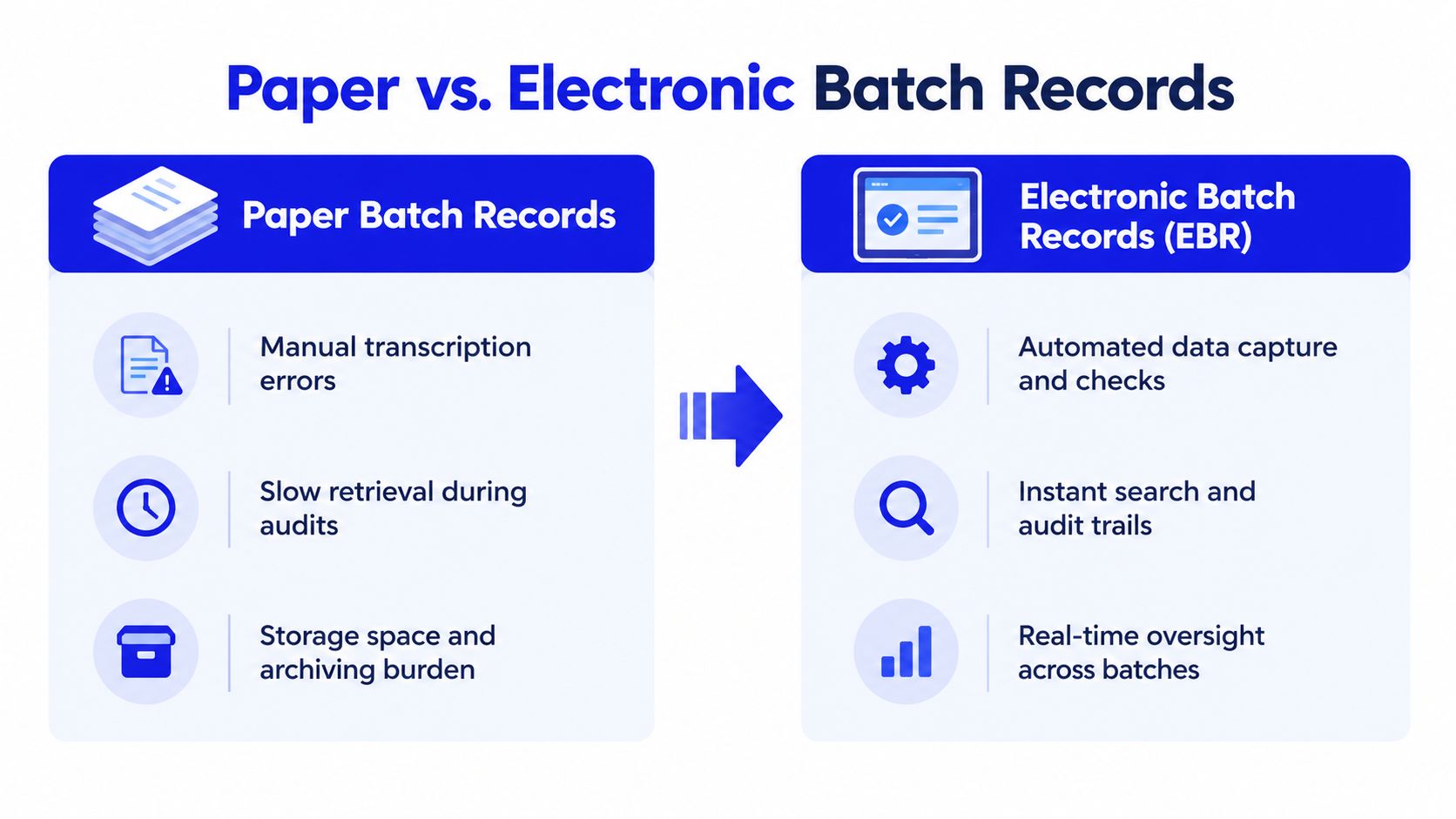
Paper records can be appropriate for a controlled operation with trained staff, stable procedures, and disciplined document management. They're familiar and don't require system configuration. Their weaknesses are manual transcription, slow retrieval, missing pages, illegible entries, and limited ability to enforce workflow or create an accessible audit trail.
An EBR can improve control by:
FDA guidance on computerized drug processing specifically requires identification of people performing, directly supervising, or checking significant steps. The FDA guidance on identification of personnel in computerized batch records makes clear that a timestamp or process value alone isn't enough. The system must preserve who did what and who verified it.
Digital systems create new risks. Poor configuration can make an incorrect workflow repeat consistently. Interfaces between MES, ERP, laboratory systems, and equipment can lose context or create duplicate data. QA teams must assess audit trails, access controls, exception handling, backup processes, change management, and how corrections are documented.
The following video provides additional visual context for electronic manufacturing documentation and workflow design.
An EBR isn't automatically compliant because it's digital. It becomes valuable when the system enforces approved processes, preserves attributable records, and makes exceptions visible to the people responsible for review.
A supplier's documentation package should let a research director verify more than a headline purity claim. It should make the lot identifiable, the test result attributable, and the manufacturing history sufficiently transparent for the intended research use.
Start with the COA, but don't stop there. Confirm that the product name, lot number, sample identity, test methods, results, and approval information are internally consistent. If the supplier provides HPLC or mass spectrometry documentation, check that the reports belong to the same batch as the vial under consideration.
Use a focused supplier review rather than a long checklist that nobody completes:
For USA-manufactured research peptides, the phrase “made in the USA” should be treated as a sourcing detail, not as proof of cGMP control by itself. The stronger question is whether the manufacturer maintains controlled batch production, testing, review, release, and retention practices that support traceability.
Documentation also has commercial value. Clear records reduce procurement friction, help laboratories compare lots, support investigations, and make it easier to determine whether a material is suitable for analytical, laboratory, or preclinical work. The benefits of peptides in research are easier to evaluate when the underlying compound history is visible and consistent.
A supplier such as Peptide Warehouse USA presents batch-specific COAs and related research documentation for its catalog of peptides and compounds. Those materials should still be reviewed against the laboratory's own qualification requirements, storage controls, analytical needs, and intended use.
The operational handoff is where many quality systems succeed or fail. Manufacturing must record the work as it happens, QC must connect results to the correct lot, and QA must review the complete evidence before release. Research teams that evaluate those connections, rather than relying on a purity number alone, make more defensible purchasing decisions.
If your laboratory needs research peptides supported by batch-specific documentation, visit Peptide Warehouse USA to review available peptides and related compounds. Explore the COA and quality-documentation options, then match each lot to your institution's purchasing, analytical, and research-use requirements.