No products in the cart.

Searching for the best BPC 157 peptide on the market usually leads to ranked lists built on advertised purity and confident language about healing or recovery. That ranking logic doesn't hold up. Human evidence is too limited, commercial products haven't been compared head to head in clinical trials, and a high chromatographic percentage doesn't prove a product works in people.
You're better off judging BPC 157 the way a procurement analyst judges any research material. Ask what the lot is, how identity was confirmed, what else was tested, and whether the paperwork can be traced to the vial in your hand. That documentation question is the defensible version of best.
No supplier can credibly claim clinical superiority on the current record. A 2025 narrative review identified only three published human pilot studies involving BPC-157, and those studies covered intra-articular treatment for knee pain, intravesical treatment for interstitial cystitis, and an intravenous safety and pharmacokinetic context, according to the 2025 narrative review of human BPC-157 pilot studies. Together they included 30 participants, and the evidence was rated very low certainty because of serious risks of bias, indirectness, and imprecision.
That scale matters. These weren't large randomized controlled trials designed to compare one commercial formulation against another. They can't tell you which brand, salt form, delivery format, or price tier produces a better human outcome.
Buyers often treat a purity figure as a proxy for effectiveness. A vial advertised at a higher percentage looks stronger, cleaner, and more advanced, even when the seller hasn't shown how that number was generated.
Purity is an analytical result for a specific lot and method. It isn't a clinical endpoint. It doesn't establish an effective human dose, a preferred route, or long-term safety, and it can't convert a research compound into a proven therapy.
A purity claim answers a narrow laboratory question. It doesn't answer whether a product is clinically superior.
For research procurement, best should describe the quality of evidence about the material itself. That means lot-specific identity testing, transparent certificates of analysis, a documented chain of custody, and labeling that clearly designates the product for laboratory or preclinical research.
Those indicators support traceability. They help a lab reproduce work, investigate an unexpected result, and show what was supplied. They don't prove efficacy or safety in humans, and honest suppliers shouldn't blur that line.
When you read phrases about healing, repair, fat loss, or recovery, treat them as research-related claims that require qualification. The benefits of peptides in laboratory models are a legitimate reason for scientific interest, but they're not a basis for ranking consumer products by therapeutic performance. Start by rejecting any ranking that can't show its paperwork.
BPC 157 is a synthetic peptide studied in laboratory and animal models, including work related to tissue responses, vascular pathways, and inflammation. It's manufactured as a defined chemical sequence rather than supplied as an approved medicine. That distinction shapes how you should read every product page.
A peptide can be well characterized as a chemical and still be investigational as a treatment. Synthesis, purity testing, and preclinical activity don't substitute for controlled human trials. They answer different questions, at different levels of evidence.
The published record is weighted heavily toward preclinical work. A 2025 systematic review summarized 36 qualifying studies, of which 35 were preclinical and only one was clinical, with no clinical safety data identified, as described in the 2025 systematic review indexed on PubMed. The studies assessed were primarily level IV and level V evidence.
Animal models can show whether a compound is worth studying further. They can't establish a validated human dosing protocol or prove that a commercial product will produce the same result in people. Species, dose, exposure period, route, and endpoint all limit translation.
Readers who are also tracking how peptides are discussed in wellness contexts can compare that broader conversation with The Sleep Consultant on peptides, while keeping the same evidentiary standard in mind. Popular interest isn't clinical validation, regardless of the application being discussed.
You'll see BPC 157 described as free base or acetate. Those aren't interchangeable labels, and a supplier should state the exact form on the product record and COA. Comparing lots without matching the chemical form is a basic procurement error.
Foundational questions also remain open because a Phase I trial identified as NCT02637284 was terminated without published results. Without that kind of completed clinical work, pharmacokinetic and human safety questions remain unresolved. That's why current reviews characterize BPC 157 as investigational and advise against clinical use outside ethically approved, regulated trials.
Research-grade isn't a single number. It's a package of identity, purity, content, contaminant, and traceability results tied to one lot. If any major piece is missing, you're not comparing quality. You're comparing marketing completeness.
The visual below summarizes the hierarchy buyers should apply before they look at price or format.
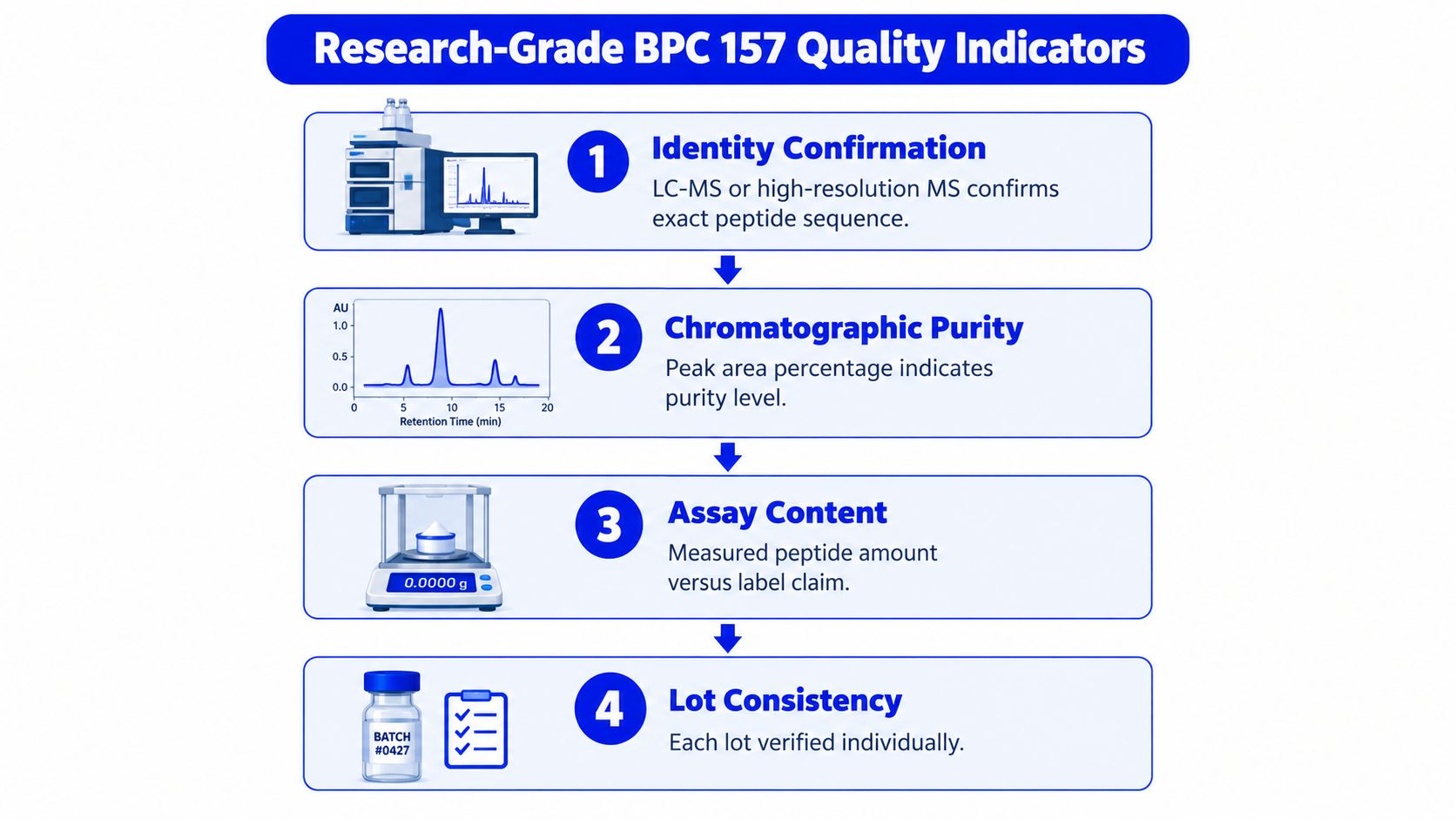
Start with orthogonal identity confirmation, such as LC-MS or high-resolution MS. Chromatography can show peaks, but mass-based evidence helps confirm that the material matches the intended peptide. A clean chromatogram of the wrong substance is still the wrong substance.
Next, separate chromatographic purity from assay or content. Purity describes the proportion attributed to the main peak under a stated method, while assay addresses how much peptide is present relative to the claim. A reported value such as 99.5% HPLC is therefore one method-specific metric, not proof of sequence correctness, potency, sterility, or stability.
A credible lot record should also address the variables that can distort research results:
There's no universal pharmacopeial shortcut for this comparison. FDA briefing materials state that BPC-157 free base and BPC-157 acetate have no applicable United States Pharmacopeia or National Formulary drug-substance monograph and are not components of an FDA-approved drug, according to FDA briefing materials on BPC-157 free base and acetate.
Procurement rule: Without a compendial reference standard, reproducibility across lots and independent verification mean more than the highest advertised percentage.
Judge suppliers by method transparency. The COA should identify the exact lot, test date, analytical method, acceptance criteria, and testing laboratory. If those fields are absent, the percentage on the sales page carries very little weight.
Format affects handling, stability planning, and how easily a lab can trace material back to a lot. It doesn't by itself make one product clinically better. Treat presentation as a logistics and protocol decision, not a quality badge.
Lyophilized powder is the easiest format to connect to conventional peptide documentation because the lot is supplied in a dry, sealed state. Liquids introduce additional questions about preparation, container, storage, and time in solution. Nasal sprays add device and formulation variables, so the documentation needs to cover more than the peptide alone.
| Format | Typical Documentation | Stability Considerations | Best Fit Research Use |
|---|---|---|---|
| Lyophilized powder | Lot-matched COA, identity, purity, assay, chemical form | Dry format, follow label storage conditions | Protocol-driven laboratory preparation and analytical work |
| Aqueous or bacteriostatic liquid | Peptide COA plus solution preparation and container details | Time in solution and storage history require documentation | Laboratory workflows designed around prepared liquid material |
| Nasal spray | Peptide COA plus formulation and device packaging details | Formulation, device integrity, and storage conditions all matter | Research settings where the spray presentation is part of the study design |
Ask whether the documentation describes the finished format being sold, not only an earlier bulk lot. A powder COA doesn't automatically characterize a later liquid preparation or a filled spray device. Packaging integrity, fill process, and storage statements become part of the procurement record.
Also check whether blends are being compared with single-compound products. A blend requires documentation for each relevant component and for the finished combination. A single headline purity value is harder to interpret when more than one peptide is present.
Research planning often sits alongside training and performance interests, which is why some readers also use tools such as the GrabGains weight training app to organize workouts. That context doesn't change the buying standard. For BPC 157, the format that fits best is the one your protocol can document, store, and trace without gaps.
Most buyers look at a COA for one number, then stop. That's backwards. The first job is to prove the document belongs to the vial, the second is to check whether the methods support the results, and only then should you compare values.
The checklist below gives you the order of operations.
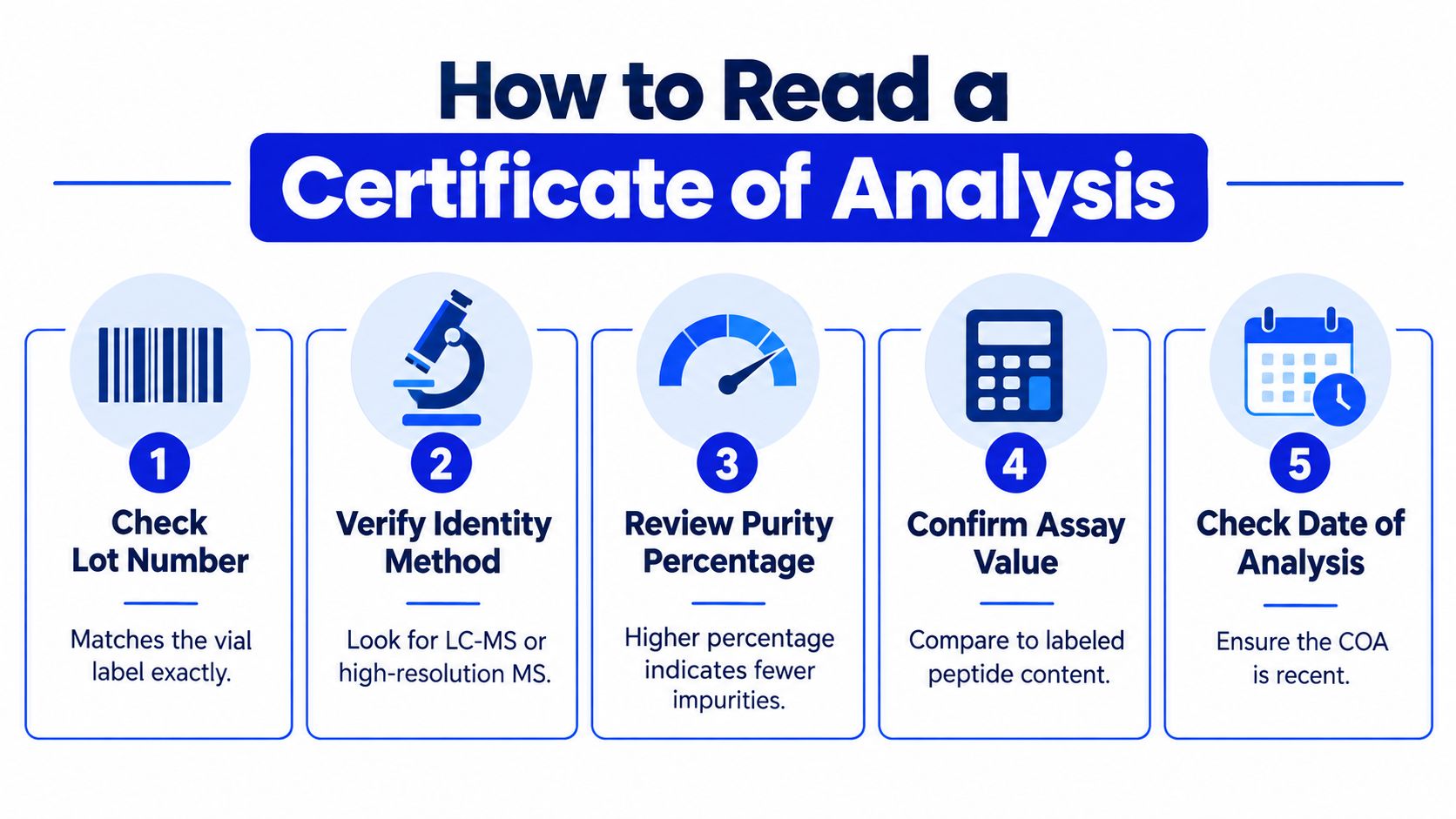
Watch the difference between purity and assay closely. A lot can show high chromatographic purity while still raising questions about actual peptide content, water, counterion, or residual material. Those aren't interchangeable measures, and a sales page that uses them as synonyms is telling you something unhelpful about its quality culture.
The short video below is useful as a visual companion while you compare a sample COA against the steps above.
Generic COAs are the most common failure. If the document has no lot number, no date, no method, or no identifiable laboratory, it functions as decoration. Ask for the current lot-matched version before purchase, and keep the file with your receiving records after delivery.
The same COA does not carry the same weight in every laboratory. A buyer developing an analytical method worries about different failure modes than a team running cell-based assays. Define the objective first, then decide which indicators are essential.
The diagram below maps those priorities across three common research settings.
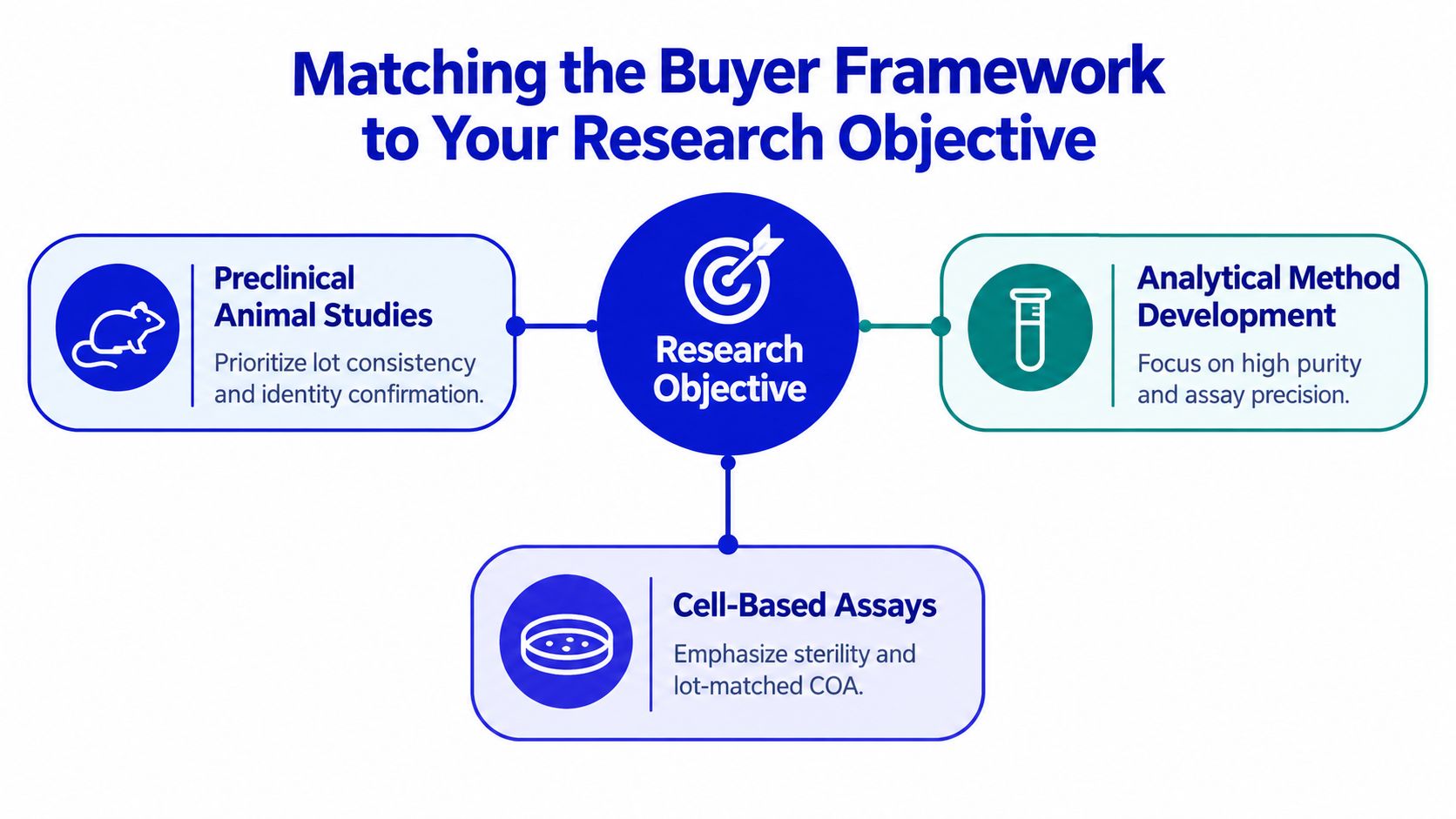
| Research Objective | Top Priority Indicators | Secondary Considerations |
|---|---|---|
| Preclinical animal studies | Identity confirmation, lot consistency, chemical form, assay | Storage history, chain of custody, supplier continuity |
| Analytical method development | Impurity profile, chromatographic purity, assay precision, method details | Water content, residual solvents, repeat-lot comparability |
| Cell-based assays | Microbial results, endotoxin results, identity, lot-matched COA | Container integrity, storage conditions, handling records |
| Formulation stability work | Assay over time, storage documentation, packaging details | Water content, format-specific testing, lot continuity |
For preclinical work, lot consistency can matter more than chasing the highest purity headline. Changing lots mid-study introduces a variable that's hard to unwind later. Procurement should therefore consider whether enough material from the documented lot is available for the planned work.
Analytical teams need the opposite emphasis in one respect. They should scrutinize impurity characterization and method detail because the material may be used to test separation, detection, or quantification performance. A sparse COA gives them little to work with.
Cell-based assays are less forgiving of biological contamination. Microbial and endotoxin results move from supporting paperwork to central acceptance criteria where relevant to the system. The lesson isn't that one universal checklist fits every lab. It's that best changes when the scientific risk changes.
Confidence shouldn't come from a badge that says premium or pharmaceutical grade. It should come from a file you can audit. Build that file before you place the order, not after an experiment produces a result you can't interpret.
The screenshot below shows the kind of supplier presentation buyers should test against the framework, rather than accepting at face value.
Regulatory context reinforces why this caution is necessary. FDA materials identify uncertainties involving immunogenicity, peptide-related impurities, active pharmaceutical ingredient characterization, and limited safety information for proposed routes of administration, as set out in FDA guidance on certain bulk drug substances used in compounding. Those uncertainties make impurity and characterization records more important, not less.
If a seller implies therapeutic outcomes, hides the lot number, or can't explain its test methods, remove it from consideration.
As one option to evaluate against this checklist, Peptide Warehouse USA lists BPC-157 research products with COA documentation and microbial and endotoxin reports. Apply the same lot-matching and method checks you'd apply to any other supplier.
Readers sometimes arrive at peptide research after exploring unrelated pain topics, including resources on best jaw pain treatments. Keep those categories separate. A treatment resource doesn't validate a research peptide, and a research peptide listing doesn't become medical guidance because the search started with symptoms. You can learn more and explore options without crossing that line.
No. A peer-reviewed preclinical study evaluated BPC-157 in mice, rats, rabbits, and dogs. It found no test-article-related effects in single-dose testing and no abnormal treatment-versus-control differences other than a creatinine decrease at 2 mg/kg in repeated-dose dogs, according to the preclinical BPC-157 safety study indexed on PubMed.
The same work reported mild local irritation and no observed genetic or embryo-fetal toxicity in the tested models. Those findings may explain continued laboratory interest, but they don't establish safe human administration. Species, dose, exposure period, and endpoint must stay attached to the result.
Follow the storage conditions stated for the exact lot and format you received. Don't borrow instructions from a different peptide, a different chemical form, or a forum post. Record receipt condition, storage location, and any deviation so later results can be interpreted against the material history.
Stability is a documentation issue as much as a refrigerator issue. If a supplier can't state storage requirements clearly, or the label and COA disagree, resolve that before the material enters a study.
Yes. BPC 157 has no FDA-approved indication and isn't an ingredient in an FDA-approved drug, as covered in the earlier section. That makes intended-use labeling, institutional rules, and purchasing records central to responsible procurement.
Keep research material clearly separated from approved medicines in your inventory and records. Documentation improves traceability, but it can't replace missing human trial data or make an investigational compound approved. Buyers who understand that boundary make cleaner decisions, and they waste less time arguing over whose advertised percentage is largest.
Peptide Warehouse USA offers BPC-157 and related research peptides with lot documentation, including certificates of analysis and microbial and endotoxin reports for laboratory and preclinical applications. Use the framework above to compare the exact chemical form, lot-matched COA, and storage information before you order. Visit Peptide Warehouse USA to review the available research products and documentation.