No products in the cart.



Searching for the best place to buy Retatrutide usually starts the same way. You open a few tabs, compare labels that look similar, and quickly realize the market is full of gaps. One seller lists purity but no batch records. Another talks about quality without showing testing. A third looks polished but doesn’t explain legal status, storage, or chain of custody.
That’s a problem for any researcher handling a sensitive compound. With Retatrutide, the key question isn’t who has the flashiest product page. It’s who can document identity, purity, and handling in a way that protects your work from bad inputs and avoidable risk.
That’s also why broad consumer-facing resources such as Retatrutide for weight management are useful as context, even if your actual sourcing decision needs a more technical lab standard. A serious buyer needs a process. Documentation first. Marketing second.
Anyone looking for the best place to buy Retatrutide runs into the same obstacle. The product is discussed widely, but the supply picture is still unsettled. That creates a market where claims are easy to publish and harder to verify.
For a researcher, that means the usual buying shortcuts don’t work. You can’t rely on price alone, website polish, or a purity badge with no supporting file behind it. You need a repeatable sourcing framework that separates documented material from speculative inventory.
Three practical questions matter most:
Practical rule: If a supplier can’t show the paper trail before purchase, don’t assume they’ll fix that problem after payment.
Researchers also need to think beyond initial procurement. A poor sourcing decision doesn’t just waste budget. It can distort assay results, create rework, and undermine confidence in downstream analysis.
The safest path is usually the most disciplined one. Retatrutide demands careful vetting because its status, supply routes, and documentation standards aren’t the same as a routine catalog reagent.
Retatrutide deserves more scrutiny than a typical peptide listing because it isn’t just another single-pathway compound. It is described in reputable research-grade materials as a 39-amino-acid synthetic peptide with non-coded residues and a C20 fatty diacid conjugation that supports albumin binding and stability, with HPLC, mass spectrometry, and COAs emphasized as core identity and purity checks in this research purchasing guide.
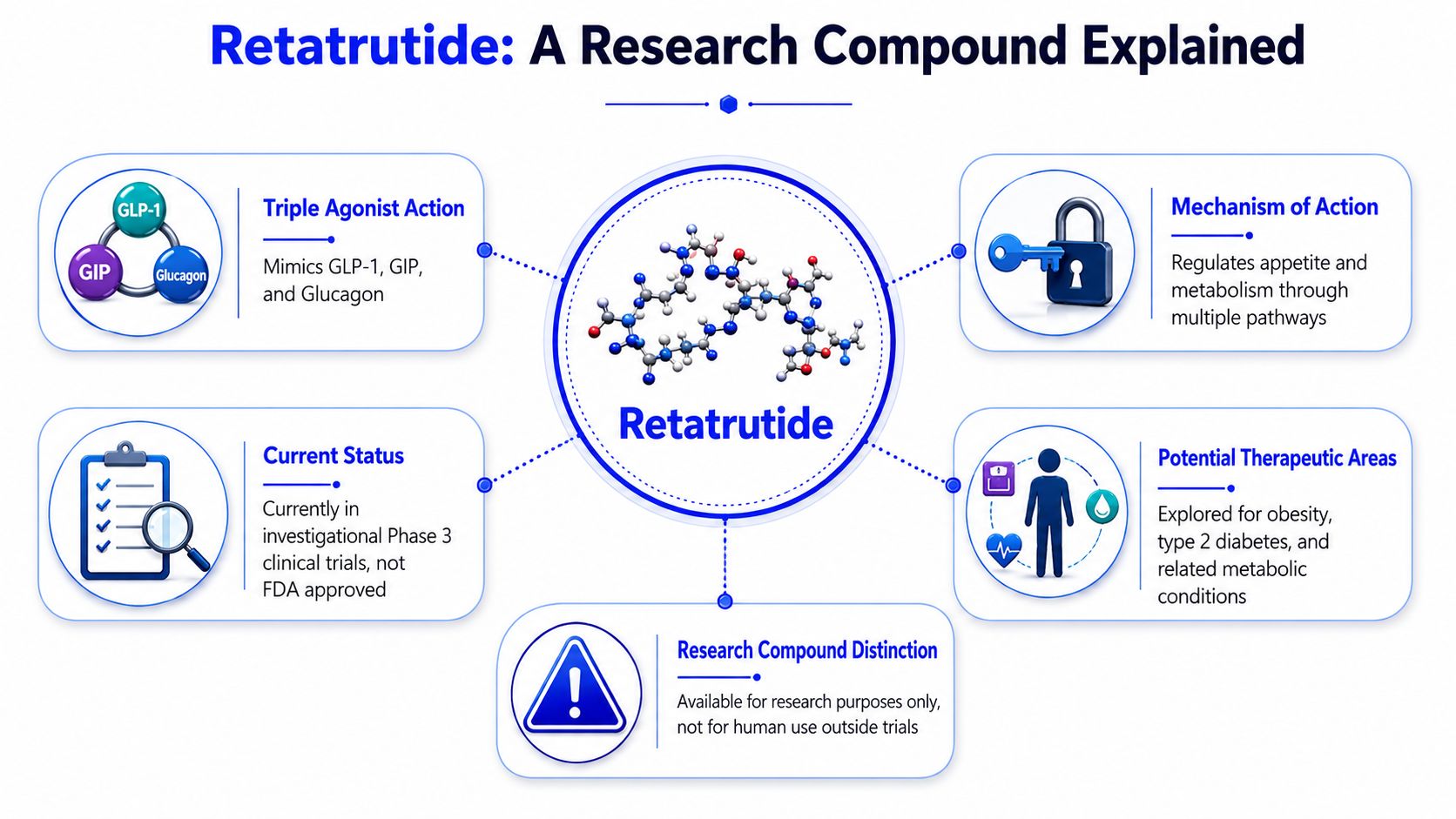
When a compound has a more complex profile, sloppy sourcing creates bigger problems. Minor uncertainty around identity, degradation, or contamination can affect interpretation fast. That’s why experienced buyers look past the front label and go directly to the underlying analytical package.
For Retatrutide, the minimum technical review should include:
A compound with this profile requires a higher standard of procurement discipline. If a supplier only offers generic claims like “lab tested” or “high purity” without actual files, the listing is incomplete. The more technically interesting the peptide, the less room you have for undocumented assumptions.
That’s one reason researchers should be careful about the phrase best place to buy Retatrutide. In practice, “best” rarely means cheapest or fastest. It means the source gives you enough technical evidence to defend the purchase in a lab meeting, an audit trail, or a failed replication review.
Buy the documentation first. The vial comes second.
A common failure point shows up before any order is placed. A researcher finds a vial online, sees a purity claim, and treats the purchase like routine catalog procurement. With Retatrutide, that is the wrong standard.
Retatrutide is still an investigational drug, not an FDA-approved product. GoodRx summarizes its current status and notes reported phase 2 weight-loss results, expected phase 3 timing, and a possible later approval path in GoodRx’s Retatrutide overview. That status changes how careful buyers should interpret listings, marketing language, and intended-use claims.

If the goal is the most defensible route, a recruiting clinical trial sits at the top. Trial access comes with protocol control, defined handling procedures, screening criteria, and formal safety monitoring. It also reduces exposure to counterfeit or poorly documented material, a point discussed in this overview of how to get Retatrutide.
That matters in practice. Controlled access gives you a chain of responsibility. Informal online purchasing often gives you a storefront, a payment page, and very little else.
Labs that already work with regulated materials should apply the same discipline here. The habits are familiar. Verify release criteria, confirm traceability, and document deviations. For teams that need a useful parallel from another regulated field, understanding medical device QA is a helpful reference because the underlying principle is the same. Process control is more reliable than trust-based procurement.
The legal question is only one part of the review. Safety also depends on whether the seller states clear research-use boundaries and can show how the batch was handled, tested, and released.
I look for four signs that a listing is not ready for serious research use:
A short explainer is useful here before reviewing any supplier videos:
The fastest way to compromise a project is to treat an investigational compound like a commodity item.
The practical consequence is straightforward. If identity, purity, legal framing, or handling history are uncertain, the purchase creates work instead of reducing it. You spend more time defending provenance, questioning results, and explaining gaps in the record than using the material productively.
A new supplier can look credible in five minutes. It often takes only one missing lot record to show whether the material can withstand real scrutiny.
Researchers asking where to source Retatrutide usually want a simple shortlist. Shortlists age badly. A scoring framework holds up better because it gives you a repeatable way to review any supplier that appears later, including one you have never dealt with before.
Pricing in this category varies widely, as noted in this Retatrutide availability guide. Wide pricing ranges are common in fragmented markets. The practical point is not to chase the lowest number. It is to ask what documentation, controls, and support sit behind that number.
Begin with the release file set. Ask for the batch-specific COA, chromatographic data, and identity support tied to the exact lot being offered. If the seller cannot produce that package promptly, the review stops there.
I train new buyers to separate storefront quality from release quality. Clean branding, polished product pages, and fast checkout do not establish identity or purity. Batch records do.
After the documents are in hand, review whether they are usable. Dates should be visible. Lot numbers should match. Test names should be specific enough for another researcher to understand what was run and what was confirmed.
A practical review should cover records, operations, and communication. Each category answers a different question. Records show what was tested. Operations show whether the business can maintain control after the test was run. Communication shows whether support can explain the file set without drifting into vague sales language.
Use price carefully. A very low quote can be legitimate, but it often signals thin analytical support, weaker packaging controls, or limited post-sale accountability. A high quote does not prove quality either. It only buys a closer look.
My preferred review sequence is simple:
Lab habit: If two suppliers look similar, choose the one whose records another scientist could audit quickly.
| Evaluation Criterion | What to Look For | Red Flag |
|---|---|---|
| Documentation | Batch-specific COA, readable HPLC data, mass spectrometry support | Generic certificate with no lot linkage |
| Product identity | Clear naming, lot traceability, consistent labeling | Vague description or mismatched product files |
| Purity claims | Purity statement backed by analytical records | Purity percentage shown with no test documentation |
| Legal framing | Explicit research-use positioning and clear disclaimers | Consumer-style claims around an investigational compound |
| Supplier transparency | Visible support channel, policies, ordering process, accountability | Anonymous operation or hard-to-find contact path |
| Pricing | Falls within the broader market context and is justified by records | Unusually cheap listing with thin documentation |
| Shipping practice | Protective packaging and clear receipt expectations | No guidance on transit, inspection, or storage |
| Post-sale support | Ability to answer technical and paperwork questions | Evasive replies or scripted sales language |
Perfect marketing is irrelevant here. A defensible release process, clear lot traceability, and support that can answer document-level questions are what make a supplier usable for serious research.
Once you’ve chosen a supplier, the buying decision is only half the job. The next risk point is logistics. A good batch can still be mishandled during receipt, transfer, storage, or reconstitution planning.
Reputable research suppliers usually slow the process down in useful ways. They may require account creation, present age or use disclaimers, and structure checkout around research-only acknowledgment. That friction is a quality signal when handled clearly.
When the shipment arrives, inspect before shelving. Confirm that the package contents match the lot records, the labels are legible, and the documentation is complete enough for your internal files.
Use a simple intake routine:
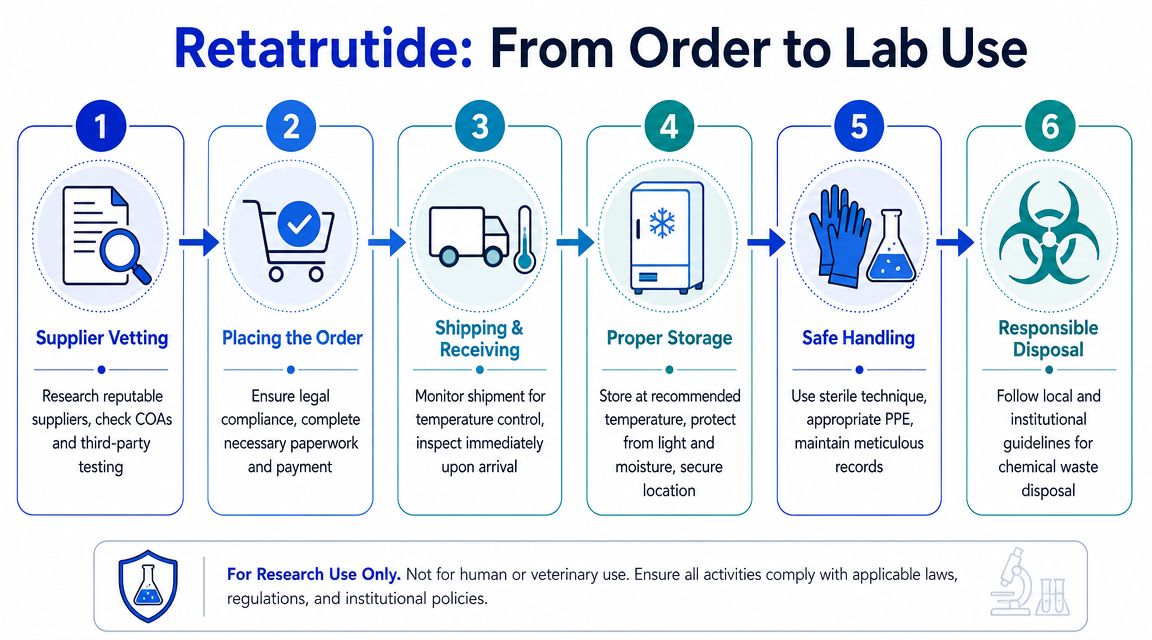
Many research-grade peptide listings present Retatrutide in lyophilized vial format, and independent sources often point to purity claims around 99%+ alongside analytical documentation as practical markers labs use when comparing authenticity and batch consistency, as noted in the earlier referenced research purchasing guide. That means your handling procedures should focus on preserving the condition you paid for.
A few habits matter more than people think:
Storage discipline protects analytical value. It isn’t just a housekeeping task.
If your lab works across multiple peptides, create one standardized receipt and storage form for all incoming investigational compounds. That reduces ad hoc handling and makes lot review much easier later.
Yes. The technical profile alone justifies stricter review. When a compound has more complex identity and stability considerations, buyers need stronger analytical support and tighter intake discipline.
That doesn’t mean sourcing has to be difficult. It means the threshold for acceptable proof should be higher than it would be for a routine catalog item.
It means the supplier is positioning the product for research, laboratory, or analytical use rather than consumer or routine clinical use. Buyers should treat that language as a compliance boundary, not boilerplate.
If a vendor displays a research-use disclaimer but markets in a consumer style, that contradiction deserves attention. The label and the sales behavior should agree.
Independent verification creates distance between the seller’s commercial interest and the analytical result. That doesn’t automatically make every outside report perfect, but it does improve confidence when the records are complete and batch linked.
In-house testing can still be useful. It just shouldn’t be the only proof you rely on when evaluating a sensitive compound.
If the evidence only exists inside the seller’s own marketing language, you don’t have much evidence at all.
No. It’s a signal, not a conclusion. Domestic manufacturing may help with traceability, communication, and shipping consistency, but you still need to review the actual release documents and support behavior.
A poor documentation package doesn’t become acceptable just because the supplier says the product is made locally.
Ask questions that force specificity. Good suppliers can answer them without drifting into generic reassurance.
A practical pre-purchase list includes:
Sometimes a lower price is a result of business model or packaging format. But low price with weak records usually means more uncertainty, not more value.
For Retatrutide, a sound procurement decision comes from aligning legal context, analytical proof, and handling discipline. Cost matters, but it should sit behind quality evidence, not ahead of it.
The best place to buy Retatrutide isn’t a universal storefront. It’s the source that stands up to scrutiny. For some researchers, that means trial-based access remains the clearest option. For others evaluating research-grade supply, the decision should rest on records, lot traceability, analytical support, and post-purchase handling standards.
That’s the practical sourcing framework that holds up under pressure. Start with legal status. Review identity and purity documents before payment. Treat pricing as context, not proof. Then protect the material with disciplined intake, storage, and recordkeeping once it reaches your lab.
Researchers get into trouble when they buy a claim instead of a batch. They protect their work when they buy documentation, process control, and accountability.
If you’re comparing suppliers now, use the checklist above as your filter. Keep the standard high. Explore options that make batch data easy to review, support easy to reach, and procurement easy to defend.
If you want a research-focused supplier to evaluate against that framework, Peptide Warehouse USA is one option to review. Check the available batch documentation, compare the ordering workflow to your lab’s requirements, and learn more before placing any research-use order.