No products in the cart.

The cheapest vial and the highest advertised purity aren't automatically the best source of peptides for laboratory work. A peptide is only a defensible purchase when the supplier's claims can be checked against records for the specific batch you receive.
That means looking beyond a purity badge. This guide compares peptide source types, explains what a Certificate of Analysis (COA) establishes and what it leaves unanswered, and shows how to weigh traceability, stability, price, and compliance. The aim is practical: help research buyers select material whose documentation fits the work and can withstand scrutiny.
For research use, the best source of peptides is the supplier whose claims you can verify, not the one with the boldest purity figure. A peer-reviewed review describes peptide quality through identity, composition, and impurity control, including four distinct attributes: primary amino-acid sequence, secondary structure, oligomer or aggregation state, and impurities or degradation products. The review of synthetic-peptide quality explains that HPLC measures peptide-related impurities, while mass-based methods help establish identity and composition.
Those methods answer different questions. HPLC can show the relative chromatographic signal associated with a main peak; mass spectrometry can check whether that component has the expected mass. A stronger quality package may also include sequence or structure confirmation, assay, residual-solvent and water testing, and microbial or endotoxin results. No single test supplies all of that evidence.
This matters to buyers working with research-use-only materials for analytical, preclinical, or method-development purposes. It isn't a guide to medical use, dosing, or treatment, and research documentation should not be mistaken for pharmaceutical approval.
The procurement decision also reaches beyond the COA. Buyers need to compare source types, confirm that records belong to the supplied lot, assess storage and shipping information, and distinguish research suppliers from regulated compounding operations. Price is meaningful only after the buyer knows what amount of verified peptide the vial contains.
The buying standard: Rank suppliers by batch-specific evidence first, then compare cost and convenience.
The table gives a quick comparison of common source types. Lead times and price positions are typical patterns, not guarantees, so confirm the terms for the exact sequence, amount, and destination.
| Source type | Documentation you can expect | Typical lead time | Price position | Best fit |
|---|---|---|---|---|
| Manufacturer-direct producer (scale or GMP-oriented) | Batch records and multi-method validation data on request | Weeks to months, quote-based | Lowest per-gram cost at volume | Large programs and audit-heavy work |
| US-made research catalog supplier | Lot-specific COA with microbial and endotoxin reports | In-stock items often ship in 1–2 business days | Mid-range per vial | Routine lab work, small and repeat orders |
| Custom synthesis contract lab | Documentation package defined in the contract | Several weeks, depending on sequence | Project-based quote | Novel sequences and method development |
| Academic peptide core facility | Analytical runs with internal QC records | Set by core queue; confirm with facility | Internal rates for affiliated users | Groups with campus access |
| Unverified reseller or marketplace | Undated or generic COA, sometimes none | Variable and unclear | Lowest headline price | Rarely suitable for defensible analytical work |
Catalog suppliers suit buyers who need an in-stock sequence and a defined batch document package. For example, the University of Colorado's peptide-protein chemistry facility describes a workflow that pairs reversed-phase HPLC purification and purity testing with LC-MS identity confirmation. That combination illustrates why orthogonal checks are more informative than a single purity metric.
A contract lab is a more natural fit when the sequence is novel or the project needs requirements written into a custom package. The extra coordination and production time may make the quote less attractive for routine replenishment, but the agreement can define which tests and records the project needs.
Academic core facilities can offer useful analytical depth to affiliated researchers, though access and queue timing are facility-specific. Marketplaces may win on headline price, but a generic or missing COA leaves the buyer with little batch-specific evidence to evaluate.
Choose the source type according to how much of the result you'll need to defend. Then evaluate the actual supplier and lot, rather than assuming that a category label guarantees quality.
One purity percentage isn't a quality verdict. The FDA's comparative-peptide guidance says peptide-related impurities at 0.10% or greater require identification, and proposed limits between 0.10% and 0.50% need supporting justification. It also calls for comparison across at least three test-product batches manufactured from at least two drug-substance batches, with testing near release and again at the end of shelf life. Those criteria come from the FDA comparative-peptide guidance, and they show why impurity transparency and batch testing matter.
A COA should make it possible to distinguish two claims: whether the material has the expected identity, and how much chromatographic signal appears as the principal component.
Identity asks what the main component is. Purity asks how its measured signal compares with other detected components.
HPLC can measure chromatographic composition; LC-MS can help check whether the main component has the expected molecular mass. Neither result alone tells a buyer the vial's net peptide content. Water, salts, and counterions can contribute to the vial's weight, so the actual peptide mass may be lower than the HPLC area percentage suggests.
Use the following checklist to inspect a lot-specific COA:
| COA element | What it proves | Red flag |
|---|---|---|
| Lot number matching the vial | Links this vial to the tested batch | Lot number missing or generic |
| Identity by LC-MS | Main component has the expected molecular mass | Identity not reported |
| HPLC purity (area percent) | Share of the chromatographic signal from the main peak | Undated claim such as “up to 99.5%” with no method |
| Net peptide content | Actual peptide mass after water, salts, and counterions | Only a purity figure is shown |
| Related substances | Impurities are reported, including those at or above the FDA guidance's identification threshold | Impurities not reported or unexplained |
| Residual solvents and water | Leftover process chemicals and moisture content | Section absent from the document |
| Microbial limits and endotoxin | Microbial and endotoxin status for the lot | Reports missing or not tied to the lot number |
| Test date and laboratory | Shows when and by whom the testing was performed | No date or laboratory attribution |
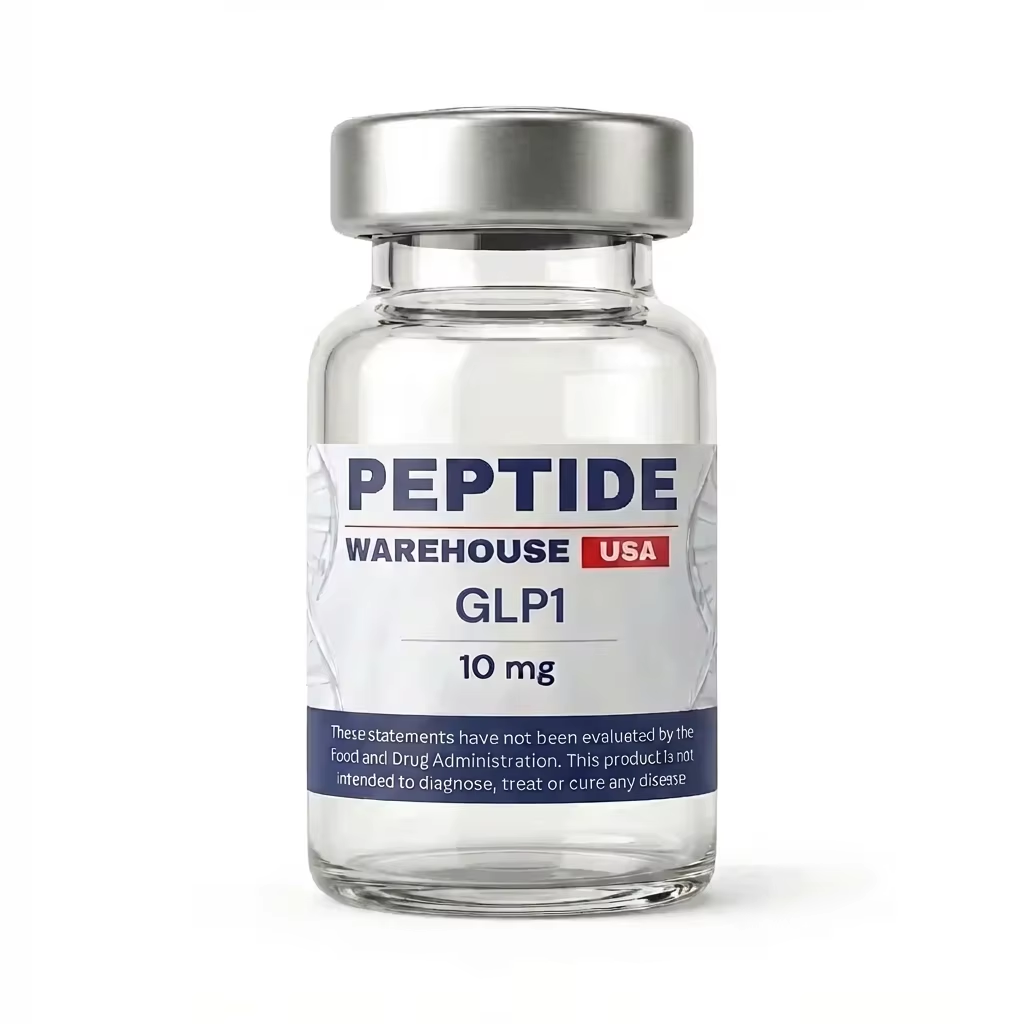
An advertised 99.5% purity figure, such as the one stated for Peptide Warehouse USA products, is a starting point for document review, not a substitute for it. Ask whether the specific lot's COA identifies the method, provides identity evidence, and connects its results to the vial. For a plain-language overview of how third-party lab testing can support product verification, Pure Paw Labs explains supplement testing.
A clean-looking purity number doesn't establish sterility, endotoxin status, biological activity, or suitability for human use. Treat each of those as a separate question requiring relevant evidence.
A “made in the USA” label tells a buyer where a product is made; it doesn't, on its own, show what was tested or how a particular batch performed. The lot record connects the supplied material to its identity, test method, and results. The FDA's Section 503A compounding guidance applies to qualifying compounded human drugs, not every research chemical, but it offers a useful documentation benchmark: identifiable lot, stated material identity, method, acceptance result, and a clear link between the record and the batch.
Ask for written answers to these questions:
Those records help a lab reproduce work, investigate unexpected results, and tell one production lot from another. Peptide Warehouse USA states that its products are made in the USA, batch produced, and batch tested. It also works with established manufacturing partners and third-party laboratories to assess defined purity and identity specifications. Buyers should still verify that the available documents match the lot they're ordering.
Peptides can degrade during manufacturing, storage, and transit. A scientific review of peptide impurities and degradation notes that degradation products can affect product quality and may increase immunogenicity; it also explains that impurity controls are often justified case by case using batch, stability, and toxicology information.
That makes a recent COA useful but incomplete. It describes testing at a point in time; it doesn't establish how the material behaves over its shelf life or what temperature and light exposure it experienced in transit. A vial can look intact after time in a warm truck, sorting facility, or mailbox, while cumulative exposure remains invisible at arrival.
Ask the supplier for storage instructions for lyophilized powder, shipping-temperature controls, retest or expiry information, stability data, and any degradation-related test results. Lyophilized powder generally has a longer working window than a reconstituted solution, but sequence and storage conditions matter; follow the product's stated instructions rather than assuming one rule applies to every peptide.
For a practical example of why missing batch identifiers complicate product verification, see when supplement batch numbers aren't found.
The lot record and storage history work together. If either one is missing, it becomes harder to explain an unexpected result or establish that the tested material was the material used.
Comparing vial prices without checking the amount of usable peptide is a common procurement mistake. A lower sticker price can hide a higher cost per usable milligram if the vial contains less net peptide than the buyer assumes, or if a failed identity check forces a repeat run.
Calculate cost per usable milligram as:
Price ÷ (labeled amount × net peptide fraction)
Then account for any lot that fails identity. For a hypothetical example, a 5 mg vial priced at $60 with 80% net peptide content provides 4 mg of usable peptide, or $15 per usable milligram. If the lot fails identity and needs replacement, the undocumented vial costs more per usable milligram once repeat runs are included.
Peptide Warehouse USA lists KISSPEPTIN-10 at $59.99 and BPC-157 at $79.99. These are different products and sizes, so their headline prices can't be compared directly. Compare the exact product, labeled amount, net content, and documentation before treating one offer as better value.
The FDA separates pharmacy compounding under Section 503A from outsourcing facilities under Section 503B. The agency's guidance on outsourcing facilities and compounding describes Section 503A as compounding by a licensed pharmacist or physician, generally based on a valid patient-specific prescription. Section 503B is a voluntary outsourcing-facility category subject to current good manufacturing practice requirements and FDA inspection under a risk-based schedule, with additional obligations such as adverse-event reporting.
| Category | What it means for a buyer |
|---|---|
| Research-chemical supplier | Sells material for research or laboratory use, not as a dispensing pharmacy |
| Section 503A compounding pharmacy | Compounds qualifying products under the Section 503A framework, generally for an identified patient with a valid prescription |
| Section 503B outsourcing facility | Voluntary category with current good manufacturing practice requirements and FDA inspection |
Peptide Warehouse USA states that it is neither a Section 503A compounding pharmacy nor a Section 503B outsourcing facility, and that its products are for research use only, not human or veterinary consumption. Buyers should expect research-use wording and an FDA disclaimer from a supplier operating in this category. Documentation can support laboratory evaluation, but it doesn't change the supplier's regulatory status.
Pay for documentation when results must be defended. For low-cost exploratory work, a lighter package may fit the purpose; for audit-heavy or consequential work, the cost of weak records can exceed the savings on the vial.
The right source depends on what the lab needs to establish and who may later question the result. Four common cases show how procurement priorities shift.
A university analytical lab developing an LC-MS method should prioritize confirmed identity, related-substance information, and data from more than one analytical method. The supplier needs to provide records for each lot, since method development can be undermined if a change in signal reflects a changed material rather than the instrument or method.
A preclinical contract research organization facing sponsor audits should weight traceability, record retention, and contract-defined documentation heavily. Manufacturer-direct supply or custom synthesis may suit projects that need requirements agreed in advance, especially when the team must show which batch supported each study.
A small biotech running in-house quality control needs repeatable material across related studies. It should seek a lot it can use across the planned work and ask whether the supplier can support repeat orders from the same lot or reserve stock. The central question is whether a change in results could be separated from a change in material.
An independent or teaching laboratory ordering small volumes may find a research catalog supplier practical when it provides a lot-specific COA and separate microbial and endotoxin reports. Peptide Warehouse USA describes third-party testing with COAs, endotoxin, and microbial reports for its research peptides; the buyer should still confirm that each document identifies the exact lot. The supplier is one example of a catalog source, not a universal choice for every study.
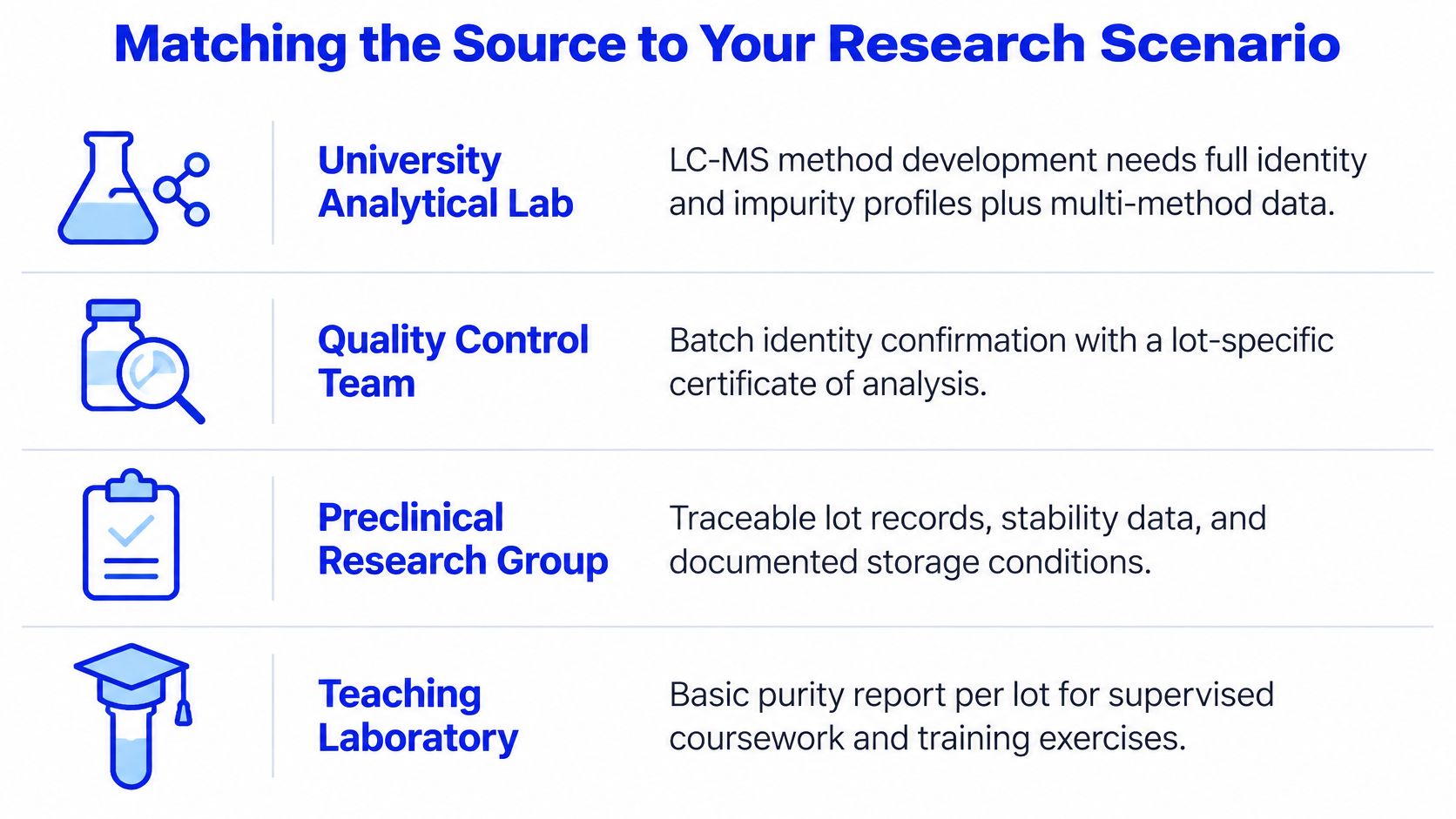
The governing rule is simple: match documentation depth to whether the result will need to be defended. A teaching exercise and a sponsor-audited study don't need identical procurement packages, but both need records appropriate to their purpose.
The video below provides another visual overview of selecting a research source.
No. A purity figure without identity, impurity, lot, and endotoxin information is weaker evidence than a complete batch package. Compare the methods and reports, not just the number.
It's the share of the vial's weight that is actual peptide after accounting for water, salts, and counterions. It can be lower than the chromatographic area percentage.
For cell-based or in vivo preclinical work, request these reports because contamination can affect experimental interpretation. For basic identity work, the study plan determines how much additional testing is necessary.
A research supplier should answer questions about documentation, availability, and order status, not provide dosing or treatment guidance. Use qualified professionals for medical questions.
It depends on the sequence and the storage conditions specified for the material. Ask for stability information and the retest date rather than applying one shelf-life assumption to every peptide.
No. It can support traceability, but it doesn't replace a lot-specific COA or stability evidence.
Use a short procurement sequence to make the comparison repeatable:
Name the work. Decide whether you need identity confirmation, purity profiling, method development, or preclinical material; each purpose calls for a different level of documentation.
Shortlist two or three sources. Match each candidate to the source types that suit your volume, sequence, and recordkeeping needs. A supplier-evaluation framework such as this guide to comparing suppliers with a scoring matrix can help teams apply the same criteria consistently.
Request the exact lot documents. Ask for the COA for the product and size you plan to buy, plus microbial and endotoxin reports where relevant. Confirm that the lot on the paperwork matches the lot supplied.
Confirm supply and storage terms. Check shipping conditions, storage instructions, expected lead time, stability information, and what happens if a lot fails testing.
Compare cost per usable milligram. Use net peptide content rather than assuming the labeled amount equals the amount of peptide available for the work.
Check the stated use and supplier category. Confirm that the supplier's research-use-only wording is clear and that its materials don't make medical or dosing claims.
Order a lot you can defend. Log its lot number, arrival date, and storage conditions on receipt. Validate the material in the relevant assay before scaling up.
Support teams can handle non-medical questions about availability, documentation, and order status. Peptide Warehouse USA provides that type of support and ships to all 50 U.S. states; dosing and treatment questions remain outside the role of a research supplier.
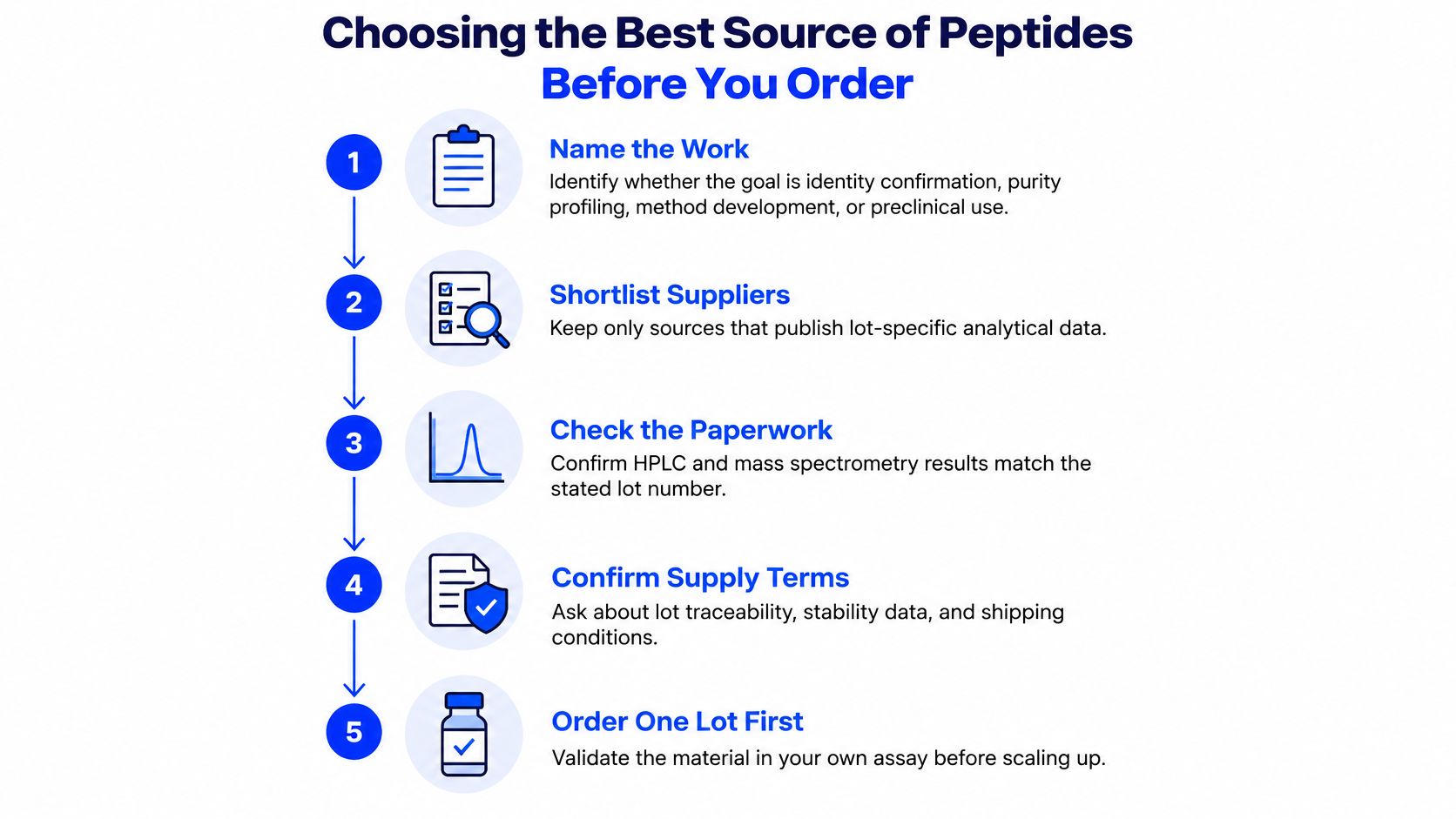
Choose the source whose lot documents, storage information, and compliance wording would survive a reviewer's questions.
The best source of peptides isn't necessarily the cheapest or the one with the largest purity claim. It's the supplier whose batch records, test methods, storage information, and stated use fit the research and can be checked before ordering.
Learn more about lot-specific documentation and explore the research peptide catalog at Peptide Warehouse USA.
Peptide Warehouse USA provides research peptides backed by third-party COAs, microbial reports, and endotoxin reports, with products made and batch tested in the USA. Review the lot documentation against your project's requirements, then visit Peptide Warehouse USA to explore the catalog and learn more about available research materials.