No products in the cart.



Interest in BPC-157 nasal spray often starts with the wrong question. People ask whether the peptide is promising, but the better bench question is simpler: what exactly is being delivered, by what device, under which quality system, and in what regulatory category?
That shift matters. A peptide can be scientifically interesting and still be poorly formulated, inconsistently dispensed, or inappropriate for human use. With BPC-157 nasal spray, those practical details sit at the center of the discussion because the compound remains investigational, and the nasal route adds its own formulation and handling demands.
This is a research-focused guide. It treats BPC-157 as a Research Use Only compound, not an approved medicine, not a dietary ingredient, and not a casual wellness product. If you’re evaluating this format for laboratory, analytical, or preclinical work, the useful questions aren’t promotional. They’re about mechanism, delivery physics, stability, documentation, and compliance.
BPC-157 nasal spray sits at the intersection of two things that draw serious attention in peptide research: interest in the peptide itself and interest in intranasal delivery as a practical route. That combination makes it easy to focus on theoretical benefits of peptides while overlooking the harder issues that determine whether a study is even interpretable.
At bench level, the first job is to separate three different questions. One is whether BPC-157 is scientifically interesting. Another is whether a nasal formulation can deliver it consistently. The third is whether the product category is appropriate to procure, handle, and study under current regulatory expectations.
Practical rule: If you can’t verify identity, concentration, actuation consistency, and regulatory status, you don’t have a strong research material. You have a bottle with a label.
Researchers also need context. Intranasal delivery isn’t some fringe idea. A peer-reviewed review described the broader nasal spray and inhalation drug market as about $7.8 billion in 2018 and projected it to approach $12 billion by the end of 2025, showing why nose-based delivery remains a major pharmaceutical route. That doesn’t validate BPC-157 as an approved nasal product, but it does explain why labs continue exploring the route.
A careful evaluation usually turns on a short list:
BPC-157 is best understood as a peptide with a specific biological origin story, not as a trend product. The basic fact that grounds the conversation is straightforward. BPC-157 is a synthetic 15-amino-acid peptide derived from a naturally occurring protein fragment first isolated from human gastric juice, often referred to as the body protection compound.
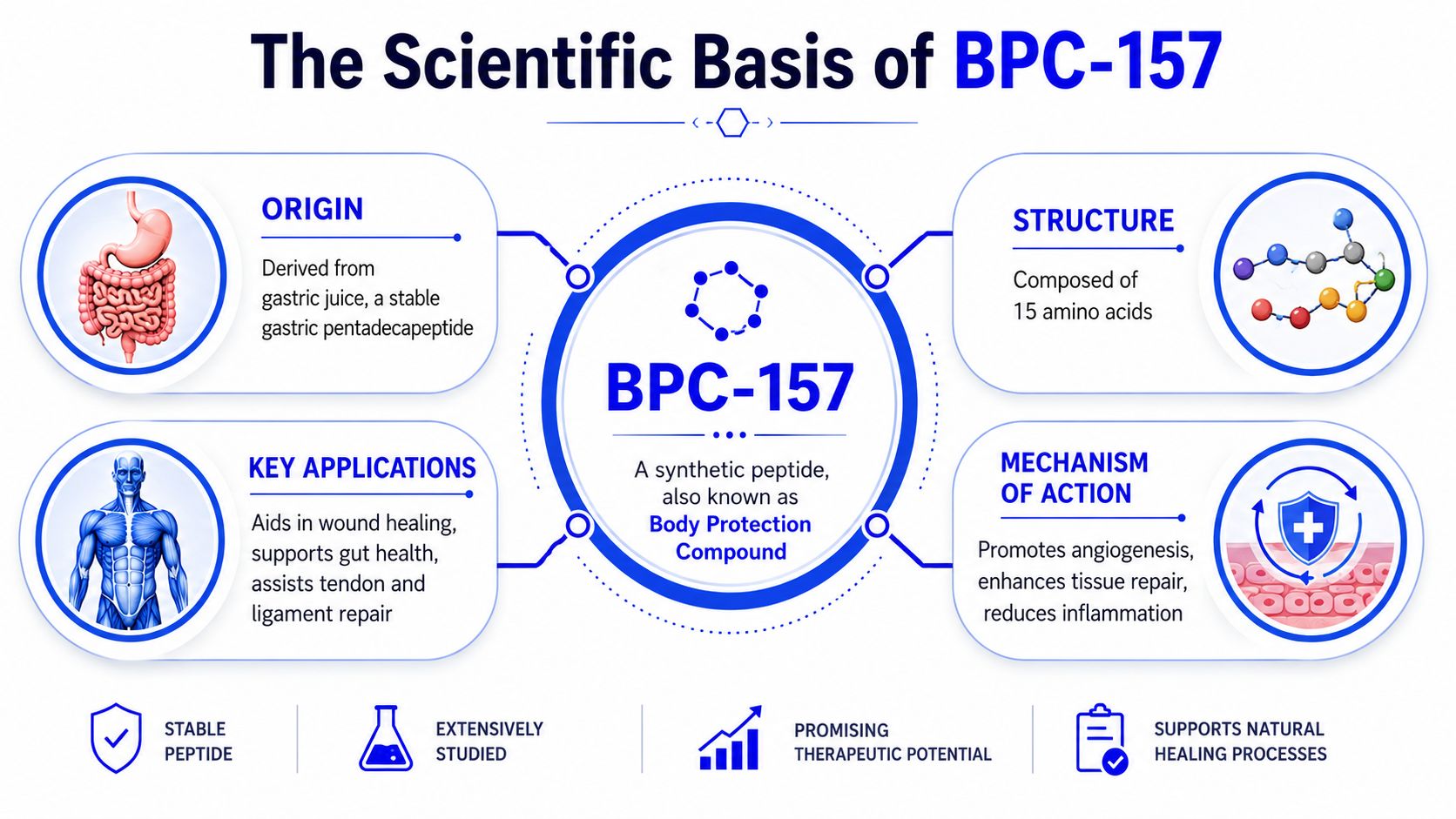
That gastric origin shapes how many researchers first encounter the peptide. Early interest centered on tissue repair and digestive support, which is a more coherent starting point than the broader internet claims that often surround it now.
This doesn’t mean the peptide has approved therapeutic uses. It means its scientific backstory came from gastrointestinal biology, and that matters because it helps you read the literature with the right frame. If a compound begins in one biological context, researchers usually ask whether its observed effects generalize to others.
For a junior colleague, the simplest way to think about BPC-157 is this:
When people discuss BPC-157 mechanism, they usually mean a set of proposed preclinical actions, not a settled human pharmacology profile. Researchers often talk about tissue repair signaling, angiogenesis-related pathways, and interaction with inflammatory and nitric oxide-related systems. Those discussions are part of why the peptide keeps appearing in research conversations.
The key discipline here is language. You can say preclinical work has driven interest in repair-oriented pathways. You shouldn’t collapse that into a human efficacy claim.
Good bench reasoning separates biological plausibility from validated clinical use. With BPC-157, that distinction isn’t optional.
Another source of confusion is the name itself. Because “body protection compound” sounds broad, some readers assume it implies broad proof. It doesn’t. The name reflects origin and concept, not approved indication.
If you’re teaching this topic, the clean explanation is that BPC-157 remains interesting because it is a small, defined peptide with a biologically meaningful origin, and because preclinical discussions often connect it to repair-related pathways. That’s enough to justify scientific curiosity. It isn’t enough to waive quality control, route-specific formulation work, or regulatory caution.
Which route answers your question with the fewest hidden variables? That is the right starting point for BPC-157 work, because route selection changes more than convenience. It changes what must be controlled at the bench, how confidently dose delivery can be interpreted, and how much uncertainty comes from the formulation rather than the peptide.
Intranasal delivery attracts attention for a practical reason. It offers a noninvasive path and may reduce some of the handling burdens that come with repeated injections. But a nasal spray is not merely “peptide in a bottle.” It is a delivery system with its own mechanics. The pump has to meter consistently. The liquid has to form an appropriate plume. The deposited droplets have to contact mucosa long enough to matter. If any one of those steps varies, the administered dose and the absorbed dose can drift apart.
A useful analogy is a micropipette versus a squeeze bottle. Both move liquid. Only one is built for controlled volume delivery. Nasal spray devices sit somewhere in between. They can be standardized, but only if the device, formulation, and operator technique are all treated as part of the experiment.
Comparing routes requires asking what each one forces you to prove.
| Route | Absorption Pattern | Main Source of Variability | Primary Research Focus | Practical Bench Consideration |
|---|---|---|---|---|
| Intranasal spray | Potentially rapid, but highly dependent on deposition and mucosal conditions | Device output, plume geometry, nasal clearance, formulation behavior | Whether a nasal formulation can deliver reproducible exposure | Requires pump qualification, actuation consistency, and route-specific handling |
| Subcutaneous injection | Often more direct and easier to define operationally | Injection technique, injection site, preparation accuracy | Dose administration with tighter procedural control | Usually simpler to standardize across operators |
| Oral administration | Often the hardest route to interpret for peptides | Gastrointestinal degradation, transit, and formulation protection | Whether the compound or formulation can persist through GI exposure | Easy to administer, difficult to translate into clear exposure assumptions |
The practical distinction is simple. With subcutaneous work, the main question is often “Did the intended dose enter the body in a controlled way?” With intranasal work, the question becomes “Did the device deliver the intended amount to the intended surface under reproducible conditions?” Those are not the same problem.
That difference matters for study design. If your hypothesis depends on precise delivered dose with minimal device-related noise, subcutaneous administration is often easier to defend. If your hypothesis is specifically about intranasal delivery, local deposition, or route feasibility, then the spray format can be appropriate, but only if you characterize the system rather than assume it behaves ideally.
Oral work sits in a different category. For peptides, the gastrointestinal tract is a chemically hostile environment. That does not make oral experiments pointless. It means the experiment has to be built around survivability, exposure uncertainty, and a more complex interpretation chain.
The route label can hide major differences in material quality.
A research-grade intranasal preparation should be traceable to identity testing, concentration verification, and documented handling conditions. A compounded product may be prepared for an individual setting under a different quality framework, with different documentation, different excipients, and different assumptions about use. Those are not interchangeable materials for research purposes, even if both carry the same peptide name on the label.
Junior researchers often get tripped up when they compare “nasal BPC-157” to “injectable BPC-157” as though route is the only variable. In practice, you may be comparing different vehicles, different storage histories, different dispensing accuracy, and different quality systems. At that point, route comparison becomes confounded before the first observation is recorded.
A cleaner decision framework looks like this:
A route is only as interpretable as the variables you measure around it.
One final caution. Regulatory treatment also differs by route and product type. A research-use peptide solution, a compounded preparation, and a product marketed with consumer-facing language can sit in very different compliance categories even if all three mention intranasal use. For bench work, that means route selection is partly a pharmacology decision and partly a sourcing and documentation decision. If the paperwork is weak, the route comparison is weak too.
What turns a nasal peptide sample into interpretable research material instead of an expensive unknown? Usually, it is not the label. It is the formulation record, the spray device, and the stability evidence that sit behind the bottle.

A nasal spray is a small delivery system, not just a dissolved peptide. The liquid has to remain chemically intact, the pump has to meter reproducibly, and the droplets have to deposit in a useful region of the nasal cavity rather than running out or pooling unpredictably. If any one of those steps is poorly controlled, your “dose” becomes partly a guess.
That point matters more with BPC-157 because researchers may encounter two very different product categories under similar naming. One is a research-use material with analytical records, traceable lots, and defined handling conditions. The other may be a compounded or commercially marketed preparation with less transparent formulation work. Those are not interchangeable from a bench perspective. They differ in documentation depth, manufacturing controls, and often in how much confidence you can place in the stated concentration.
Start with the parts that directly affect delivered material, not the sales copy. A credible nasal formulation should give you enough information to answer a simple question: what is leaving the actuator each time, and under what conditions does that remain true?
Check these points early:
A useful comparison is a micropipette. You would not trust a pipette because the sticker says 100 µL. You trust it after calibration, maintenance records, and repeatable output. A nasal device deserves the same mindset.
A Certificate of Analysis helps only if it reduces uncertainty. Many junior researchers make the mistake of treating a COA as proof by itself. It is closer to a lab notebook summary. The value depends on whether the methods, lot identifiers, and dates let you connect the document to the physical sample in hand.
Review the package in this order:
Here’s a helpful visual overview before we go deeper into handling logic.
Peptide identity answers only one question. Device performance answers the next one, which is whether the peptide reaches the subject in a repeatable way.
Nasal delivery is governed by simple physical constraints. Droplet size influences where material deposits. Spray plume shape affects whether the liquid contacts a broad mucosal area or strikes one small region. Viscosity changes how easily the pump atomizes the formulation. Surface tension affects breakup into droplets. Even the operator’s angle and priming technique can alter output. None of that is secondary if your protocol depends on consistent exposure.
A pure peptide in an inconsistent pump is like a calibrated standard loaded into a drifting instrument. The analyte may be correct, but the measurement system is not.
For bench work, that means treating the following as analytical variables:
Short studies can still be confounded here. A bottle may perform differently on the first actuation, after several uses, or near the end of its fill. If the protocol does not record those details, apparent biological variation may partly be device variation.
Research-grade material usually shows its strength in paperwork and reproducibility, not in polished branding. You should be able to identify who made it, which lot was tested, what methods were used, and how storage conditions were defined. If those basics are missing, the burden shifts to your lab to verify far more before using the material in any serious study.
Compounded products raise a separate set of questions. Compounding can serve a legitimate preparation function in some contexts, but a compounded nasal peptide is not automatically equivalent to a research-grade material prepared under a different quality system. Differences in excipients, sterility assurance, beyond-use dating, and batch scale can change both stability and interpretability.
That is the bench-level distinction to keep in view. Two bottles may carry the same peptide name. One supports reproducible work. The other gives you a hypothesis plus uncertainty.
Regulatory status isn’t background noise for BPC-157. It is one of the main facts that should shape procurement and study planning. If you treat it as secondary, you risk building a project on the wrong assumptions from day one.
The U.S. Office of Dietary Supplement Programs states that BPC-157 is an unapproved drug, and in late 2023 the FDA flagged it as a substance presenting significant safety risks for compounding, including concerns about immune reactions and impurities, as outlined in this Office of Dietary Supplement Programs summary on BPC-157. That single point clears up a lot of confusion.
It means BPC-157 should not be discussed as if it were a routine supplement ingredient. It also means researchers should be wary of products marketed in a way that blurs the line between investigational material and consumer-ready human-use goods.
A disciplined interpretation is straightforward:
When a compound sits in this regulatory position, every handling decision should reflect that reality. Labs should procure only from suppliers that are clear about research-use restrictions, documentation, and batch traceability.
That also changes how you interpret online claims. If a seller talks mainly about outcomes and barely mentions compliance, documentation, impurities, or safety concerns, that imbalance is itself useful information.
Regulatory caution doesn’t kill scientific interest. It sets the minimum standard for how responsible researchers handle that interest.
In practice, safe research guidelines start with strict scope control. Keep BPC-157 in legitimate laboratory, analytical, or preclinical contexts. Document lots carefully. Preserve records. Avoid language or workflows that imply ordinary consumer or therapeutic use.
A good sample can become a bad sample through ordinary sloppiness. With peptide liquids, handling discipline protects both the material and the study.
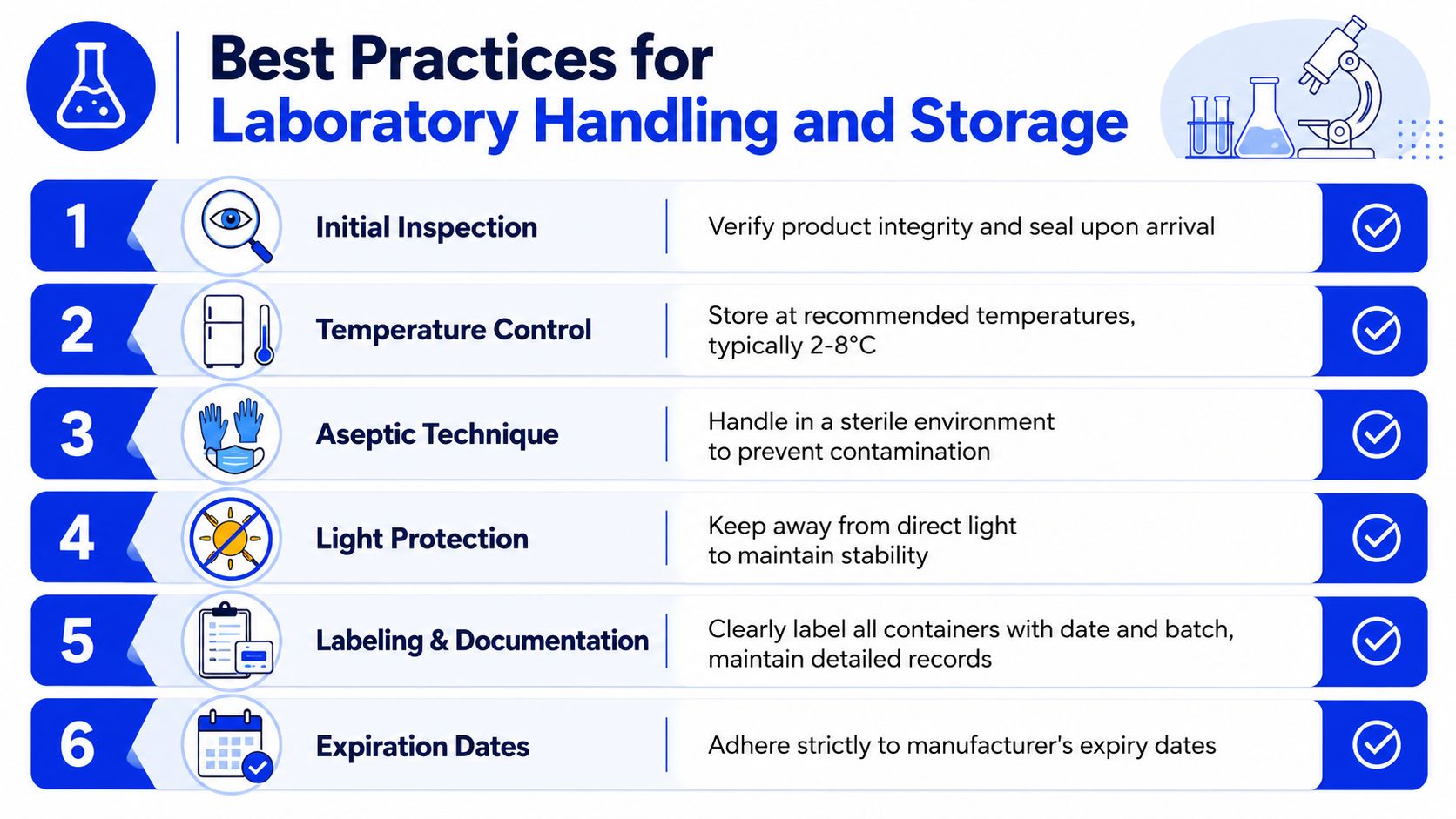
Start with the bottle in your hand, not the protocol on your screen. Inspect the seal, label, lot information, and physical condition on arrival. If anything doesn’t match the documentation, quarantine it until the discrepancy is resolved.
For day-to-day handling, a short checklist prevents many avoidable errors:
Researchers often know storage matters, but the deeper point is why. Peptide stability can drift through repeated temperature changes, excess light exposure, or poor closure after use. Every one of those errors can shift the study away from the labeled formulation.
A practical storage routine looks like this:
Small handling errors are easy to ignore because they don’t announce themselves. They show up later as noisy data and inconsistent interpretation.
Documentation is part of storage, too. The strongest labs don’t just store the bottle properly. They store the history properly.
A lab can explore formulation work, but that doesn’t make the task simple. Nasal delivery depends on more than dissolving a peptide in liquid. You still need to evaluate solution stability, container compatibility, actuation performance, and documentation quality. Without that work, a custom preparation may be less controlled than a properly documented research-use liquid.
“Better” is usually the wrong word. Intranasal delivery is most useful when the route itself is relevant to the hypothesis and when the lab can control route-specific variables. If the main goal is tightly controlled administration, other routes may be easier to standardize.
Researchers should pay attention to mismatched paperwork, damaged seals, visible changes in the liquid, inconsistent spray behavior, or unclear batch traceability. None of these signs proves failure on its own, but each one is a reason to pause and verify before using the material in a study.
Treat claims as prompts for verification, not as evidence. With BPC-157, buyer awareness should center on whether the product is clearly sold for research use, whether the quality package is transparent, and whether the seller acknowledges the compound’s unapproved regulatory status.
If you’re sourcing research-use peptide materials and want a supplier that emphasizes batch documentation, transparent testing, and US-based fulfillment, learn more about Peptide Warehouse USA and explore options built for laboratory, analytical, and preclinical workflows.