No products in the cart.



What makes a peptide worth studying by mouth if most peptides fall apart in the stomach? That's the central gap with BPC 157 oral peptide discussion, and it's why the topic keeps showing up in both lab notebooks and search results. The short answer is that BPC-157 is unusual enough to justify oral research, but the human evidence still doesn't let anyone call it a settled therapy.
BPC-157 sits in an awkward middle ground. Animal work and gastric-stability data make oral delivery biologically plausible, yet the published human record is thin, and the best human data still leaves big questions about exposure, formulation, and real-world translation. If you're trying to understand whether oral BPC-157 is promising, overhyped, or underdeveloped, the right starting point is the evidence chain, not the marketing language.
That's also why this guide leans on the bench-scientist mindset. The useful questions are practical ones, like what the molecule is, why the stomach doesn't destroy it as quickly as expected, what rodent studies tested, what the human trial did and didn't show, and what you should look for in a Certificate of Analysis before you trust any vial or capsule. For a broader comparison of delivery routes, the MEDISTIK guide on topical vs oral relief is a helpful example of how route-of-administration changes the biology of a product.
The reason oral BPC-157 keeps coming back is simple. It behaves unlike most peptides in the part of the body that usually destroys peptides, and that makes it worth asking whether the oral route has a real biological basis. The literature doesn't say “this is a proven oral therapy.” It says the molecule is unusual enough that oral study made sense, and researchers took that seriously.
Multiple reviews describe BPC-157 as highly stable in human gastric juice, and a 2011 line of research reported that it stayed intact for more than 24 hours at about pH 2.0, while resisting enzymes such as pepsin and trypsin (Rethink Peptides). That stability is the whole reason oral dosing entered the conversation at all. Most peptide drugs don't get that far.
Readers often get confused here. Stability doesn't equal proven benefit, and it definitely doesn't equal proven human bioavailability. It only means the molecule survives long enough to make oral research plausible.
BPC-157 is a 15-amino-acid pentadecapeptide with a molecular weight of about 1,419.5 Da and a reported formula of C62H98N16O22 (PMC). That size and sequence matter because they help explain why this peptide has been discussed as orally usable rather than immediately broken apart in the gut. The oral route is therefore a chemistry question before it's a dosing question.
Practical rule: if a peptide survives gastric juice in a lab assay, that tells you it might reach target tissue orally. It does not tell you how much gets there in people.
The bigger takeaway is that the oral story is built on mechanistic plausibility, not on a finished clinical record. That's useful because it keeps the discussion honest. It also keeps the focus where it belongs, on what the molecule can realistically do, not on what a vendor page claims it can do.
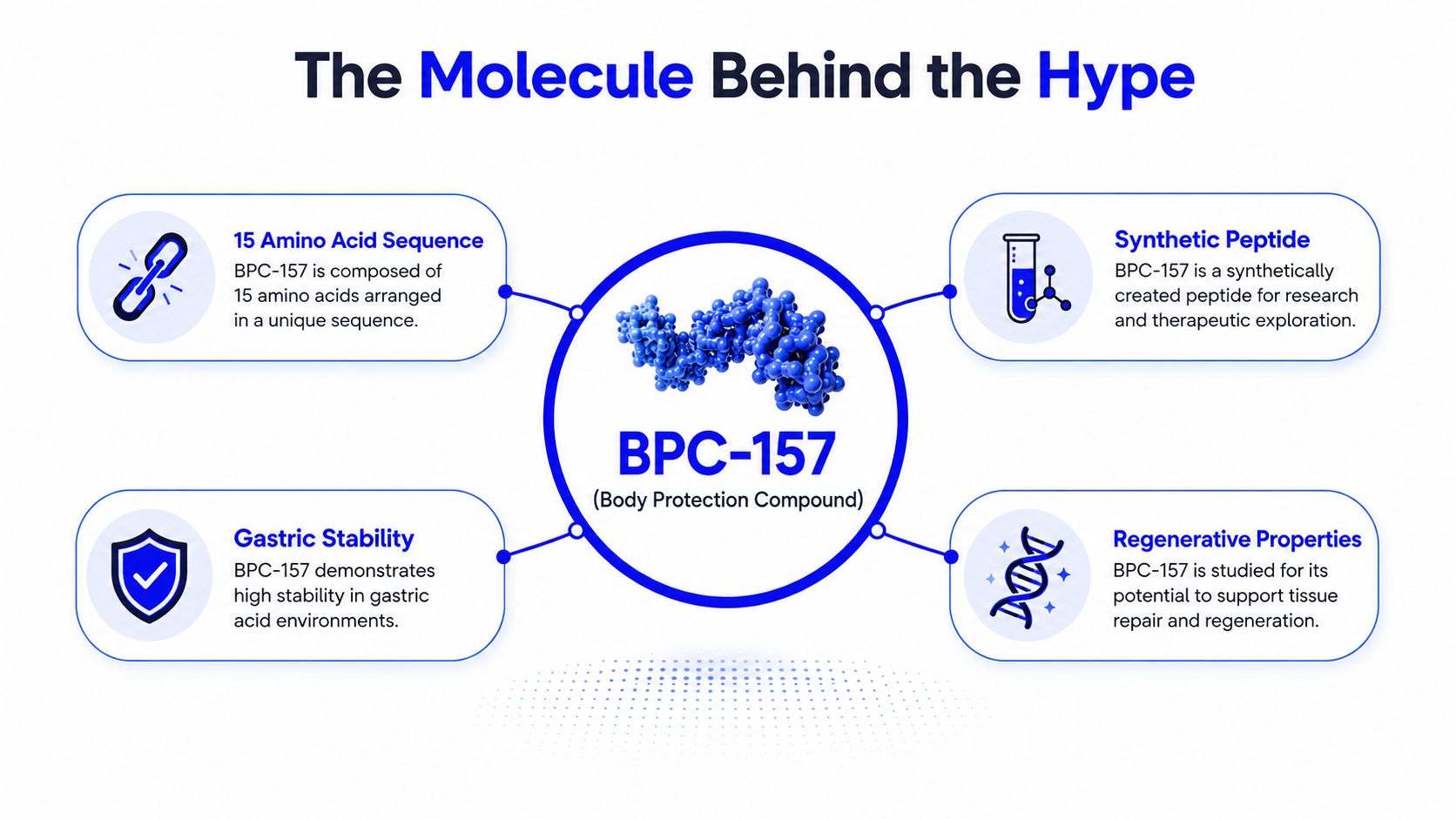
BPC-157 is easier to read as a chemistry problem than as a wellness slogan. It is a synthetic peptide that drew attention because its structure appeared interesting enough to justify oral study, even though the human record is still limited.
The core facts are simple. BPC-157 is a 15-amino-acid pentadecapeptide, and its reported mass of about 1,419.5 Da places it far below a protein but still in a size range where digestion matters (PMC). That combination is unusual. It is compact enough to treat as a defined chemical entity, yet distinctive enough that its sequence has been discussed as carrying biology that is not typical of generic peptides.
BPC-157's 1,419.5 Da mass and sequence allow it to persist in gastric juice long enough for oral investigation. The point is not that the molecule is proven to work by mouth. The point is that it does not immediately disappear in the way many peptides do, so oral study becomes a reasonable question instead of a dead end.
Reviews repeatedly note that BPC-157 is unusually stable in human gastric juice (PMC, Rethink Peptides). That is the main reason oral study entered the discussion. For most peptides, the stomach ends the conversation. For this one, the molecule appears to survive long enough for researchers to keep asking what happens next.
The mechanistic language in the literature usually returns to nitric oxide signaling, VEGFR2 interaction, and angiogenic pathways. Those terms matter because they explain why the peptide has been explored in tissue repair models, but they should stay in their lane. They are working hypotheses supported by preclinical research, not proof of clinical effect in people.
Bench note: a peptide can be chemically stable, active in cells or animals, and still fail to produce measurable human exposure. Those are three separate questions.
The cleanest way to hold the idea in mind is this. BPC-157 is a research peptide with a structure that makes oral investigation scientifically reasonable, while the human evidence still has to catch up.
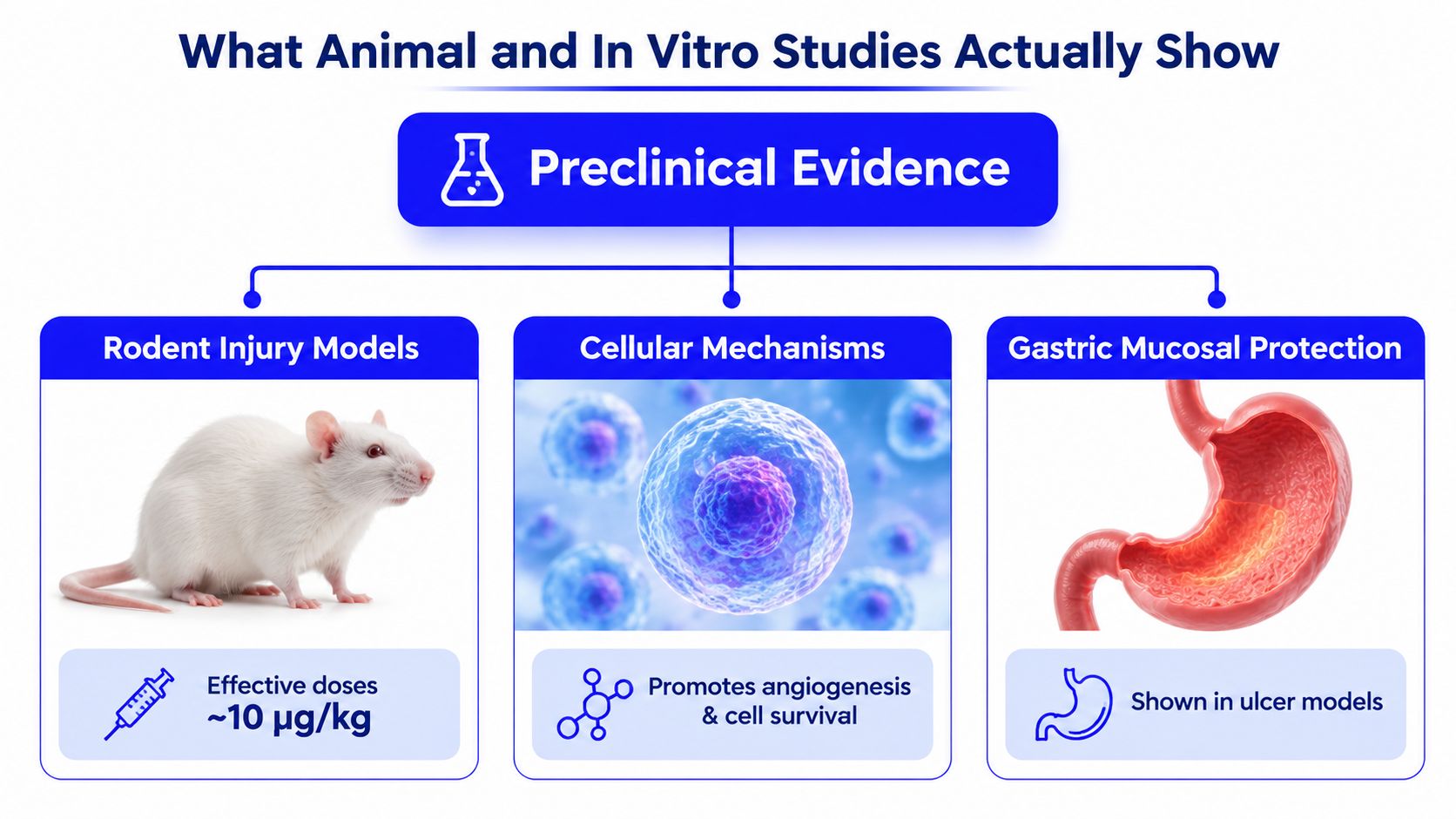
The preclinical literature is where oral BPC-157 gets most of its momentum. That doesn't make the human case stronger, but it does explain why researchers keep returning to it. Oral dosing has been tested in rodent models at very small doses, including an estimated 10 μg/kg in one research summary, with effects described as similar to injected dosing in some models (Rethink Peptides).
Animal studies are useful here because they let researchers control the route, the dose, and the model. That's why oral BPC-157 can be examined in gut injury, tendon repair, and tissue recovery settings without the confounding noise of human behavior. The strongest pattern in those studies is not “miracle recovery.” It's that oral administration can produce measurable biological effects in models where local tissue protection matters.
The dose detail matters, too. 10 μg/kg is a research context number, not a clinical suggestion. It tells you that oral bioactivity has been tested at very small exposures in animals, not that the same number should be copied into human use.
The in vitro gastric-stability findings are just as important as the rodent studies. BPC-157 remained intact in human gastric juice for more than 24 hours at about pH 2.0, and it resisted digestion by pepsin and trypsin (Rethink Peptides). That's highly unusual for a peptide and gives the oral route a real mechanistic basis.
What that does not give you is a human pharmacokinetic curve.
That distinction is where a lot of public discussion falls apart. A compound can look promising in animals and still fail to show measurable systemic levels in people. With oral BPC-157, that's exactly the tension the literature leaves us with.
The preclinical evidence is real. The translation to humans is not finished.
So, what do we have in humans? The record is still small and uneven. By early 2026, the published human evidence base was described as three pilot studies, one set of Phase I/II trial data published only as conference abstracts, and one cancelled Phase I trial. That is not a finished clinical story. It is an early translational footprint, useful for setting expectations but not for drawing strong treatment conclusions.
The clearest human oral study was NCT02637284, which enrolled 42 healthy volunteers and tested oral doses of 1, 3, 6, or 9 mg per day for up to two weeks (PMC). The study was reported as safe and well tolerated. That matters, because it shows oral BPC-157 was tested in people under defined conditions rather than only in animals or cell models.
The same study also found no quantifiable BPC-157 in plasma or urine. That is the part readers often miss. A peptide can be given by mouth, pass through a safety study, and still leave no measurable systemic exposure in the assay used. In lab terms, the bottle was opened and the compound was administered, but the downstream readout did not confirm that it showed up in circulation in a way that could be measured.
The cleanest reading is cautious. Oral BPC-157 has a short-term human safety signal in healthy volunteers, but the exposure question is still open. Independent reviews published in 2025–2026 repeat that BPC-157 is not approved by any regulatory agency for human use and that no peer-reviewed human pharmacokinetic profile exists for the oral route (PMC).
| Study | Design | Oral Dose | Key Finding |
|---|---|---|---|
| NCT02637284 | Phase 1, 42 healthy volunteers | 1, 3, 6, or 9 mg per day | Safe and well tolerated, but no quantifiable BPC-157 in plasma or urine (PMC) |
| Published human record by early 2026 | Review summary | Not specified | Three pilot studies, one Phase I/II abstract set, one cancelled Phase I trial |
The oral route is biologically plausible. It is not yet a benchmarked human system.
That sentence captures the human evidence picture well. Oral BPC-157 has moved from theory into formal testing, but it has not reached a validated clinical profile.
Oral BPC-157 dosing is easy to misread when research handling and clinical use get blended together. In a lab, a numerical dose helps define an experiment. In a customer-facing setting, that same number can be mistaken for a treatment instruction, even when the evidence does not support that leap.
Preclinical studies usually begin with mg/kg or μg/kg values, then adjust for species, route, and model. That gives the bench team a place to start, but it does not convert cleanly into a human oral regimen because BPC-157 oral bioavailability is still unknown in a benchmarked sense (MDPI). Allometric conversion can help with planning, though it remains a rough scaffold rather than a reliable oral dose for people.
The delivery problem is bigger than dose alone. A peer-reviewed development review notes that no characterized oral formulation paper has been published, and that the literature is still largely limited to patent disclosures and preclinical efficacy studies. That matters because the same nominal amount can behave differently if the vehicle, release profile, or protection from the gut environment changes.
A compound can be chemically stable and still have an oral delivery system that is too poorly defined for serious dose interpretation. In that setting, the formulation is part of the result, not just packaging around it.
A practical preclinical checklist looks like this:
Research rule: if the formulation is not characterized, the dose is only a placeholder for the experiment, not a claim about oral bioavailability.
The next mistake is to read a rodent number as if it were a human instruction. It is a starting point for experimental design, nothing more. The literature supports oral experimentation as a translational question, but it does not let us skip the question itself.
Most practical mistakes happen before a peptide ever reaches a model. With BPC-157, the first question is usually not whether it works. It is whether the sample stayed what it was supposed to be. That is why handling details matter so much in research settings.
BPC-157 is commonly supplied as lyophilized powder, and that format helps with storage and later reconstitution. Research teams typically reconstitute it with bacteriostatic water or another research-grade solvent, then keep stock and working solutions under cold conditions. Gentle handling matters because rough agitation can complicate stability interpretation.
The oral-formulation literature adds another layer. Because oral bioavailability is unknown and formulation papers are lacking, researchers have explored oral-protection approaches such as enteric coating, permeation enhancers, and solid-dispersion concepts in patents and preclinical work (MDPI). None of that validates a commercial oral protocol by itself. It shows where development effort has been concentrated, and it also shows how much of the current picture still depends on indirect evidence rather than a fully characterized oral product.
A compound can be chemically stable and still have an oral delivery system that is too poorly defined for serious dose interpretation. In that setting, the formulation is part of the result, not just packaging around it.
A practical preclinical checklist looks like this:
Research rule: if the formulation is not characterized, the dose is only a placeholder for the experiment, not a claim about oral bioavailability.
The next mistake is to read a rodent number as if it were a human instruction. It is a starting point for experimental design, nothing more. The literature supports oral experimentation as a translational question, but it does not let us skip the question itself.
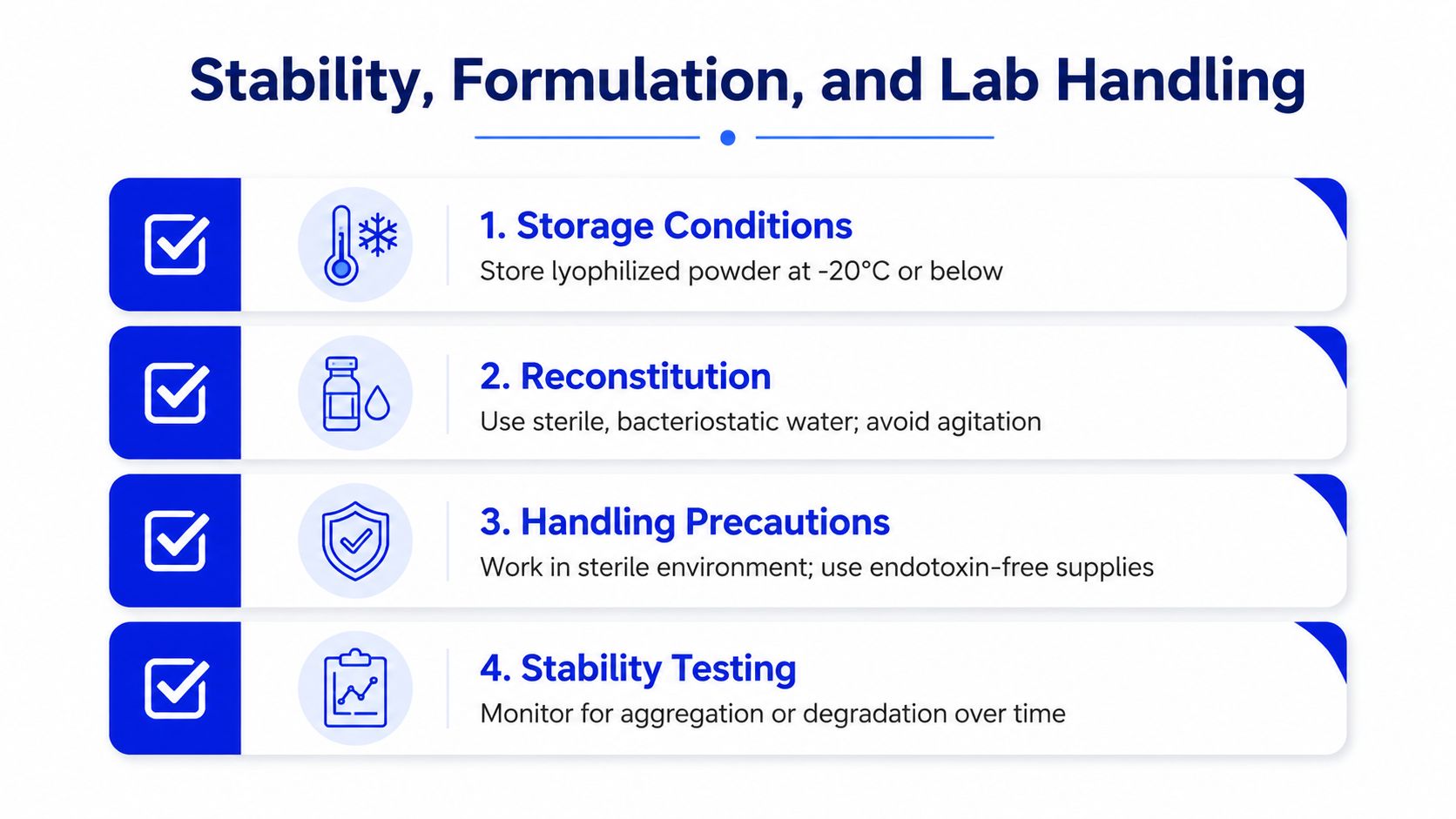
The point of handling discipline is reproducibility. If two labs get different results, you want to know whether the difference came from the formulation, not from the peptide itself. That is the core value of bench-side rigor.
A Certificate of Analysis only helps if you know what to look for. A lot of buyers stop at the purity line, but that's just one field in a much larger document. If the COA can't connect identity, purity, contamination control, and batch traceability, it doesn't fully support the claim being made.
A solid COA should show HPLC purity, mass spectrometry identity confirmation, endotoxin limits, microbial testing results, batch numbers, and the analytical method used. The batch number on the vial should match the batch number on the COA, because mismatch is an immediate documentation problem. Purity claims also need context. A stated number is only meaningful if you can see the method and the limit of detection that produced it.
Third-party verification matters more than self-issued paperwork. If you want a plain-English way to think about that, the logic is similar to the one explained in how supplement verification works from Tecton Ketones™, where the quality of the evidence matters as much as the label.
Peptide Warehouse USA is one example of a US research supplier that lists third-party documentation, COAs, and contamination reports for research-grade materials, which is the kind of paperwork researchers typically want before they compare lots or plan an experiment.
The broader lesson is straightforward. A COA is not a marketing sheet. It's a traceability document, and you should read it that way.
Oral BPC-157 sits inside a strict regulatory frame. Legitimate US research peptide suppliers use research-use-only language, and the usual FDA disclaimer still applies, which means the product information has not been evaluated and the material is not intended to diagnose, treat, cure, or prevent any disease. That distinction matters because it separates a laboratory reagent from a therapy claim.
The available human studies support short-term tolerability at the doses tested. The Phase 1 oral trial already discussed showed that pattern, but the lack of measurable plasma or urine levels leaves the safety picture incomplete. If systemic exposure cannot be measured clearly, long-term behavior is still a question mark.
That is why careful researchers keep the language narrow. BPC-157 is not approved by any regulatory agency for human use. The point is not to dismiss the compound. It is to keep the evidence and the application in the right lane.
The research-use-only label is not just paperwork. It signals that the material is meant for lab, analytical, or preclinical work, not human consumption. It also helps keep sourcing, storage, and shipping tied to documented laboratory use.
If you are building a compliant supply chain, shipping matters too. The guidance at ensure pharmaceutical shipping compliance from Ship Restrict is useful for understanding how regulated products are handled with documentation and route awareness.
The open questions are still the ones that matter. Can a characterized oral formulation produce measurable exposure in humans, which models are most appropriate for oral testing, and what documentation best predicts batch-to-batch reproducibility? Until those answers are tighter, oral BPC-157 remains a biologically plausible research peptide, not a settled human protocol.
If you are comparing research peptides for a study or cataloging documentation standards, Peptide Warehouse USA offers US-made research materials with batch testing and COAs that fit the kind of scrutiny this topic demands. Visit Peptide Warehouse USA to review current options and examine the documentation behind each lot.