No products in the cart.



Can a patch deliver BPC-157 effectively because it avoids an injection? That assumption confuses delivery convenience with clinical validation. BPC-157 patches are marketed as a transdermal research format, but the patch itself introduces a separate scientific question: whether enough intact peptide crosses the skin to produce a measurable systemic exposure.
This guide explains what BPC-157 patches are, how transdermal delivery works, what the human evidence does and doesn't establish, and how patches compare with injections and oral formats. It also covers COA review, storage, sourcing, and the regulatory distinction between increased attention and actual approval.
A BPC-157 patch is a transdermal delivery format. It contains a synthetic 15-amino-acid peptide fragment derived from a naturally occurring protein found in gastric juice, according to independent FDA-status summaries such as this overview of BPC-157's legal status. The peptide is held in a patch matrix designed to release material at the skin surface and, depending on the formulation, support movement across the outer skin barrier.
That definition matters because a patch is a delivery system, not a new molecule. A transdermal product, an injectable preparation, and an oral product may all contain BPC-157, but the route changes the formulation problem, the handling process, and the assumptions researchers can make about exposure.
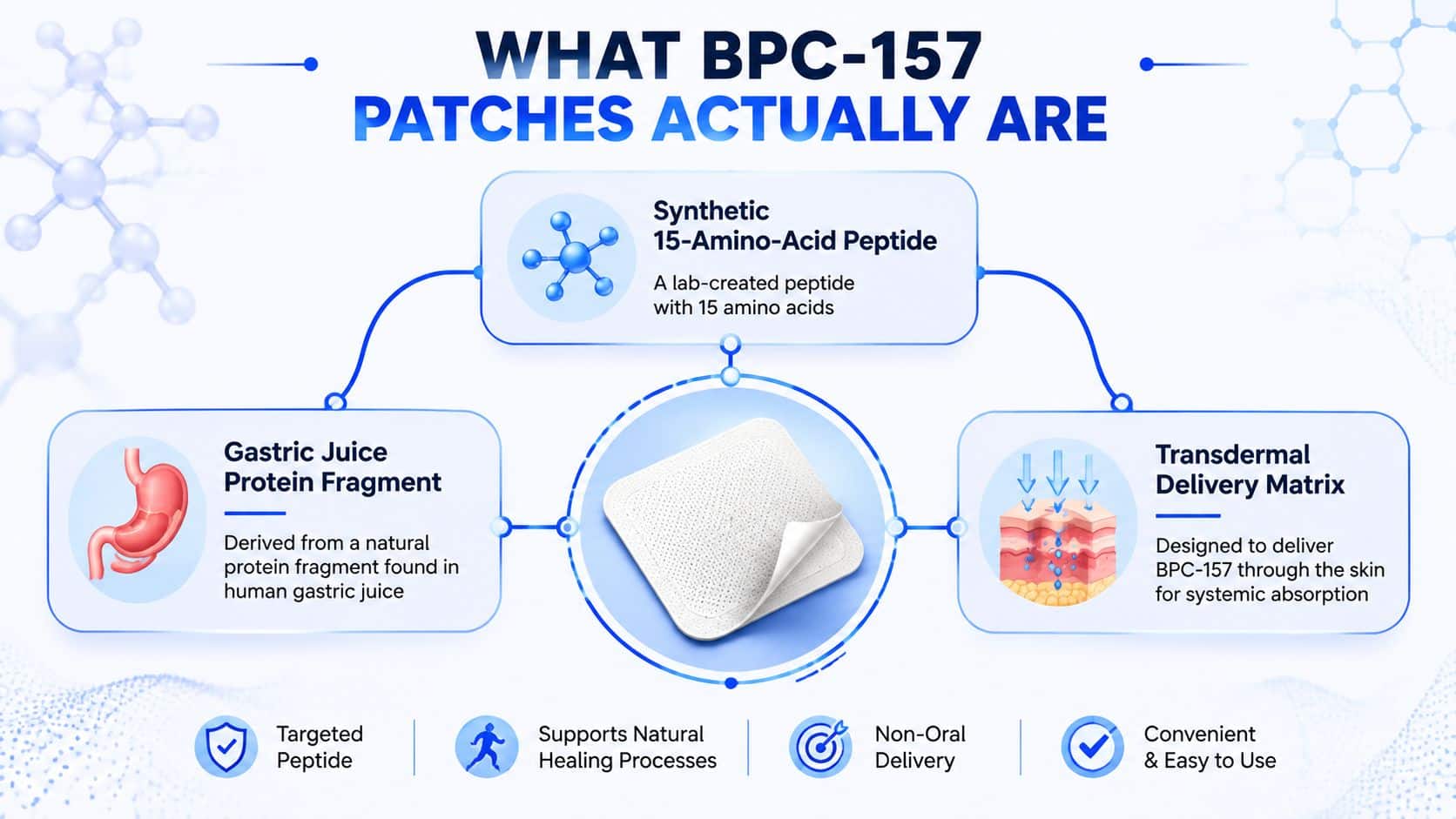
Peptides are structurally more fragile than many small-molecule compounds. Oral delivery can expose them to digestive conditions, while transdermal delivery asks them to remain intact in a patch and pass through a tightly organized skin barrier. A patch can therefore be attractive as a research workflow option, but its convenience doesn't prove that it delivers a biologically meaningful amount of peptide.
Researchers may evaluate patches for reasons such as handling simplicity, reduced preparation steps, or interest in sustained release. Those are practical considerations. They shouldn't be confused with evidence that patches have a verified clinical benefit or that they outperform another route.
A useful procurement distinction is:
The rest of the evaluation should follow that order. First ask whether the patch contains the stated peptide. Then ask whether the formulation releases it. Finally, ask whether human data connect that exposure to a validated outcome. Those are three different checkpoints, and the format alone satisfies none of them.
Most proposed BPC-157 mechanisms come from preclinical research, particularly animal models. Researchers have investigated relationships involving nitric oxide signaling, blood-vessel formation pathways, and inflammatory mediators. These observations can help generate hypotheses, but they don't establish a therapeutic effect in humans or show that a patch reproduces the exposure used in an animal experiment.
The delivery problem is easier to understand with a simple analogy. An injection places the material past the outer barrier, like handing a package directly to the recipient. A patch places the package outside a locked building and depends on the package remaining intact while finding a controlled route through the door.
The outermost skin layer is designed to limit penetration. A transdermal formulation must account for peptide size, charge, stability, release rate, and interaction with the skin. Formulators may also study permeation enhancers, adhesive behavior, moisture control, and the time-dependent release of the active ingredient.
Patch designs aren't interchangeable:
A buyer should ask which design is being used rather than treating every “transdermal patch” as equivalent. The label should identify the active ingredient, the amount loaded, the lot, storage conditions, and any available release or permeation data.
Practical rule: A proposed mechanism describes what BPC-157 might do after reaching a target site. It doesn't prove that a particular patch gets intact peptide there.
The central scientific question is therefore not just whether BPC-157 has interesting biological activity in preclinical models. It's whether the finished patch can preserve the peptide and deliver a reproducible exposure. Without that information, a patch remains a formulation hypothesis rather than a validated route.
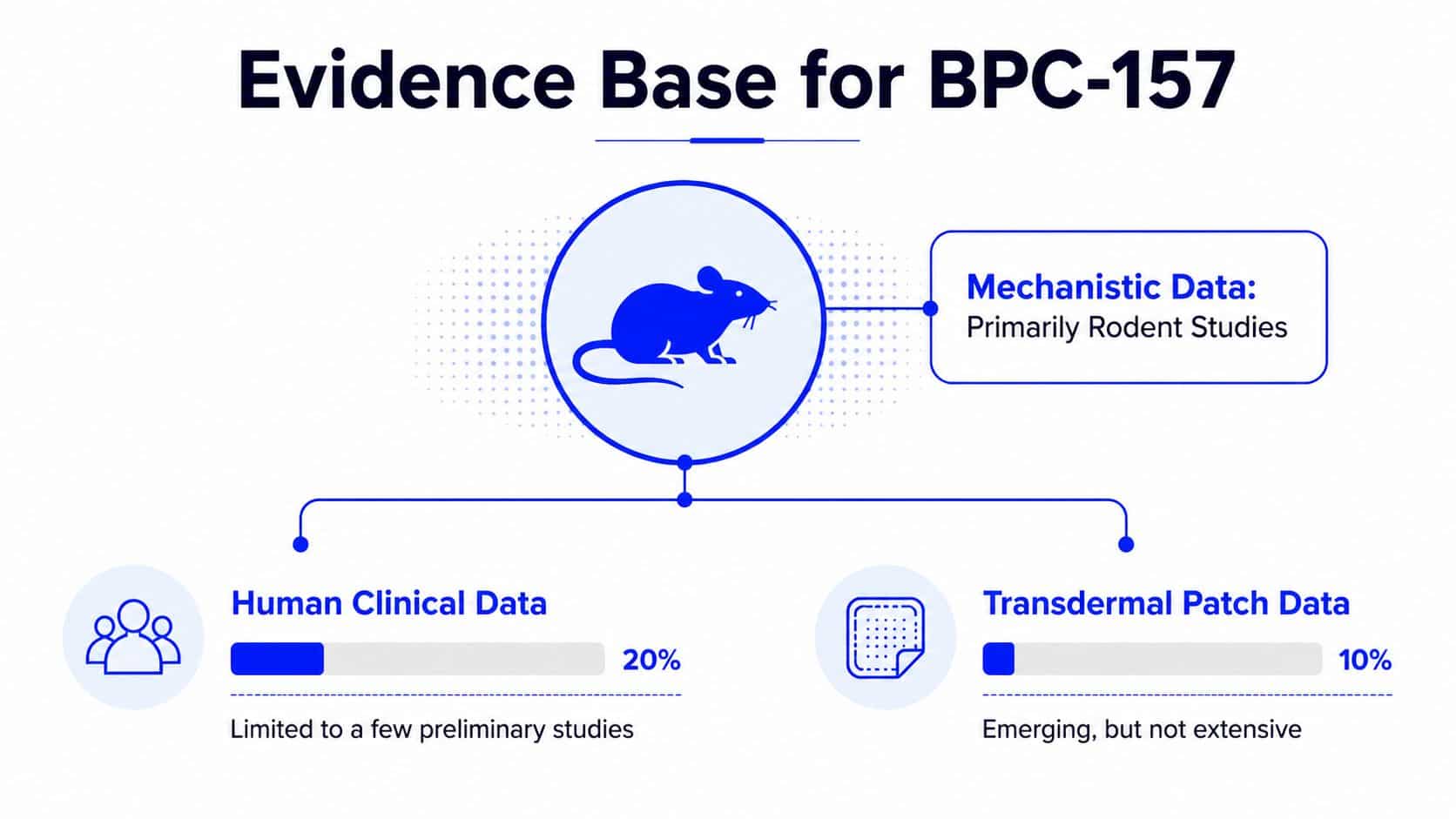
The evidence is uneven. Independent reviews describe the broader BPC-157 literature as dominated by rodent research, while human evidence remains very limited. A review of the human evidence base found only three published human pilot studies, involving fewer than 30 subjects in total, and none were randomized controlled trials. The same review concluded that the available human data don't support evidence-based clinical recommendations for any indication.
That limitation becomes more important when the question shifts from BPC-157 generally to BPC-157 patches specifically. The same review identified no peer-reviewed human trials of transdermal BPC-157 patches. A separate 2026 pharmaceutical review noted that the only registered human clinical trial was a Phase I study from 2016 that was terminated without published results.
Pharmacokinetics measures what happens to a compound in the body, including absorption, distribution, and clearance. For a patch, researchers need to know whether the peptide remains intact, how quickly it enters circulation, how much reaches circulation, and how consistently different patches perform.
No verified human patch pharmacokinetic profile means there's no established:
The absence of this data doesn't prove that a patch cannot work. It means a responsible researcher can't treat marketing language as a substitute for route-specific validation.
For readers investigating joint-related research topics, LifeWorks Integrative Health joint care provides broader clinical context, but it shouldn't be read as evidence that BPC-157 patches have been clinically validated.
The embedded discussion below may help readers understand how peptide claims are often framed, but any educational video should be evaluated alongside peer-reviewed evidence and product-specific documentation.
A rodent result can support further research. It can't establish that a human transdermal patch delivers the same exposure or produces the same result.
Route selection changes the experiment's logistics and its exposure assumptions. It doesn't create new clinical evidence. In published BPC-157 research, injected administration is generally the more familiar reference format, while oral and transdermal products raise additional questions about stability and absorption.
| Route | Evidence Strength | Stability Concern | Dose Control | Handling |
|---|---|---|---|---|
| Injection | More represented in preclinical literature | Peptide preparation and storage still require control | Direct administration supports clearer experimental dosing | Requires sterile technique and trained handling |
| Oral format | Limited basis for assuming intact systemic exposure | Digestive degradation and absorption uncertainty | Delivered amount may not equal absorbed amount | Convenient, but formulation performance needs verification |
| Transdermal patch | No identified peer-reviewed human patch trials | Peptide stability in the matrix and skin permeation | Labeled loading isn't the same as verified systemic delivery | Simple application workflow, but release data are important |
An injection may be appropriate when the research question requires a more direct and controlled administration route. It still requires attention to concentration, preparation, sterility, and the specific protocol.
An oral capsule or tablet is easier to handle, but a lab shouldn't infer systemic exposure from the amount printed on the label. The digestive environment and intestinal absorption create variables that must be measured rather than assumed.
A patch can reduce preparation steps and may fit a study examining sustained contact with the skin or formulation release. However, researchers need patch-specific evidence, including peptide loading, release behavior, and, ideally, permeation or pharmacokinetic measurements.
Route convenience can improve workflow. It can't compensate for missing exposure data.
For procurement, the right format depends on the question. If the study compares formulations, the team may need to measure release and stability directly. If the study evaluates a biological endpoint, the route should be documented as a major experimental variable rather than treated as a neutral packaging choice.
A patch can look professionally packaged and still leave critical questions unanswered. The first document to request is a lot-specific Certificate of Analysis, not a general product sheet or a website purity statement.
A useful COA should identify the exact product and lot, the testing laboratory, the test method, the result, and the date of analysis. Researchers should check whether the document describes the finished patch or only the incoming peptide powder. Those are different materials, and the finished matrix can introduce its own quality variables.
Look for documentation covering:
Patch-specific QA adds another layer. Ask whether the supplier can provide peptide loading confirmation, matrix integrity information, and in vitro release data. The peptide may meet an incoming-material purity specification, yet the finished patch still needs to retain and release the active ingredient in a controlled way.
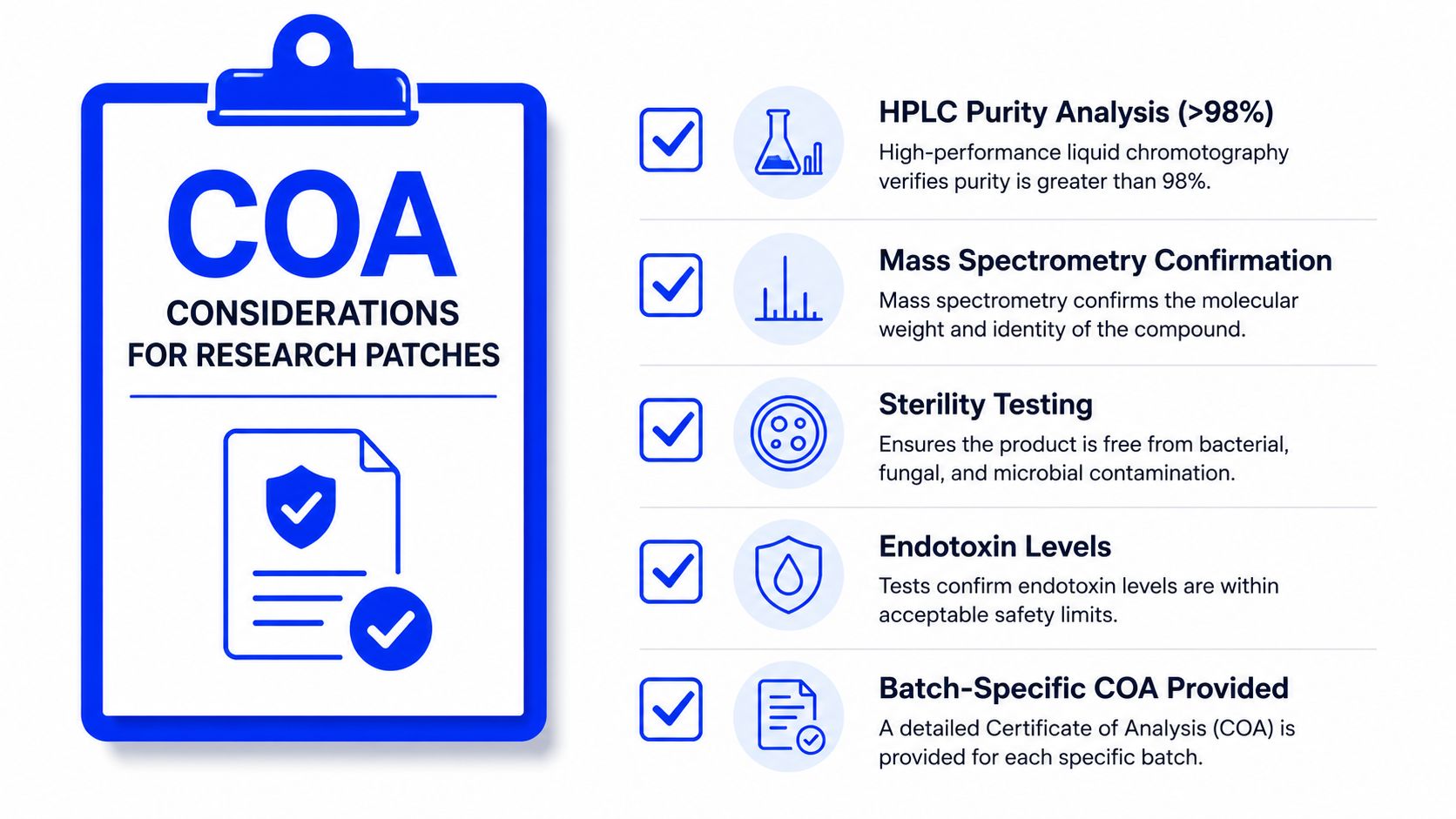
Before placing a research order, request:
A US-manufactured supply chain with batch testing protocols can simplify traceability, but the country of manufacture doesn't replace reviewing the actual documents. Reproducibility depends on what the lab can verify for the lot it receives.
BPC-157 has never been approved by the FDA for any therapeutic indication, as summarized in independent FDA-status research. That status applies to BPC-157 as a compound and doesn't change because a seller uses a patch, spray, capsule, or injectable format.
In late 2023, the FDA placed BPC-157 on its Category 2 list for bulk drug substances used in compounding, according to a review of the compound's regulatory history. Category 2 signaled insufficient safety data for compounded use in the United States. It wasn't an approval, and it didn't establish that a finished patch could be prescribed or marketed as an authorized medicine.
On July 23, 2026, an FDA advisory committee voted 8 to 6, with one abstention, to recommend BPC-157 for possible inclusion on the 503A Bulk Drug Substances List, as reported by Reuters' coverage of the advisory vote. The vote was advisory and non-binding. It still required FDA sign-off and didn't itself make BPC-157 legal to prescribe, compound, or purchase as a finished medicine in the United States.
WADA added BPC-157 to its Prohibited List in January 2022 under the non-approved substances category, according to the regulatory review linked above. That matters for athletes and sports organizations, even though it isn't evidence of efficacy or safety.
The practical distinction is straightforward:
BPC-157 patches remain outside the formal FDA drug-approval pathway. Researchers should read regulatory developments as status information, not as proof that the patch format has been clinically tested.
Research patches should generally remain in a cool, dry environment away from direct light, with the original packaging sealed until the experimental run. Humidity, heat, and repeated temperature swings can affect both the peptide and the adhesive or matrix, so storage conditions should follow the supplier's label and documentation.
Unlike lyophilized powder, a patch typically arrives in a ready-to-use format within the laboratory workflow. That can reduce reconstitution steps, but it also means the lab can't rely on its own preparation stage to confirm what entered the formulation. The COA and finished-product documentation carry more weight.
When a shipment arrives:
A lab notebook should connect every result to the exact lot used. That record supports troubleshooting if release behavior, adhesive performance, or experimental outcomes vary between batches.
The answer depends on the product, seller, intended use, and applicable federal and state requirements. BPC-157 isn't FDA approved for human use, and the July 2026 advisory committee vote was non-binding. It didn't itself authorize finished BPC-157 medicines or make every patch product legal to prescribe, compound, or buy.
No. The FDA has never approved BPC-157 for any therapeutic indication. A research-use label is not the same as approval, and a transdermal format doesn't create a separate approval status.
No peer-reviewed human trials of transdermal BPC-157 patches were identified in the cited review. The broader human record consists of three small pilot studies with fewer than 30 total subjects, none of which were randomized controlled trials, and that evidence doesn't establish patch performance.
The published literature doesn't justify calling patches better. Injections are more represented in preclinical work, while patches introduce unresolved questions about skin permeation, release, and systemic exposure. Route choice should follow the research question, not a general assumption that convenience equals effectiveness.
Request a lot-specific COA with identity, chromatographic purity, and traceability information. For a finished patch, also ask for peptide loading confirmation, matrix or adhesive information, storage conditions, and in vitro release data where available. Microbial, endotoxin, and residual-solvent reports can provide additional quality context.
Athletes should treat BPC-157 as prohibited under WADA's Prohibited List, where it appears under non-approved substances. Competition rules and personal circumstances can vary, so athletes should consult the relevant anti-doping organization rather than relying on a product label.
Peptide Warehouse USA offers research-use peptide products and related formats supported by batch documentation, including COAs and microbial and endotoxin reports, but its materials are not approved medicines and aren't intended for human consumption. Visit Peptide Warehouse USA to review available research options and request the documentation needed for responsible sourcing.