No products in the cart.



The most popular advice about BPC 157 powder usually starts in the wrong place. Buyers often ask how to use it, how to stack it, or which form is strongest before asking whether the material is an approved medicine, a compounded product, or a research reagent. Those categories aren't interchangeable, and confusing them can compromise both regulatory compliance and experimental validity.
BPC-157 is a scientifically interesting peptide with a long preclinical history, a defined molecular structure, and a limited human evidence base. It also sits in a complicated regulatory position in 2026. This guide focuses on what laboratory buyers and research technicians need to evaluate: identity, stability, analytical documentation, storage, reconstitution principles, sourcing, and the boundary between research supply and human use.
BPC-157 powder is a synthetic research peptide based on a 15-amino-acid fragment associated with human gastric juice. Its name expands to Body Protection Compound-157. In a laboratory, it belongs in the reagent category: a defined material for controlled in vitro and preclinical work, separate from an approved pharmaceutical or a product prepared for clinical use.
The distinction is practical, not merely semantic. Online listings may place research peptides beside products promoted for recovery, injury support, or other health outcomes. A familiar biological target and promising animal findings do not turn a research reagent into a medicine. BPC-157 is not FDA-approved for any human indication. FDA materials also describe limited safety information for proposed administration routes and uncertainty about potential harm in humans. Procurement teams should review the FDA discussion of bulk drug substances and compounding risks before evaluating a supplier or use case.
Within an appropriately approved program, BPC-157 powder may support:
These applications describe what the material can help a laboratory study. They do not establish dietary-supplement status, wellness benefits, approved treatment, or suitability for self-administration. Research-grade powder should be handled like any other investigational compound, with a documented chain of custody, supplier instructions, lot records, and a use plan that matches institutional approvals.
The research interest centers on wound-healing signaling, angiogenesis-related pathways, gastrointestinal biology, and musculoskeletal repair models. Those subjects generate experimental questions, not proof of clinical benefit. The label “research use only” is a boundary marker, not a complete compliance plan.
Practical rule: Compliance depends on the study design, facility, personnel, records, and institutional approvals, not on the wording printed on the vial.
BPC-157 powder is a defined peptide sequence, not a generic “healing” ingredient. It is a 15-amino-acid gastric pentadecapeptide with the sequence GEPPPGKPADDAGLV, also written as Gly-Glu-Pro-Pro-Pro-Gly-Lys-Pro-Ala-Asp-Asp-Ala-Gly-Leu-Val. Its molecular weight is approximately 1419 Da. Sequence identity and related physicochemical properties are described in the PubMed-indexed characterization of BPC-157.
The molecule is more like a small, precisely cut key than a complete protein. Its biological source or research context does not define the powder by itself. The residue order, conformation, and chemical state determine what a laboratory can evaluate. The proline-rich region matters because proline can limit peptide-chain flexibility and support a relatively stable conformation.
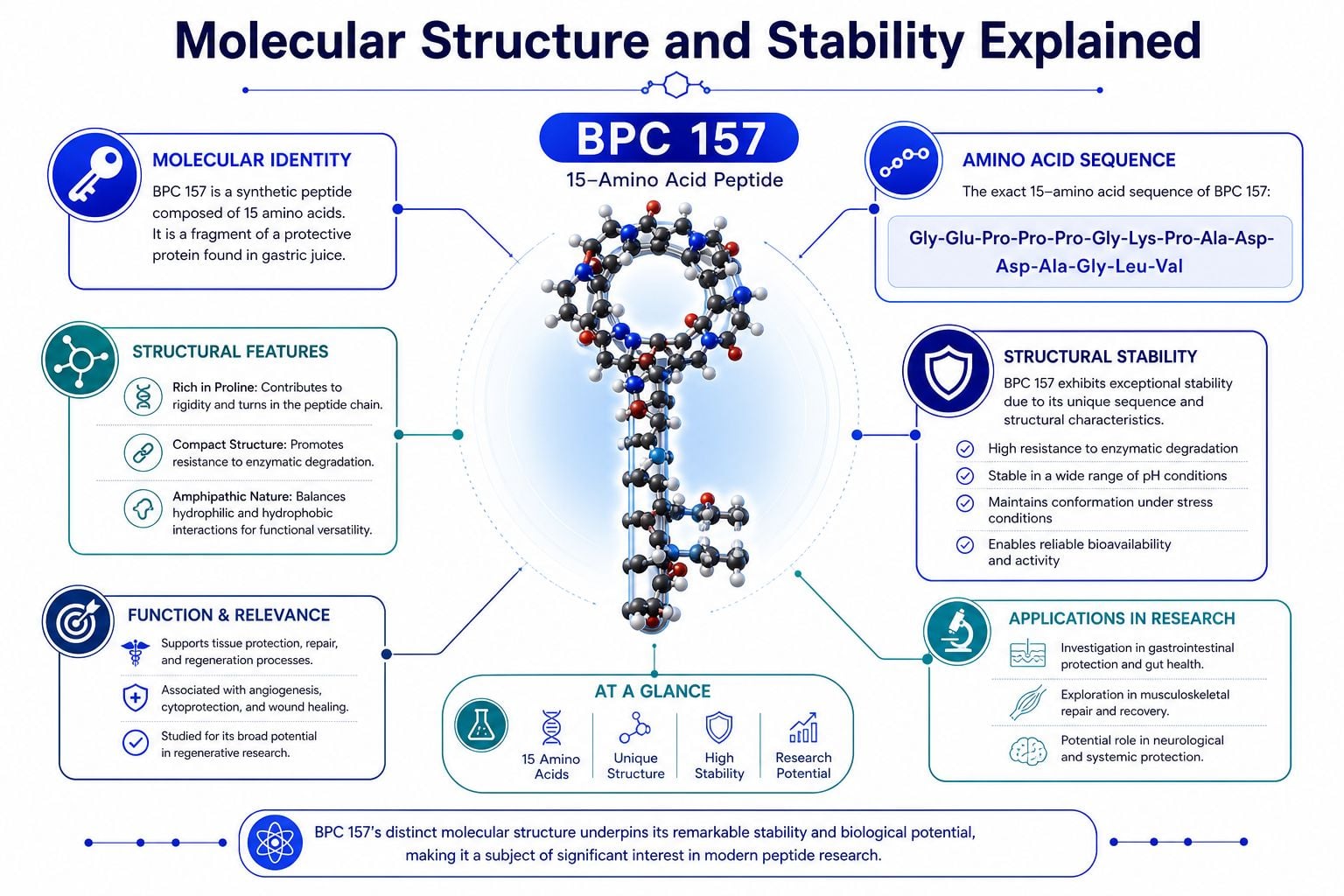
The cited characterization reports stability in human gastric juice and free solubility in water at pH 7.0 and in saline. Those findings describe tested properties of the characterized material. They do not guarantee that every research-grade lot, compounded preparation, or clinical product will behave identically during storage or assay preparation.
BPC-157 has no disulfide bonds, so handling does not center on preserving disulfide bridges. Moisture, temperature, pH, contamination, and mechanical stress still require control. A vial can look normal while its identity, purity, or concentration has changed.
Lyophilization removes water and leaves a dry powder for sealed storage and later reconstitution. Appearance cannot establish quality. The laboratory record should connect each vial to a batch-specific COA, mass confirmation, purity method, and storage history.
Practical implications include:
BPC-157 experiments are best framed around pro-repair signaling, rather than a broad claim about recovery. Preclinical studies have examined associations with VEGFR2, the Akt-eNOS axis, nitric oxide production, ERK1/2, and FAK-paxillin activity across endothelial, fibroblast, and tendon-cell systems. A peer-reviewed review available through PMC summarizes these pathways and their use in tissue-repair models.
Nitric oxide offers a practical starting point. A laboratory can expose a defined BPC-157 preparation to a wound-healing assay, then measure markers related to NO production, endothelial behavior, or cell migration. VEGFR2, Akt, and eNOS readouts can be assessed in the same experimental framework to determine whether the response fits an angiogenesis-associated mechanism.
ERK1/2 and FAK-paxillin measurements address a different part of the mechanism. They relate to adhesion, cytoskeletal organization, and migration, making them relevant to endothelial or fibroblast movement assays. A pathway signal remains an assay result. It does not establish that the same response will occur in human tissue.
| Research Area | Key Pathways Studied | Common Experimental Models |
|---|---|---|
| Endothelial migration | VEGFR2, Akt-eNOS, nitric oxide | Cell migration and wound-closure assays |
| Wound-healing signaling | VEGFR2, ERK1/2, FAK-paxillin | Endothelial and fibroblast systems |
| Gastrointestinal biology | Cytoprotective and nitric oxide-related signaling | Gastric and intestinal preclinical models |
| Musculoskeletal research | FAK-paxillin, ERK1/2, inflammatory signaling | Tendon-cell and tendon-to-bone models |
| Vascular response | Nitric oxide and angiogenesis-associated markers | Controlled vascular and tissue-injury models |
Early work focused on gastrointestinal questions. Later studies explored tendon, muscle, vascular, and nervous-system models. This range supports hypothesis generation, while also making model boundaries important. A finding in one tissue or species should not be treated as a universal mechanism.
A well-designed experiment specifies the cell type or animal model, exposure conditions, controls, endpoints, and analytical method before results are interpreted. Material identity and preparation records also matter, because research-grade powder, a compounded preparation, and a clinical product are not interchangeable experimental inputs.
The evidence remains preclinical. It does not establish human efficacy, dosing, or safety. Research staff should therefore record the model, lot, formulation, and assay conditions alongside every result, so a biological observation is not confused with a product or clinical claim.
A polished PDF and a high purity figure do not, by themselves, identify research material. A usable Certificate of Analysis (COA) must connect the product name, lot number, test date, analytical method, result, and laboratory identity to the batch in your hands. This traceability is the practical difference between a research-grade powder record and documentation for a compounded or clinical product, which should not be treated as the same experimental input.
Reversed-phase HPLC with UV detection is commonly used to assess BPC-157 purity. The reported percentage usually compares the area of the principal peptide peak with the total detected chromatographic peak area. Independent documentation reports 99.55% and 99.7% area purity for research batches, as shown in this archived BPC-157 COA.
Area purity is not the same as net peptide content by total mass. Gross vial weight may include salts, counterions, residual water, excipients, or other formulation components. Check whether the stated amount refers to net peptide or total material before calculating assay concentrations.
Mass spectrometry provides a separate identity check. Public assay documentation places BPC-157's mass around 1419.5 Da and describes HPLC or HPLC-MS confirmation. The BPC-157 HPLC-MS guidance from Condor Research also shows why review should extend beyond the headline purity value, including endotoxin information.
| COA Field | Acceptable Standard | Red Flag Indicator |
|---|---|---|
| Batch identification | Lot-specific product and batch number | Generic document with no matching lot |
| HPLC result | Method, chromatogram, retention data, and result | Purity claim without raw or supporting data |
| Mass confirmation | Stated identity consistent with approximately 1419.5 Da | No identity test or unexplained mass |
| Net content | Clear distinction between peptide content and gross fill weight | Vial amount presented without composition detail |
| Endotoxin data | A stated limit appropriate to the intended research system | No endotoxin information for sensitive cell work |
| Testing date | Date tied to the released batch | Undated or recycled template |
| Laboratory identity | Named testing facility or traceable analytical source | Unverifiable letterhead or anonymous report |
One public research document specifies endotoxin limits below 5 EU/mg. Acceptance criteria still depend on the assay and institution. A result suitable for one research system may not meet another system's requirements, so set the limit before receiving and approving the lot.
Storage and reconstitution directly affect experimental consistency. A verified research-grade powder can still yield variable results if moisture enters the vial, temperature fluctuates, or solvent and mixing conditions change between batches. These controls apply to laboratory material and should not be confused with instructions for compounded or clinical products.
BPC 157 powder is generally supplied in lyophilized form. Keep the sealed vial protected from moisture and light under the supplier's validated conditions. Let a cold vial reach a suitable handling temperature while it remains sealed. This reduces condensation on the powder when the container is opened.
Inspect the vial. Match the product name, lot number, seal, and powder appearance to the receiving record. Quarantine any container with a damaged closure or unexplained contamination.
Select the solvent. Water or saline are described as compatible in the cited characterization. Choose the final solvent according to the assay design, sterility requirements, pH, and institutional SOP.
Add solvent slowly. Direct liquid down the vial wall instead of striking the lyophilized cake with a narrow stream. Gentle swirling usually disperses the material with less foaming than aggressive vortexing.
Record the preparation. Document the lot, solvent, volume, concentration, date, operator, and observations. Calculate concentration from documented net peptide content, not from gross fill weight, when the study depends on concentration.
Aliquot when appropriate. Single-use aliquots reduce repeated vial access and freeze-thaw exposure. Label each aliquot with concentration, date, lot, and storage condition.
Inspect before use. Unexpected cloudiness, visible particles, or altered appearance requires quarantine and review. Visual inspection cannot confirm peptide integrity, but it can reveal an obvious preparation problem.
Follow the validated laboratory method for assay reconstitution. Online dosing protocols do not substitute for an approved SOP, and research-use-only material does not become a clinical product through reconstitution.
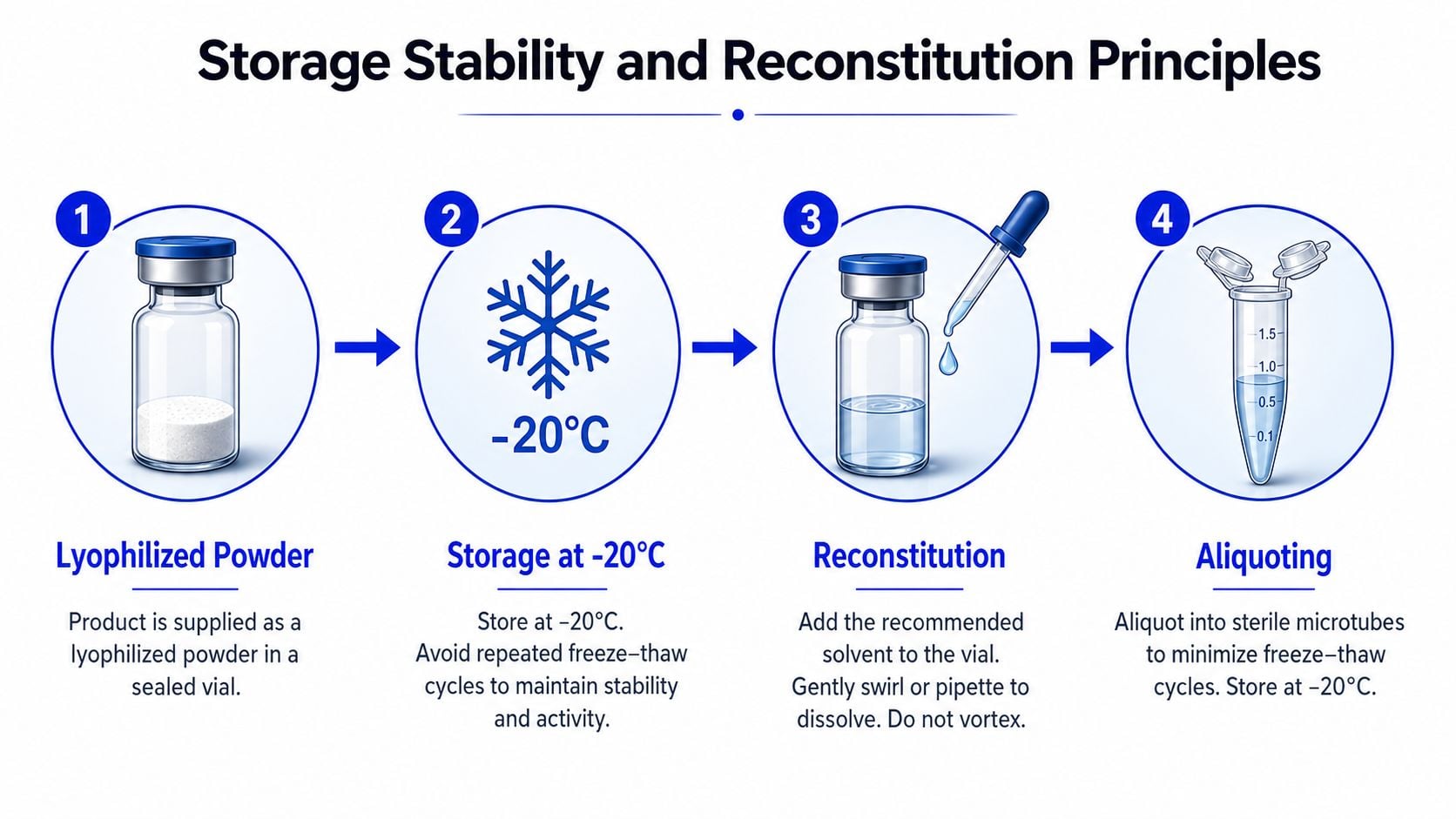
A visual demonstration can clarify the sequence for technicians, but supplier documentation and the approved SOP govern the actual procedure.
BPC-157 remains not FDA-approved for human use. U.S. anti-doping and public-health guidance describes it as a prohibited peptide and an unapproved drug, with reliable human safety and effectiveness data remaining limited. That distinction matters at the bench: a powder sold for research is not equivalent to an approved peptide medicine merely because both are discussed online.
The FDA has identified BPC-157 among bulk drug substances that may present significant safety risks for compounding. Available regulatory material describes limited safety information for proposed routes and insufficient evidence to determine whether the substance could harm humans. Regulatory reporting also places BPC-157 on the agency's Category 2 list in 2026, which prevents U.S. compounding pharmacies from legally preparing it under that pathway. FDA regulatory material should take priority over vendor marketing.
A research-use-only product is a chemical supplied for laboratory, analytical, or preclinical work. A compounded drug is prepared under a different regulatory framework for a patient or clinical purpose. An approved medicine has completed the authorization process for labeled human indications. These categories carry different documentation, quality controls, and permitted uses, so one cannot be substituted for another.
Supplier language often exposes that boundary. Dosing schedules, injury-recovery promises, or instructions for self-injection indicate communication aimed beyond laboratory research. A responsible listing identifies the material, supplies batch documentation, and states that the product is not for human consumption.
A registered human trial does not change the current approval status. ClinicalTrials.gov lists a randomized, double-blind, placebo-controlled Phase 2 trial for an acute grade II hamstring strain, with a study start date of February 2, 2026, a target enrollment of 120 participants, and estimated primary completion in February 2027. These details show formal investigation, not an approved treatment pathway.
Institutions should maintain:
A procurement decision should function like a qualification review, not a comparison of vial photographs. The central question is whether the supplier can document what was delivered, how the material was tested, and which uses the supplier permits. Research-grade powder should be evaluated as an analytical material, not assumed to be equivalent to a compounded or clinical product.
Identity, purity, and handling records answer different questions. A strong chromatographic result cannot replace mass confirmation, endotoxin information, or a documented chain of custody. Review the archived COA and supporting raw data as one package, much like matching a sample label to its instrument record before accepting a result.
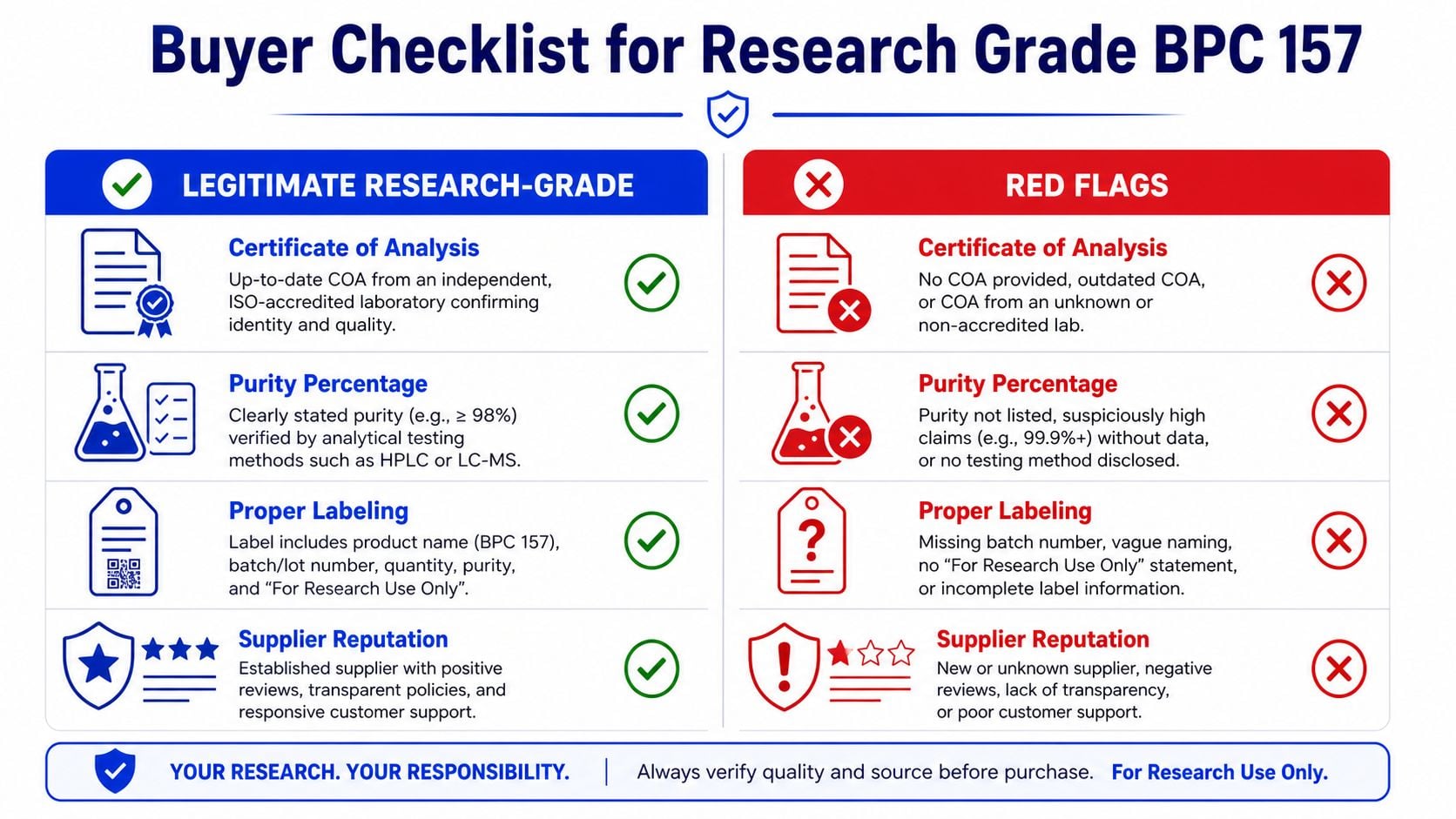
Price is only one screening variable. Suspiciously low pricing, unlabeled additives, missing raw analytical data, and therapeutic claims each require a documented procurement response. If a supplier cannot answer basic quality questions before payment, receiving staff should pause the order rather than try to resolve the gap after delivery.
Reliable BPC-157 research begins before the vial enters the freezer. Research-grade powder, compounded material, and clinical products may share a name while carrying different documentation and permitted uses. The sequence, analytical record, storage plan, and regulatory classification should agree. Unresolved gaps require review, not assumptions or online anecdotes.
A practical procurement SOP should define:
These controls separate a traceable research reagent from a product marketed for use in people. A vial photograph or a high purity value cannot establish identity, sterility, or appropriate regulatory status.
The same discipline applies to research peptides beyond BPC-157. Reproducibility depends on knowing what entered the experiment, how technicians handled it, and whether conclusions remain within the available evidence.
Peptide Warehouse USA lists a U.S.-made, research-use-only BPC-157 lyophilized powder with batch documentation, including COAs and microbial or endotoxin reports. Review its documentation and labeling, then visit Peptide Warehouse USA to assess whether the available records fit your institution's procurement requirements.