No products in the cart.



You've got a vial of lyophilized BPC-157 in one hand, bacteriostatic water nearby, and a syringe marked in units. The label gives you milligrams, your target is written in micrograms, and the syringe doesn't show either. That's exactly where a BPC-157 reconstitution calculator can help, but the calculator is more useful when you understand the arithmetic behind its answer.
This guide breaks the process into its four inputs, vial strength, water volume, target dose, and syringe type. You'll see how concentration is calculated, how a target amount becomes a draw volume, and how that volume converts into U-100 syringe units. The examples are for laboratory and research handling only, not medical dosing or human use.
A peptide vial usually starts as a dry, lyophilized powder. The label may identify the total amount in milligrams, while research calculations often use micrograms. Once water is added, the result becomes a liquid concentration expressed as milligrams per milliliter, but the syringe may display only units.
That creates three different measurement languages in one small workflow:
The calculator exists to connect those languages. It isn't performing advanced pharmacometric modeling. It applies concentration math, divides the desired amount by that concentration, and converts the resulting milliliters into syringe markings when the syringe is U-100. Published calculator examples commonly reduce the process to vial strength, water volume, target dose, and syringe units, with support for 5 mg, 10 mg, and 30 mg vials.Peppal's peptide calculator tools
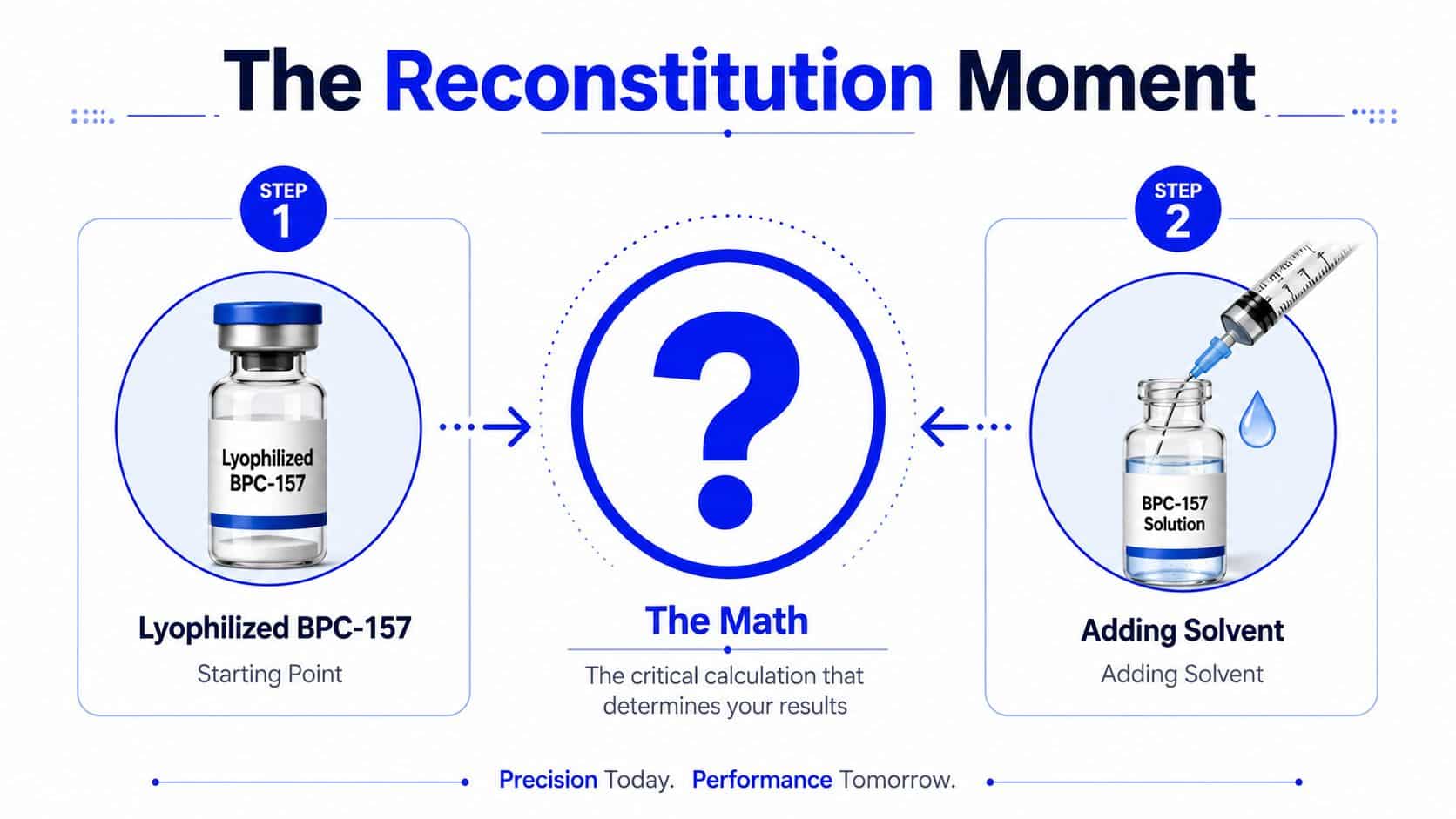
First, determine how much peptide is present in each milliliter after mixing. Next, determine how many milliliters contain the target amount. Finally, convert milliliters into syringe units if the syringe uses the U-100 scale.
Practical rule: A calculator result is only as reliable as the inputs. Confirm the vial amount, the actual water volume, and the syringe scale before relying on the displayed units.
The same math applies when the setup changes. A 5 mg vial mixed with 1 mL won't have the same concentration as a 5 mg vial mixed with 2 mL. For broader context on how BPC-157 is discussed alongside other research peptides, see Novagenesis Biopharma on BPC 157, while keeping the research-use boundary in mind.
A label may list the peptide in milligrams while the target amount appears in micrograms. One milligram equals 1,000 micrograms, so a 5 mg vial contains 5,000 mcg before water is added. PeptideDeck's calculator guidance uses this same unit logic.
Convert the units before dividing. If the vial amount stays in milligrams but the target stays in micrograms, the calculation misses a factor of 1,000. Treat the units like matching rulers: the numbers can be correct, but the result is meaningless if the rulers differ.
Milliliters, abbreviated mL, describe liquid volume, including the amount of bacteriostatic water added to the vial. Cubic centimeters, written as cc, measure the same volume for this calculation. One cc equals 1 mL.
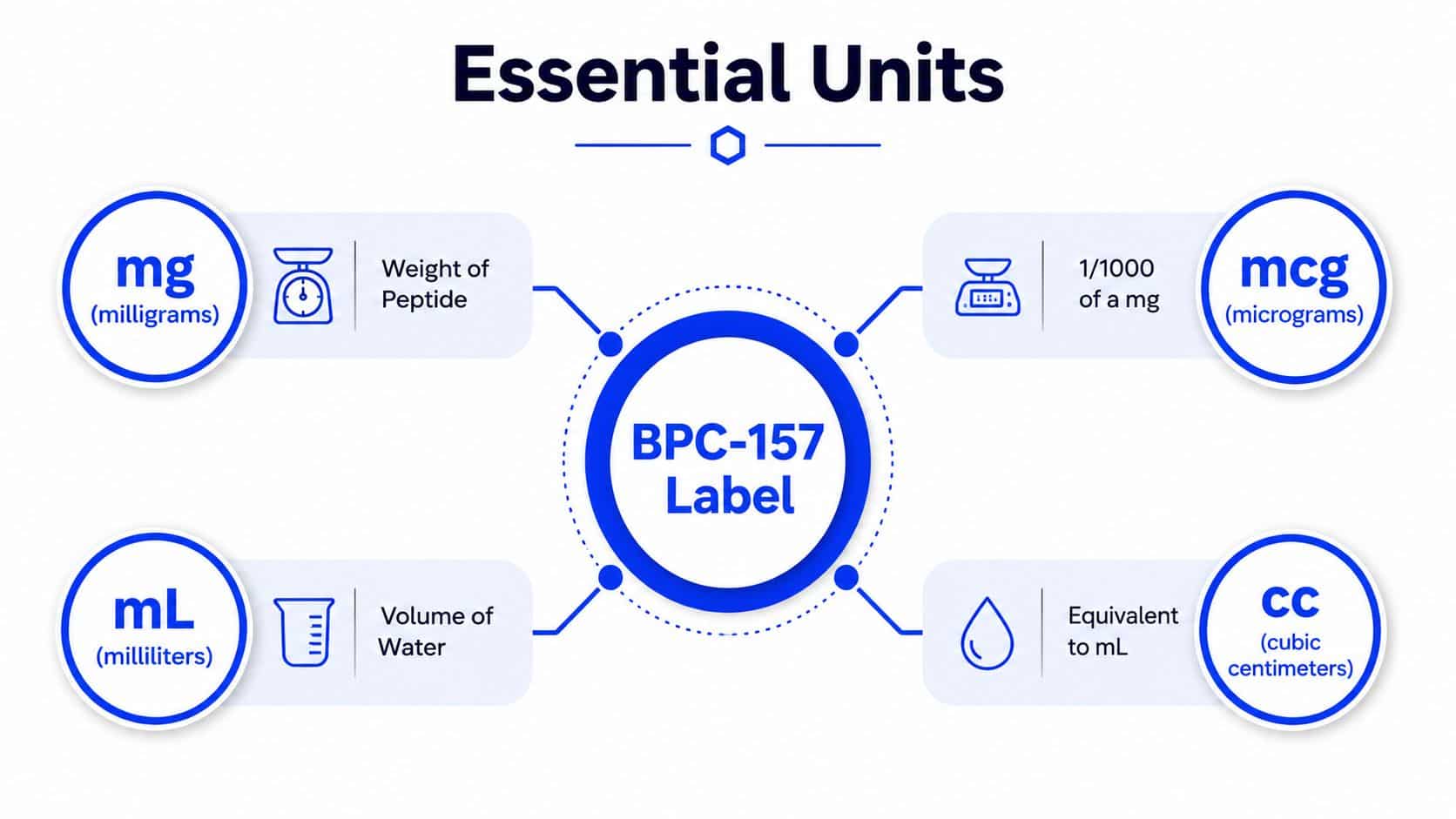
Adding water does not change the vial's total peptide amount. It changes the concentration, meaning how much peptide is contained in each milliliter.
A 5 mg vial mixed with 1 mL is more concentrated than the same vial mixed with 2 mL. Both contain the same total mass, but the second setup spreads it through twice the liquid volume. Each milliliter therefore contains less peptide. This is why the calculator must include the actual water volume, not a default assumption.
Syringe markings add another unit conversion. A U-100 insulin syringe assigns 100 units to 1 mL:
The syringe scale belongs in the final check. A different syringe type may use a different relationship, so verify its label before treating a units result as usable. Record the vial amount, water volume, target unit, and syringe scale together. That small habit makes the calculator's answer possible to audit and adapt to a non-standard setup.
A calculator should show its reasoning, not only display a final number. Every BPC-157 reconstitution calculation starts with two formulas that connect the vial, added water, target dose, and syringe scale.
Concentration equals total peptide divided by water added.
Written out:
Concentration = vial amount ÷ water volume
For a vial amount in milligrams and water volume in milliliters, the result is mg/mL. It describes how much peptide is contained in each milliliter of solution. The same relationship is explained in PeptideWiz's BPC-157 calculator explanation.
Draw volume equals target dose divided by concentration.
Written out:
Draw volume = desired dose ÷ concentration
Keep the units consistent before dividing. If concentration is in mg/mL, convert the target dose to milligrams. Or express concentration in mcg/mL and keep the target in micrograms. Mixing mg and mcg creates a thousandfold conversion error.
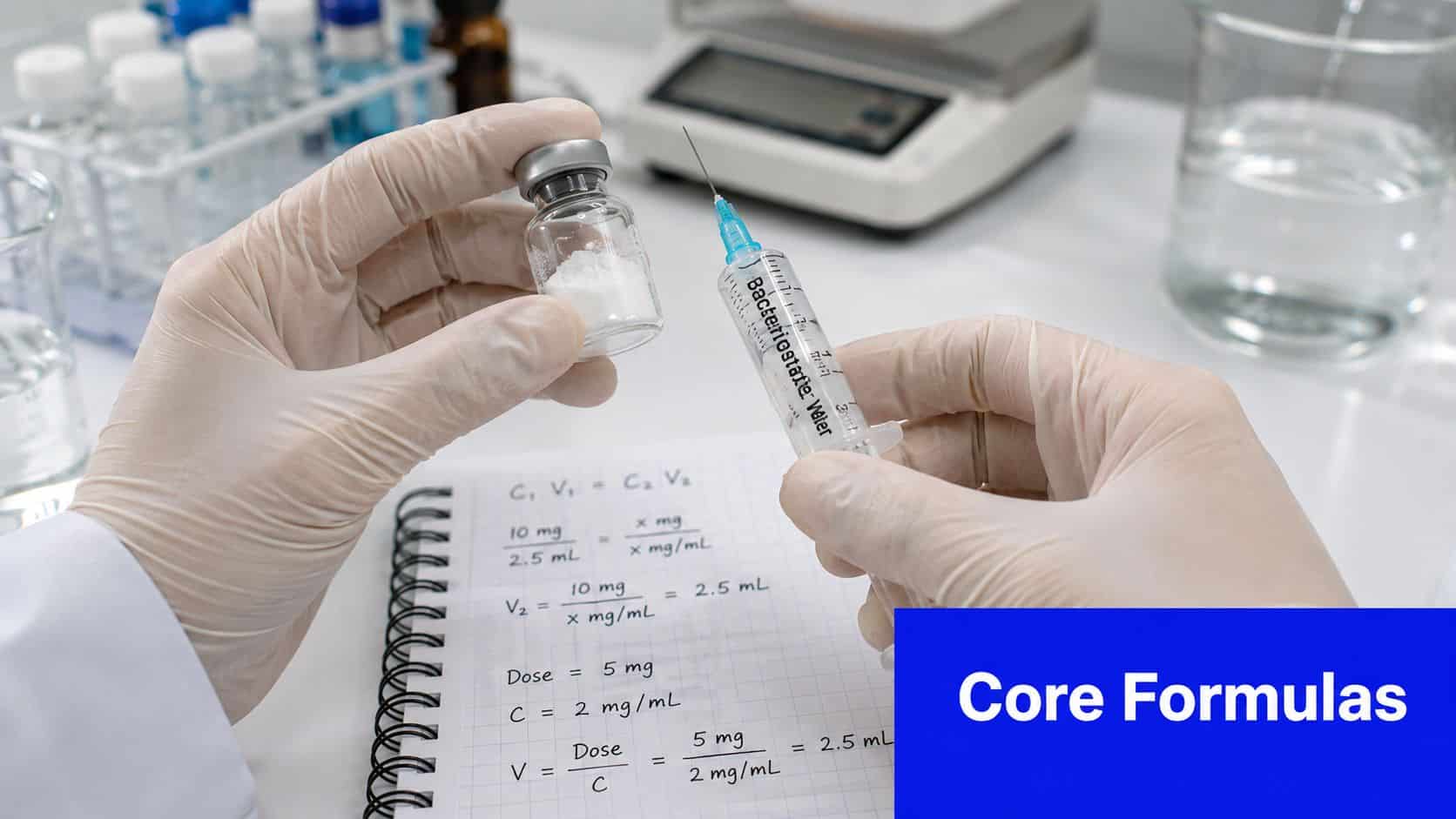
Use a 5 mg vial mixed with 2 mL as a check. The concentration is 5 mg ÷ 2 mL, or 2.5 mg/mL. A 250 mcg target is 0.25 mg. Dividing 0.25 mg by 2.5 mg/mL gives 0.1 mL. With a U-100 syringe, multiplying 0.1 mL by 100 produces 10 units. Rite Aid's peptide dosage calculator provides a comparable calculation reference.
A useful interface exposes each assumption:
Use the embedded media as a visual reference for the workflow. Verify the vial label, unit conversion, water volume, and syringe scale yourself. That habit lets you audit the result and adjust the math for setups the calculator does not list.
A consistent sequence makes each result easy to check. Begin with the vial amount, divide by the added water to find concentration, convert the target into the same mass unit, then convert liquid volume into syringe units.
For a 5 mg vial with 2 mL of bacteriostatic water, the concentration is 2.5 mg/mL. A 250 mcg target equals 0.25 mg. Dividing 0.25 mg by 2.5 mg/mL gives 0.1 mL, or 10 U-100 units. A 500 mcg target equals 0.5 mg, giving 0.2 mL, or 20 units. These figures demonstrate the arithmetic only, not a human-use protocol.
| Vial Size | Water Volume | Concentration | 250 mcg Dose (units) | 500 mcg Dose (units) |
|---|---|---|---|---|
| 5 mg | 2 mL | 2.5 mg/mL | 10 units | 20 units |
| 10 mg | 3 mL | approximately 3.33 mg/mL | approximately 7.5 units | approximately 15 units |
| 30 mg | 3 mL | 10 mg/mL | 2.5 units | 5 units |
The 10 mg with 3 mL setup produces approximately 3.33 mg/mL. A 250 mcg target occupies approximately 0.075 mL, which corresponds to approximately 7.5 units on a U-100 syringe. A 500 mcg target occupies approximately 0.15 mL, or approximately 15 units. The approximation comes from dividing by a repeating decimal, so the displayed result may need careful interpretation.
The 30 mg with 3 mL setup is more concentrated. Both reference targets therefore occupy smaller liquid volumes, and the corresponding syringe markings are lower. The calculation can be correct while the draw remains difficult to read.
Other setup combinations include 5 mg vials mixed with 1 mL, 2 mL, or 3 mL of bacteriostatic water. Recalculate concentration and draw volume whenever either variable changes, rather than transferring units from a different setup. A calculator is most useful when it shows those inputs clearly enough for you to verify the result yourself.
Most errors aren't caused by difficult mathematics. They come from entering one variable in the wrong unit or assuming the syringe uses a familiar scale.
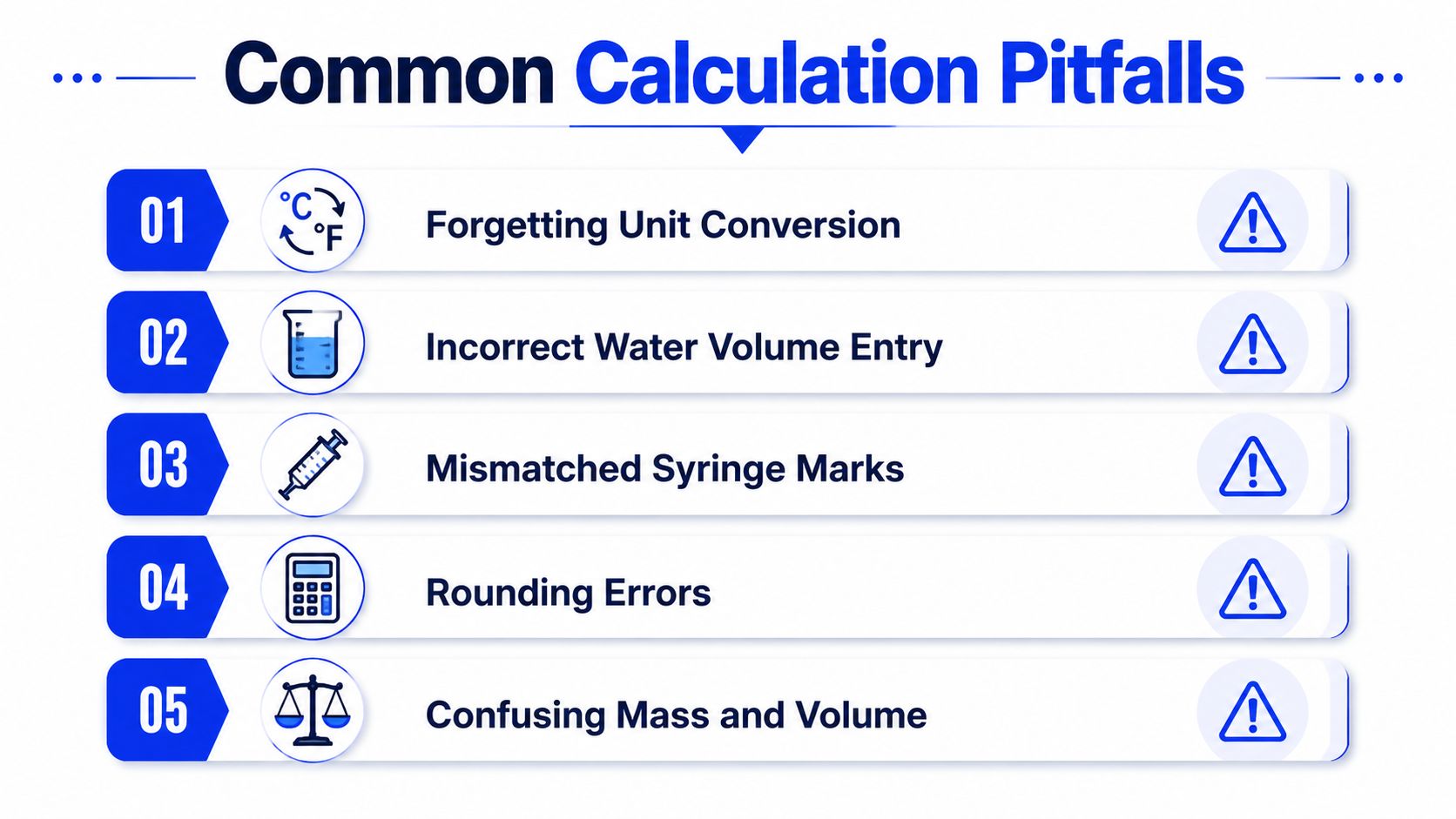
Forgetting the mass conversion: The symptom is an implausibly large or tiny draw amount. Convert milligrams to micrograms, or convert the target into milligrams, before dividing.
Entering water in syringe units: A calculator expects water volume in mL, not the number shown on a syringe. Enter the actual liquid volume added, such as 2 mL, rather than 200 units.
Confusing draw volume with total volume: The concentration uses all the water added, while the draw-volume formula calculates only the portion containing the target amount. Don't substitute the target draw volume for the reconstitution volume.
Reading the wrong syringe scale: U-100 means 100 units per milliliter, but a syringe's capacity and graduation style can differ. A 30-unit or 50-unit syringe also requires you to verify whether its markings use the U-100 convention.
Trusting hidden assumptions: A result may look precise while the calculator assumes a U-100 syringe or a particular unit system. Check whether the interface displays vial strength, water volume, target units, and syringe type.
A useful diagnostic: If the answer looks surprising, calculate concentration first. A wrong concentration usually points to the original input error.
Rounding creates a separate problem. A calculator may display a decimal unit value that doesn't align neatly with the syringe markings. Preserve the unrounded result during your check, then determine whether the available scale can represent it clearly. Never round casually just to make a number look convenient.
Correct arithmetic doesn't protect a prepared solution from contamination, light, or temperature stress. Handling decisions matter because the concentration you calculated is useful only if the solution remains suitable for the intended laboratory work.
Research workflows commonly keep reconstituted peptide solutions under refrigeration, protect them from direct light, and avoid unnecessary temperature changes. Exact storage requirements should come from the product documentation and the responsible laboratory's procedures, because stability can vary by compound, container, solvent, and handling conditions.
The dry, lyophilized form is generally easier to store than a reconstituted solution because no liquid phase has been introduced. That doesn't remove the need to follow the manufacturer's storage information, but it explains why laboratories often reconstitute only the amount needed for their planned handling period.
Bacteriostatic water is part of the setup, but it doesn't eliminate aseptic technique. Preservative-containing solvent isn't a replacement for clean vial access, appropriate labeling, or controlled storage. If a product's documentation conflicts with a general online guide, follow the product documentation and your laboratory's approved procedures.
A reliable calculation follows a repeatable sequence:
That sequence is the teaching value of a BPC-157 reconstitution calculator. It doesn't just produce a number. It lets you test whether the number makes sense when you change vial size, water volume, or target amount.
BPC-157 products and related compounds should remain within their stated research-use-only boundaries. Peptide Warehouse USA describes its BPC-157 catalog as intended for laboratory and analytical work, with product documentation that includes COAs and stated purity information. Those documents support traceability and procurement review, but they don't turn a research compound into an approved medicine or provide medical dosing guidance.
Use the calculator resources referenced above to cross-check your arithmetic, and compare every result with the vial label, solvent documentation, and syringe markings. If your laboratory needs a BPC-157 reference material, review the product documentation before selecting a format or concentration.
Peptide Warehouse USA offers BPC-157 and related research peptides for laboratory, analytical, and preclinical applications, with batch documentation such as COAs available for review. Visit Peptide Warehouse USA to explore the BPC-157 product page and calculator resources, then verify your reconstitution inputs before beginning any approved research workflow.