No products in the cart.



The first time you pull a vial of BPC-157 from the freezer, the question is never abstract. You're standing there with cold fingers, a label in front of you, and a quiet need to know whether the material is still worth using. BPC 157 storage is where that answer begins, because the same peptide can behave very differently depending on whether it stayed dry, stayed cold, and stayed out of repeated handling.
That's why storage isn't a housekeeping detail. It's the first variable you control, and in a peptide workflow it often decides whether the rest of the run is defensible. Lyophilized material and reconstituted solution live under different rules, and the operational habits around each one matter just as much as the temperature number on the freezer door.
A good lab day often starts with something small, like a researcher opening the freezer and checking a vial that has been sitting untouched for months. If that vial was kept sealed, dry, and cold, it's one kind of material. If it spent time warming, thawing, or sitting in a busy refrigerator door, it's a different one, even if the label looks identical.
That's the core reason bpc 157 storage matters so much. The peptide isn't magic, and it doesn't ignore physics just because the vial is labeled properly. Temperature drift, moisture, light, and repeated handling all change the odds, which is why the storage state comes first and the experiment comes second.
Lyophilized BPC-157 is the long-term form. Verified storage guides place the best long-term stability at -20°C or colder, with one benchmark describing 12-24 months under proper frozen storage and another noting that properly stored lyophilized peptides can remain stable for years (Durham Peptides). Once the vial is reconstituted, the window shrinks fast, and the handling standards get stricter.
Practical rule: if the vial is still dry, protect it like inventory. If it's mixed, treat it like a short-lived working solution.
That split is also why shipping, receiving, and freezer habits all connect. If a team is relocating a cold room or reorganizing stock, a guide to safe lab transition is useful because the actual risk isn't just moving boxes, it's exposing material to uncontrolled warming, moisture, and confusion in the handoff.
The practical takeaway is simple. A dry vial can usually tolerate careful long-term storage. A mixed vial can't. The rest of the workflow should be built around that fact, not around hope.
Unopened BPC-157 should be treated like a sealed, fragile inventory item, not a convenience bottle. The best home for it is a dedicated lab freezer at -20°C or colder, away from repeated door openings and away from anything that introduces moisture or light. A freezer that serves as a general catchall is usually where storage discipline starts to erode.
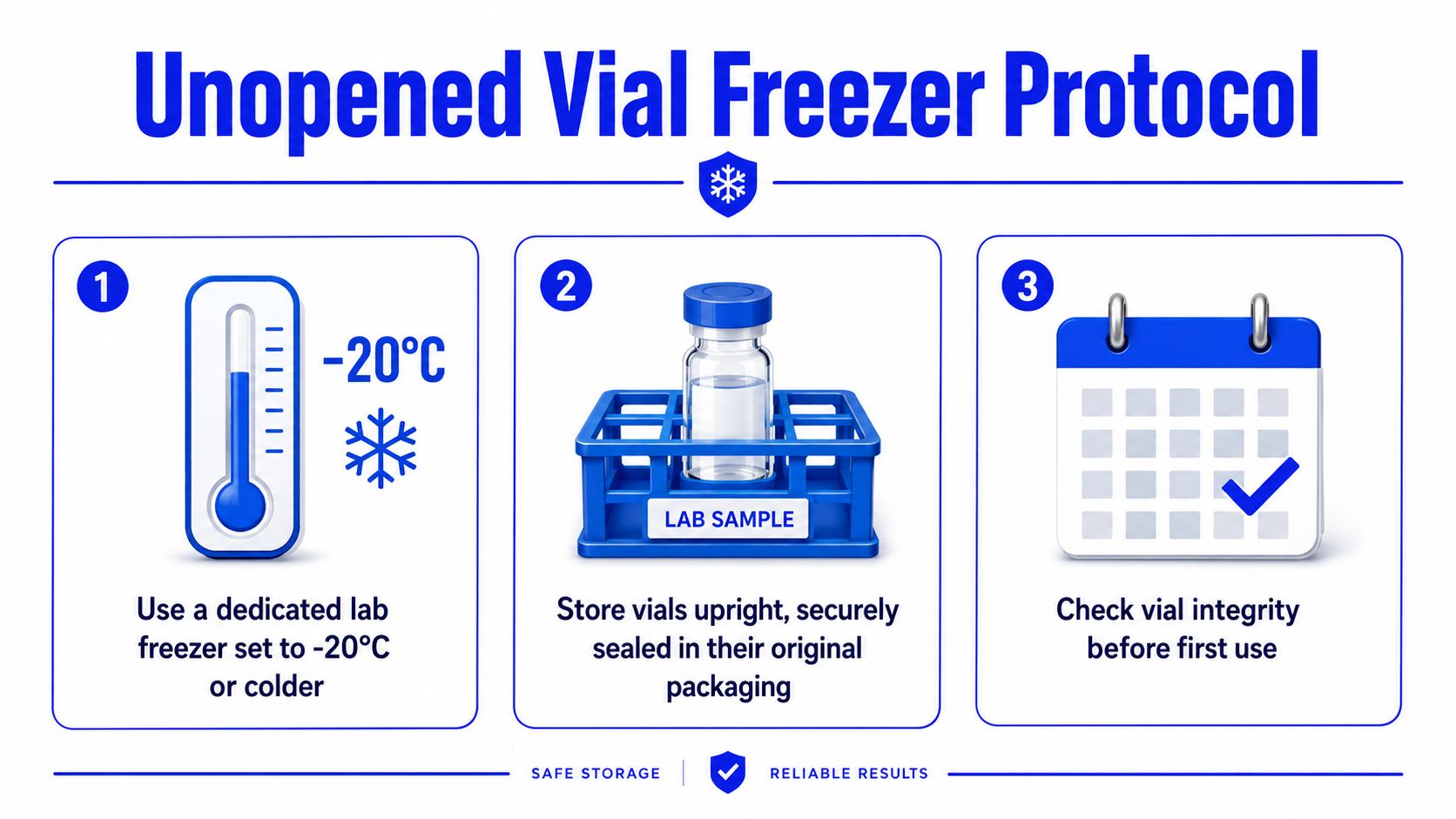
The original sealed container matters. Keep the vial upright, keep the closure secure, and keep the desiccant or protective packaging in place when it's part of the shipment design. That sealed environment is what keeps the dry powder from taking on moisture before you're ready to use it.
The cleaner the storage, the more the vial tends to look like a proper lyophilized peptide. Good material usually appears as a white to off-white fluffy powder. When handling slips, the first visual clue is often the easiest one to miss, the powder looks wet, compacted, or stuck to the vial wall, which points to moisture exposure. Discoloration is another warning sign, especially if the powder looks yellowed or brownish.
Many labs lose control at this point. They open the long-term vial too early and then use that same vial as the working source. This creates avoidable exposure every time the stopper is punctured or the vial comes out of cold storage.
A better setup is a master stock kept sealed in the freezer and a working stock held in the refrigerator only when needed. The separation gives the master vial a longer chance to stay within the stability window, instead of letting every routine check, draw, and return to storage chip away at it.
Keep the master vial boring. The more often it moves, the less trustworthy it becomes.
The storage benchmark is still the same, -20°C or colder, and the practical long-term range supported by the verified guides is 12-24 months under proper frozen storage (Real Peptides). That's useful only if the vial stays dry, sealed, and unhurried.
The moment bacteriostatic water enters the vial, the rules change. A reconstituted peptide is no longer a long-term freezer item, it's a short-term refrigerated solution that needs sterility, date labeling, and much tighter oversight.
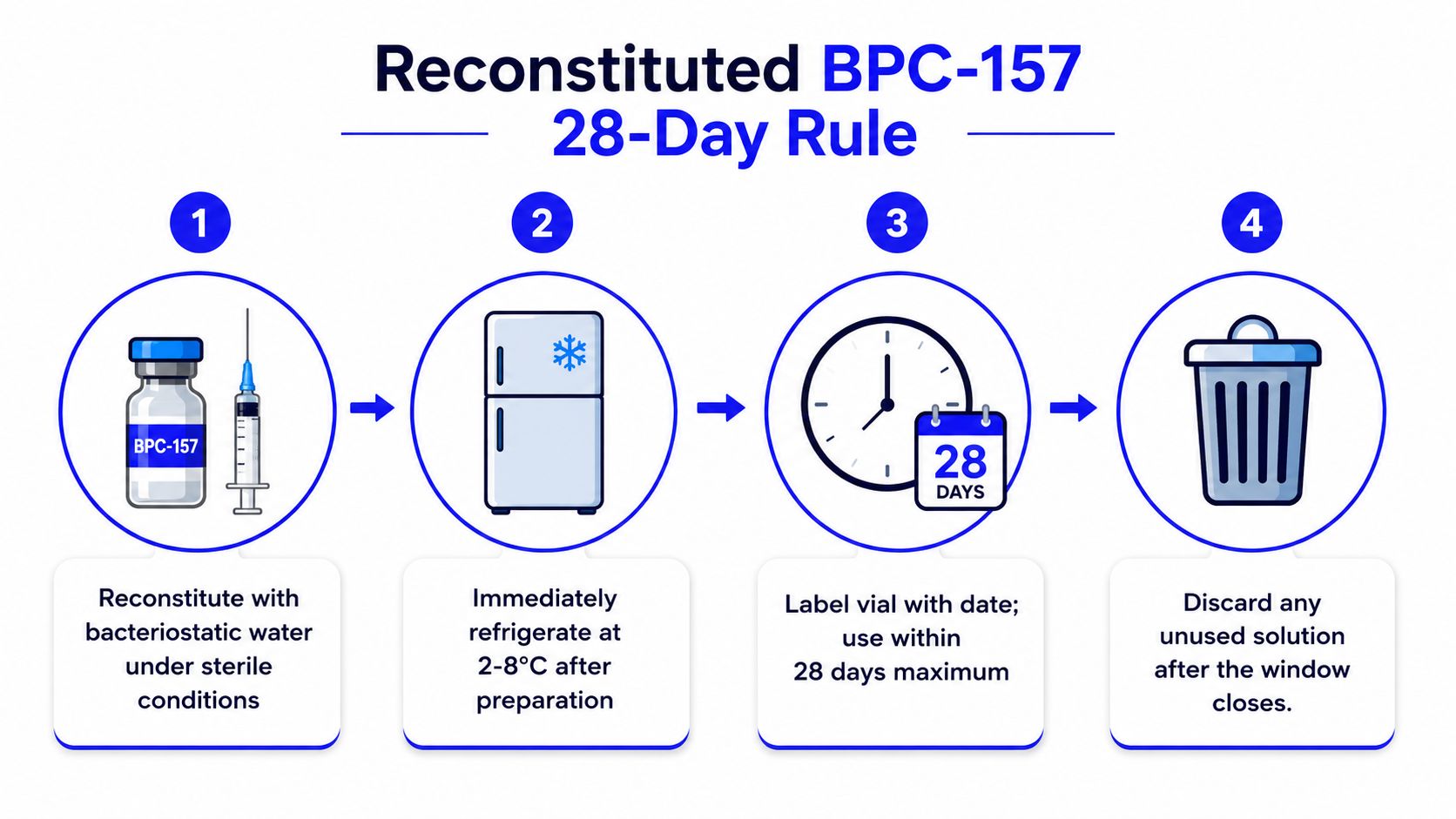
After reconstitution, verified guidance consistently points to 2-8°C refrigeration, with typical usability ranging from about 28 days to 4-6 weeks depending on solvent choice and how carefully the vial is handled (Peptpedia). A separate storage guide gives a more concrete benchmark, 28 days in the refrigerator after reconstitution with bacteriostatic water (Real Peptides).
That shorter window isn't a suggestion to stretch. It's the practical limit that keeps the material defensible. The more punctures, temperature swings, and sloppy transfers a vial sees, the more cautious the storage period should be.
Sterile technique matters because the vial is now vulnerable to contamination as well as degradation. General peptide handling guidance also supports using sterile buffers at about pH 5-6 to prolong solution life in solution, which is one reason cold storage and a controlled solvent matter so much once the peptide is mixed (NIBSC).
Reconstituted material should look clear and free of visible particles. Cloudiness, particulates, seal damage, or an unexplained odor are all reasons to stop trusting the vial. A clear solution can still have a bad history, but a cloudy one is telling you the history has already gone sideways.
A mixed vial should also be dated immediately. If that date isn't on the label, it isn't really under control.
Repeated freeze-thaw cycles are where many peptide workflows break down. Each cycle adds mechanical stress to the solution, and that stress is the kind of thing nobody notices until results look inconsistent or a vial seems to age faster than expected.

The point of aliquoting is simple. You divide the reconstituted peptide into smaller volumes so the master stock stays frozen and untouched, while the working vial stays small and active. That keeps one vial from carrying the burden of every use.
General peptide storage guidance notes that repeated freeze-thaw cycling contributes to physical aggregation, possible structural disruption, and gradual loss of research activity. That's not a subtle effect in real lab life. It's the difference between a careful workflow and a fridge full of uncertain material.
A practical setup looks like this:
If the team needs a comparison point for handling and cold-chain discipline, a Ship Center in Sugar Land is a reminder that packaged materials hold up better when transit conditions are controlled, documented, and not left to chance. The same logic applies at the bench, where every warm minute matters more than people think.
Working rule: thaw only what you need, keep the rest sealed, and don't refreeze a casually handled vial as if nothing happened.
For most labs, the safest path is to keep the working vial small enough that it doesn't sit around long enough to become a question mark.
The labs that stay organized usually do two things well. They separate storage into master stock and working stock, and they write everything down the same way every time.
The sealed freezer master vial is the long-term reserve. It stays in the coldest stable place you have, and it stays closed until there's a real reason to open it. The smaller working refrigerator vial is the one that gets used day to day, which keeps the master material from taking unnecessary handling damage.
That separation is more than neatness. It keeps long-term stability from being eroded by routine access. It also gives you a clean fallback if the working vial has an issue, because the master stock was never part of the day-to-day churn.
A real reconstitution log is the difference between memory and traceability. Every time a vial is opened, record the lot number, reconstitution date, solvent, final concentration, and researcher initials. Those fields don't just help with inventory. They tell you what happened when results later look off.
| Reconstitution Log Fields | Why it matters |
|---|---|
| Lot number | Connects the vial to its batch history |
| Reconstitution date | Defines the storage clock |
| Solvent used | Helps explain stability differences |
| Final concentration | Supports reproducibility across runs |
| Researcher initials | Shows who prepared the vial |
A log also protects the team from guessing. If two people handled the same peptide on different days, the record shows who mixed what, when, and how. That matters when the question becomes whether the material behaved differently or the handling did.
The storage literature is full of temperature talk, but the operational win is consistency. A lab that logs cleanly is easier to audit, easier to troubleshoot, and much harder to confuse with itself.
Storage starts before the vial goes into the freezer. The way a shipment arrives, and the way it's checked in, determines whether the material enters the workflow with a clean chain of custody or with uncertainty attached.
A good incoming box should be handled immediately, not left on a counter while someone finishes another task. The first job is to inspect the packaging for temperature-control indicators, confirm the vial identity, and make sure the paperwork matches the physical item. That's where the Certificate of Analysis earns its keep.
The vial label and the COA should agree on the lot number. The paperwork should also show the claimed purity, and the lab should note the manufacture date so the stability clock starts with the correct reference point. If microbial or endotoxin testing reports are included, they belong with the same file set because they're part of the same chain of documentation.
A useful cold-chain reference for the logistics side is this guide to cold transport for pharma. It's relevant because a vial that was packed correctly still has to be unpacked correctly, and the fastest way to make a good shipment messy is to let it sit while people look for a place to put it.
If the packaging suggests a temperature excursion, document it immediately. If the label doesn't match the paperwork, set the vial aside until the discrepancy is resolved. If the seal looks compromised, don't fold it into active stock as if nothing happened.
A clean freezer can't fix a bad receiving process.
The receiving step is where many teams either preserve traceability or lose it at the front door. The freezer only protects what the intake process already verified.
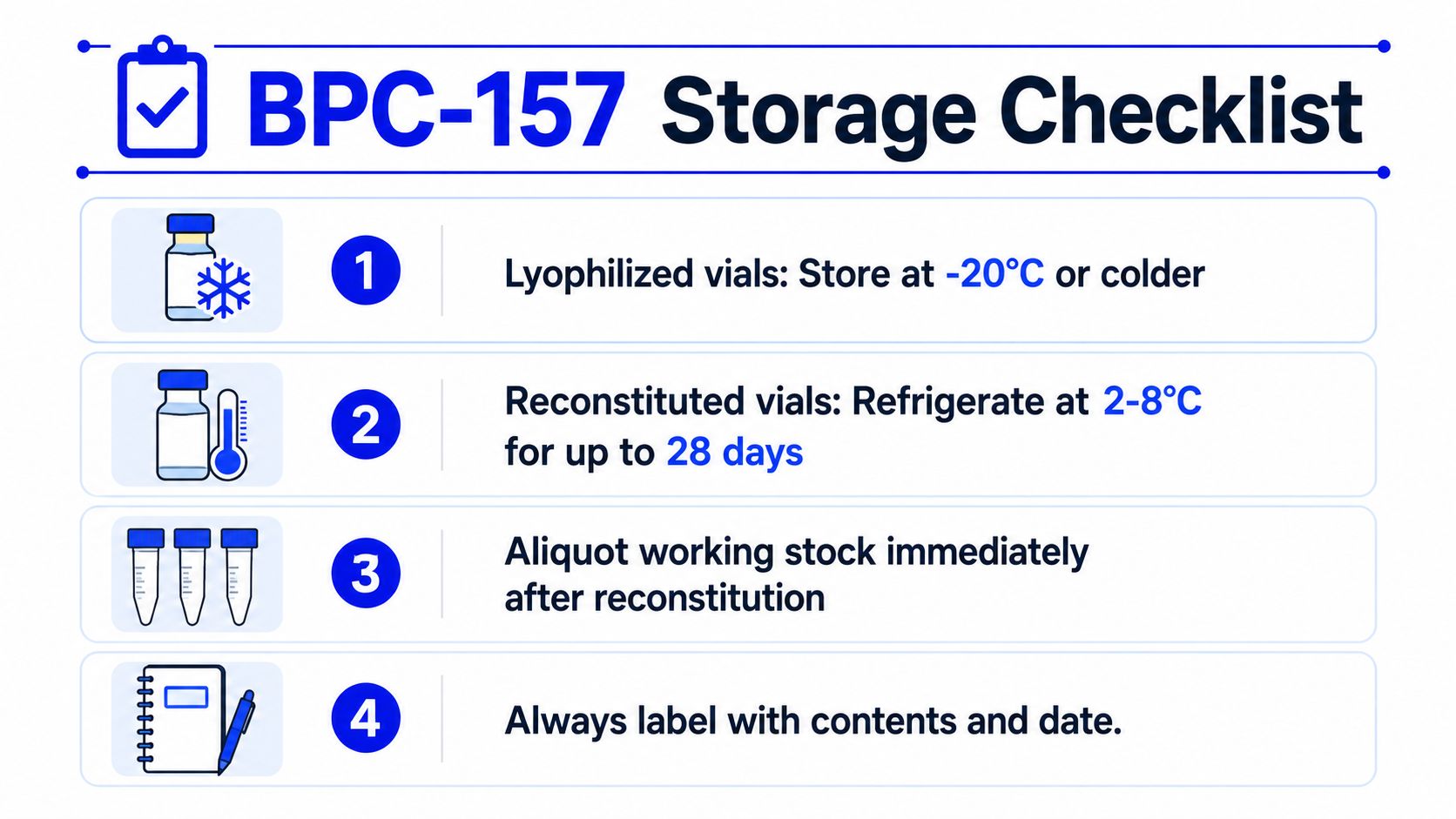
The cleanest bpc 157 storage setup is also the simplest to remember. Unopened lyophilized vials belong in a freezer at -20°C or colder. Reconstituted vials belong in the refrigerator at 2-8°C, with a practical ceiling of 28 days in a conservative workflow (Real Peptides). The working stock should be separated from the master stock, and every reconstitution should be logged.
BPC-157 from Peptide Warehouse USA is supplied strictly for laboratory, analytical, and preclinical research use, not for human consumption. That distinction matters because consistent storage is part of what makes the research defensible in the first place.
If you're ready to source material you can trace from shipment to freezer, explore COA-verified BPC-157 and the broader research peptide catalog at Peptide Warehouse USA.