No products in the cart.

A translational lab lead is staring at a quote for 50 vials of the same peptide. One supplier is cheaper. The other provides more complete batch records. Both advertise high purity, but only one has supplied raw chromatograms, endotoxin data, and a clear chain of custody. At this volume, choosing by sequence availability or headline price is a procurement failure waiting to happen.
Bulk research peptides turn a routine catalog purchase into an operations decision. You need to verify supplier capability, define the right quality-control package, protect inventory during storage, document every transfer, and understand how research-use-only labeling affects your compliance posture. This guide gives you a practical framework for evaluating vendors and receiving bulk lots without allowing a weak certificate of analysis, contamination event, or temperature excursion to derail your study.
A single-vial purchase gives a lab flexibility. A bulk order creates dependence on one lot, one supplier, one shipment, and one storage plan. The project may still involve the same sequence, but the operational consequences are different.
The five risks are interconnected:
Peptide demand has expanded alongside pharmaceutical development. Insulin was first used in patients in 1922, while solid-phase peptide synthesis, introduced in 1965, made longer peptide assembly more repeatable and scalable for laboratories and manufacturers. Recent industry summaries cite roughly 100 FDA-approved peptide-based drugs, and one analysis reports that peptides represented about 10% of new FDA drug approvals from 2020 to 2024. Those figures help explain why research groups increasingly need reference materials, analytical standards, and preclinical candidates across areas such as metabolic disease, oncology, and specialty therapeutics. See the historical and FDA peptide approval overview for the underlying context.
The procurement lead must ask more than, “Can you supply this sequence?”
A useful internal definition is simple: bulk research peptides are research-use peptide materials purchased in a quantity or lot configuration that requires negotiated specifications, documented release controls, and planned inventory management. The exact quantity matters less than the operational burden it creates.
Bulk research peptides sit between ordinary catalog purchasing and full contract manufacturing. The category is defined by the work required around the material, not just by the amount in the vial.
A single-vial purchase typically uses a published catalog specification, standard packaging, and a routine shipment. A bulk order often requires a quote, reserved production capacity, agreed fill configuration, expanded documentation, and a delivery plan that protects the material in transit. Pricing also moves from a list price to a negotiated commercial package.
When a project moves from milligrams to grams, ask the supplier to define these points in writing:
Catalog bulk lots may be faster when inventory already exists, but they can offer less customization. Custom synthesis gives you more influence over lot design, fill size, and documentation, but it can introduce longer scheduling and approval cycles.
Procurement should also request the COA, safety data sheet, and chain-of-custody records before issuing a purchase order. A safety data sheet supports handling decisions, while chain-of-custody paperwork records who manufactured, released, shipped, received, and stored the material. These documents don't replace analytical testing, but they create the record needed to investigate discrepancies.
| Attribute | Single-Vial Purchase | Bulk Order |
|---|---|---|
| Commercial model | Catalog price | Negotiated quote |
| Lot planning | Often minimal | Lot identity and uniformity must be defined |
| Documentation | Standard COA may be sufficient | Expanded analytical and custody package expected |
| Packaging | Ready-to-use vial | Bulk container or planned aliquots |
| Lead time | Often routine | May include production scheduling |
| Storage | Limited inventory | Dedicated freezer and inventory controls |
| Acceptance decision | Simple receipt check | Formal lot release or rejection process |
Use this category definition internally: if a purchase can affect multiple experiments or teams, it deserves bulk-order controls even when the material arrives in several smaller vials.
A purity number is an advertising claim until you can connect it to a specific lot, analytical method, and underlying record. A credible supplier should be able to explain what the number means and provide supporting evidence without treating raw data as confidential by default.
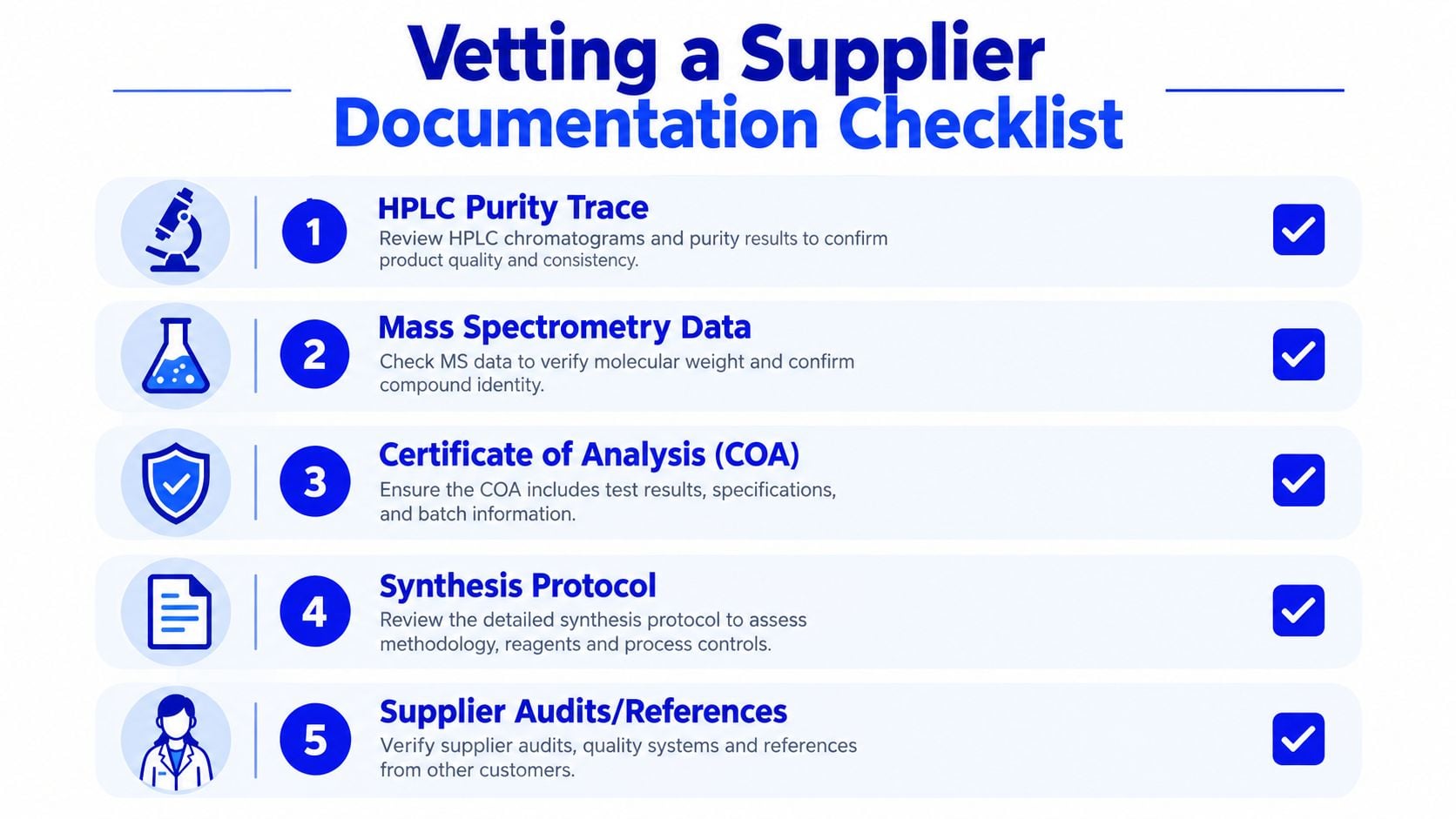
Build your request around the actual risks of your work:
The endotoxin and sterility testing guidance for research peptides reinforces an important point. HPLC and mass spectrometry don't detect bacterial endotoxin or live microbial contamination, so those controls must be handled separately.
Reject the quote, or place the supplier on hold, when you encounter:
Run the checklist in sequence. First verify identity and lot traceability. Then review analytical scope. Next confirm manufacturing and third-party arrangements. Finally agree on acceptance criteria, shipment conditions, and rejection terms before your buyer approves the order.
HPLC purity isn't the same as biological suitability. Reversed-phase HPLC can show the relative area of detected chromatographic peaks, but it doesn't establish that the material is free of endotoxin, live microbes, or every sequence-level impurity. A lot can show very high HPLC purity and still carry biologically relevant lipopolysaccharide contamination.
Mass spectrometry adds molecular-weight confirmation, which is valuable for identity. It still may not resolve every sequence variant, truncation, modification, or positional difference. For difficult sequences or high-consequence studies, the laboratory may need additional sequence-level work, such as MS-MS or amino acid analysis, depending on the specification and risk assessment.
| Test Method | What It Confirms | What It Does Not Detect | Typical Acceptance |
|---|---|---|---|
| Reversed-phase HPLC | Relative chromatographic purity and major product peak | Endotoxin, live microbes, and all sequence-level impurities | Predefined lot purity specification using the stated method |
| Mass spectrometry | Molecular-mass consistency and identity support | Complete sequence confirmation and biological contamination | Mass consistent with the approved peptide identity |
| LAL or rFC endotoxin testing | Endotoxin burden | Chemical purity and all microbial conditions | Application-specific limit defined before release |
| Microbial testing | Evidence related to microbial contamination under the selected method | Endotoxin unless separately tested, and complete sterility assurance | Defined microbial or sterility requirement for the intended research |
| Residual-moisture testing | Water content relevant to storage and handling | Identity, sequence, and endotoxin | Internal moisture limit based on stability needs |
USP <85> is commonly associated with LAL or recombinant factor C testing for endotoxin control. The method choice, sample preparation, and acceptance limit should match the intended application, especially when innate-immune activation could confound cytokine assays, cell-based readouts, or in vivo tolerability observations.
Put routine identity and purity evidence in the supplier specification. Add incoming verification when the study is sensitive to lot variation, when the supplier is new, or when the material will support an expensive experiment.
Sterility also needs careful wording. A non-sterile lyophilized research product shouldn't be described as sterile just because microbial testing was performed. Your quality agreement should state whether the material is non-sterile, bioburden-controlled, or released under a defined sterility protocol.
Lyophilized peptide is more stable than a reconstituted solution, but it isn't indestructible. Sealed, cold, moisture-protected storage helps preserve the material, while oxidation, aggregation, and residual-moisture effects can still change analytical performance over time. The peptide storage and stability guide correctly frames the COA as a snapshot of the sample at testing, not an indefinite guarantee for every future use.
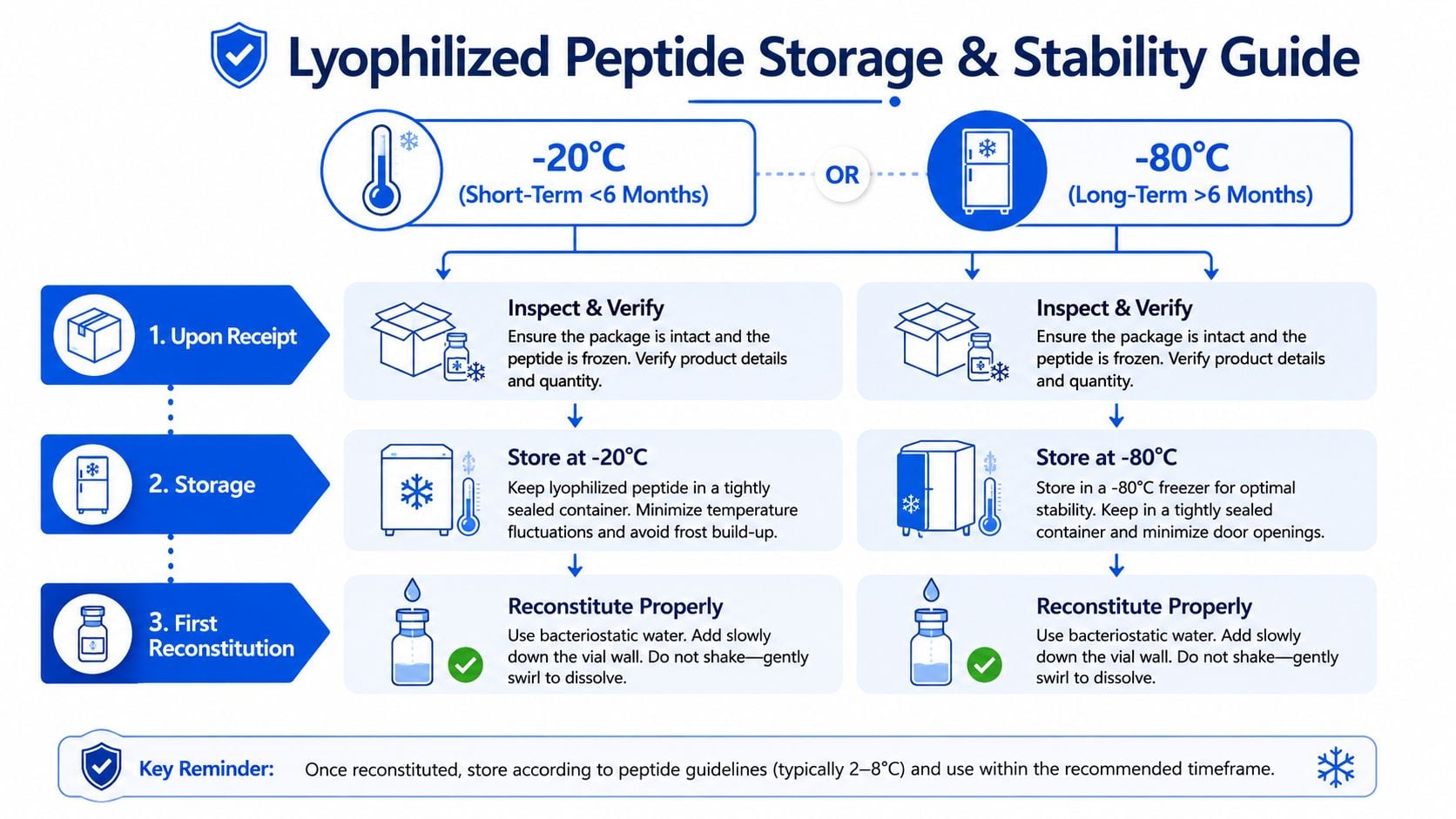
Assign a storage owner before delivery. That person should record the received date, lot number, quantity, freezer location, packaging condition, and any temperature indicator or logger information.
Use these operating controls:
For shipments involving cold-chain risk, procurement teams should compare data logger types for logistics before selecting a monitoring approach. The logger should support the decision you need to make, such as whether the shipment remained within the agreed range.
Practical rule: Treat a bulk vial like a reference standard, not a reagent bottle.
If grams must be shared across teams, plan controlled aliquoting under dry conditions rather than repeatedly opening one communal container. Store the supplier's stability data sheet with the inventory record and use it to establish retest or review intervals. Don't invent a shelf-life assumption because the material arrived dry.
Two quotes can describe the same peptide and still represent different products operationally. The price reflects synthesis difficulty, purification burden, testing scope, packaging, logistics, and the supplier's allocation of fixed overhead.
Sequence complexity is a primary driver. Longer sequences and difficult residues can reduce coupling efficiency, increase deletion products, and require more purification work. Modifications, unusual termini, salts, counterions, and oxidation-sensitive residues can also change the manufacturing route.
Purification grade often creates the largest specification difference. Crude or partially purified material may suit an early analytical screen, while a translational assay may require a tighter purity and contamination package. A higher headline price can be justified when it includes deeper purification, lot-specific raw data, endotoxin testing, and more controlled filling.
Scale economies can reduce the per-unit burden when the supplier can run an efficient batch and spread setup or analytical costs across the order. That advantage isn't automatic. A complicated sequence may remain expensive at scale if yield and purification remain difficult.
| Pricing Driver | Typical Impact | Buyer Lever |
|---|---|---|
| Sequence length and complexity | More synthesis and purification effort | Ask for a manufacturing feasibility review |
| Purification target | Higher specification can increase process burden | Match the grade to the assay risk |
| Quantity and lot design | Larger lots may spread fixed costs | Define whether one lot is required |
| QC documentation | Expanded testing adds laboratory and reporting work | Specify required reports before quoting |
| Packaging and lyophilization | Custom vialing and handling add process steps | Choose fill sizes that reduce repeated opening |
| Shipping conditions | Temperature controls and monitoring affect logistics | Agree on packaging and excursion procedures |
| Import and customs handling | Cross-border delivery adds documentation and delay risk | Compare landed cost, not just product price |
Domestic and international quotes should be compared on the same basis. Include documentation, customs handling, temperature protection, repackaging, and replacement terms. The cheapest line item can become the most expensive option if a missing report delays release or a chain-of-custody gap forces an investigation.
Research-use-only labeling isn't a legal shield. FDA actions and independent coverage in 2026 have clarified that RUO language doesn't protect products marketed for human use, and sourcing rules are being narrowed for certain GLP-1 peptides. The 2026 compliance discussion on peptide sourcing and supply chains also describes recurring concerns involving endotoxin, heavy metals, and sequence impurities in lower-tier supply chains, including reported findings of endotoxins in about 18% of tested samples and heavy metals in about 12% of tested samples.
Those figures aren't a substitute for testing your lot. They are a reason to build contamination controls into procurement instead of treating them as an afterthought.
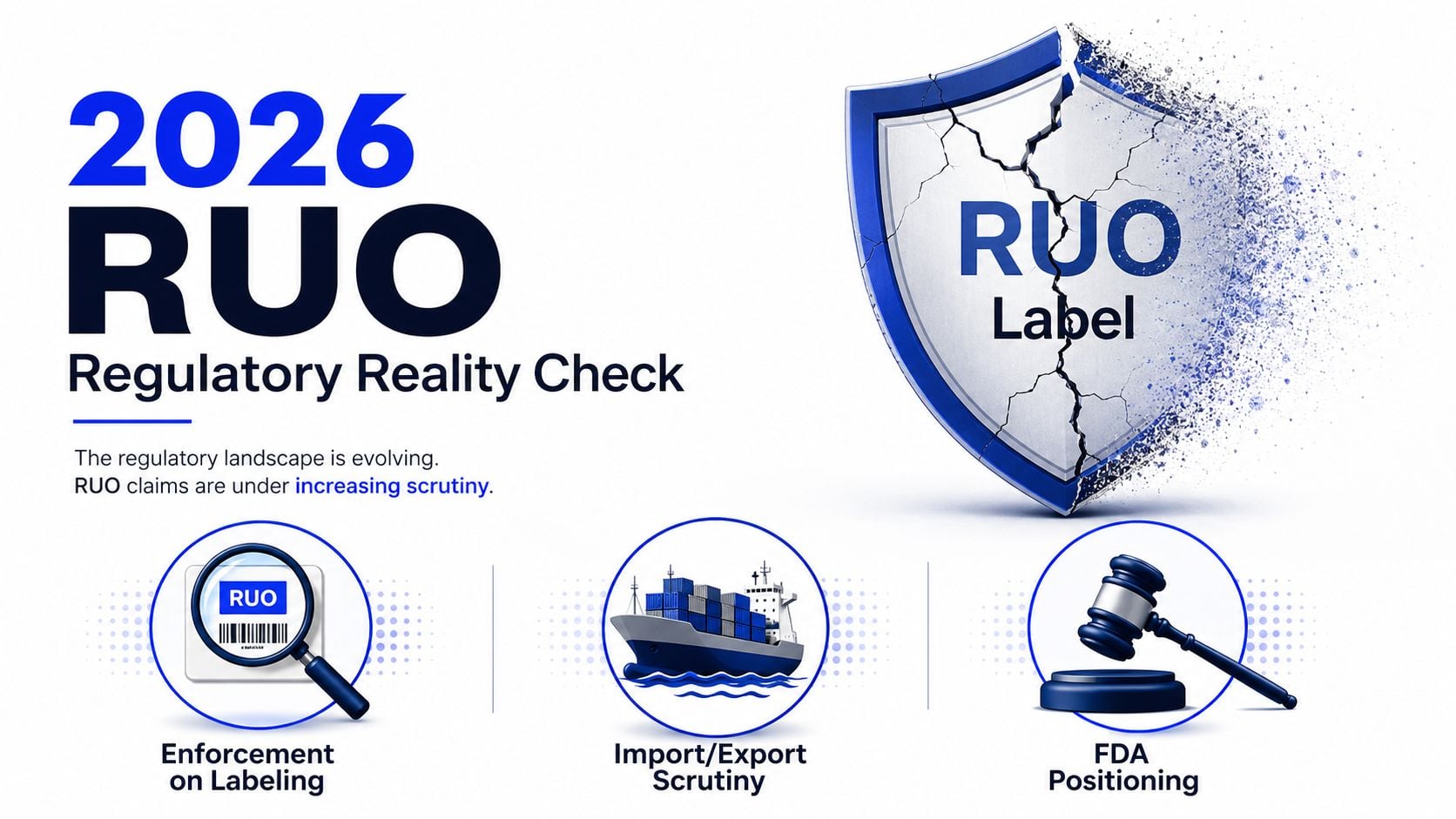
Your purchase order, shipping documentation, inventory records, and laboratory protocol should describe the same research purpose. Don't accept a supplier's marketing language as a substitute for your own compliance assessment, especially when products are discussed in human-adjacent terms.
Control the handoff with:
The buyer remains responsible for how the material is stored, transferred, described, and used after delivery. If a vial enters a clinical workflow without the required regulatory pathway, the vendor's label won't repair the gap.
This video provides additional context for teams reviewing the changing regulatory environment:
Recent approval activity shows why procurement pressure is increasing. A 2024 review valued the peptide therapeutic market at $38 billion in 2023 and projected $106 billion by 2033, implying a 10.8% CAGR over that period. The same review cited more than 100 FDA-approved peptide drugs, including 31 approvals in the previous 7 years. An independent review reported that FDA approved 46 novel drugs in 2025, including four TIDES, and that peptides accumulated 34 FDA approvals between 2016 and 2024. These figures are discussed in the FDA-approved peptide development summary. For procurement teams, the practical message is clear. A growing field requires stronger controls, not looser ones.
A durable process assigns an owner to every decision. The lab manager shouldn't be expected to reconstruct supplier qualification, freezer placement, and compliance records after the shipment arrives.
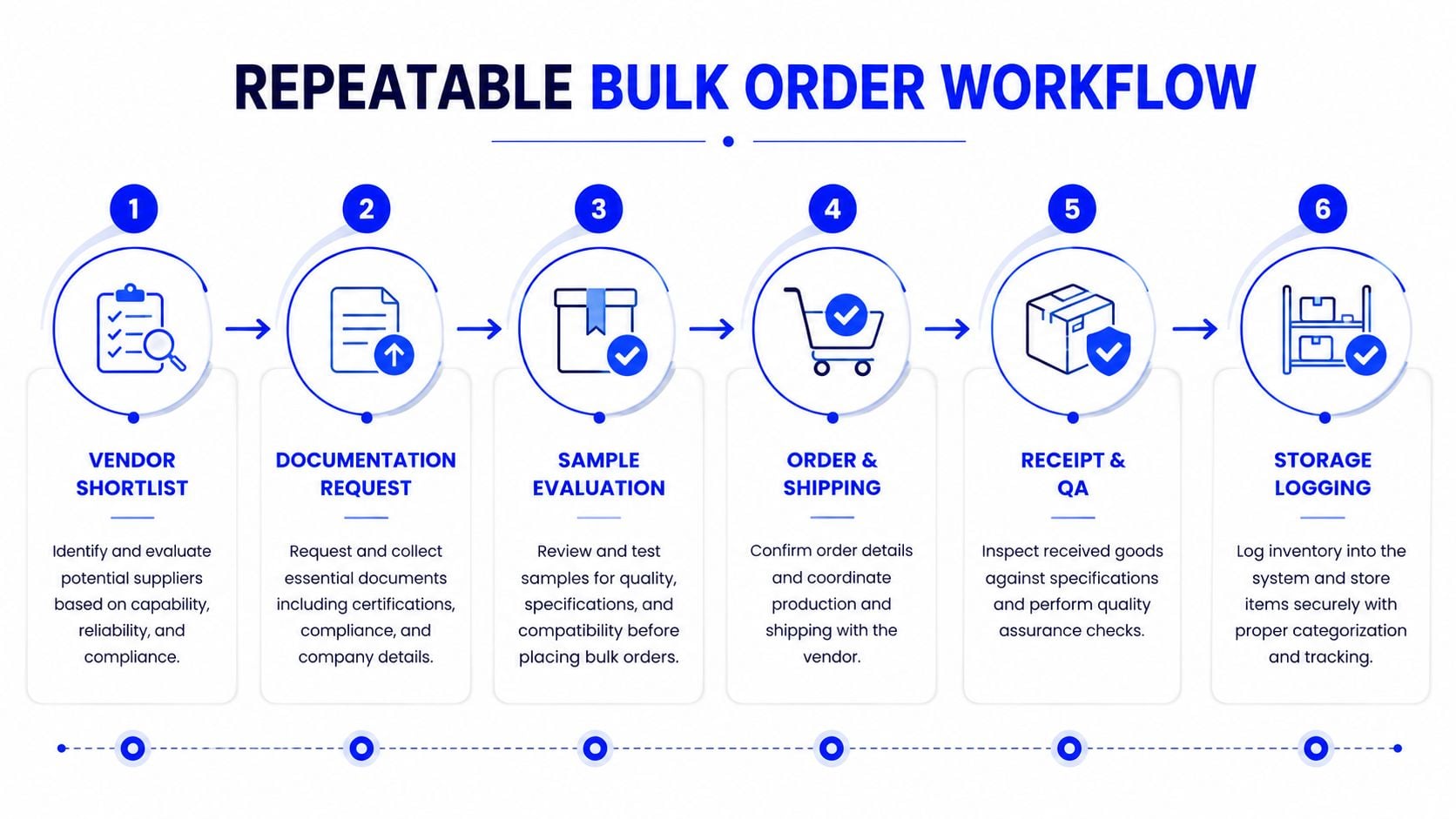
Some controls repeat with every order, including receipt inspection, document filing, and storage logging. Supplier qualification can be revisited when the vendor, sequence class, manufacturing site, shipment size, or intended application changes.
The only reliable defense against mislabeled vials, drifting quality, and undocumented custody is a workflow that survives staff turnover.
For teams comparing suppliers, Peptide Warehouse USA describes a US-based research supply model with batch production, third-party documentation, COAs, microbial and endotoxin reports, and research-use-only positioning. Visit Peptide Warehouse USA to review its research peptide options and documentation approach, then apply the same verification checklist to any supplier before committing bulk inventory.