No products in the cart.


5-Amino-1MQ is a preclinical small-molecule NNMT inhibitor sold strictly for research use, not for human consumption, and not FDA-approved for any medical indication as of 2026. The published record includes zero human clinical trials as of 2026, so buying it requires laboratory-grade procurement discipline rather than supplement-shopping habits.
A postdoc comparing suppliers can easily end up with two very different pages open at once. One has a glossy logo, a discount banner, and same-day shipping. The other shows a lot number, a batch-specific Certificate of Analysis, analytical traces, storage details, and a research-use-only disclaimer. Those pages may look equally polished, but they don't offer equal evidence.
The central question isn't where to buy 5-Amino-1MQ. It's whether the material can be traced, identified, stored, and documented well enough for the intended laboratory work. This guide walks through the compound's research status, the evidence behind it, the FDA framing, and the checks to complete before approving a purchase order.
Most supplement buyers start with branding, reviews, convenience, and price. A laboratory buyer needs a different checklist. 5-Amino-1MQ has no clinical-grade supply chain, and its preclinical status means the supplier's documentation may be the strongest quality evidence available for a particular lot.
Consider the two supplier pages described above. The first may be easy to purchase from, but a shipping promise doesn't establish identity or purity. The second gives a procurement team something usable: a lot-specific record, an analytical trail, and a clear statement that the material isn't intended for people or animals.
A responsible buyer should expect more than a product name and an attractive purity claim. Before checkout, look for:
There isn't a USP or equivalent patient-safety framework that turns a research chemical into a medicine. The lab purchasing the compound becomes responsible for evaluating whether the material is appropriate for its own protocol.
Procurement rule: If a supplier can't connect the vial to a specific batch record, treat the listing as incomplete, regardless of how professional the website looks.
A low price can also conceal a quality gap. It may reflect relabeled bulk powder, missing testing, weak chain of custody, or a supplier that doesn't maintain the records your lab needs. Price is a purchasing factor, not an identity test.
5-Amino-1MQ is a synthetic small-molecule inhibitor of nicotinamide N-methyltransferase, or NNMT. It isn't a peptide, although some commercial pages categorize it alongside research peptides. The compound's research interest comes from its relationship with nicotinamide metabolism and cellular energy pathways.
NNMT transfers a methyl group from S-adenosylmethionine, commonly called SAM, to nicotinamide, or NAM. That reaction produces 1-methylnicotinamide, or MNA, and S-adenosylhomocysteine. Because NAM is connected to NAD+ salvage biology, researchers study NNMT inhibition as a way to examine how methylation and cellular NAD+ availability interact.
The published research record describes a direct experimental chain. Inhibiting NNMT reduces intracellular MNA, increases intracellular NAD+, and suppresses lipogenesis in adipocytes. The evidence is mechanistic and preclinical, not a demonstration of a human treatment effect. (Published review of 5-amino-1MQ and NNMT biology)
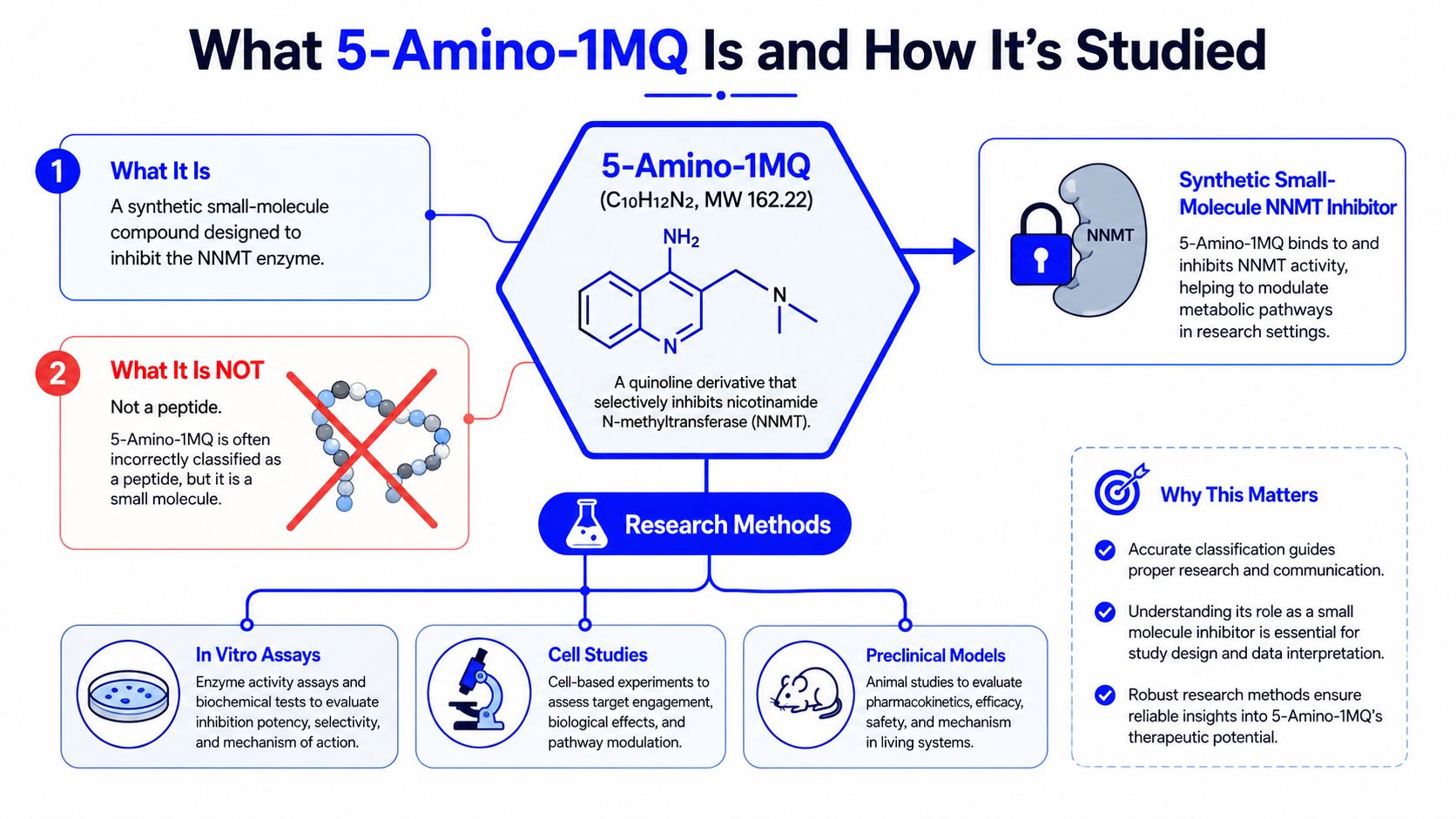
Researchers typically move through several levels of testing:
One academic study reported a permeability score of 1.2 and an IC50 of 3.01472E-06 in laboratory assay systems, findings that support measurable membrane permeability and activity in the tested model. Those values describe assay behavior, not a human dose or a therapeutic recommendation. (Foundational preclinical study of 5-amino-1MQ)
The material may arrive as a powder intended for controlled laboratory preparation. Researchers should follow the supplier's handling data rather than assume a universal protocol. A laboratory may prepare a DMSO stock for an assay and dilute it into an aqueous system when the protocol calls for that approach, but vehicle compatibility, concentration, storage, and stability must be validated for the specific experiment.
The research history is useful, but it has a firm boundary. Published work has examined 5-Amino-1MQ in enzyme systems, cells, and rodents. No published human clinical trials had been identified as of 2026, including no Phase 1 pharmacokinetic, dose-finding, safety, or efficacy studies. (2026 summary of the compound's preclinical status)
The main obesity-focused mouse study administered 5-amino-1MQ at 20 mg/kg subcutaneously three times daily for 11 days. Researchers reported reductions in body weight, white adipose mass, and adipocyte size, without a significant change in food intake or observable adverse effects in that model. A separate summary described a roughly 7% body-weight reduction in diet-induced obese mice within 11 days when NNMT inhibition was paired with a low-fat diet. (Published mouse study)
Those findings help explain why the compound attracts interest in adipocyte and metabolic research. They don't establish safety, dosing, effectiveness, or suitability for human use. A later muscle-focused report also described improved grip strength in aged mice, showing that the research footprint expanded into muscle and aging biology rather than remaining limited to adipose tissue. (Preclinical evidence summary)
| Study type | Model | Key readout | Relevance to buyer |
|---|---|---|---|
| Enzyme and permeability assays | Laboratory assay systems | NNMT-related activity, permeability, and potency measurements | The lot's identity and analytical profile matter before mechanistic testing |
| Cell research | Adipocyte and related cellular systems | Lower MNA, higher NAD+, and suppressed lipogenesis | Vehicle, concentration, and contamination controls can affect interpretation |
| Obesity research | Diet-induced obese mice | Lower body weight, white adipose mass, and adipocyte size | Animal findings don't support human-use claims |
| Muscle and aging research | Aged mice | Improved grip-strength readout in the cited report | The compound's research applications extend beyond fat biology |
| Hepatic and metabolic work | Rodent and cellular models | Metabolic and lipid-related markers | Researchers need a documented material history for reproducibility |
For a buyer, the implication is practical. Research grade is the relevant category because the compound remains preclinical. If a supplier skips identity testing or can't provide a batch record, the experiment may measure an impurity profile rather than the intended molecule.
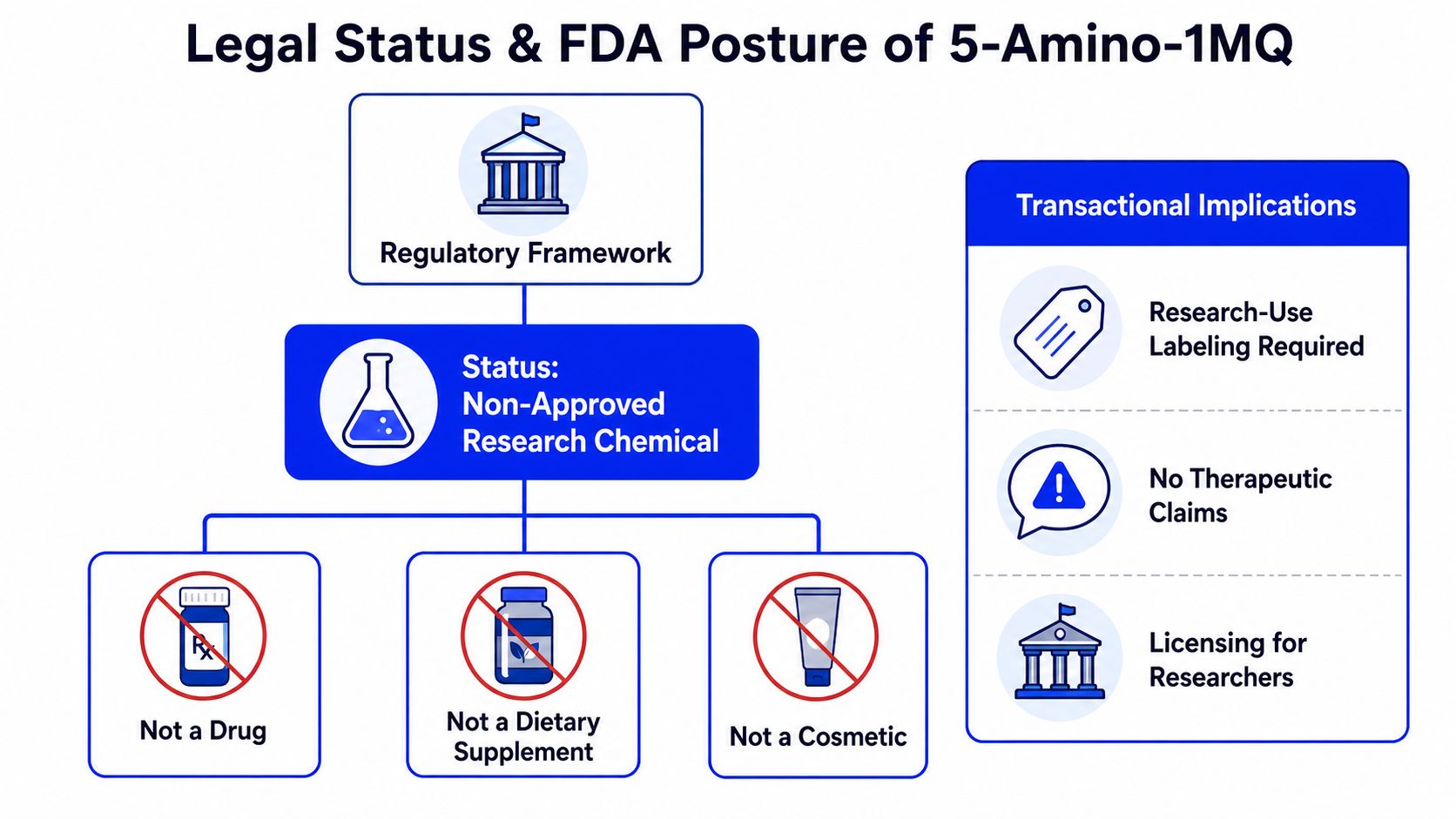
A first-time buyer can place a compliant research order or create a regulatory problem with the same compound. Treat 5-Amino-1MQ as a non-approved research chemical, not a drug, dietary supplement, or cosmetic ingredient. It is not FDA-approved for human medical use, and the FDA has described safety concerns around certain bulk substances used in compounding. (FDA information on bulk drug substances and compounding safety risks)
The label must match the transaction. A laboratory supplier should state the intended research use, while the purchasing lab should retain records showing lawful analytical, non-clinical, or research-related use. A research-use disclaimer does not permit human administration, veterinary use, compounding, or therapeutic marketing.
Build the procurement file before the material arrives:
FDA rules for 503A pharmacies and 503B outsourcing facilities involve separate requirements. A laboratory must not treat bulk research powder as suitable for compounding or patient administration. No INDA, NDA, or approved indication exists for 5-Amino-1MQ as of 2026. Therapeutic claims can therefore create a compliance issue even when the container carries research-use labeling.
For cross-border orders, keep the complete documentation trail. Country of origin, material description, end use, and recipient details should match across the commercial invoice, package label, and purchase order. Any mismatch deserves resolution before checkout.
Reject listings that compare the compound with GLP-1 drugs, supplements, or cosmetic actives. Those comparisons blur the product's category and weaken the documentation chain. Choose a listing whose wording, paperwork, and intended-use statement all identify laboratory research material.
Supplier evaluation works best when you compare evidence, not presentation. A polished site can be useful, but it can't replace a lot-specific COA, analytical support, and traceable business information.
| Criterion | Reliable supplier | Risky supplier |
|---|---|---|
| Certificate of Analysis | Provides a lot-specific COA that matches the vial | Displays a generic document or no supporting file |
| Analytical data | Offers HPLC, LC-MS, or equivalent evidence that can be reviewed | Shows only an unsupported purity statement |
| Chain of custody | Explains manufacture, storage, dispatch, and lot tracking | Gives no clear account of material history |
| Business identity | Publishes contact details, responsible principals, and verifiable payment information | Uses vague contact details or inconsistent business names |
| Returns policy | Defines remedies for damaged, mislabeled, or incorrect shipments | Avoids responsibility after payment |
| Labeling | States research use, storage, hazards, and material identity clearly | Uses wellness or therapeutic language |
| Pricing | Explains the commercial basis for the offer | Uses an unusually low price with no testing explanation |
| Shipping | Describes packaging and handling conditions | Provides only a delivery promise |
Independent reputation checks can add context, but they should supplement objective documentation. Research forums, life-science directories, and independent review platforms may reveal recurring issues, although a review can't prove the identity of a chemical lot.
If your lab also evaluates payment and vendor-management tools, Amina Group alternatives for crypto companies offers a separate comparison resource. It isn't a chemical-quality source, but it can be relevant to teams reviewing broader supplier-payment infrastructure.
Ask for the file before placing the order: A supplier that can provide the lot record promptly has already reduced one major procurement risk.
Don't accept a screenshot when you can request the underlying report. Ask whether the analytical result belongs to the exact lot being offered, whether the laboratory is identified, and whether the data includes identity evidence as well as a headline purity value.
A procurement check should be complete before payment. For 5-Amino-1MQ, identify the material, connect it to a specific lot, verify its handling history, and define the remedy for a damaged or mislabeled shipment.
Confirm the lot number, manufacture date, expiry information, and Certificate of Analysis. The COA must match the product label and identify the material clearly enough for your laboratory records. Ask for the complete analytical package, not a single purity line.
Useful records include:
A COA starts the review. It does not replace independent verification. If the work carries significant experimental consequences, the receiving lab should decide whether additional identity testing is required.
Check container integrity, tamper-evident seals, label legibility, and the material's physical appearance. A powder that differs from the supplier's description requires a hold and review before use, even though appearance alone cannot establish identity.
Ask how the supplier controlled storage and transport. The response should address the stated storage condition, moisture and light exposure, packaging, and any temperature monitoring used during dispatch. Keep an unverified shipment out of an active study until the discrepancy is resolved.
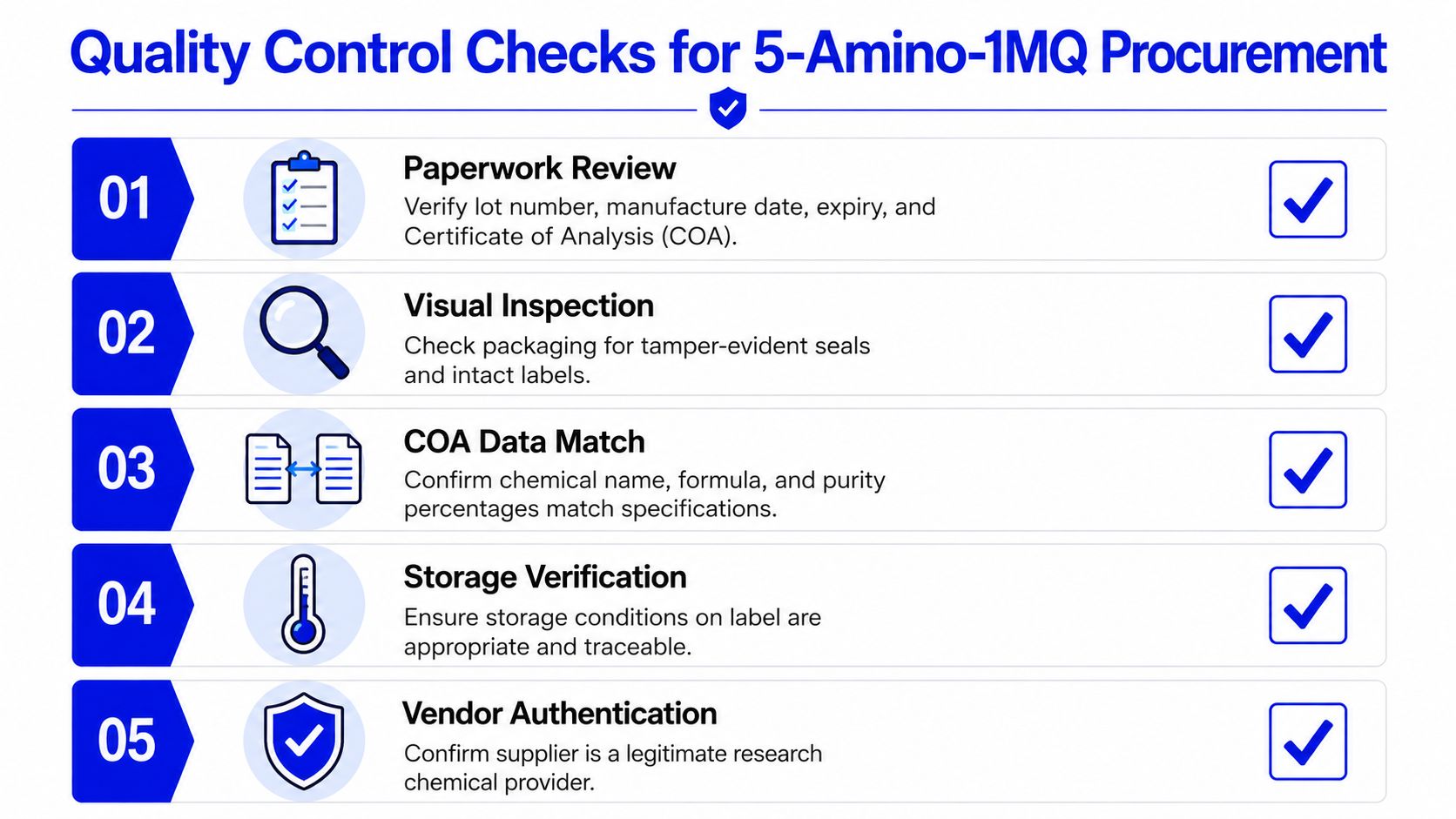
For higher-consequence work, use in-house NMR or FTIR, or hire an independent analytical laboratory to confirm identity before the reagent enters the workflow. Archive the receipt date, shipment condition, storage location, test results, deviations, and approval decision.
Chain of custody is experimental data: Preserve the purchase order, shipping record, COA, receiving inspection, and any confirmatory result together.
A complete record supports reproducibility and gives the lab a defensible investigation path if results later appear unusual. It can help distinguish protocol variation, handling problems, degradation, and material-identity issues. Keep the documentation with the lot record, not only in an email thread.
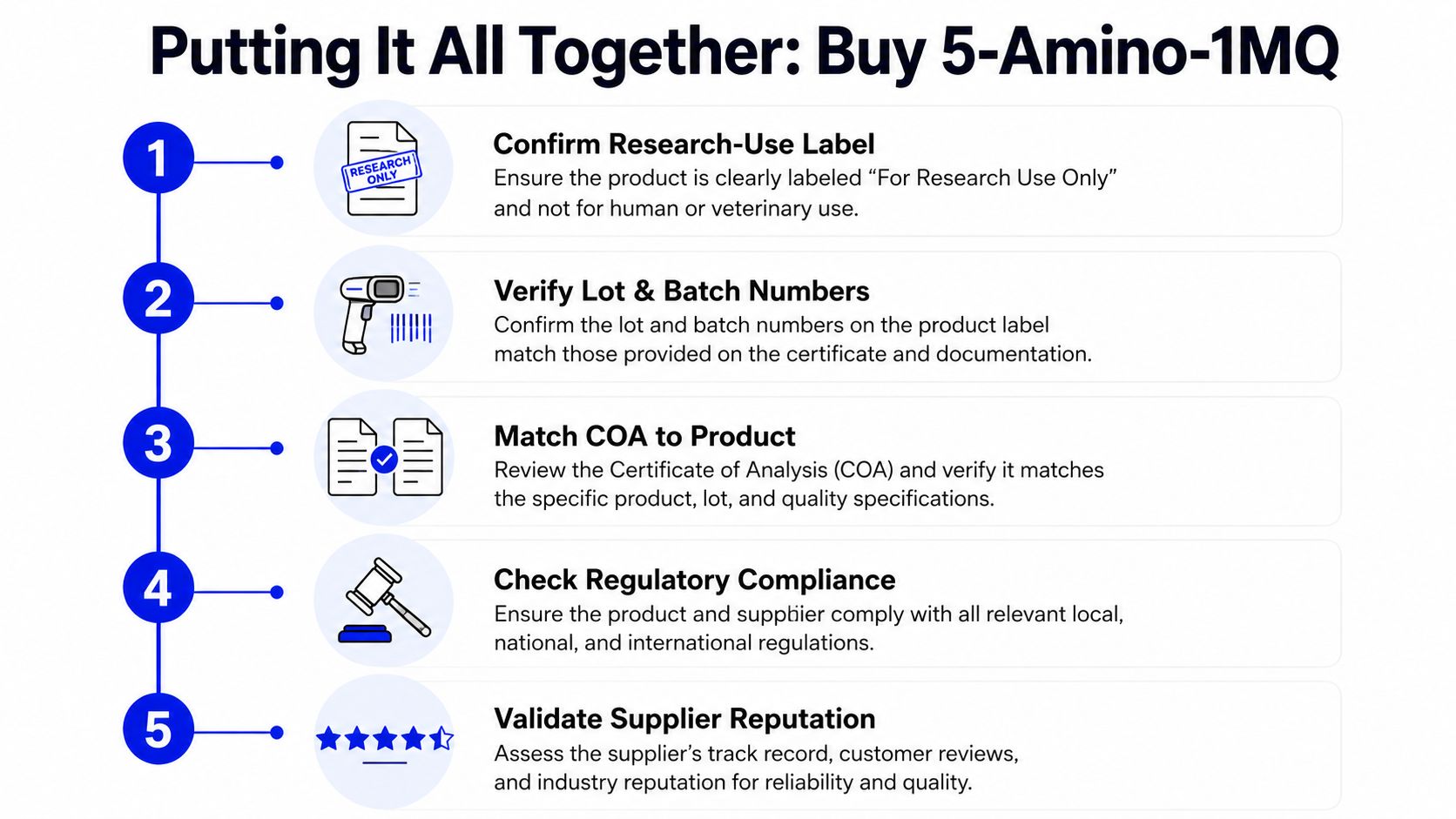
The purchase decision can be reduced to five filters. Each one removes a different category of risk, and none requires the buyer to accept a supplier's marketing claims on trust.
First, confirm the label. The product should be clearly designated for research use, with no suggestion that it is a supplement, medicine, cosmetic ingredient, or treatment.
Second, verify the lot. Match the vial, quotation, invoice, COA, and shipping record. If the lot number changes during the transaction, stop and request clarification.
Third, assess the analytical record. Prefer a supplier that can provide supporting chromatograms, identity data, and relevant contaminant information. A headline purity statement without a traceable report is not enough for a careful lab.
Fourth, check the legal and shipping context. Confirm that the intended use is lawful in your jurisdiction, and retain import, origin, and end-use paperwork where applicable. Your institution's compliance or biosafety office should resolve questions that extend beyond ordinary procurement.
Fifth, pressure-test the supplier. Review the business identity, storage claims, returns process, responsiveness, and price rationale. A low offer isn't valuable if the material arrives without usable documentation.
A catalog can be a starting point, but it shouldn't replace due diligence. Peptide Warehouse USA lists 5-AMINO-1MQ as a research-use-only compound and presents batch documentation, product information, and purchase options for laboratory, analytical, and preclinical applications. Review the listing, request the records your protocol requires, and have your lab approve the material before use.
Peptide Warehouse USA offers 5-AMINO-1MQ and related research compounds with product documentation intended to support laboratory procurement, including Certificates of Analysis and stated batch information. Visit Peptide Warehouse USA to explore the catalog, review the available research-use materials, and contact the team with specific documentation questions before placing an order.