No products in the cart.


You're trying to buy CJC 1295 No DAC, but the primary challenge usually isn't finding a listing. It's figuring out which vendor can prove what they're selling. One page says “research grade,” another says “99% pure,” and a third gives you a PDF that doesn't clearly match the vial on your desk.
That gap between marketing and documentation is where most procurement mistakes happen. For lab work, the peptide itself matters, but the Certificate of Analysis, lot traceability, and compliance trail matter just as much. This guide breaks down how to separate CJC-1295 No DAC from the DAC form, how to review vendor paperwork, what to check when you order, how to inspect shipments, and how to verify the material after it arrives.
A common procurement headache starts the same way. A researcher needs CJC-1295 No DAC for a preclinical workflow, but the supplier page is vague, the purity claim is broad, and the storage guidance doesn't say much beyond “keep refrigerated.” That's not enough when the goal is a usable research material with a paper trail you can defend later.
The safer approach is to treat purchase decisions like a documentation review, not a shopping cart decision. With peptides, the wrong variant can change the entire experiment, and a polished product page can still leave you with weak traceability.
A reliable buying process starts with three questions. Is this the No DAC form, not the longer-acting DAC version? Does the vendor provide batch-specific proof, not just a marketing claim? And can your lab receive, log, and qualify the material without gaps in compliance?
A procurement review of CJC-1295 No DAC starts with the label, not the price tag. The short-acting form is commonly labeled Mod GRF 1-29, and independent research summaries list its molecular weight as 3,367.9 g/mol. Before a lab places an order, the vial name and the Certificate of Analysis should match the exact variant, because the DAC and no-DAC forms do not serve the same research purpose PeptRiva.
A useful comparison is a stopwatch versus a timed release capsule. One supports a brief exposure window, the other holds activity longer. That difference is why the no-DAC version is typically selected for workflows that need tighter timing around sampling and assay readouts, while the DAC form is used in studies that call for longer persistence.
A published clinical summary says CJC-1295 with DAC extends activity to about 6-8 days, while the non-DAC version clears much faster Yunique Medical. For a colleague planning a study, that means the sampling plan cannot be copied from one variant to the other without changing the interpretation.
The timing difference affects more than the dosing schedule. It changes when blood draws are taken, how repeat administrations are spaced, and how hormone-response curves are read later in the workflow. A material that clears quickly can be a better fit for pulse-like behavior, while the DAC form supports sustained activity studies.
The paperwork check is where many purchases are either approved or paused. A vial label that names one variant, a COA that names another, or a product page that stays vague creates a traceability gap. For compliance teams, that gap matters as much as the chemistry, which is why Verifying authenticity for compliance should be part of the receipt review.
Practical rule: if the vial label, COA, and product page do not identify the same variant, treat the lot as unverified until the vendor clarifies it.
A purchase can look fine on the product page and still create problems at receiving if the paperwork is thin. For a lab team, the first question is not just whether the peptide appears pure, but whether the vendor can show a clear paper trail from listing to vial to test report. A lot-specific COA with identity confirmation gives you that trail, and major research suppliers commonly pair purity claims with mass spectrometry identity confirmation, plus sterility and endotoxin screening Nationwide Peptides.
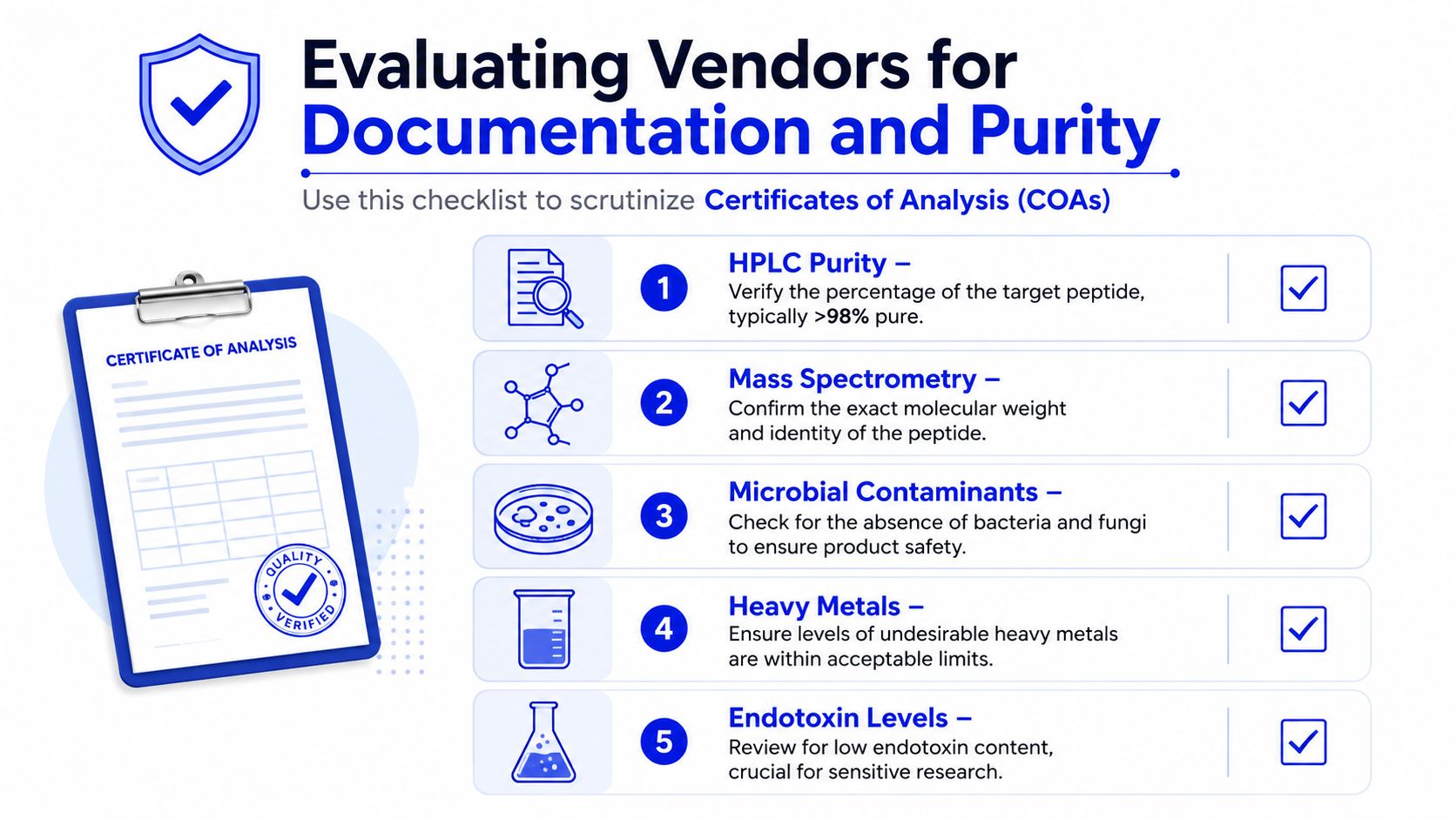
A useful COA does more than repeat the product name. It should connect the material to a batch number, show the test date, and state the methods used so the report can be matched against the vial without guesswork. In practical procurement terms, the COA should read like a chain of custody form, not a sales flyer.
Third-party reports often go beyond a single purity result and include identity confirmation, endotoxin screening, and sterility checks, which is why lot-level documentation has become a clear separator between vendors Healius Peptides. That extra documentation matters because a peptide can look clean on HPLC and still be the wrong sequence variant if the evidence package is weak.
Purity and identity answer different questions. Purity tells you how much of the sample is the target material, while mass spectrometry helps confirm that the vial contains the exact form you ordered. Without both checks, the paperwork may look polished while the actual product remains unverified.
A good reference point is a vendor process that makes authenticity easy to check from the start. For a practical compliance lens, review Verifying authenticity for compliance and compare that approach with the COA package you are being offered.
Buyer's habit: if you cannot connect the vial to the COA in one minute, your lab file probably cannot defend the purchase later either.
Some suppliers publish more than one purity claim, and the exact number matters less than the proof behind it. Public listings in major markets commonly show ≥98% to ≥99.1% HPLC purity, with some batch reports showing 99.3%, 99.4%, or 99.96% purity PeptRiva. That range shows why the document set is part of the product itself, not just an attachment.
Use the COA as a screening tool, not as a substitute for lab qualification. If the vendor cannot show purity, identity, and contamination testing together, keep looking.
Ordering buy CJC 1295 No DAC isn't just a checkout task. It's a compliance step, a logistics step, and a records step all at once. A good purchase process reduces ambiguity before the box ships, which saves time when someone later asks why you chose that supplier or how the material was handled.
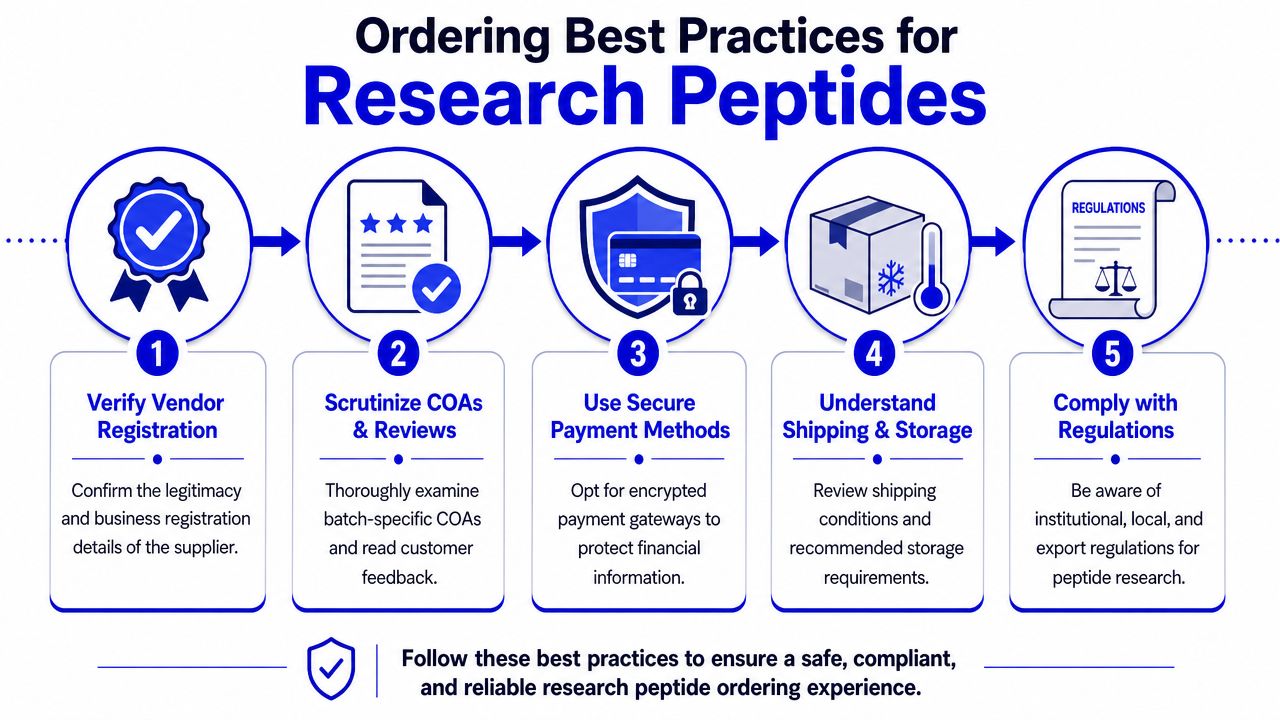
Regulatory sources agree that CJC-1295 remains investigational and is not FDA-approved for humans, so research-only compliance has to stay front and center Paragon Sports Medicine. That means the person placing the order should confirm the institution's research policy, buying authority, and any export or import considerations before payment.
Secure payment methods matter too. Use encrypted checkout, keep the invoice, and make sure the billing name aligns with the lab or institution that will receive the product. That kind of consistency helps later if procurement, finance, or compliance teams need to reconcile the order.
For labs that coordinate across multiple departments, the ordering step is where delays often start. If procurement, principal investigators, and lab staff all review the same COA and shipping terms before the order is placed, you avoid the most common handoff mistakes.
The video below is a useful visual reference for the broader purchase workflow.
The box may be on the bench, but the work is not finished. Receiving is the point where small errors are easiest to catch, and they are much easier to document in the moment than to rebuild later from memory. Good labs treat arrival day like a formal checkpoint, because that is where the paper trail meets the physical shipment.
A test report example tied to this workflow showed batch-level documentation with 99.96% purity, TFA not detected, and both endotoxin and sterility marked Pass, which is the kind of record that helps a receiving team compare the shipment against the paperwork without guessing Healius Peptides. If a vial arrives with that level of documentation, the team still has to confirm that the label, lot, and condition match what was ordered.
Open the parcel carefully and compare every label against the purchase record. Check that the vial name, batch number, and paperwork all match, then confirm that the seal is intact and the packaging matches the shipping method you were promised.
The lot number should be logged right away. If several vials or batches are stored in the same freezer, delayed entry can create confusion later, especially when a project begins using aliquots weeks after receipt. A clean record at intake works like a chain of custody, each step makes the next one easier to defend.
For teams that care about operational reliability, receipt inspection is a data quality problem as much as a packaging problem. A workflow mindset similar to data quality for modern teams helps here, because the team is checking whether the delivered item matches the documented item before it enters the lab inventory.
Keep the unpacking environment controlled. Protect the material from unnecessary light exposure, avoid excessive humidity, and move it quickly into the correct storage condition once the initial inspection is done. If the product arrives with any visible damage or labeling mismatch, quarantine it before it touches the rest of your inventory.
Receiving rule: do not file it later. If the label is wrong, the freezer can wait.
A vial can pass through ordering and receiving with no obvious issues, then still fail once your team inspects what is in the freezer. Post-receipt QC is the final checkpoint before the material enters a study, and it gives procurement a clear record if anyone later asks whether the lot was examined in-house.
For CJC-1295 No DAC, identity confirmation should start with the basics: verify that the vial label and COA describe the same variant, then compare those documents against your incoming records. Independent research summaries list the molecular weight as 3,367.9 g/mol, so the expected identity is not just a name on paper, it is a specific molecular profile that should be checked against the batch documentation PeptRiva.
Use a small aliquot and follow the same logic the vendor should have documented. HPLC looks at purity, mass spectrometry checks identity, and an endotoxin assay helps when the protocol is sensitive to contamination. If your lab also requires sterility assurance, include that step before the material is cleared for use.
| QC Test | Purpose | Acceptance Criterion |
|---|---|---|
| HPLC | Checks peptide purity | Match the vendor's documented purity claim |
| Mass spectrometry | Confirms peptide identity | Match the expected CJC-1295 No DAC molecular weight |
| Endotoxin assay | Screens for contamination risk | Meet your lab's internal threshold |
| Sterility check | Verifies microbial cleanliness | No growth under your protocol conditions |
QC is not a simple pass or fail stamp. It is the check that links the vial in your freezer to the paperwork that accompanied it, so the product and the record stay aligned. If the purity looks acceptable but the identity result is uncertain, the lot still needs more review before it is used in a study.
The same logic helps later when a team orders again. A documented QC baseline gives you a reference point for the next batch, which makes it easier to spot drift in vendor performance or changes in the paper trail.
Buying CJC-1295 No DAC the right way comes down to discipline, not guesswork. You need the correct variant, a COA that proves identity and purity, a compliant ordering process, careful receiving checks, and post-receipt QC that confirms the material before it enters a study. That workflow protects research integrity and keeps procurement from becoming a silent source of experimental error.
The most reliable labs don't treat documentation as paperwork. They treat it as part of the product. When the COA, vial label, batch number, and test results line up, your team can move forward with more confidence and fewer surprises.
If you're ready to review reliable research options, explore the available peptide listings, compare the COAs, and contact support with any documentation questions before you place an order. A careful procurement process is just as important to good science as the experiment itself.
A CTA for Peptide Warehouse USA.