No products in the cart.



You're usually not looking to buy GHK-Cu because of curiosity alone. You're trying to keep a study moving, replace a vendor that stopped providing real documentation, or prevent a simple purchasing decision from contaminating months of assay work.
That's where most buyers get this wrong. They focus on the peptide name, the vial size, or the price, and they treat quality paperwork like a formality. In practice, the documents matter as much as the compound. If you want to buy GHK-Cu for legitimate research, the safest approach is to evaluate the supplier the same way you'd evaluate a method. You want identity, purity, traceability, storage integrity, and clean legal boundaries.
A junior scientist orders a vial labeled GHK-Cu, plugs it into a repair or matrix-signaling assay, and assumes the label settles the question. In practice, that is where the real work starts. With a copper peptide, identity, complexation state, and documentation all affect whether the material in hand is suitable for research use.
GHK-Cu is the copper complex of the tripeptide glycyl-L-histidyl-L-lysine. Researchers study it because it behaves as a broad signaling peptide rather than a single-target tool. That matters in experimental design. A broad-acting compound can shift several readouts at once, which makes clean sourcing and clear lot documentation more important if you want interpretable data. A useful starting point is the published overview in this GHK-Cu literature overview.
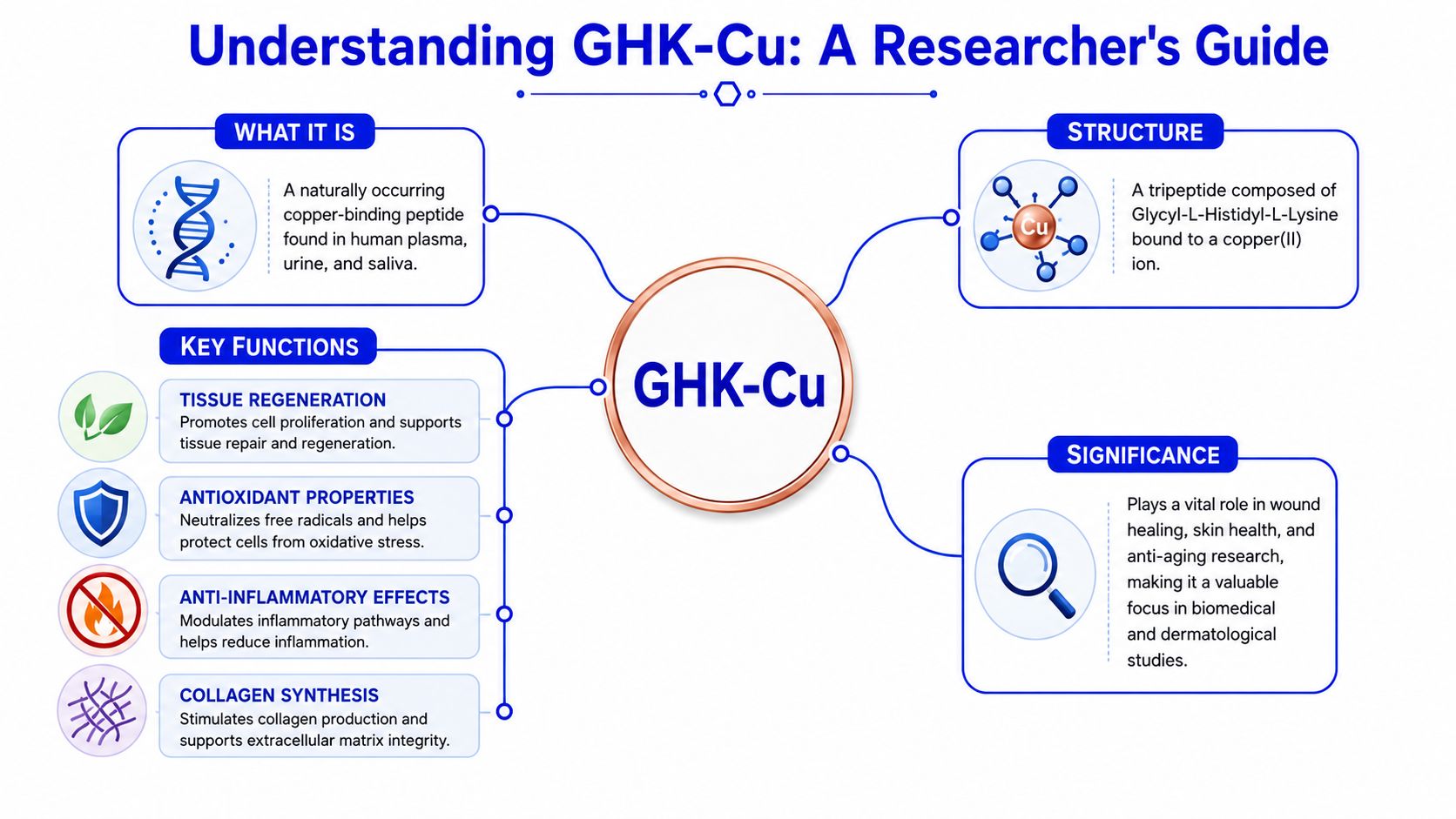
GHK entered the literature decades ago, and that long publication trail is one reason labs still evaluate the copper complex in tissue-repair, extracellular-matrix, and inflammatory models. The compound is not interesting because it is trendy. It remains in circulation because researchers continue to test it in systems where cell maintenance, remodeling, and stress response overlap.
That broad relevance shows up in several common use cases:
For lab managers, the key point is straightforward. GHK-Cu is not just "a peptide." It is a specific peptide-metal complex, and that distinction should shape how you evaluate any supplier file.
If a vendor cannot show how the lot was identified, how purity was assessed, or whether the copper-associated form was characterized, the material may still arrive with a polished label and poor research value. I have seen teams lose weeks this way. The assay produced movement, but nobody could defend whether the effect came from the intended complex, free peptide, residual impurities, or handling damage before the vial ever reached the bench.
Use the literature to understand mechanism and expected applications. Use documents to decide whether a batch belongs in your lab. If you are screening papers while narrowing vendors or refining an assay plan, an AI solution for literature review can help organize primary sources and compare methods faster.
A failed lot rarely announces itself on day one. The vial arrives on time, the label looks clean, and the product page sounds technical. Two weeks later, assay behavior drifts, repeat runs do not line up, and the team is left arguing about biology when the actual problem started in procurement.
Buying GHK-Cu without documentary due diligence creates that risk. A storefront cannot show whether the lot in the vial matches the label, whether the material was tested on that batch, or whether the supplier can support traceability if results are challenged later.
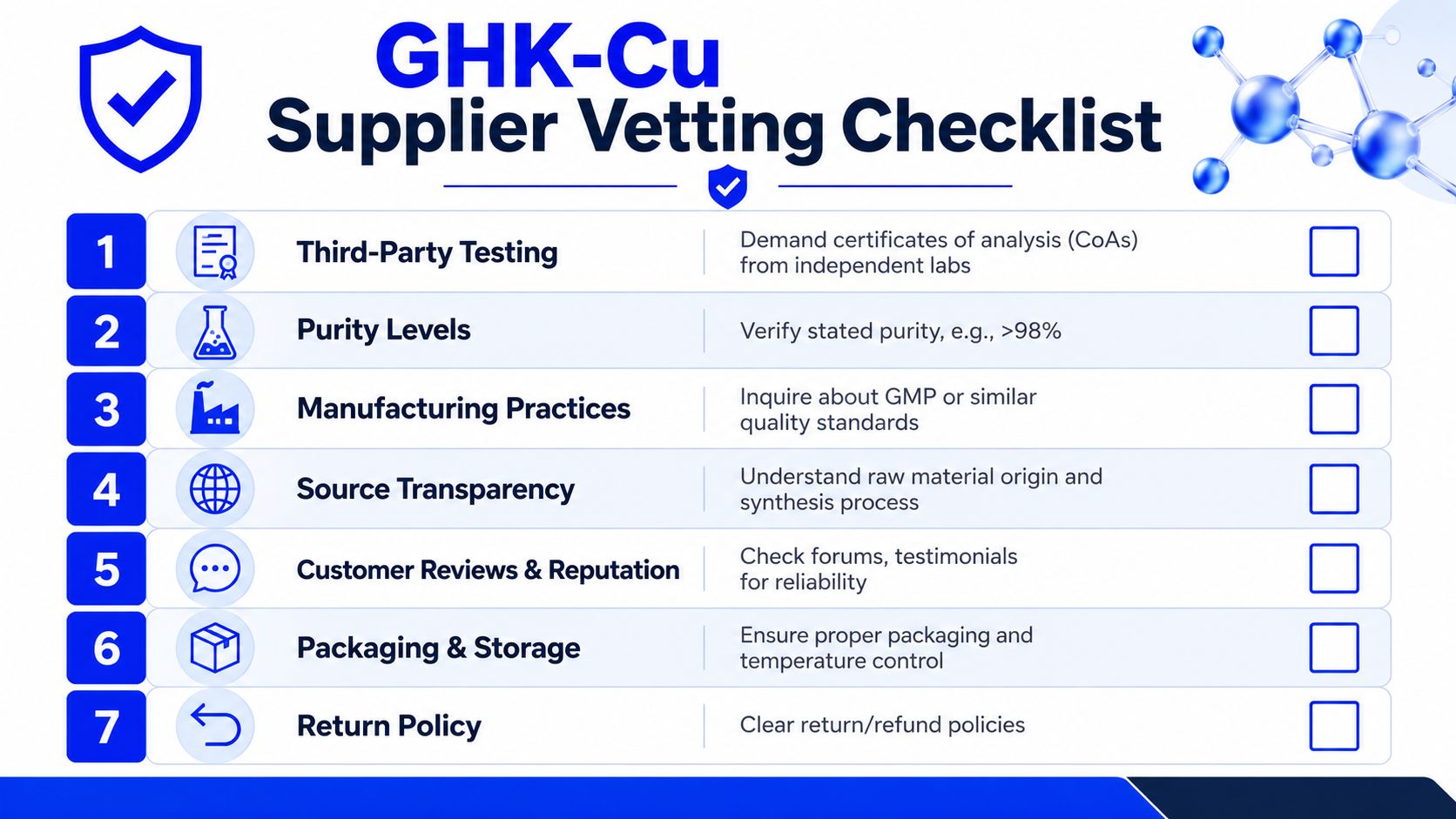
The procurement question is simple. Can the supplier produce records that let your lab verify identity, purity, handling, and lot traceability before money changes hands?
That review should happen before anyone debates vendor reputation or product page claims. For GHK-Cu, I want to see the supplier operate like a controlled materials vendor, not a retail supplement storefront dressed up for researchers.
Use this screening process before issuing a PO:
Weak suppliers usually fail on the same points. They send a generic certificate, avoid direct answers about testing, or answer technical questions with copied product page language. That is enough reason to pause.
Later in the review process, some teams also find it helpful to watch a short overview before finalizing purchasing criteria:
Credible transparency is procedural. It shows up in records, version control, and the supplier's ability to answer ordinary QA questions without hedging.
A reliable supplier makes lot traceability easy to follow. The vial should map cleanly to its paperwork. The company should also separate research-use material from any human-use claims with clear labeling and clear terms. If that distinction is blurred, involve your compliance lead before proceeding.
Specifications also need to be concrete. "High purity" is marketing language. A measured purity result tied to a lot is procurement data. The same standard applies to shipping and storage instructions. Labs need to know how the peptide was packaged, what environmental controls were used in transit, and what conditions are required on receipt.
Good vendors reduce procurement uncertainty by producing records you can audit.
If you are comparing suppliers, look for a documented pattern rather than a polished promise. Peptide Warehouse USA, for example, is often cited by buyers because its research peptide materials are described with COAs and supporting microbial or endotoxin documentation available by lot or by request. That is the level of documentation structure worth expecting from any vendor under consideration.
Most buyers say they want a COA. Fewer can read one well enough to reject a weak lot. That gap matters because a COA only protects your project if you know which fields influence experimental validity.
For research-grade procurement, buyers should prioritize GHK-Cu products with ≥99% HPLC purity, lyophilized blue-to-blue-green powder form, and batch-specific COAs that report mass spectrometry-confirmed identity (C14H23CuN6O4; MW 340.38 g/mol) and copper content, according to this GHK-Cu specification reference.
Start with HPLC purity. If the vendor claims research grade but doesn't show a strong purity result, you're guessing about the amount of target compound versus related impurities. For GHK-Cu, the documented benchmark above gives you a practical standard for procurement review.
Then move to mass spectrometry identity. The supplier shows that the molecular identity aligns with the intended compound rather than a mislabeled or degraded product. For a lab manager, this is essential because identity failure can invalidate every downstream result.
Appearance also matters more than people think. The expected blue-to-blue-green lyophilized powder is a practical sanity check. Appearance doesn't replace analytics, but if the visual presentation is inconsistent with the documented form, pause the order and ask questions.
Finally, check for copper content reporting. GHK-Cu isn't just a peptide sequence. It's a copper complex. If the copper side of the complex is poorly characterized, your biological behavior may drift from what you intended to test.
Lab note: If a COA gives you a peptide name and a purity line but no lot-specific identity data, you do not have enough to qualify the material confidently.
| Parameter | Example Specification | What It Means for Your Research |
|---|---|---|
| Peptide name | GHK-Cu | Confirms the lot is labeled as the intended copper peptide complex |
| HPLC purity | ≥99% | Reduces uncertainty from contaminant peaks and supports cleaner interpretation |
| Mass spectrometry | Identity confirmed | Verifies that the lot matches the expected molecular identity |
| Molecular formula | C14H23CuN6O4 | Lets QA staff compare the reported compound against the expected complex |
| Molecular weight | 340.38 g/mol | Helps confirm identity consistency across vendor documentation |
| Appearance | Lyophilized blue-to-blue-green powder | Provides a practical visual check before reconstitution |
| Copper content | Reported on COA | Confirms the complex has been characterized beyond peptide naming alone |
| Batch number | Lot-specific | Enables traceability if results later need review or repeat testing |
A clean COA should let a new team member answer three questions quickly. What is this? How pure is it? Was this exact lot tested?
If the document can't answer those plainly, it isn't doing its job.
A lot of confusion in this market comes from buyers mixing research procurement with therapeutic assumptions. Those are separate lanes, and the paperwork should reflect that clearly.
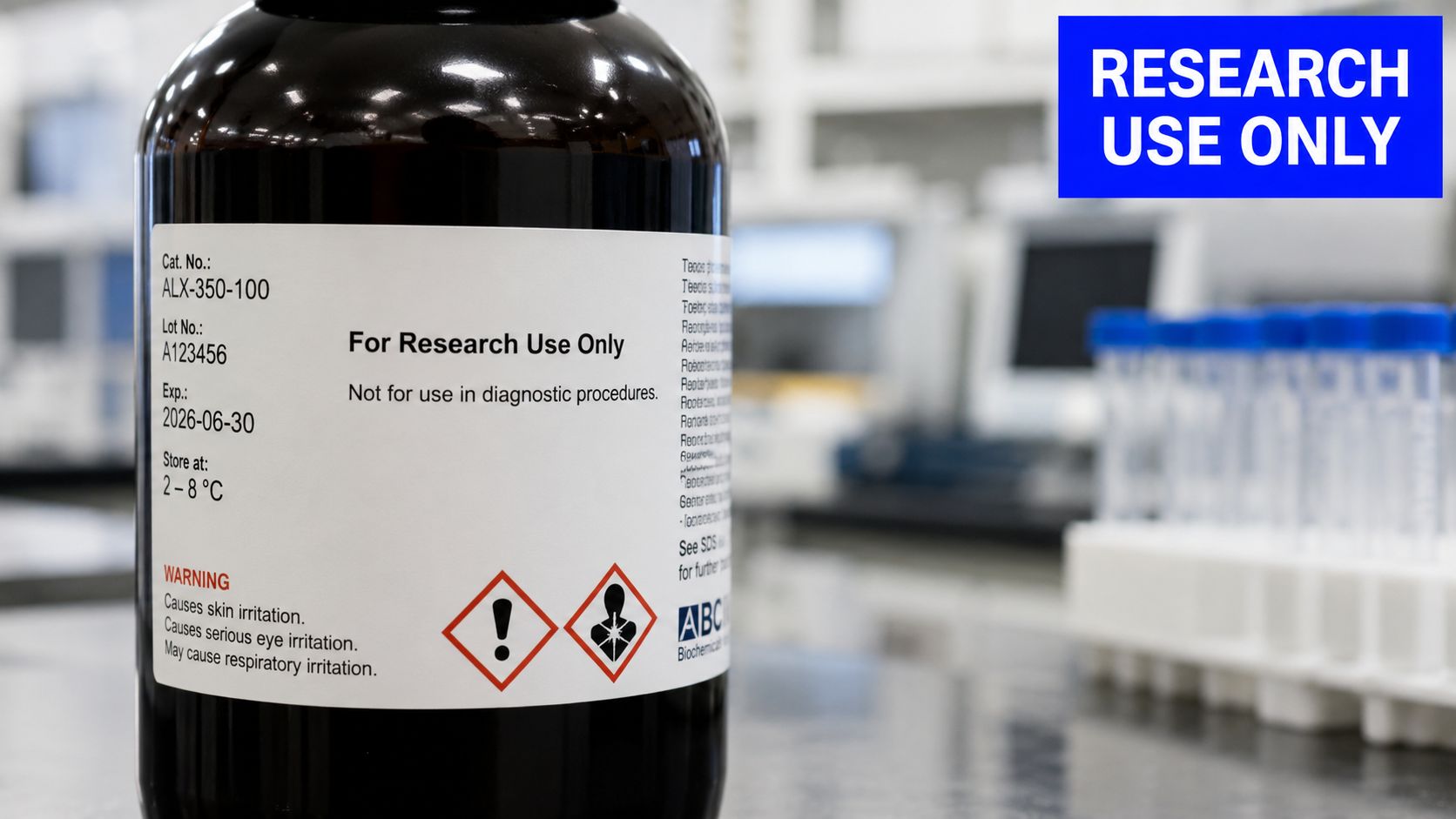
If you buy GHK-Cu for laboratory, analytical, or preclinical work, the Research Use Only boundary needs to be explicit. A compliant supplier should label the product and site experience in a way that makes the intended use unmistakable.
That matters for two reasons. First, it protects your institution by keeping procurement aligned with research functions. Second, it helps separate legitimate lab sourcing from gray-market behavior that creates avoidable exposure for purchasers, reviewers, and administrators.
A vendor that hints at human administration while using RUO language is creating risk, not convenience.
In 2024 and 2025, the U.S. Food and Drug Administration placed GHK-Cu on its bulk drug substance list in Category 2 for 503A and 503B outsourcing facilities, meaning that injectable GHK-Cu is no longer permitted to be compounded for human use under those sections of the Federal Food, Drug, and Cosmetic Act, as summarized in this regulatory discussion of GHK-Cu purchasing and status.
For labs, the practical takeaway is straightforward:
The safest procurement file is the one a compliance officer can read without having to infer intent.
If your team is evaluating vendors, check whether the site has age gating, FDA disclaimers, and a clear statement that products are sold for research use only. Those aren't cosmetic features. They show whether the supplier understands the category it operates in.
Once you've narrowed the field to suppliers with credible documentation, procurement should be boring. That's a good sign. Smooth ordering means the operational side is under control and your team won't waste time chasing basic order details.
Use a simple internal workflow rather than letting each buyer improvise.
Some teams buying GHK-Cu also standardize their hazard review workflow across all incoming research chemicals. If your institution operates internationally or maintains regional safety procedures, a resource on controlling hazardous chemicals in Australia can be a useful reference point for building cleaner document management practices around SDSs and inventory controls.
Receiving is where a lot of preventable mistakes happen.
Use this short intake checklist:
A good purchase isn't complete at checkout. It's complete when the lot is received, verified, logged, and stored correctly.
A vial can arrive with clean paperwork, match the COA, and still fail your study if the lab mishandles it after check-in. I have seen good material lost to something as ordinary as condensation during repeated freezer access or a reconstituted stock left in service long after the prep date was forgotten.
Storage control starts with one practical rule. Protect the lyophilized peptide from moisture, heat, and unnecessary light. Published product handling guidance for GHK-Cu points to frozen, desiccated storage for the dry material and careful concentration control after reconstitution, with added caution around copper-related effects in biological systems, as noted in this GHK-Cu handling and procurement reference.
For lab operations, that means writing the handling steps down and making them routine:
Reconstitution deserves the same discipline as assay setup. Treat it as a controlled preparation step, not a quick bench task. The peptide carries copper, so poor concentration choices can distort the biology you think you are measuring. In practice, that means using a written prep record, checking dilution math independently, and defining an in-use window for reconstituted stocks before the first experiment starts.
A handling routine that holds up under audit usually includes a few simple controls:
The goal is not just to preserve the peptide. It is to preserve confidence in the result. If storage history, reconstitution records, or aliquot labels are weak, the experiment inherits that uncertainty.
Locating where to buy GHK-Cu often leads to an expectation of a vendor list. What they really need is a qualification process. The peptide name is only the starting point. The key decision sits in the documents, the compliance posture, the shipping discipline, and the way the lot is handled once it lands in your lab.
Run this checklist before approving any purchase:
If any answer is vague, delay the purchase.
The strongest GHK-Cu buying decision usually isn't the fastest one. It's the one that preserves experimental validity, keeps your paperwork defensible, and gives your team confidence that the signal they measure came from the compound they intended to study.
If you want a research supplier that aligns with this QA-first approach, Peptide Warehouse USA is worth reviewing. Explore options, examine the available documentation, and make sure the lot you buy meets your lab's standards before it enters a single assay.