No products in the cart.


You've searched “buy reta peptide”, found a dozen polished product pages, and now you're trying to determine which listing represents a usable research material rather than a relabeled vial with attractive marketing. That's the right concern. Retatrutide is investigational, and the quality of the documentation matters more than the product photo, discount, or promise of fast results.
This guide takes a procurement-first approach. You'll learn how to distinguish research-use-only supply from consumer-facing medical claims, read a batch-specific Certificate of Analysis, compare sourcing channels, and reject listings that can't establish identity, purity, traceability, and responsible handling.
The phrase “buy reta peptide” usually reflects a search for a laboratory research material, not a prescription product. Retatrutide, often shortened to “reta,” is not FDA-approved and isn't legally available through ordinary US pharmacy or retail channels outside an authorized clinical pathway, according to independent coverage of retatrutide's legal status.
That distinction should appear at the top of your sourcing process. A legitimate research supplier should identify the material as for research use only, or RUO, and should describe laboratory, analytical, in-vitro, animal, or preclinical applications. RUO labeling doesn't grant FDA approval or permission for human use. It defines the intended research context, as explained in this overview of research-use-only peptides.
A credible listing commonly provides:
Pharmacy-style language is a warning sign. Claims about treating obesity, accelerating fat loss, replacing a prescription, or providing a personal injection protocol blur the line between research supply and medical marketing. A seller that welcomes personal-use questions is showing you that its compliance controls may be weak.
Procurement rule: If the listing can't clearly establish research-only intent, don't move to checkout. Move to another supplier.
The right question isn't “Which vendor promises the strongest benefits of peptides?” It's “Which vendor can document what this material is, which lot it came from, how it was tested, and how it should be handled in a laboratory?”
Retatrutide is a triple-hormone receptor agonist studied in metabolic and weight-related research. The published clinical milestone most often used as an independent reference is a phase 2 obesity trial in the New England Journal of Medicine. The trial enrolled 338 participants from May 2021 through November 2022, and reported dose-dependent mean weight loss of up to 17.5% after 24 weeks and up to 24.2% after 48 weeks.
Those findings explain why the molecule receives substantial search attention. They don't change its regulatory status, and they don't validate every online vial labeled retatrutide. A peer-reviewed clinical report, a clinical-trial-stage compound, and a gray-market product are three different things.
The molecule has a scientific identity. The listing has a supplier, lot number, analytical record, storage history, and chain of custody. Your research depends on the second group of factors just as much as the first.
A supplier may use the name “retatrutide” in a product title, but the title alone doesn't confirm molecular identity. It also doesn't tell you whether the vial was synthesized by the stated source, relabeled after bulk purchase, exposed to unsuitable conditions, or tested using a method that the supplier hasn't documented.
The broader peptide therapeutics category helps explain the commercial pressure around this search. One market analysis of peptide therapeutics estimated the global market at USD 140.9 billion in 2025 and projected it to reach USD 294.6 billion by 2033, with an 8.7% CAGR from 2026 through 2033. Those figures describe the wider pharmaceutical sector, not the quality of any individual retatrutide listing.
High search demand attracts serious suppliers and opportunistic sellers. The latter often copy terminology from clinical research while omitting the evidence needed to verify a specific batch.
Treat retatrutide as a higher-scrutiny procurement item. Don't let clinical publicity substitute for documentation, and don't treat a familiar product name as proof of purity or identity.
A sound purchase decision rests on four checks. Use them as a repeatable supplier audit rather than relying on appearance, testimonials, or a single purity number.
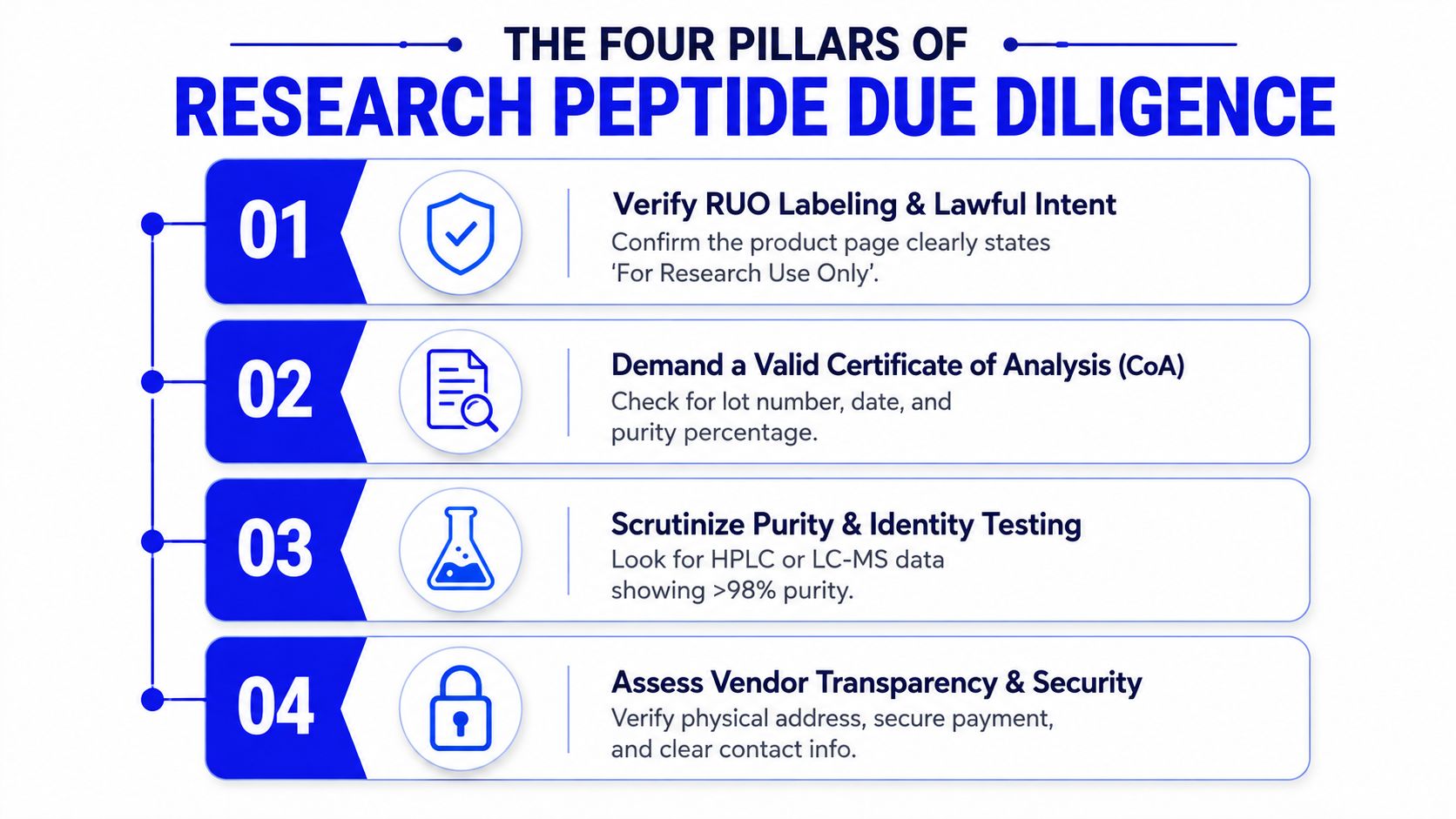
Start with the product page and the checkout flow. The page should state For Research Use Only and avoid human dosing, treatment claims, or personal-use instructions. If a seller refuses to supply someone who describes personal consumption, that's a useful compliance signal.
Don't accept a disclaimer buried in the footer while the rest of the page markets body-composition outcomes. The full presentation matters. A responsible supplier keeps the product description aligned with laboratory, analytical, or preclinical use.
Ask for a certificate tied to the exact lot. A credible COA should report identity, purity, and contaminants rather than displaying only a large purity figure. Guidance on reading a peptide COA specifically emphasizes lot-level traceability and analytical detail.
Independent HPLC and mass spectrometry are the core checks. The supplied report should identify the testing laboratory, the tested material, the lot, the analysis date, and the methods used.
A US-facing supplier should provide a verifiable physical address, usable contact information, clear business details, and a compliance contact who can answer technical questions. Domestic billing or a US domain doesn't prove domestic synthesis, so ask where manufacturing and testing occur.
You should also understand shipping and storage handling before placing an order. If the vendor can't explain how the lyophilized material is packaged, tracked, and protected during transit, procurement risk remains unresolved.
Packaging should look like research packaging, not a consumer medicine kit. Labels should identify the material and lot, include research-use language, and provide handling information without implying human administration.
Secure payment, tracking, clear returns terms, and documented storage guidance complete the basic screen. These details won't prove molecular identity, but their absence often signals weak operational controls.
A COA isn't a decorative PDF. It's the document that connects a tested sample to the vial you're considering. Start by matching the vendor name, product name, catalog number, lot number, and analysis date to the product page and label.
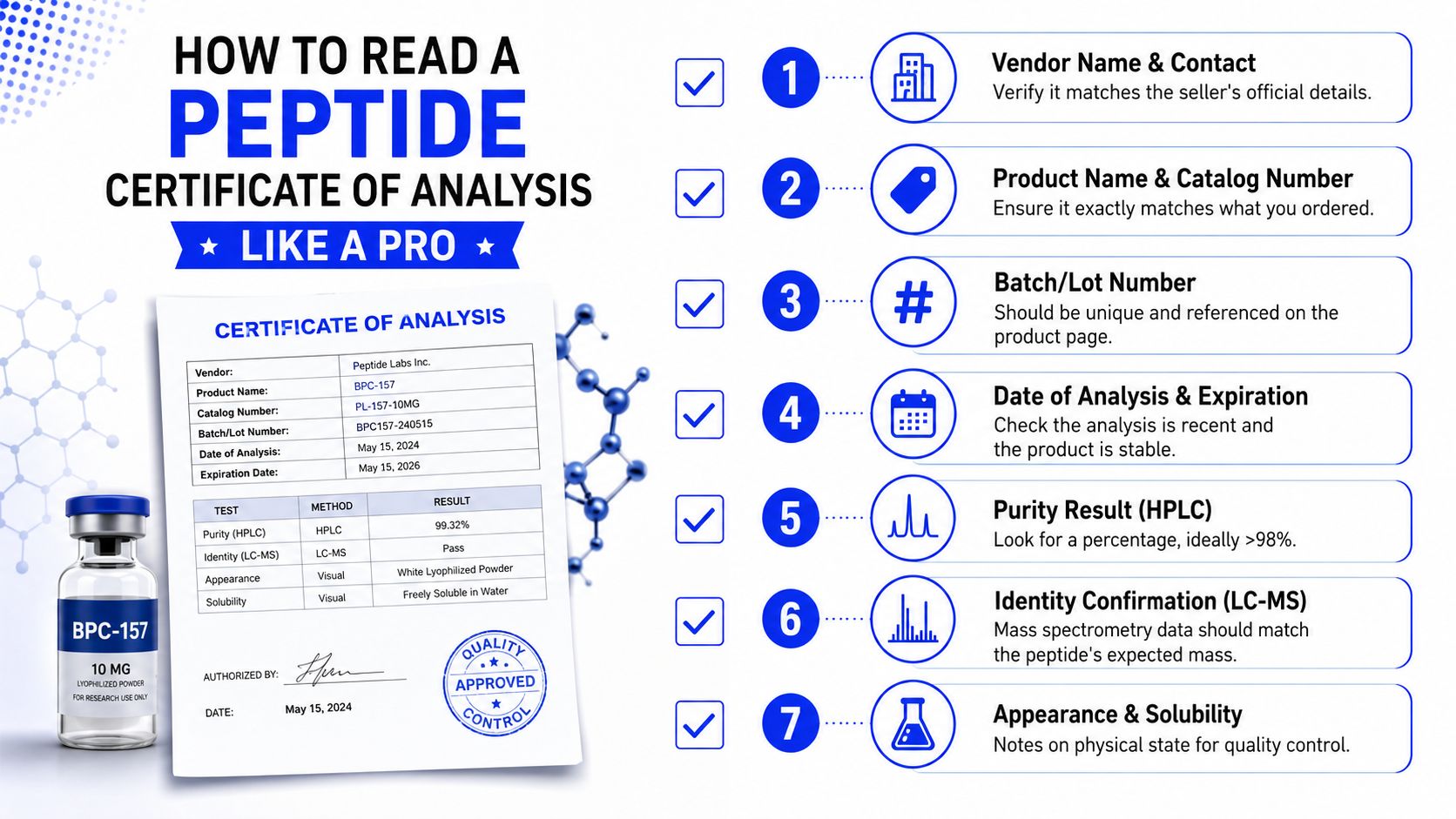
HPLC can show how the sample separates chromatographically, but a clean-looking purity result doesn't independently establish that the main peak is retatrutide. Mass spectrometry provides an identity check by comparing the measured mass with the expected molecular mass.
Read the report for:
A trustworthy COA is batch-specific and usually reports HPLC purity, mass spectrometry identity, and impurity data, rather than presenting a single isolated purity number. The report should also identify the analyst or laboratory responsible for the work.
A logo isn't proof of third-party testing. Verify the issuing laboratory through its own domain, confirm that the report format is consistent with its stated services, and check that the vendor hasn't uploaded an undated template.
Be cautious with a report that has no analyst signature, no method details, no chromatogram, no lot number, or a purity result that looks mechanically rounded. A certificate issued before the listed synthesis or batch date is internally inconsistent. Don't explain away that contradiction. Ask for a corrected report or reject the lot.
Research teams should save the COA in the project folder alongside the purchase record, vial photographs, and receiving notes. That simple habit preserves traceability if a result later looks unusual.
Use the following video as a supplementary visual introduction to COA review, not as a replacement for the actual batch record.
The channel you choose changes the amount of verification work you'll need to perform. A direct manufacturer may offer stronger chain-of-custody information, while a marketplace may offer convenience but less consistency between lots. The safest choice is the channel that gives your lab enough documentation to make the material auditable.
| Channel | Documentation Quality | Pricing Transparency | Buyer Protection | Best Use Case |
|---|---|---|---|---|
| Direct manufacturer website | Potentially strong, if lot records and testing are accessible | Usually clear for listed products | Depends on published terms and support | Buyers who need direct sourcing information |
| Multi-brand research supplier | Variable across brands and compounds | Often easy to compare | May provide centralized support and returns | Labs seeking catalog breadth |
| Peptide aggregator marketplace | Inconsistent between sellers | Can appear competitive, but fees and fulfillment may vary | Marketplace policies may not cover material quality | Initial product discovery, followed by independent vetting |
| Peer-to-peer forum or classified listing | Often weak or absent | Frequently unclear | Limited recourse if the material is wrong | Generally unsuitable for controlled procurement |
A direct manufacturer or tightly controlled supplier can make it easier to establish who produced the material, who tested it, and which lot you received. That advantage disappears if the site doesn't publish meaningful documentation or if support can't answer basic questions about testing.
Ask whether the listed COA belongs to the current lot. Don't assume the word “manufacturer” guarantees traceability.
Multi-brand suppliers can simplify ordering when a lab needs several compounds. The weakness is inconsistency. Each brand may use different laboratories, formats, naming conventions, and storage policies.
Treat every product as its own vendor audit. A strong document for one compound doesn't validate another.
Aggregators can help you identify available formats and suppliers, but they're poor substitutes for primary documentation. Relabeled bulk vials, international drop-shipping, and unclear dispute resolution create problems that a low listed price won't solve.
Forum sales carry the greatest operational risk. If the seller can't provide a verifiable business identity, a batch-specific COA, and an accountable returns process, walk away.
Most sourcing failures don't begin with a complex analytical problem. They begin with a shortcut that seemed reasonable at checkout.
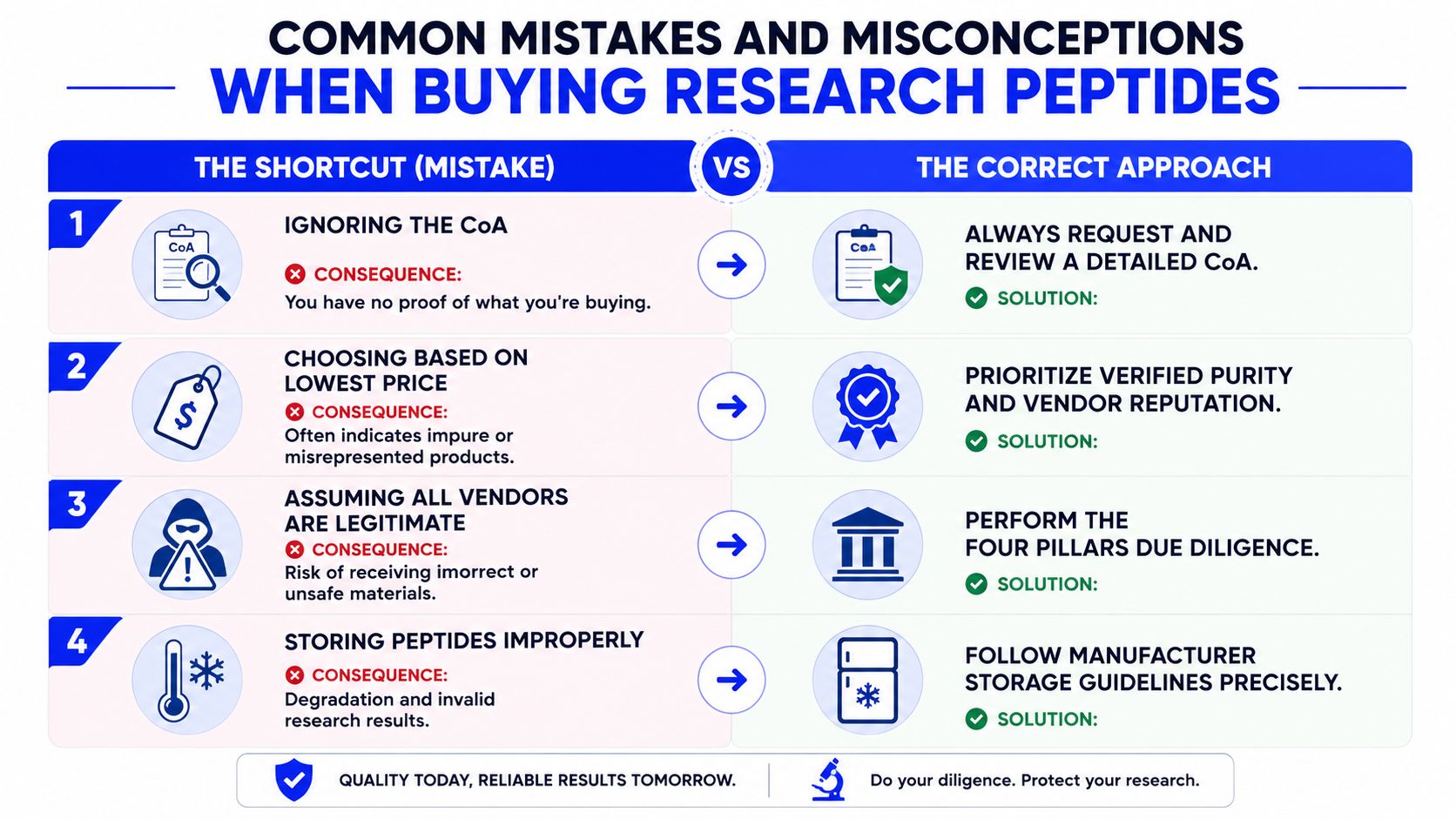
A cheap vial may reflect weaker documentation, lower purification effort, unclear origin, or a seller trying to move material without a defensible record. Compare the evidence package, not just the product price.
Counter-move: Require the same documentation standard from every candidate. If a cheaper listing can't supply it, remove the listing from consideration.
Sellers can display a testing logo without giving you a verifiable report. A branded PDF with no lot number or method details leaves you unable to connect the analysis to your vial.
Counter-move: Visit the issuing lab's official domain and verify the report or request confirmation through an independently sourced contact channel.
A domestic checkout, phone number, or warehouse address can coexist with international synthesis or fulfillment. That isn't automatically disqualifying, but it must be disclosed clearly so your team understands the supply chain.
Counter-move: Ask where the material is manufactured, where it's tested, and where the specific lot ships from.
Research-use-only labeling describes intended use. It isn't a prescription, a clinical authorization, or evidence that a compound is safe for self-administration.
Counter-move: Keep research procurement separate from medical decision-making. Don't convert a laboratory listing into personal treatment guidance.
A larger package can create more waste if your protocol requires a different amount or if the material lacks adequate stability documentation. Likewise, heavy online discussion demonstrates attention, not characterization of the specific lot you're buying.
Counter-move: Select the format your approved protocol requires, then verify identity, purity, storage, and documentation before ordering.
Use this checklist before you approve a purchase order. It should be quick to run, but don't rush the two items that determine whether the material is traceable.
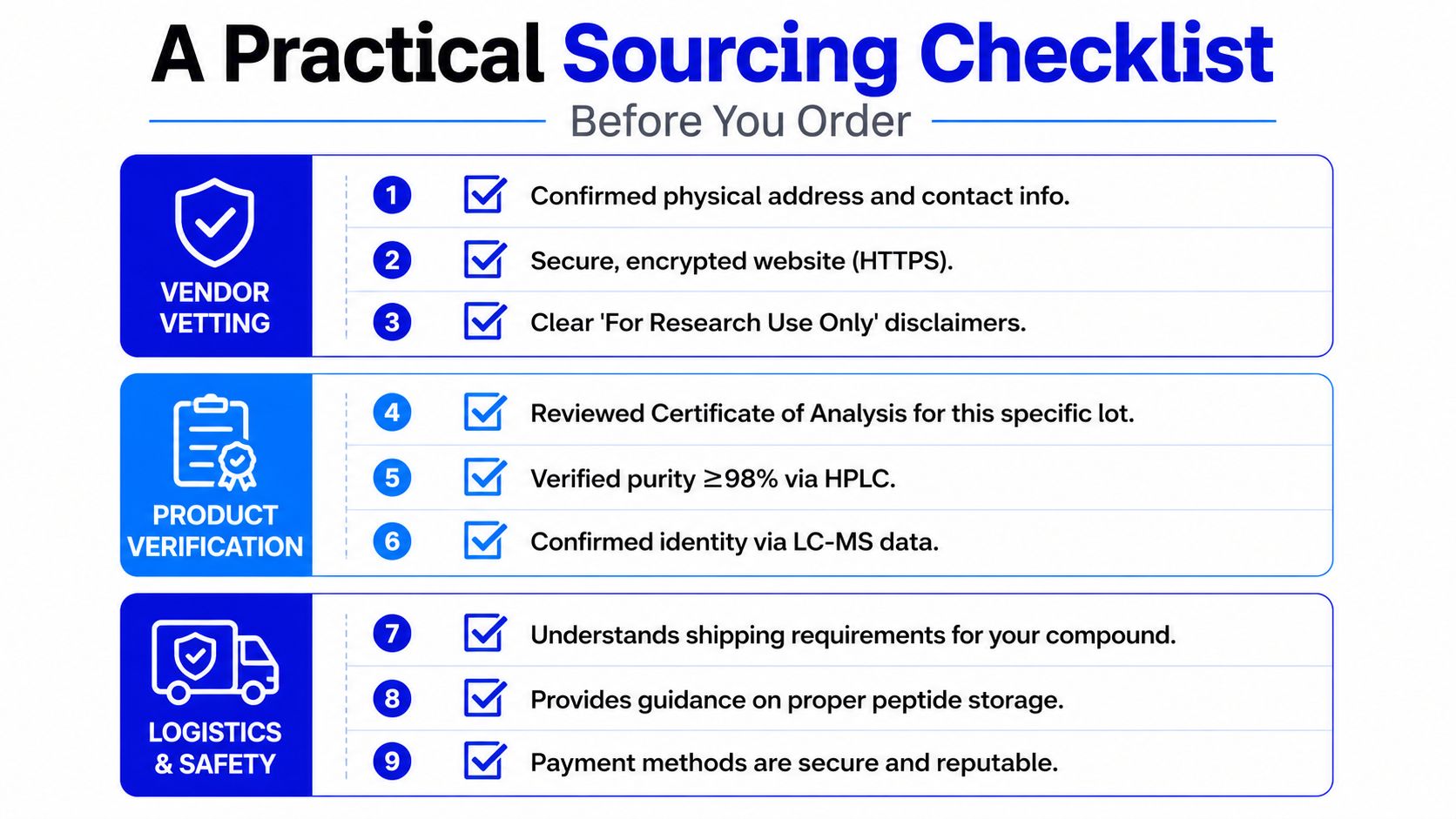
Never compromise on two points: don't buy a listing without a current COA tied to the exact lot, and don't proceed when the supplier can't explain the research-only status and chain of custody.
For buyers who want a pre-vetted starting point, Peptide Warehouse USA lists research-use-only retatrutide products and provides supplier information, batch documentation, and research-focused purchasing controls. Review the available records against your own protocol and procurement requirements before placing an order.
If you're ready to evaluate a documented US research supply option, visit Peptide Warehouse USA to review its retatrutide listing, research-use-only terms, and available batch documentation. Use the checklist above before ordering, and contact the support team if you need a record tied to a specific lot.