No products in the cart.

You've searched “buy thymosin alpha 1” and found a confusing mix of international pharmaceutical references, research-use-only listings, clinical discussions, and vendor claims that don't always agree. One page describes thymosin alpha 1 as an established immune compound, while another warns that it isn't approved for general use in the United States. Both statements can appear in the same search result, yet they refer to different regulatory contexts.
The practical answer is to separate scientific history, legal status, product quality, and laboratory handling. Thymosin alpha 1 was first characterized in 1977 and has been studied extensively in humans. A PubMed review summarizes more than 11,000 human subjects across more than 30 clinical trials (PubMed review of thymosin alpha 1 research). That research record doesn't turn every online product into an approved medicine, however. For a compliant buyer, the supplier's documentation and your institution's purchasing controls matter as much as the compound's reputation.
A US researcher may encounter a product page that uses terms such as thymalfasin, Ta1, or research peptide, then see international references to clinical use. The first mistake is treating those terms as interchangeable. Thymosin alpha 1 is the peptide, while thymalfasin is its synthetic form. International approval history describes specific products, indications, and jurisdictions. It doesn't create a general US authorization for an online purchase or human administration.
A laboratory manager should classify the intended activity before contacting a supplier. If the material is for analytical work, assay development, preclinical research, or another legitimate laboratory purpose, the purchase should stay inside the institution's approved workflow. If the intended purpose is personal use, self-administration, treatment, or resale for treatment, a research-use-only listing isn't an appropriate route.
Research use only is a boundary around intended use, not a substitute for regulatory approval. A label with that wording generally signals that the product isn't being sold as a prescription medicine, dietary supplement, or approved treatment. It also means the buyer must avoid converting a laboratory material into an unapproved human-use product.
Before procurement, confirm:
The FDA's position is especially important for US buyers. A published FDA document states that Ta1 is not approved in the United States, Japan, or Europe except Italy, and that the FDA doesn't recognize it in the European or Japanese Pharmacopoeias (FDA document on thymosin alpha 1 status). That status should control the language used in purchase records and laboratory files.
Practical rule: International clinical history can support a research rationale, but it can't replace a US compliance review.
Thymosin alpha 1 occupies an unusual position. The compound has a substantial human research history, and its synthetic form, thymalfasin, was later approved in more than 35 countries for hepatitis B and C and as an immune enhancer in other diseases, according to a review in the biomedical literature. The same review describes FDA orphan-drug status for several US indications, including malignant melanoma, chronic active hepatitis B, DiGeorge anomaly with immune defects, and hepatocellular carcinoma.
Those facts show international development and indication-specific regulatory activity, not broad US approval. Orphan-drug status can recognize a development pathway for a specific condition. It doesn't mean that every formulation, seller, concentration, or use has been cleared for consumers or laboratories.
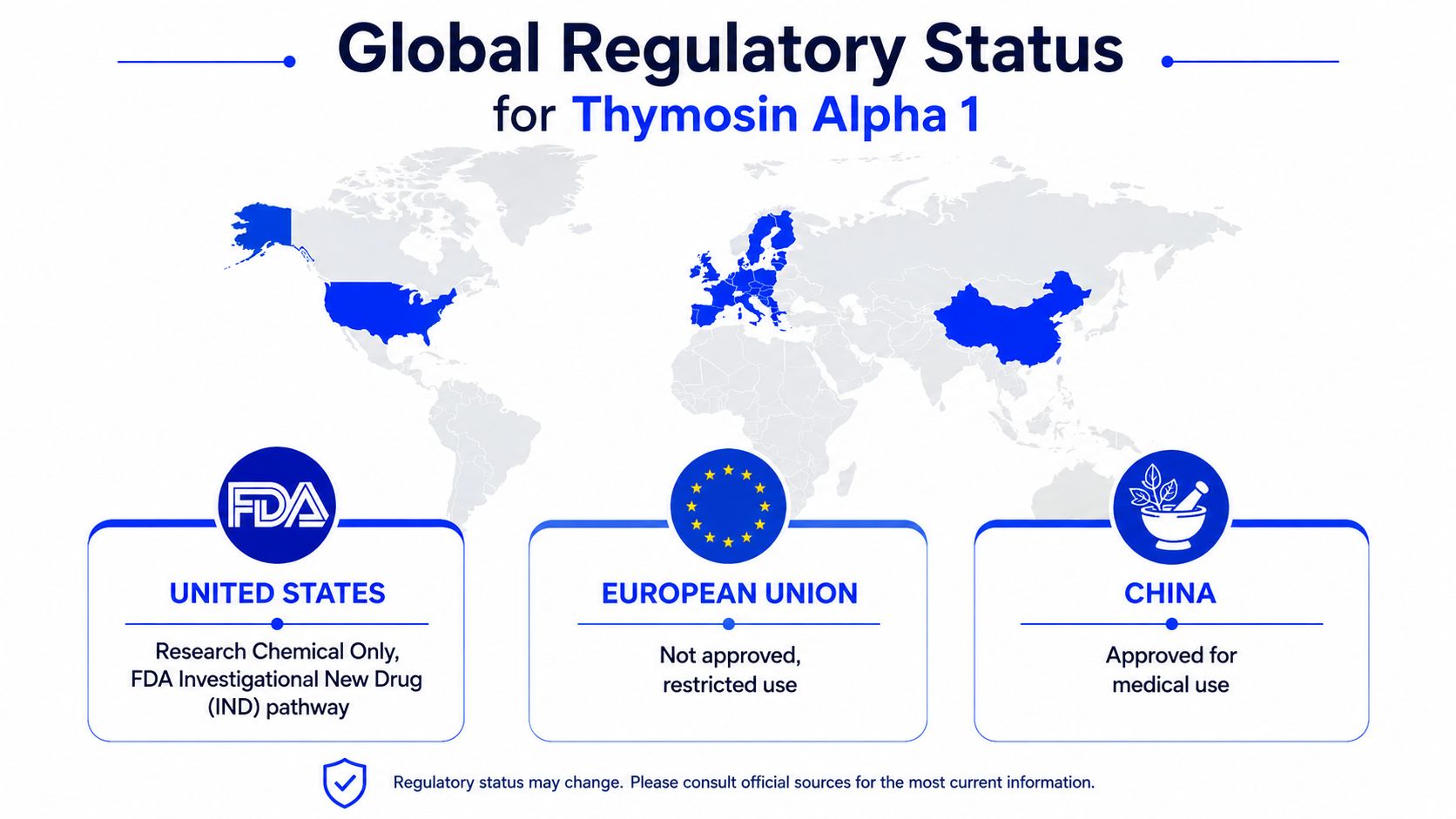
A compound can be commercially available while remaining outside a country's approved medicine framework. Online availability may reflect research supply, import practices, local pharmaceutical distribution, or inconsistent vendor labeling. It isn't evidence that the buyer can lawfully use the product in people.
The FDA document's distinction around pharmacopoeias also matters. If a substance isn't recognized in the relevant European or Japanese pharmacopoeia, buyers should be cautious about pages that imply universal pharmaceutical acceptance. Ask suppliers to identify the exact jurisdiction, product, manufacturer, and intended use behind any approval claim.
Commercial estimates place the global thymosin alpha 1 market in the hundreds of millions of dollars. One report estimated worldwide revenue at USD 267.251 million in 2021, projected USD 341.547 million by the end of 2025 and USD 557.842 million by 2033, with an implied 6.324% CAGR over that forecast period (thymosin alpha 1 market analysis). Another estimate placed the market at USD 200 million in 2024 and projected USD 500 million by 2033.
These estimates are useful market context, not a quality certificate. A growing market can attract careful manufacturers and opportunistic resellers at the same time. Treat unusually confident claims about approval, outcomes, or universal availability as prompts for verification rather than reasons to buy.
A professional supplier should make it possible to trace a vial back to a defined lot and a testing record. A polished website isn't enough. Procurement decisions should rely on documents that identify what was tested, how it was tested, when the test occurred, and whether the report corresponds to the product being offered.
Start with the COA, then work outward to the supplier's quality system.
| Document Type | What It Verifies | Acceptable Standards |
|---|---|---|
| Certificate of Analysis | Identity, lot traceability, stated purity, and release review | Product-specific, dated, lot-matched, and attributable to a named laboratory |
| HPLC report | Chromatographic purity profile | Method identified, result tied to the lot, and chromatogram available when appropriate |
| Mass spectrometry report | Molecular mass and identity support | Clear instrument result with sample and lot identification |
| Endotoxin report | Endotoxin screening result | Test method, sample identity, and result clearly documented |
| Microbial report | Microbial screening information | Product and lot matched, with laboratory and method details |
| Manufacturing or handling record | Chain of custody and storage controls | Traceable shipment, storage instructions, and receiving documentation |
A COA is only useful when it belongs to the vial you received.
Red flags include a single COA reused across multiple lots, purity claims with no method, missing lot numbers, unexplained discrepancies between the label and report, and promises of medical outcomes. Ask direct questions before purchase: Which lot will ship? Who performed each test? How was the material stored before dispatch? What happens if the shipment arrives warm or damaged?
For institutional work, save files in a controlled folder with restricted editing access. Record the receiving date, package condition, temperature indicators if supplied, lot number, and the staff member who accepted the shipment. Those simple controls support reproducibility and protect the integrity of later results.
Purity is not a single universal quality label. It describes the proportion of the tested material that meets a particular analytical definition, and the result depends on the method, reference standard, sample preparation, and reporting practices. A supplier's claim of 99% or greater purity should therefore be read alongside the underlying test method, not in isolation.
HPLC is commonly used to separate peptide-related components and estimate chromatographic purity. Mass spectrometry provides complementary identity information by examining molecular mass. Amino acid analysis can support composition assessment, but it doesn't replace identity confirmation or a chromatographic profile.
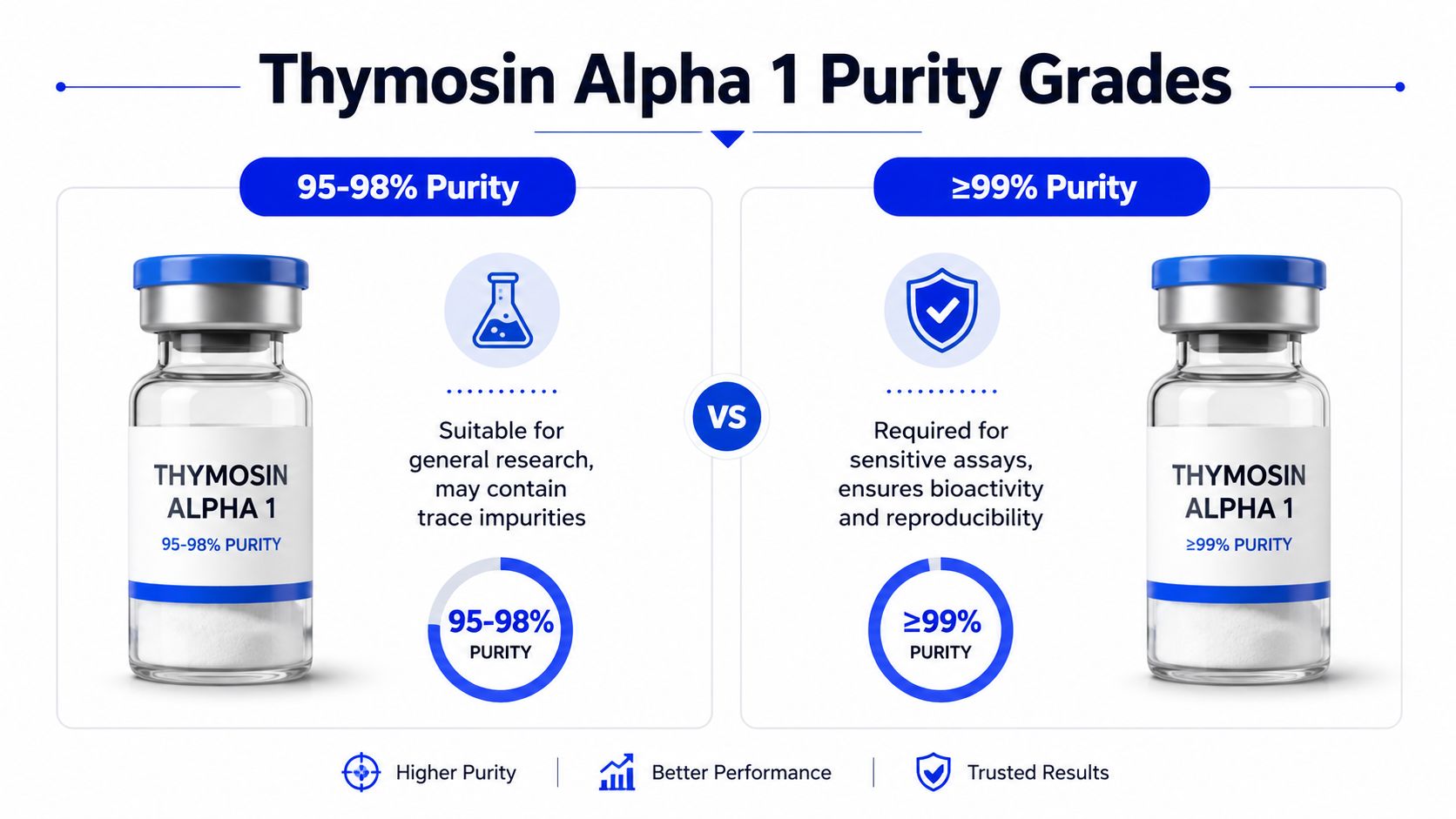
Crude material may be suitable only for early process work where the research question tolerates substantial uncertainty. It can contain synthesis-related impurities, truncated sequences, residual reagents, or other components that complicate interpretation.
Research-grade material should provide an identifiable analytical profile and enough documentation for the stated laboratory application. It isn't automatically pharmaceutical-grade and shouldn't be described that way unless the manufacturer can substantiate the claim under the relevant regulatory framework.
Pharmaceutical-grade material carries expectations beyond a high purity number. Those expectations may include validated manufacturing controls, approved indications, controlled facilities, stability data, and jurisdiction-specific authorization. A research supplier shouldn't imply that a high HPLC result alone creates pharmaceutical status.
A high HPLC result can still leave questions about identity, contamination, counterions, residual solvents, aggregation, or storage history. Mass spectrometry may confirm expected molecular mass while missing a broader purity picture. Endotoxin and microbial tests answer contamination questions that neither HPLC nor mass spectrometry is designed to answer.
For sensitive assays, choose documentation that supports identity, purity, and contamination control together. Match the grade to the protocol, but don't accept a number without the method and lot context. The useful comparison isn't “95% versus 99%.” It's whether the supplier provides enough independent evidence for your assay's tolerance for variability.
Thymosin alpha 1 is a peptide, so handling is part of the quality equation. A product can leave the manufacturer with a sound analytical profile and still become unreliable through poor transport, repeated warming, aggressive mixing, or undocumented storage. A pharmacokinetic study reported rapid absorption, peak serum concentrations within about 2 hours, return to baseline within 24 hours, and an approximate 2-hour half-life (thymosin alpha 1 pharmacokinetic study). For laboratory work, that short exposure profile makes consistent preparation and timing especially important.
Inspect the package immediately. Confirm the vial identity, lot number, seal, appearance, and accompanying paperwork before placing the material into the designated storage location.
Follow the supplier's validated instructions and your facility's approved SOP. For lyophilized material, protect the vial from unnecessary heat, light, moisture, and repeated temperature cycling. For reconstituted material, use only the diluent, container, aseptic technique, and storage period approved for the specific protocol. Don't assume that a community protocol or a different peptide's handling guide applies to Ta1.
Use a clean, documented workspace and trained personnel. Record:
Don't calculate a concentration from an assumed vial fill. Use the actual labeled quantity and measured diluent volume, then have a second trained person verify the calculation when the work is consequential.
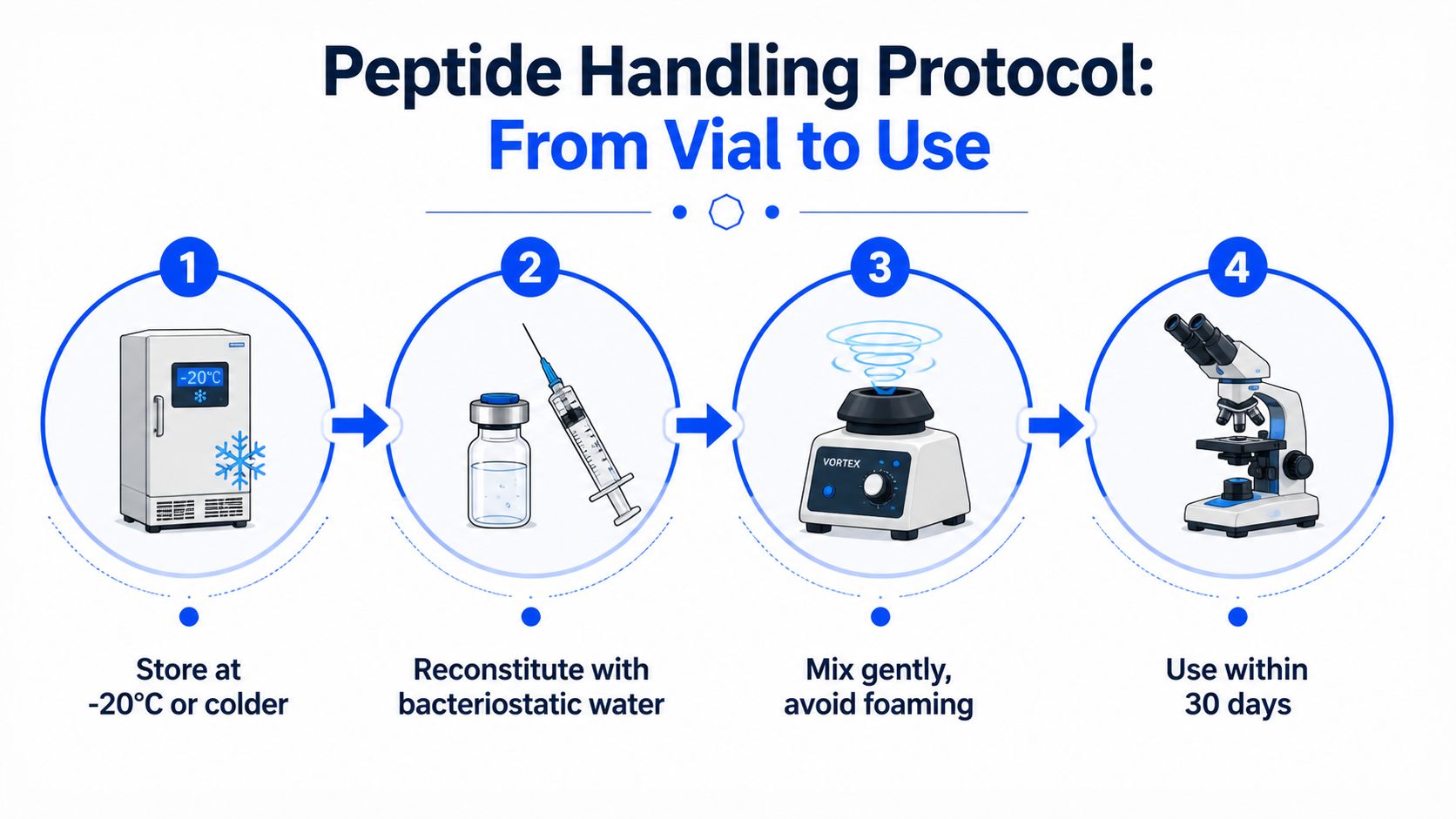
A written stability plan is more reliable than a calendar assumption. If your study depends on extended storage, define acceptance criteria, sampling points, and analytical tests before the experiment begins.
The following video can support general visual training, but it shouldn't replace your facility's approved SOP or the supplier's compound-specific documentation.
A defensible purchase decision has three gates: legal fit, analytical fit, and logistical fit. A supplier that passes only one or two gates still creates risk. For example, strong purity documentation doesn't solve an intended-use problem, and a compliant research purpose doesn't make an undocumented vial acceptable for a sensitive assay.
Use a short decision record before placing an order.
Legal fit: Confirm that the material is being purchased for legitimate research, laboratory, analytical, or preclinical work. Check your institution's rules, the destination jurisdiction, and any import or receiving requirements. Don't describe the material as an approved treatment if the relevant authority hasn't approved it for that use.
Analytical fit: Require a lot-matched COA and supporting identity and contamination records. Decide whether your protocol needs independent HPLC, mass spectrometry, endotoxin, microbial, or additional testing before release.
Logistical fit: Verify packaging, shipping conditions, storage instructions, replacement terms, and support contacts. The lowest listed price isn't the lowest total cost if a damaged shipment leaves your project without usable documentation or material.
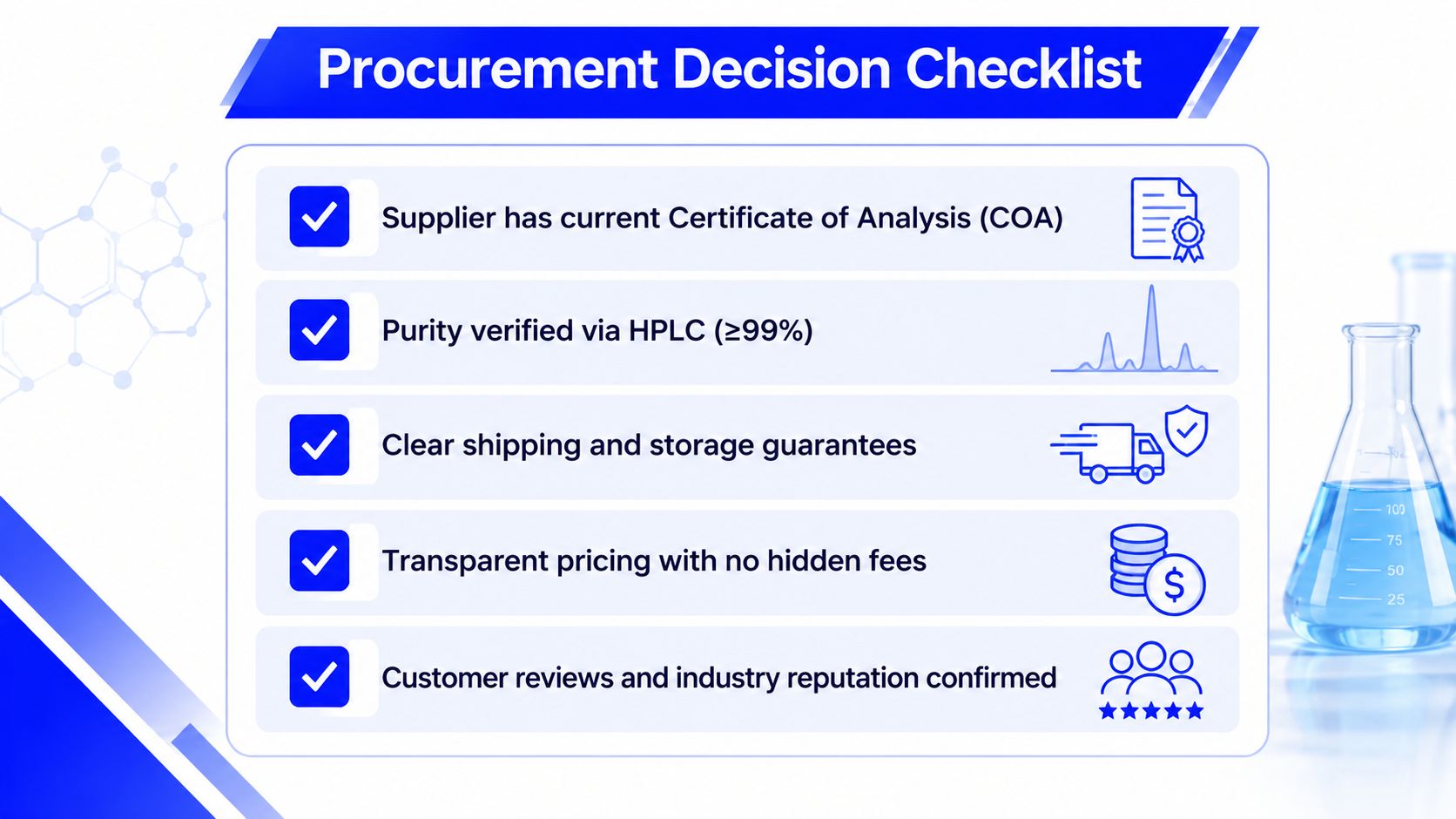
Ask the supplier to answer in writing:
Peptide Warehouse USA lists a 10 mg lyophilized Thymosin Alpha 1 research product at $99.99 on its product page (Thymosin Alpha 1 product listing), and its company information describes US manufacturing, batch testing, COAs, microbial and endotoxin reports, and stated purity levels up to 99.5% (Peptide Warehouse USA research supply information). Treat those details as procurement inputs to verify against the current lot documentation and your own laboratory requirements, not as a substitute for internal approval.
Don't build a peptide stack because several compounds appear on the same catalog page. A research question involving immune signaling may require a different model, control, or comparator rather than an additional peptide. Define the biological endpoint first, then select the smallest defensible set of materials that can answer it.
Keep an eye on regulatory updates from the relevant authorities and maintain a dated supplier file. Regulatory discussions can move faster than consumer pages, so review approval language, intended-use statements, and documentation each time you reorder.
Peptide Warehouse USA offers a US-based research supply option for thymosin alpha 1 in lyophilized form, with lot documentation and research-use labeling to support a compliance-first procurement process. Review the current product and documentation details, then visit Peptide Warehouse USA to explore options for your laboratory, analytical, or preclinical workflow.