No products in the cart.



You’re probably here because you need to buy Tirzepatide peptide for legitimate research, and the market isn’t making that easy. A search turns up polished storefronts, vague purity claims, aggressive pricing, and a lot of “research use only” language that tells you very little about what will arrive in the vial.
That’s a procurement problem, not just a shopping problem. If the peptide is misidentified, under-purified, contaminated, or poorly documented, the damage shows up later as failed assays, unusable data, budget waste, and hard questions from your PI, QA lead, or institution.
The only workable approach is forensic. Check the supplier. Check the paperwork. Check the batch. Then check what arrives and how it’s handled. Researchers who treat sourcing as part of the experimental method usually avoid the worst mistakes. Researchers who buy on price alone usually learn why that was expensive.
Researchers don’t run into trouble with tirzepatide because the compound lacks relevance. They run into trouble because online supply channels mix serious vendors with sellers who rely on thin documentation and buyer inexperience. That’s especially true in the post-shortage environment, where gray-market listings and research-only pages often sit beside each other with no obvious quality signal.
If you need to buy Tirzepatide peptide, the right move isn’t speed. It’s controlled verification.
A good procurement process answers a few basic questions before money leaves the lab budget. Who made the batch. Who tested it. Whether the COA matches the vial. Whether the seller can support traceability if something looks wrong on arrival. Those checks aren’t bureaucracy. They’re what keeps a reagent from turning into a variable.
Buy the documentation first. The vial comes second.
Most buying guides stop at generic advice like “choose a trusted source.” That’s not enough for a peptide with real analytical and contamination risk. The practical standard is much higher. You need supplier due diligence, batch-specific evidence, and handling discipline after delivery if you want the material to hold up under scrutiny.
Tirzepatide isn’t a generic commodity reagent. It entered the market as the first dual GIP/GLP-1 receptor agonist, with FDA approval for type 2 diabetes mellitus in May 2022. Clinical data in the approval summary showed dose-dependent HbA1c reductions from -1.06% at 1 mg to -1.94% at 15 mg, body-weight reductions from -0.9 kg to -11.3 kg, and 33% to 90% of treated patients reaching an HbA1c target below 7%, compared with 12% for placebo and 52% for dulaglutide in the cited comparison data.

Those figures matter here for one reason. A biologically important peptide is only useful in research if the material in your vial is the peptide you intended to study, at the purity you were promised, with documentation strong enough to defend the work.
Low-grade sourcing breaks that chain immediately. If the batch contains meaningful impurities, the signal in receptor, signaling, stability, or formulation work no longer belongs cleanly to tirzepatide. It belongs to a mixture.
That’s why procurement should be treated as part of the scientific method. Labs that understand strategic product sourcing don’t reduce the decision to price and availability. They look at supplier controls, batch traceability, test documentation, and repeatability across orders.
Three consequences show up fast when sourcing is weak:
Practical rule: If you wouldn’t defend the supplier’s paperwork in front of your QA team, don’t defend the data generated from that batch.
Researchers sometimes underestimate how much downstream trouble begins with one casual purchase. In practice, the first real quality decision in a tirzepatide project is not assay design. It’s source selection.
A common post-shortage failure looks like this: a lab finds stock online, the listing shows a polished label, checkout takes two minutes, and critical questions surface only after the vial arrives. The lot number does not match the paperwork. Technical support cannot identify the testing lab. The COA looks reused. At that point, the risk is already in your freezer.
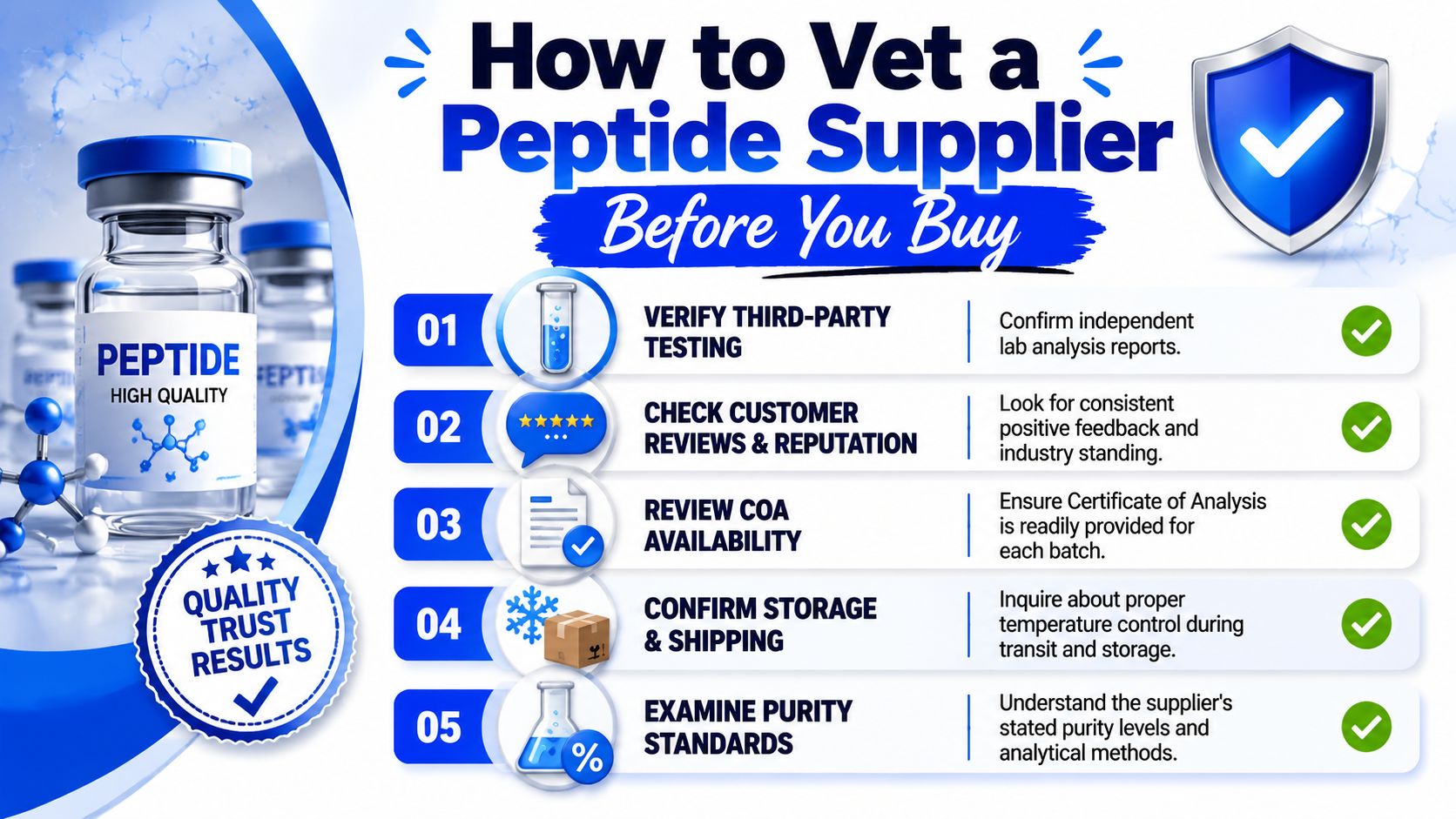
The current tirzepatide research market rewards speed and punishes careless buying. After the shortage period, a large gray market formed around research peptides. Some sellers are legitimate research suppliers. Others are storefront operators with copied documentation, inconsistent fulfillment, and no real batch control. The practical job is to separate those groups before payment, not after a failed run.
A credible supplier reduces ambiguity. You should be able to confirm who they are, what they tested, how they document each lot, and whether they understand research-use-only boundaries.
Start by checking five areas:
Website behavior also matters. Check the business identity, domain age, consistency between product pages and policy pages, and whether contact information leads to a functioning organization. Gray-market sellers often spend more effort on product images than on traceability. That imbalance is useful. It tells you where their priorities sit.
Independent evidence supports that caution. A 2024 JAMA Network Open study reported severe purity failures and endotoxin contamination among consumer-accessible GLP-1 products sold outside legitimate channels, according to the PubMed record for that study.
Here’s the video version of the vetting mindset many buyers need before placing an order:
Some problems are obvious once you check for them. Others require a slightly more forensic review.
| Supplier signal | What it usually means |
|---|---|
| Generic COA with no lot match | Documentation may not belong to your vial |
| No named third-party lab | Testing may be internal, incomplete, or unverifiable |
| Vague purity language | Marketing is replacing analytical detail |
| No support response to technical questions | Post-sale traceability will likely be poor |
| Price that looks disconnected from the rest of the market | Risk is being hidden somewhere |
Look closely at the paperwork format. Reused file names, cropped lab headers, inconsistent fonts, missing test dates, and COAs that cover many products with only the peptide name swapped are common signs of copied documentation. A legitimate supplier may still use in-house testing for some release steps, but they should be able to explain the method, the lot record, and the chain from synthesis to shipment.
Pricing deserves the same scrutiny. An unusually low offer can signal degraded material, underfilled vials, recycled documentation, or no testing at all. In procurement, the cheapest option often becomes the most expensive once reorders, failed assays, and review questions are counted.
If a seller cannot verify a lot before payment, there is no reason to expect better traceability after delivery.
A short pre-purchase email is one of the fastest screening tools available. Ask questions that require the supplier to respond with records, not slogans.
The quality of the reply usually tells you what the homepage does not. Strong suppliers answer directly, attach documents, and keep their lot references consistent across the exchange. Weak suppliers delay, avoid specifics, or send a generic file that could belong to any batch. In this part of the market, that distinction is not administrative. It is your first real contamination control step.
A COA is the single document that tells you whether the supplier is giving you evidence or just giving you copy. Most buyers say they “check the COA.” Fewer read it like a control document.
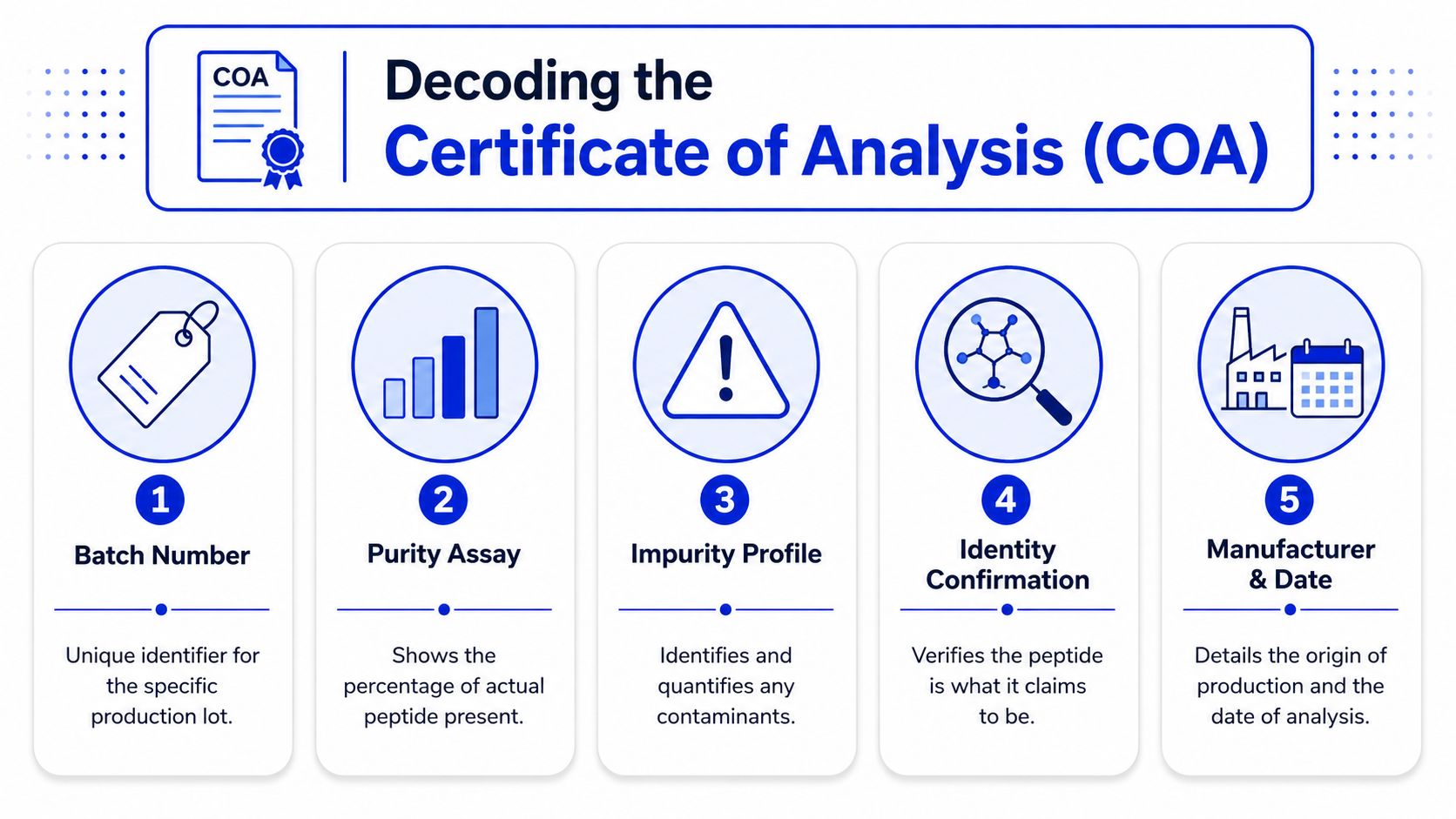
For research-grade tirzepatide, one benchmark matters immediately. A credible supplier should show at least 98% purity by HPLC, with many reputable suppliers reporting greater than 99.5%. The COA should also validate a molecular weight of approximately 4,813.5 Da via mass spectrometry and document endotoxin levels below 2.50 EU/mL.
That means a usable COA should include:
HPLC tells you how much of the sample appears to be the target peptide versus other components. You don’t need to be an analytical chemist to use it well. You do need to see that the supplier is presenting a genuine assay result rather than a bare percentage pasted into a template.
Mass spectrometry serves a different purpose. It supports identity. In practical terms, it helps answer whether the material corresponds to tirzepatide rather than something mislabeled or poorly synthesized.
Use this reading sequence:
Bench habit: Print the COA or save it into the project folder before the vial is opened. Traceability is much easier to preserve than to reconstruct.
Weak COAs tend to fail in the same ways. They’re vague, detached from the actual lot, or too clean in the wrong places. A one-page PDF with a product name, a purity percentage, and no chromatogram is not persuasive. Neither is a report with no lab identity, no analysis date, or no link to the shipped vial.
A good rule is simple. If the document doesn’t let you independently tie identity, purity, and batch together, it isn’t doing its job.
Once the supplier and documentation pass review, the order itself should still follow a controlled process. Many labs often get sloppy at this stage. They verify the science, then improvise the procurement.
A proper workflow usually includes a research-use acknowledgment, billing and shipping verification, order confirmation, and document retention. That’s not busywork. It creates an audit trail showing that the material was purchased for laboratory purposes under defined terms.
At checkout, pay attention to the seller’s language. A legitimate research supplier usually makes intended use explicit and avoids therapeutic positioning. If the site blurs that line, procurement should slow down immediately and involve someone responsible for compliance.
Buyers should also confirm the operational side before final approval:
Tirzepatide pricing online is noisy, and the noise increased after availability shifted. Coverage tied to the post-shortage environment noted online access for roughly “a hundred bucks” without prescription screening, while other market guides quoted $149 to $299 per month for cash-pay or compounded-style options, as discussed in this market overview of tirzepatide pricing and access changes.
That spread tells you something important. Price by itself doesn’t explain channel risk.
A low number can reflect missing controls, weak documentation, poor continuity, or inappropriate supply channels. A higher number doesn’t automatically mean quality either. You still need to know what the seller is delivering in terms of lot traceability, testing, and support.
A practical internal workflow looks like this:
That sequence reduces handoff errors. It also prevents the common situation where one person orders, another receives, and no one owns the documentation set.
Quality assurance doesn’t stop when the box hits the bench. A good batch can still be mishandled into a bad experiment if receiving, storage, and reconstitution are sloppy.
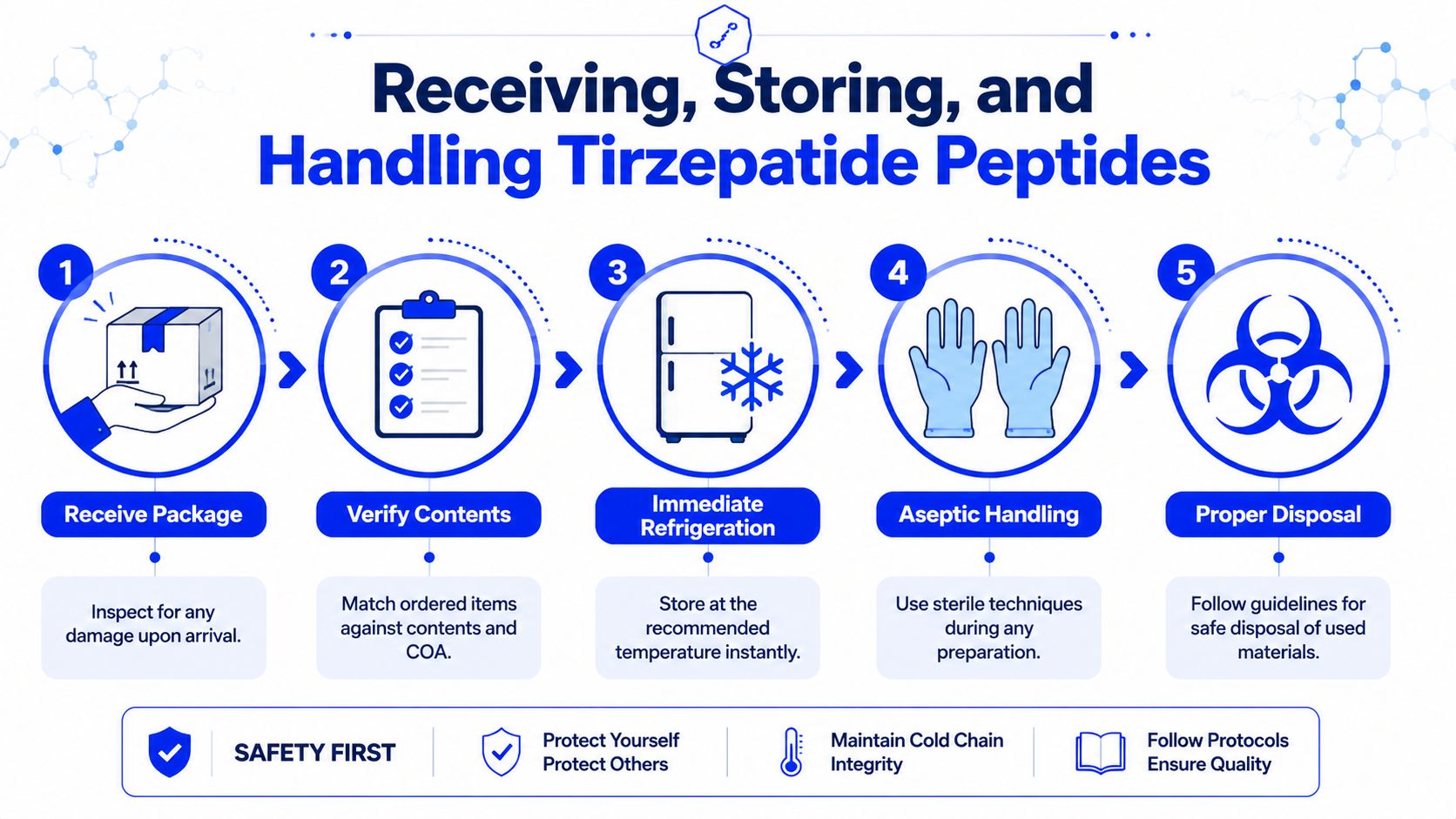
Open the shipment like you’re conducting intake, not opening supplies.
Confirm that the vial labels match the order and that the lot number matches the paperwork retained at purchase. Inspect packaging integrity and note anything that suggests damage, temperature stress, or handling issues in transit. If something looks off, pause use until the discrepancy is resolved.
A short receiving checklist helps:
Reconstitution errors are common and preventable. Guidance for tirzepatide handling recommends disinfecting the stopper, drawing bacteriostatic water, injecting it slowly against the glass wall, and gently swirling rather than shaking. The powder typically dissolves within 1 to 3 minutes, and the solution should appear clear and colorless to slightly yellow, without cloudiness or visible particles.
That guidance matters because agitation can damage peptide structure. Shaking feels efficient. It isn’t.
Use a controlled sequence:
Don’t rush dissolution. A minute saved during prep can cost you the whole batch if the peptide is mishandled.
After reconstitution, the biggest risks are inconsistency and contamination introduced by the lab itself. This usually happens through repeated unnecessary access, poor labeling, casual storage habits, or undocumented transfers between team members.
Set a simple internal standard:
Researchers often focus intensely on where to buy Tirzepatide peptide and far less on what happens after receipt. In practice, both stages matter equally. Procurement gives you a verified starting point. Handling preserves it.
Buying tirzepatide for research should feel methodical, because it is. The strongest buyers don’t rely on branding, vague purity promises, or bargain pricing. They verify the supplier, inspect the COA, document the order, and control what happens when the material reaches the lab.
A final checklist is straightforward:
That process protects more than the order. It protects the work built on the order.
If you’re evaluating sources now, keep the standard high. Explore options that document batch quality clearly, support traceability, and operate within a research-only framework. That’s what turns procurement from a gamble into a controlled input.
If you’re ready to apply that checklist in practice, Peptide Warehouse USA is one research-only option to review for documented, high-purity peptide sourcing. Learn more, compare the available documentation, and explore options that fit a compliant laboratory procurement process.