No products in the cart.


Bacteriostatic water can generally be bought at a pharmacy in the United States, but it's a prescription-only product labeled “Rx only”. For lab work, that's the situation, but it's usually not the smartest sourcing route, because many research teams need a consistent supply that community pharmacies don't reliably stock.
You're probably here because you've got a lyophilized peptide, a reconstitution deadline, and a local pharmacy counter that may or may not be helpful. The right answer depends on whether you need a pharmacopeial vial for a specific injectable medication, or a research-grade supply chain that's built for repeat purchasing and traceability.
A researcher usually starts asking about bacteriostatic water at the moment a dry vial stops being just a powder and becomes a workflow problem. Once a lyophilized compound needs a liquid diluent, the source matters just as much as the dose, because the wrong water can undermine the whole prep.
Bacteriostatic water is not a casual lab liquid. It's a regulated parenteral product, which means it's meant to be used after something injectable has been added, not as a stand-alone fluid for hydration or general injection. The labeled purpose is dilution or dissolution of injectable drugs for intravenous, intramuscular, or subcutaneous administration, and the manufacturer's instructions decide whether it's appropriate for that drug.
That distinction matters because a lab or clinic is not buying “water.” It's buying a specific pharmaceutical tool with a defined use case, a defined preservative system, and label restrictions that you ignore at your own risk.
Practical rule: If the vial isn't intended for the compound you're reconstituting, don't force the protocol. Ask for compatibility first.
For researchers, the first question shouldn't be “can I get it anywhere?” It should be “do I need a pharmacy-dispensed injectable product, or do I need a dependable supply channel for repeated lab use?” Those are different procurement problems.
People often treat sterile water, bacteriostatic water, and saline as if they're interchangeable. They're not. The difference shows up fast when a protocol requires repeated withdrawals, stable handling, or pharmacy-level labeling.
A lab manager would tell a new researcher to do three things first:
That last point is the one many readers miss. If you're working in a research setting, the question isn't only whether a pharmacy can dispense it. It's whether that source makes operational sense for the way you use it.
Bacteriostatic water for injection is sterile, nonpyrogenic Water for Injection with a preservative system built into it. Official labeling describes it as containing either 0.9% benzyl alcohol, equivalent to 9 mg/mL, or 1.1% benzyl alcohol, equivalent to 11 mg/mL, and a 30 mL vial at 0.9% contains approximately 270 mg of benzyl alcohol, while a 1.1% formulation contains approximately 330 mg. DailyMed label information
The preservative is what makes repeated withdrawals possible. It doesn't make the vial immortal, and it doesn't turn bad technique into safe technique. It helps the vial resist contamination better than an unpreserved alternative when the container is accessed more than once.
The label also gives the product a pH of approximately 5.7, with an allowed range of 4.5 to 7.0. That range is part of why some injectable drugs pair better with this diluent than others, because formulation compatibility is never just about water, it's about the full chemical environment.
The key comparison is not “clean water versus dirty water.” It's bacteriostatic water versus sterile water for injection. Sterile water for injection contains no bacteriostatic agent, so it's a different tool with different clinical uses. If you need a multi-dose workflow, the difference is decisive.
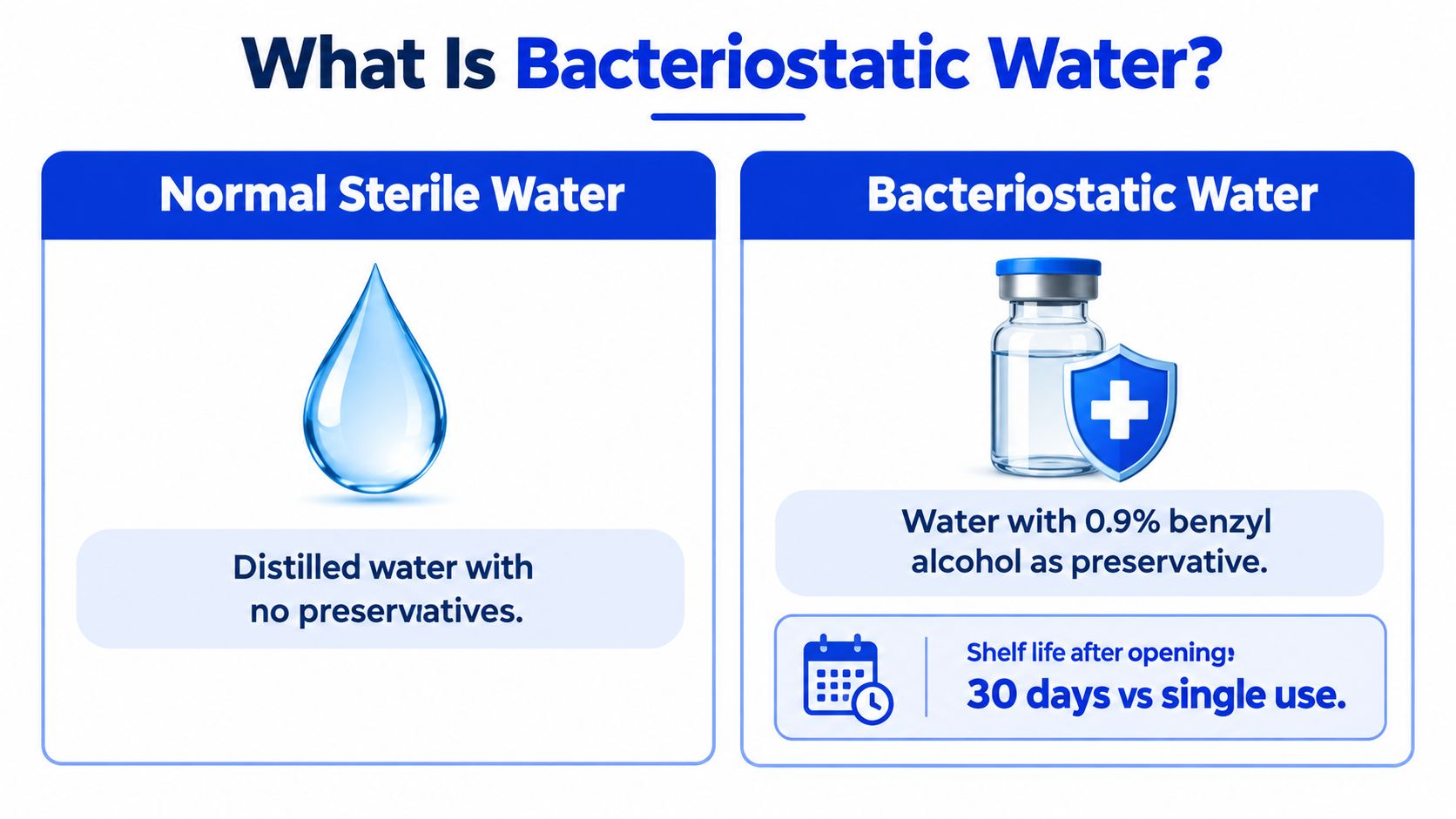
The product is engineered for a narrow purpose. It's meant for dilution or dissolution after the medication has been added, and the drug manufacturer's directions still control whether it's the right choice. The label also warns that it is not for use in neonates.
That warning is not decorative. It's part of why you should never treat this as a generic lab liquid or a universal injectate. A pharmacy-dispensed vial is standardized, traceable, and labeled for a purpose. An unlabeled online bottle isn't the same thing, even if the contents claim to be similar.
In the United States, bacteriostatic water for injection is generally a prescription-only, sterile parenteral product rather than an ordinary over-the-counter pharmacy item. A pharmacy may dispense it if a licensed clinician writes the prescription, but stock levels vary by inventory, wholesaler supply, and state requirements. FDA label data on bacteriostatic water
Calling a chain pharmacy and assuming it's on the shelf is a mistake. Availability can differ between chain pharmacies, hospitals, and independent pharmacies, and the person behind the counter may have to check ordering systems before giving you an answer.
If you do ask for it, ask for the exact product name, “Bacteriostatic Water for Injection, USP”, and confirm the vial size, manufacturer, concentration, and prescription requirements. A pharmacist can also tell you whether sterile water for injection is the better diluent for your use case.
Direct advice: Don't ask for “the water for peptides.” Ask for the exact pharmaceutical product name. Vague requests waste time and invite mistakes.
The FDA-listed formulation is intended only to dilute or dissolve a specific injectable drug according to that drug's manufacturer instructions, not to serve as a hydration fluid or general-purpose sterile water. That's why the standard pharmacy route can be awkward for research workflows that need predictable repeat access.
Do not trust online listings that blur the line between pharmacy medicine and research merchandise. Products marketed as “research use only” are not interchangeable with a pharmacy-dispensed prescription medicine and should not be used for human injection. That distinction matters even when the packaging looks polished.
If you need a quick checklist, keep it simple:
If the pharmacy can't fill it quickly, that doesn't mean you're blocked. It usually means the pharmacy channel is built for medication dispensing, not for lab procurement.
For lab work, the better question is not whether a pharmacy can sell it. The better question is which source gives you the cleanest combination of traceability, convenience, and repeatability. Pharmacy dispensing and research supply are different procurement models, and they're not equally efficient for every use case.
A pharmacy route usually emphasizes prescription rules, manufacturer packaging, and clinical labeling. A research supplier emphasizes lab workflow, broader catalog access, and documentation around the product batch. Those priorities shape everything from packaging to reorder speed.
For teams that need routine access, a research supplier can be easier to work with because the product fits into a procurement system built around laboratory materials. That doesn't make it better for clinical use, it makes it more practical for research use.
Peptide Warehouse USA is one option on the research side, since it sells Bacteriostatic Water (BAC Water) in 30 mL format as a laboratory supply for research use only, not as a pharmacy product or for human consumption. That matters because it keeps the source aligned with the lab environment rather than the retail counter.
| Source Type | Regulatory Status | Typical Volume | Quality Documentation |
|---|---|---|---|
| Community pharmacy | Prescription medicine, jurisdiction-dependent dispensing | Small vial formats vary | Pharmacy labeling and traceability |
| Compounding pharmacy | Patient-specific compounded sterile preparation | Varies by prescription | Prescriber order, compounding records |
| Hospital or clinic pharmacy | Clinical dispensing channel | Varies by institution | Institutional medication labeling |
| Research supplier | Laboratory supply, research use only | Often 30 mL or similar | Product documentation depends on vendor |
A pharmacy is usually the right answer when you need a regulated medication channel. A research supplier is usually the right answer when you need a practical lab supply chain and you're operating outside the human-use medication path.
Choose the research channel when the work is routine, the purchasing team wants predictable ordering, and the product is being used in laboratory or analytical workflows rather than in a patient pharmacy context. That's the cleanest fit for a lot of peptide-adjacent procurement.
Choose the pharmacy channel when a licensed clinician is directly involved and the product needs to move through a prescription workflow. Mixing those two models creates avoidable delays and paperwork.
Once the vial is in hand, the next problem is not “where did I buy it?” It's “did I keep it clean, traceable, and usable?” Bacteriostatic water only stays useful if the handling is disciplined from the first puncture onward.
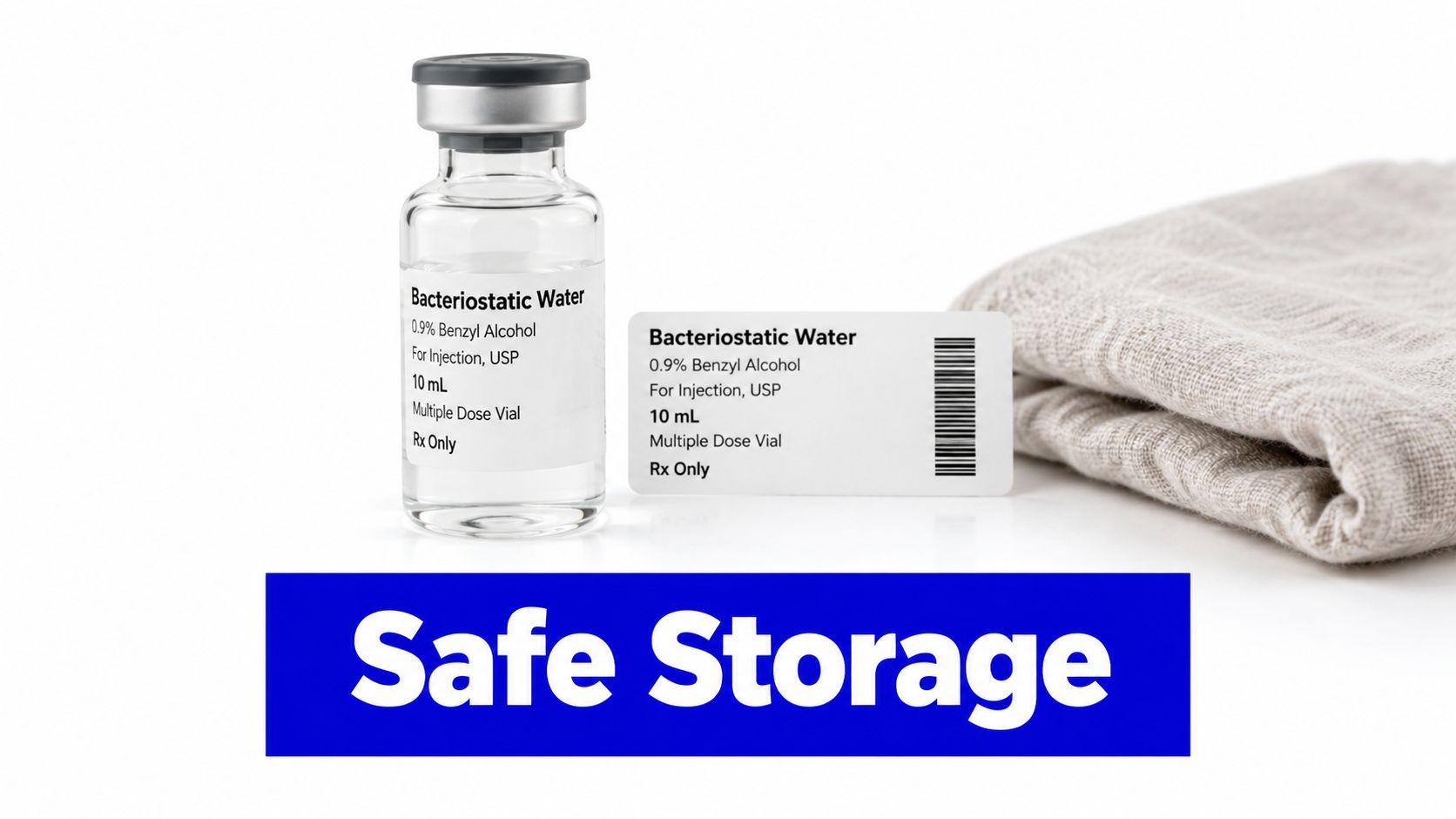
The label requires aseptic technique, and that's not a suggestion. Mix diluted drugs thoroughly and use them promptly, and don't store reconstituted solutions unless the solute manufacturer specifically directs otherwise. That instruction is easy to ignore and expensive to ignore.
For the unopened vial, keep the product away from obvious contamination and follow the printed storage instructions. For the opened vial, respect the in-use window and document the first puncture date. If a vial has been opened and handled badly, the preservative doesn't rescue it.
The best habit is boring and effective:
Keep the vial clean, keep it labeled, and keep the timeline short once it's opened.
If your team handles injectable-grade supplies, make the label and storage rules part of your routine training. A simple refresher on labels, SDSs and HazCom training can prevent sloppy handling from turning into a procurement or safety problem. For a practical reference point, see labels, SDSs and HazCom training from Facility Management Insights.
The point is simple. A preserved vial is not a permission slip for casual handling. It's still a controlled product that rewards good technique and punishes shortcuts.
If you're asking can I buy bacteriostatic water at a pharmacy, the accurate answer is yes, but only under prescription and dispensing conditions in the U.S., and only if the pharmacy stocks or orders it. That makes the pharmacy route legitimate, but not always efficient.
For a small, clinician-directed need, the pharmacy path makes sense. For repeated lab work, predictable ordering, and research-scale procurement, a research supplier is usually the more practical choice because the product, packaging, and ordering process are built around laboratory use.
Pick the pharmacy route when:
Pick the research route when:
The biggest mistake is choosing a source just because it's nearby. Pick the source that fits the use case, not the one that creates the least resistance at the counter.
If you need a research-side source for laboratory supply, Peptide Warehouse USA offers bacteriostatic water alongside other research compounds with documented batch support. Visit Peptide Warehouse USA to review the current product page and compare it against your lab's procurement needs.