No products in the cart.



Can you buy peptides legally, or does a “research use only” label automatically make any online purchase acceptable? The answer depends less on the amino-acid sequence than on intended use, seller language, product category, and documentation.
A lab manager sourcing a high-purity compound for a preclinical study faces a different set of rules from a patient seeking an FDA-approved prescription or a consumer browsing wellness products. The same peptide name can appear in several commercial settings, but those settings don't carry the same legal meaning.
This guide explains how to evaluate peptide purchasing step by step. You'll learn how prescription products, compounded preparations, and research-use-only compounds differ, how recent FDA classification changes have affected access, what records researchers should retain, and which warning signs can turn a seemingly ordinary online listing into a regulatory problem.
A researcher preparing a preclinical assay may begin with a straightforward question: can you buy peptides for laboratory work without creating a compliance problem? The practical answer is yes, legitimate research procurement exists, but the buyer must be able to show that the purchase is properly connected to laboratory, analytical, or preclinical activity.
That distinction matters because peptides now occupy several overlapping markets. The global peptide market reached USD 46.7 billion in 2024, and roughly 100 peptide-based drugs have received regulatory approval worldwide, according to industry market data on peptide development. The same source reports that 34 new peptide therapeutics were approved between 2016 and 2024, reflecting the molecule class's importance in pharmaceutical research.
Those figures describe a broad industry, not permission for every buyer to obtain every peptide. An FDA-approved medicine belongs in a prescription channel. A compounded preparation must follow an applicable compounding pathway. An unapproved compound may be offered for legitimate laboratory research, but it can't lawfully be marketed as a self-administered treatment merely because its label says “research use only.”
Practical rule: Treat the purchase context like a map. The destination, human treatment, patient-specific compounding, or laboratory research determines which route is appropriate.
Regulatory access also changes. A 2026 regulatory update reported that approximately 14 peptides moved from a restricted category to a less restricted category on February 27, 2026, while the FDA removed BPC-157 from the restricted bulk-substance list on April 23, 2026, pending further review, as described in the update on U.S. peptide regulatory status. These developments show why old online answers can quickly become incomplete.
Before choosing a supplier, identify the category that matches the intended use. Think of these categories as different lanes on a road. The molecule may have the same name, but each lane has its own entry requirements, records, and restrictions.
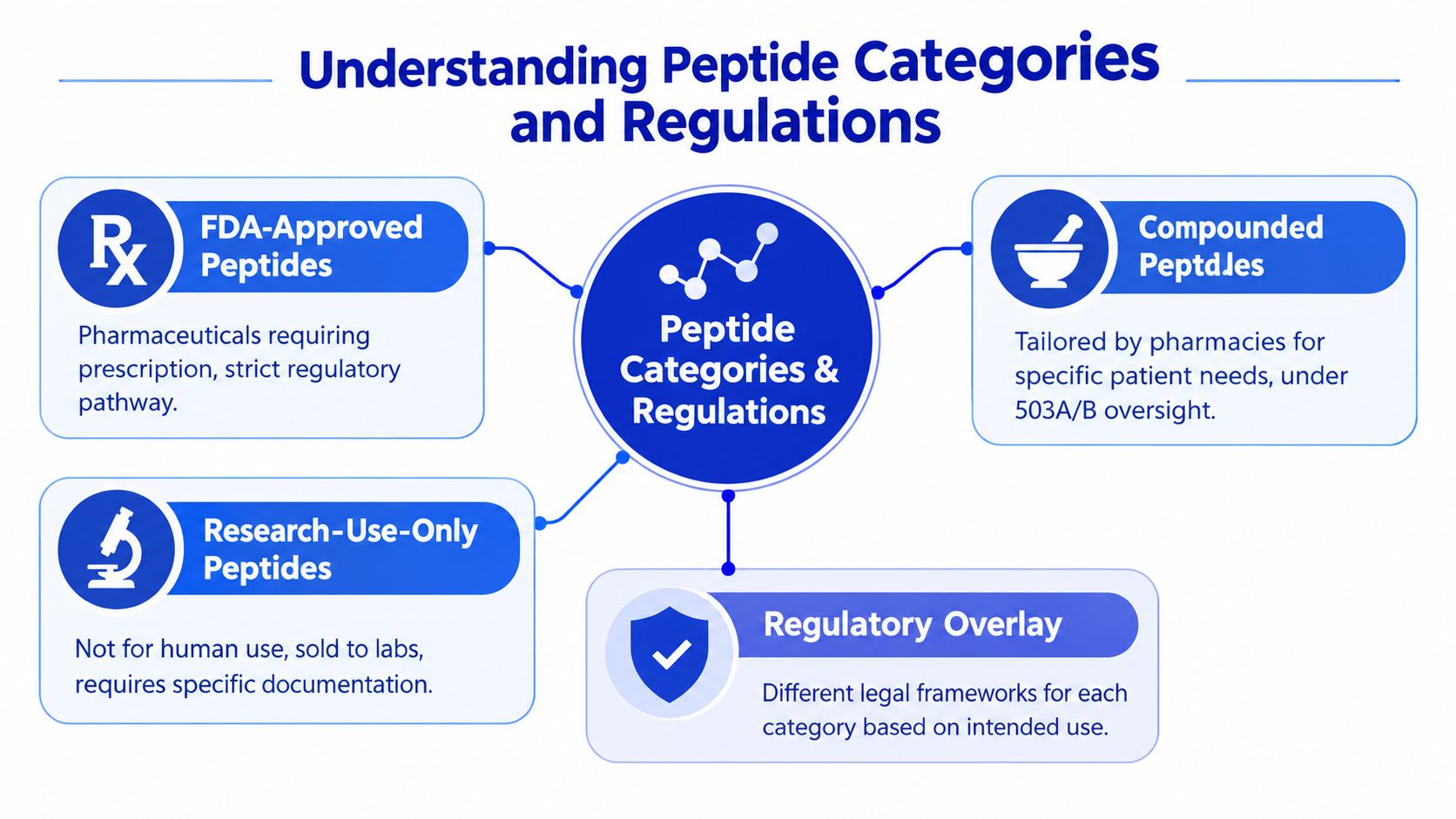
An FDA-approved peptide medication is obtained through a prescription channel. A licensed prescriber evaluates the patient, and a licensed pharmacy dispenses the product under the applicable pharmaceutical framework. This is the correct route when the intended use is treatment of a medical condition.
A prescription product isn't interchangeable with an online vial labeled for laboratory work. Product identity, manufacturing controls, dispensing, patient instructions, and clinical oversight all form part of the regulatory context.
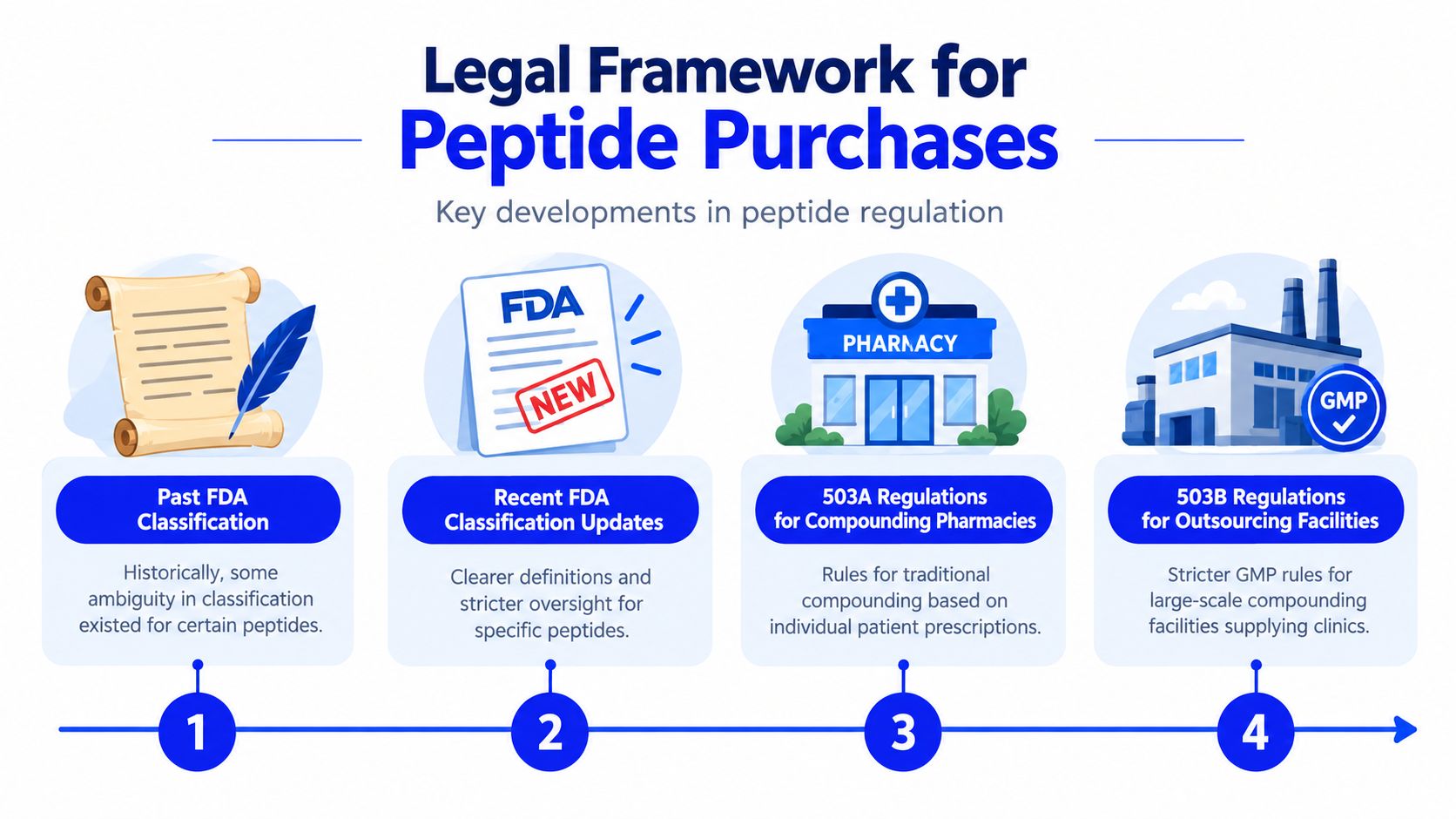
Compounded peptides occupy a separate pathway. Section 503A of the Federal Food, Drug, and Cosmetic Act covers traditional compounding for an identified individual patient with a valid prescription. Section 503B applies to registered outsourcing facilities that compound in bulk for healthcare providers, under direct FDA oversight and current Good Manufacturing Practice requirements, as summarized in this comparison of 503A and 503B compounding.
The key question isn't whether a pharmacy can make a preparation. It is whether the pharmacy and the order fit the relevant statutory pathway.
Research-use-only products are intended for laboratory research, in vitro testing, animal research, or preclinical investigation. They aren't FDA-approved therapies and aren't approved for human administration or medical treatment, as explained in regulatory guidance on research-use-only peptides.
For a legitimate research purchase, the buyer should be a qualified researcher or institution, and the supplier should provide traceable records such as a Certificate of Analysis. A label alone doesn't transform a consumer product into a research product. Regulators can examine the website, product descriptions, customer profile, instructions, and promotional language when determining intended use.
U.S. peptide procurement becomes easier to understand when three questions are asked in order:
A patient seeking an approved therapy needs a licensed prescriber and pharmacy. A patient-specific compounded preparation must fit the 503A framework. A registered outsourcing facility may operate under 503B requirements. A research laboratory may purchase an unapproved peptide for laboratory work when the product is represented and documented for that purpose.
The most important dividing line is drug intent versus research intent. A supplier that promotes a research-labeled peptide for weight loss, muscle gain, anti-aging, healing, or another consumer health objective may create evidence that the product is being marketed as a drug. The legal concern then comes from the complete presentation, not merely from the words printed on the vial.
The 2026 changes illustrate why buyers should verify current status before placing an order. The reported February 27 reclassification involved approximately 14 peptides, and the April 23 action involved BPC-157, which was removed from the restricted bulk-substance list pending further review. Those changes may affect procurement options, but they don't create blanket permission for human use or over-the-counter sales.
The same compound can sit in different legal buckets when its purpose, seller, and claims change.
Researchers and businesses also need to consider payment and merchant-risk controls. Companies handling regulated or high-risk categories may find broader compliance guidance useful, including this resource on secure CBD payment processing, especially when building a documented purchasing and payment workflow.
A compliant research purchase should leave an evidence trail that another qualified person could understand later. The molecule itself is only one part of the review. The lab should be able to connect the order to a real project, a qualified purchaser, a documented supplier, and a defined laboratory purpose.
FDA-related guidance on research peptide classification states that unapproved peptides may be sold as research-use-only products when labeled and documented for laboratory research. It also identifies Certificates of Analysis and batch records as important evidence of legitimate research intent.
This process resembles an audit trail in other regulated industries. A purchase order shows what was bought, a COA identifies the batch, and the project file explains why the lab needed it. Together, those records are more meaningful than a disclaimer viewed in isolation.
For startups building a broader compliance system, a guide on Florida startup compliance may help place procurement controls alongside other business obligations.
A research label supports compliance only when the surrounding facts support research intent.
The right source depends on the end use, not on which website has the fastest checkout. Prescription pharmacies, compounding facilities, and research suppliers serve different buyers and should be evaluated using different criteria.
| Channel | Requirements | Pros | Cons |
|---|---|---|---|
| Prescription pharmacy | Licensed prescriber and prescription | Appropriate for FDA-approved treatment | Not a route for unapproved research compounds |
| Compounding pharmacy or outsourcing facility | Valid patient-specific prescription for 503A, or an applicable 503B pathway | Can prepare products within a recognized compounding framework | Eligibility, formulation, and documentation depend on the specific pathway |
| Research chemical supplier | Qualified research purchaser, laboratory purpose, COA, batch records, and research-only positioning | Supports laboratory and preclinical procurement | Not appropriate for human administration or therapeutic claims |
A licensed pharmacy is the clearest option for an approved prescription peptide. The prescriber and pharmacist handle the clinical and dispensing relationship, while the patient receives a product intended for treatment.
Compounding requires closer scrutiny. A 503A pharmacy works from an identified individual patient's prescription. A 503B outsourcing facility operates under a different model and must meet its own registration and manufacturing requirements. Buyers should verify the facility's status rather than assuming that every “compounded” listing follows the same rules.
Research suppliers should make documentation easy to review. Look for batch-specific COAs, clear product identity, stated research purpose, and consistent labeling. Be cautious when a supplier's checkout flow resembles a consumer wellness store or when product descriptions promise outcomes that belong in a clinical setting.
Payment providers and merchants handling regulated or high-risk categories can also review Tagada's guidance for managing high risk MCCs when designing transaction controls.
Consider an academic lab evaluating GHK-Cu in a preclinical skin research project. The lab's file should identify the study purpose, the responsible researcher, the supplier, the batch, and the analytical or experimental methods. The product page and internal records should describe laboratory use, not cosmetic treatment or human skin-repair claims.
The lab can store the material with its research inventory and use the COA as part of the project documentation. It shouldn't distribute the compound as a treatment, provide self-injection instructions, or allow a wellness team to repurpose the product for customers.
A clinic presents a different scenario. Suppose a licensed prescriber believes a patient-specific preparation is appropriate and sends an order to a pharmacy operating within the applicable 503A pathway. The prescription, patient identity, pharmacy records, formulation information, and dispensing process belong to that clinical route.
The clinic shouldn't purchase a research vial and describe it as equivalent to a compounded prescription. A research supplier isn't a substitute for a licensed prescriber or compounding pharmacy, and a research-use label doesn't authorize administration to a patient.
A third example involves an outsourcing facility preparing TB-500 for institutional distribution under a 503B model. The facility must operate within the requirements that apply to its registration, manufacturing controls, records, and supply relationships. The receiving institution should verify the supplier's status and maintain documentation showing how the material entered its inventory.
Recent FDA warning letters in 2026 targeted online sellers that marketed research-use-only peptides with wellness claims, according to the FDA's internet pharmacy warning-letter information. That enforcement pattern makes the language around a product a central compliance issue.
The safest procurement file answers three questions clearly: who bought it, why they bought it, and how the material was controlled after delivery.
So, can you buy peptides legally? Yes, but legality follows the intended use and the correct supply channel. FDA-approved peptides belong in prescription pathways. Compounded peptides must fit the relevant 503A or 503B framework. Unapproved research peptides must remain connected to legitimate laboratory work and must not be marketed or used as human therapies.
Before placing an order, audit the process:
For laboratories seeking a documented research supply chain, Peptide Warehouse USA operates as a research chemical supplier, not a compounding pharmacy or outsourcing facility. Its catalog includes research peptides and related compounds, with product documentation such as COAs, microbial and endotoxin reports, and stated purity information available for procurement review.
Peptide Warehouse USA offers research-use-only peptides and related compounds for laboratory, analytical, and preclinical applications, with batch documentation designed to support traceable purchasing. Review the catalog and visit Peptide Warehouse USA to explore options that align with your lab's intended use and compliance records.