No products in the cart.



You’re probably here because Cartalax keeps appearing in peptide discussions about cartilage, joint support, and even healthy aging, but the explanations are all over the place. Some pages make it sound like a breakthrough. Others reduce it to vague lab jargon. If you want a grounded view of Cartalax peptide benefits, the useful question isn’t “Is it amazing?” It’s “What does the evidence support, and where does that evidence stop?”
That distinction matters. Cartalax sits in a category of short, tissue-targeted peptides that researchers study for specific cellular effects rather than broad hormone-like activity. People interested in regenerative science often compare these compounds with other approaches to tissue support, including aesthetic and connective-tissue strategies such as non-surgical polynucleotide rejuvenation, because both conversations revolve around repair signaling, tissue quality, and biological maintenance.
What makes Cartalax interesting is its narrow focus. It’s discussed as a cartilage-oriented bioregulator, not a general wellness molecule. That gives it a clearer research identity than many peptides, but it also means its practical claims need close reading.
Interest in tissue-specific peptides has grown because many researchers want molecules that do more than temporarily mask symptoms. In cartilage research, that matters a lot. Cartilage has limited self-repair capacity, so compounds that may influence chondrocyte behavior attract attention quickly.
Cartalax stands out because it’s discussed as a targeted bioregulator rather than a general growth signal. That sounds abstract at first, but the core idea is simple. Instead of acting like a broad systemic hammer, it’s being investigated as a small signal that may nudge cartilage cells toward maintenance and repair-related activity.
Researchers also pay attention to Cartalax because the discussion doesn’t stop at joint mechanics. Some technical summaries place it in a wider conversation about tissue integrity, cellular stress, and age-related decline. That broader framing is intriguing, but it also creates confusion, because mechanistic promise and clinically meaningful benefit aren’t the same thing.
Cartalax is most useful to think about as a research peptide with a narrow biological target and a wide speculative halo around it.
The practical question is whether the proposed mechanisms translate into measurable outcomes. For Cartalax, the answer is mixed. There are concrete signals worth knowing, especially around joint function and cartilage-related pathways, but the strongest claims still come from limited human-style observational reporting and older peptide-bioregulator literature.
Cartalax is described in technical summaries as a synthetic tripeptide bioregulator with the sequence alanine-glutamic acid-aspartic acid (AED), and it’s discussed as a cartilage-targeted molecule that may modulate gene expression in chondrocytes rather than acting like a hormone or growth factor, according to this technical overview of the AED tripeptide.

That phrase, “bioregulator,” can sound more complicated than it is. In this context, it refers to a short peptide studied for tissue-specific signaling effects. Cartalax is usually framed as being relevant to cartilage cells, especially chondrocytes, which are the cells responsible for producing and maintaining the extracellular matrix that gives cartilage its structure.
A useful analogy is a key fitting a specific lock. A hormone often affects many tissues across the body. A tissue-focused bioregulator is discussed more like a small key designed to interact with a narrower cellular context. That doesn’t guarantee a strong effect, but it helps explain why Cartalax gets grouped with targeted peptide research rather than broad endocrine compounds.
Cartilage is mechanically demanding tissue. It has to handle compression, shear, and repeated loading while maintaining resilience. Yet it doesn’t repair itself efficiently once damaged.
That’s why a cartilage-targeted peptide draws attention. If a molecule can influence the gene programs inside chondrocytes, even modestly, researchers see a plausible route toward supporting matrix maintenance rather than only responding to breakdown after it happens.
Cartalax is often placed within the post-Soviet peptide bioregulator tradition. That research stream focused on tissue-specific compounds developed for defined organs or systems instead of one-size-fits-all interventions.
Context matters: Cartalax didn’t emerge from mainstream Western sports-peptide culture. It comes from a bioregulator framework that emphasized organ and tissue targeting.
That historical background helps explain both its appeal and its limitations. The concept is coherent. The evidence base, however, doesn’t always match modern expectations for independently replicated clinical validation.
A researcher looking at Cartalax is usually asking a narrower question than “Does this regenerate joints?” The closer question is whether a very small peptide can shift how chondrocytes, the cells that maintain cartilage, read and execute parts of their genetic program.
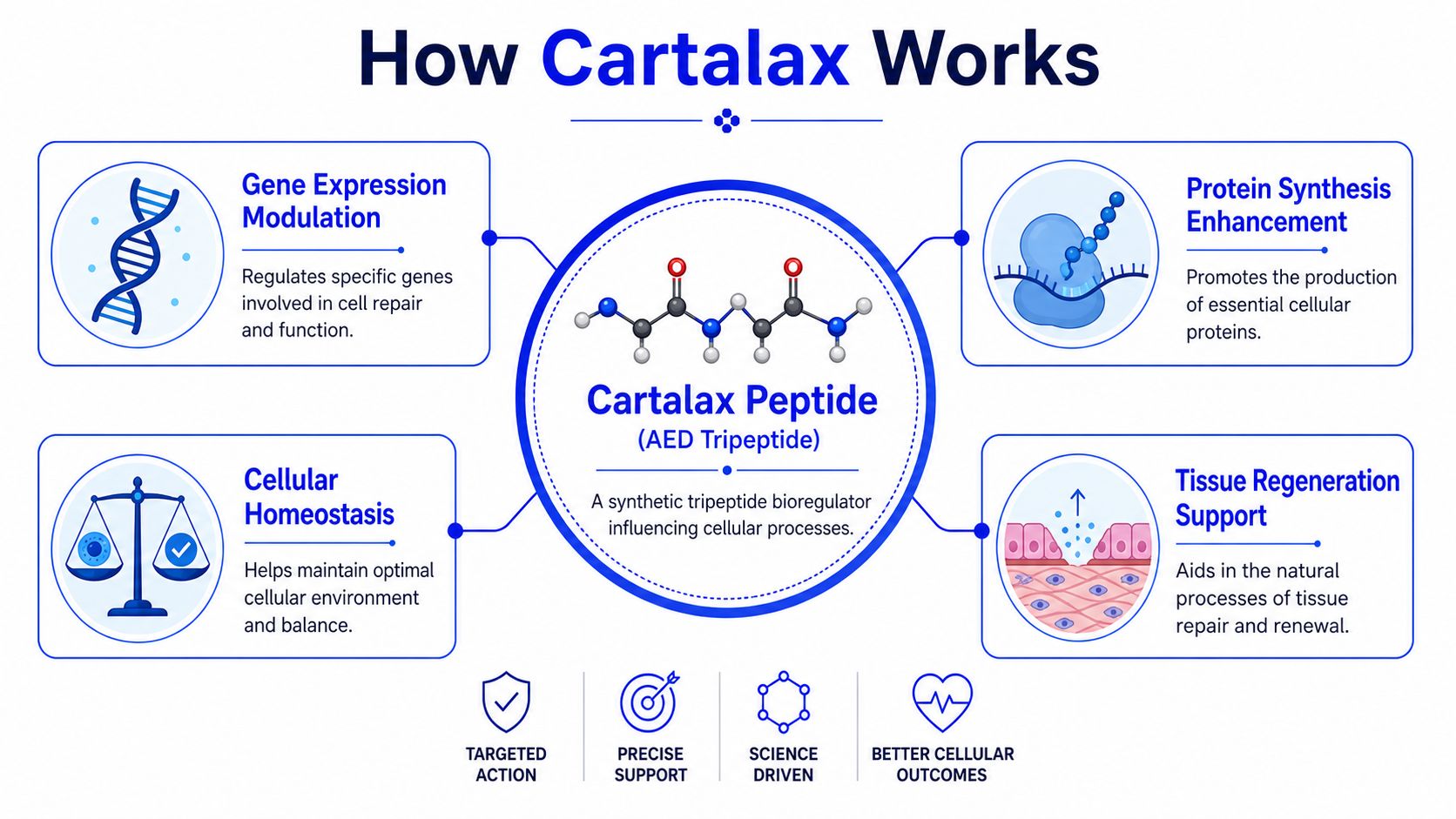
The main proposed mechanism is gene expression modulation in chondrocytes. In plain language, the peptide is being studied for its potential to nudge cartilage cells toward maintenance-related activity instead of breakdown-related activity.
That distinction matters. Cartilage is not repaired the way skin or liver tissue can be repaired. It relies heavily on a relatively small population of cells embedded inside a dense matrix. If those cells change what they produce, the tissue environment can change over time. If they do not, structural decline tends to continue.
Preclinical summaries often describe Cartalax in connection with matrix-related genes such as collagen and aggrecan, along with lower activity of degradative enzymes such as MMP-1 and MMP-13. The pattern is biologically interesting because cartilage health depends on both sides of that balance. One side builds and maintains the scaffold. The other side breaks it down.
A useful comparison is routine building maintenance. Collagen and aggrecan are part of the load-bearing material. Matrix metalloproteinases act more like demolition tools. Chondrocytes decide, at least in part, which set of instructions gets more emphasis.
That does not mean Cartalax has been proven to rebuild damaged cartilage in living humans. It means the mechanism being investigated is coherent enough to justify research attention.
Cartalax is also discussed in relation to cellular senescence and stress signaling. This can sound far removed from joint biology, but the connection is straightforward. Older or chronically stressed cells often lose their ability to maintain tissue well, even if they are still present.
Technical summaries have linked Cartalax exposure with lower expression of senescence-associated markers such as p16, p21, and p53, along with increased SIRT6. Researchers care about those markers because they sit near processes tied to cell-cycle control, DNA stability, and the broader ability of a cell to keep functioning under stress.
Readers can easily overinterpret that point, so it helps to be precise. A shift in senescence markers is not the same as a demonstrated anti-aging effect. It is better understood as a clue about the kind of cellular environment Cartalax may influence under experimental conditions.
Here is the practical interpretation:
| Mechanistic theme | Why researchers care |
|---|---|
| Matrix support | Cartilage depends on continued production of structural components such as collagen and aggrecan |
| Degradative control | Lower catabolic signaling could reduce pressure toward matrix loss |
| Senescence modulation | Cells with fewer senescence features may retain more repair capacity |
| Genomic maintenance signals | Pathways linked to DNA stability help explain interest beyond symptom-focused joint research |
Mechanistic plausibility helps researchers decide what to study next. It does not establish clinical benefit on its own. Cartalax remains a peptide with an interesting preclinical rationale, while real-world usefulness still depends on better human evidence and careful research standards.
A common research scenario looks like this. A peptide shows plausible effects in cells, a few human-facing summaries report better function, and interest rises faster than the evidence base. Cartalax sits in that middle ground. It is more than a purely theoretical compound, but it is also far from a settled clinical tool.
A useful way to assess Cartalax benefits is to separate outcomes that matter to joint performance from signals that help explain why the peptide remains under study. That distinction matters because a change in how tissue behaves is closer to practical relevance than a change in a lab marker alone.

The main reason Cartalax keeps showing up in musculoskeletal research is simple. Investigators are asking whether it can help preserve the structure and function of cartilage in settings where that tissue is under chronic stress.
Earlier summaries in the article noted observational reports of reduced joint pain and better mobility over a period of months, using cyclical dosing patterns in research contexts. Those observations are the closest thing Cartalax has to real-world relevance because they point to function, not just mechanism. If a cartilage-directed peptide is going to matter outside a lab, some sign of easier movement or less discomfort is what researchers would expect to see.
That said, observational symptom reports should be treated the way a scientist treats an early signal on an instrument panel. They are useful. They are not final proof. Without well-controlled randomized replication, it is hard to know how much of the reported effect reflects the peptide itself, background care, expectation effects, or differences in study design.
For a research-minded reader, the practical interpretation is fairly narrow:
Later in the section, it helps to see the context in motion:
A second group of proposed benefits comes from cell-level findings. This part of the Cartalax story is less visible in day-to-day function, but it helps explain why preclinical interest persists.
Cartilage can be viewed as a maintenance problem. Chondrocytes are the maintenance crew, and aging or stress can push them into a less productive state. Research attention on Cartalax comes partly from the idea that it may shift that state in a more favorable direction under experimental conditions. Earlier discussion covered changes in senescence-associated markers and SIRT6-related signaling, so the key point here is not the marker list itself. The key point is what those shifts could mean for study design.
Researchers usually draw three cautious inferences from that kind of pattern:
Confusion often starts here. A peptide associated with senescence markers is not automatically an anti-aging intervention in any broad clinical sense. In practice, these findings are better understood as a reason to test Cartalax in controlled models of tissue resilience, not as a basis for whole-body rejuvenation claims.
Practical rule: The farther a claim moves from cartilage biology toward broad longevity promises, the weaker the evidence usually becomes.
Cartalax remains interesting because it connects a defined tissue target with plausible regulatory biology and some human-facing symptom observations. Few peptides generate interest on all three fronts at once.
That combination supports further study in areas such as cartilage matrix maintenance, joint function, cellular stress response, and connective-tissue models. It does not support confident claims that the peptide is clinically established.
The gap between preclinical enthusiasm and real-world application is still the central issue. A careful reader should come away with measured interest. Cartalax has enough evidence to justify research attention, and not enough to justify overstated conclusions.
A balanced view of Cartalax starts with a simple fact. The evidence is not empty, but it’s uneven. Some parts are mechanistically persuasive. Some parts are observationally promising. Very little of it reaches the standard most readers expect when they hear “clinically proven.”
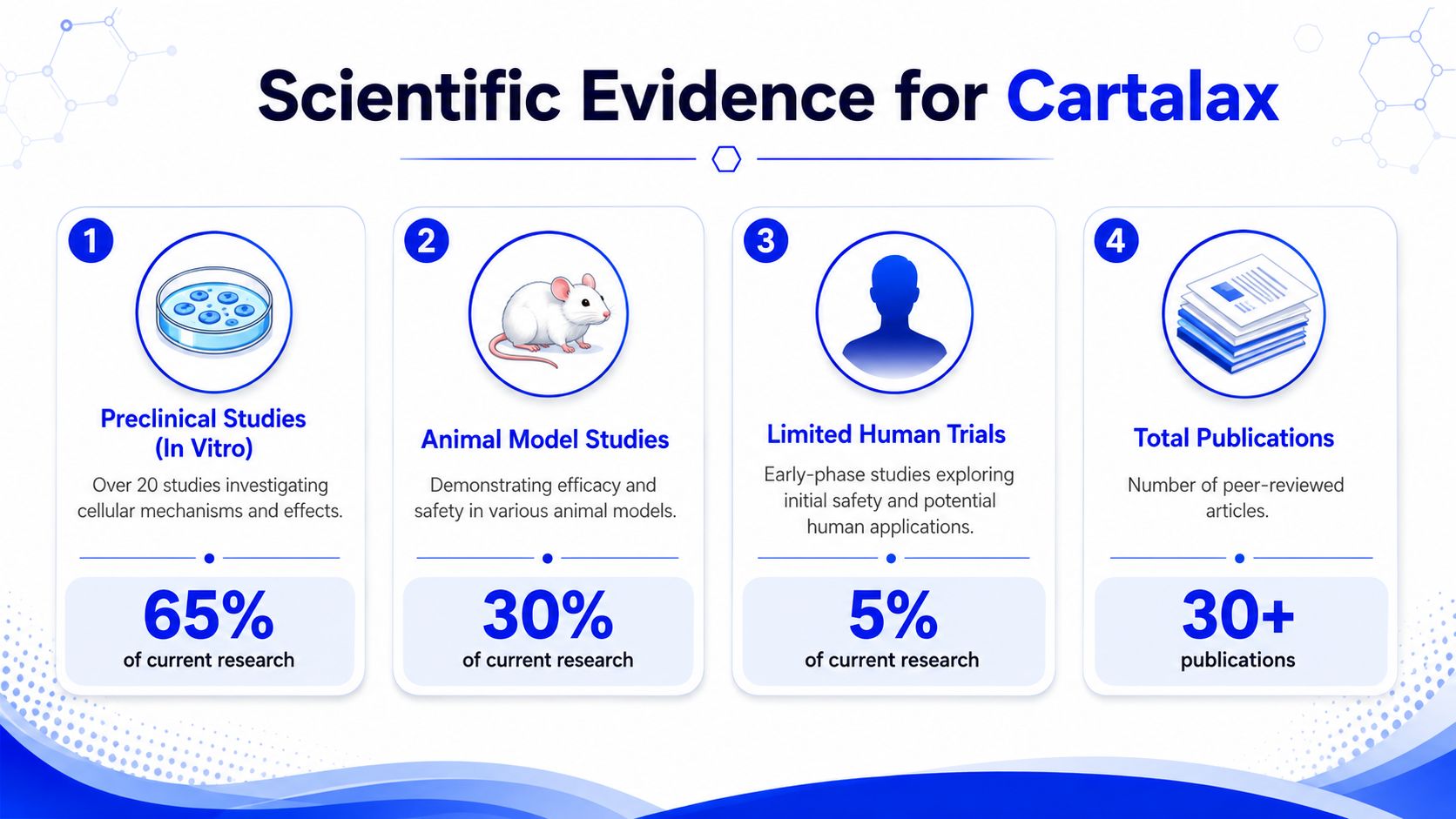
One of the most cited historical foundations comes from Russian peptide-bioregulator research. In a lecture summarizing that body of work, Cartalax and a related peptide were reported to increase the cartilage area index by 18–38%, and Cartalax was linked to improved joint mobility in 68.5% of cases in clinical or experimental settings.
The same source states that the peptide complex restored PCNA synthesis in chondrocytes and supported cartilage repair. PCNA matters because it’s associated with cell proliferation and tissue regeneration, so that claim fits the broader repair-oriented model behind Cartalax.
Those historical signals help explain why Cartalax never disappeared from niche peptide discussions. They give the molecule a research identity tied to musculoskeletal tissue rather than generic “performance enhancement” language.
There are two important limits you shouldn’t gloss over.
First, much of the human-facing discussion still relies on observational reporting and literature summaries rather than independently replicated randomized trials. That means the findings may be suggestive without being definitive.
Second, recent review-style content keeps pointing out the same gap. Cartalax is often discussed with enthusiasm for matrix genes, senescence markers, and tissue-repair theory, but the human evidence remains thin and largely rooted in Russian observational work rather than broader clinical validation.
If you’re trying to judge whether Cartalax belongs in serious research consideration, this framework helps:
| Evidence layer | What it offers | Main limitation |
|---|---|---|
| Mechanistic summaries | A coherent explanation for cartilage and senescence-related effects | Mechanism doesn’t prove outcome |
| Historical peptide-bioregulator data | Concrete signals in cartilage-focused contexts | Older and not broadly replicated |
| Observational human-style reports | Functional outcomes such as pain and mobility changes | Not the same as randomized confirmation |
| Broader anti-aging discussion | Expands possible relevance to tissue integrity | Easily drifts into overclaiming |
The bottom line is straightforward. Cartalax looks promising enough to warrant careful research attention, especially for cartilage-related questions. It doesn’t yet justify the kind of certainty you’d attach to well-replicated clinical interventions.
The practical side of Cartalax research starts with restraint. It should be approached as an investigational compound, not as an approved therapy, supplement shortcut, or consumer wellness product.
With peptides, bad sourcing can ruin the entire point of the research. If identity, purity, or contamination status is unclear, even a strong theoretical compound becomes useless because the material itself may not match the label.
That’s why documentation matters. A Certificate of Analysis (COA) is the basic record researchers use to confirm what a batch is supposed to contain. It’s not marketing copy. It’s part of traceability.
Look for evidence that a supplier provides:
A careful buyer doesn’t start with the lowest price. They start with the paper trail.
Use a simple screening approach:
Good peptide research starts before the vial is opened. It starts when the sourcing documents hold up to scrutiny.
Recent summaries note that Cartalax is not FDA-approved and shouldn’t be treated as an approved drug or dietary supplement in major Western markets. That matters because it sets the boundary for responsible discussion.
A scientifically honest position is simple. Cartalax may be a valuable research tool for studying cartilage signaling, matrix maintenance, and senescence-related biology. It should still be handled within proper laboratory, analytical, and preclinical frameworks, with no leap from investigational interest to medical certainty.
If you’re looking for a research-focused source with transparent documentation, Peptide Warehouse USA is worth exploring. The company supplies USA-made research peptides with batch testing, COAs, microbial and endotoxin reports, and clear research-use-only positioning, which makes it easier to evaluate materials responsibly. Learn more and explore options if your lab prioritizes traceability, consistency, and compliant peptide sourcing.