No products in the cart.



The most popular advice about Chemyo RAD 140 usually starts with bodybuilding outcomes, cycle length, or stacking. That framing skips the central fact: the only published first-in-human trial studied RAD-140, also called Testolone, in postmenopausal women with hormone-receptor-positive breast cancer, not in athletes seeking muscle growth. A careful review therefore has to begin with clinical safety, pharmacology, evidence limits, and regulatory status, rather than anecdotal performance claims.
This research overview separates what has been documented from what remains unproven. It also provides a practical sourcing framework for laboratory managers evaluating research-grade compounds, with particular attention to batch documentation, analytical testing, and institutional compliance.
Bodybuilding content often presents RAD-140 as though its human performance profile were established. The evidence does not support that conclusion. Published human research comes from oncology, while claims about muscle gain, strength, fat loss, recovery, or “safer steroid” performance lack support from a published trial in healthy athletes.
RAD-140 was first disclosed in a 2010 preclinical paper describing its discovery as a potent, orally bioavailable, nonsteroidal SARM. The compound then moved toward oncology research rather than physique enhancement. The U.S. National Cancer Institute lists a first-in-human phase 1 study in postmenopausal women with hormone-receptor-positive breast cancer. That study was marked complete and focused primarily on safety, tolerability, and pharmacokinetics, as documented in the published RAD-140 discovery and clinical research record.
The published trial enrolled 22 patients, with dose cohorts of 50 mg, 100 mg, and 150 mg once daily. These figures describe an oncology dose-escalation program. They do not establish a bodybuilding protocol, a safe athletic dose, or a validated cycle structure.
The research population, disease state, treatment objective, and monitoring conditions differ substantially from recreational use. For a laboratory manager, the trial is evidence about RAD-140 exposure and observed safety signals in a defined clinical setting. It is not a dosing guide for performance enhancement.
RAD-140's research trajectory remains relevant because the compound progressed from preclinical characterization into a defined clinical program by 2016 to 2017, with patient enrollment by 2021, according to the clinical history summarized in the same peer-reviewed record. That history confirms that Testolone is a documented research compound, not merely a forum-created label. It does not show that online product claims match the compound's clinical behavior.
Evidence rule: A compound may have genuine clinical research behind it while lacking evidence for the use most often promoted online.
Anyone evaluating Chemyo RAD 140 should ask three questions before accepting a claimed benefit:
These questions define the central gap between marketing and evidence. RAD-140 has a human research history, but that history is narrower than bodybuilding content implies.
RAD-140 is a selective androgen receptor modulator, or SARM. Unlike steroidal androgens, it is a nonsteroidal compound developed to interact with androgen receptors while producing a tissue-selective pharmacological profile. “Selective” describes relative receptor activity and tissue preference. It does not establish that adverse effects are excluded across other tissues, doses, or exposure conditions.
Preclinical work focused on androgen-receptor activation in tissues such as muscle and bone while seeking less activity in other androgen-sensitive tissues. That pharmacological rationale explains the compound's research interest. It does not establish predictable or beneficial outcomes in humans, particularly when online bodybuilding material presents receptor selectivity as a substitute for clinical safety evidence.
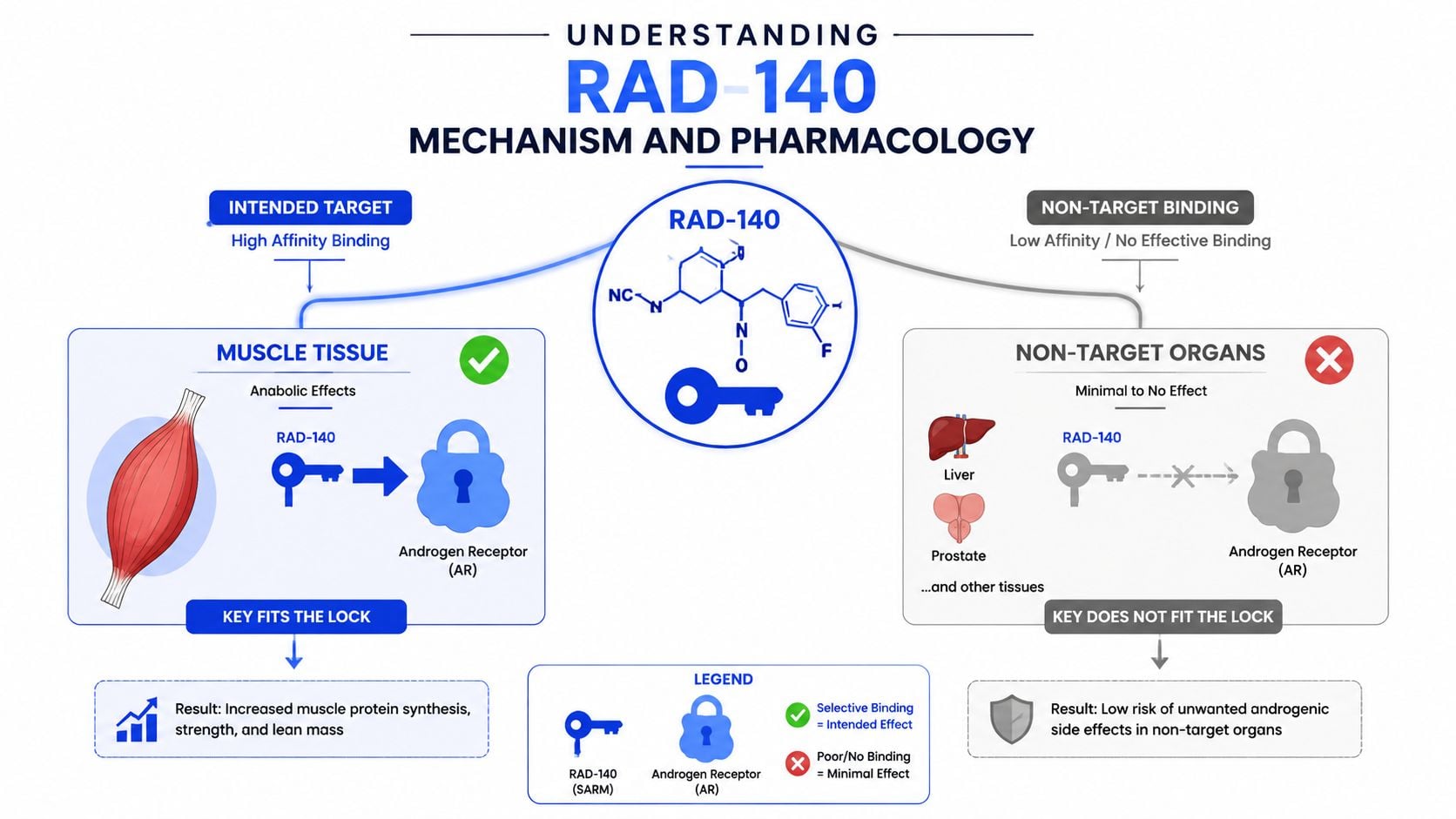
Preclinical receptor activity can support compound development, but it cannot resolve long-term hepatic safety, cardiovascular outcomes, endocrine effects, batch consistency, or the comparability of an unapproved commercial formulation to material used in a controlled study. Those questions require human exposure data and verified product identity.
The published first-in-human study provides a more concrete pharmacokinetic reference. RAD-140 had a half-life of 44.7 hours, supporting once-daily administration within that trial. This finding conflicts with shorter half-life estimates repeated in some bodybuilding content. For research review, the clinical pharmacokinetic record carries more evidentiary weight than unsourced community protocols.
The trial included once-daily administration across 50 mg, 100 mg, and 150 mg cohorts. These cohorts belonged to an oncology study and should not be treated as recreational dosing guidance. Clinical dose selection reflects protocol design, disease context, escalation rules, monitoring, and predefined endpoints. It cannot be separated from those controls.
For procurement and study review, several terms require precise use:
RAD-140's mechanism explains why it entered research. Its pharmacokinetics explain the trial's once-daily schedule. Neither finding demonstrates muscle-building efficacy or safety in healthy people, and neither validates the identity or quality of an online product.
Bodybuilding-style discussions often treat RAD-140 as a performance compound with predictable effects. The human record supports a narrower conclusion: clinical activity was measurable in an oncology trial, while safety signals were frequent. At 24 weeks, the overall clinical benefit rate was 18.2%, median progression-free survival was 2.3 months, and one patient achieved a partial response at the 100 mg/day maximum tolerated dose, according to the published human trial report.
The same trial recorded substantial treatment-emergent toxicity. Increased AST occurred in 59.1% of patients, increased ALT in 45.5%, and total bilirubin elevation in 27.3%. Grade 3/4 treatment-emergent adverse events occurred in 72.7%, and treatment-related adverse events occurred in 77.3% of participants.
| Adverse Event | Incidence Rate | Clinical Significance |
|---|---|---|
| Increased AST | 59.1% | Frequent liver-enzyme signal requiring clinical interpretation |
| Increased ALT | 45.5% | Common hepatic laboratory abnormality |
| Increased total bilirubin | 27.3% | Relevant signal for liver and biliary assessment |
| Grade 3/4 treatment-emergent adverse events | 72.7% | Substantial burden of serious or severe events |
| Treatment-related adverse events | 77.3% | Most participants experienced an event judged related to treatment |
These findings do not show that every RAD-140 exposure causes liver injury. They do show that liver-related laboratory abnormalities were common in the only published first-in-human study, conducted in a defined oncology population with clinical monitoring. That context limits direct extrapolation to healthy users, but it does not make the safety signal irrelevant.
Real-world reports add a separate line of evidence. A 2022 NIH case report described RAD-140-associated drug-induced liver injury after a patient used supplements containing RAD-140. Outside a controlled trial, the product's identity, concentration, and co-exposures may be uncertain, so the report cannot establish a population incidence rate. It does, however, support a clinically meaningful liver-harm concern. The American College of Gastroenterology also reported multiple RAD-140 liver-injury cases, including a case described as the second significant RAD-140 DILI report and the third SARM-related DILI case requiring supplement discontinuation, in its case report on RAD-140 drug-induced liver injury.
For laboratory risk assessment, the stronger interpretation comes from convergence: trial abnormalities, real-world DILI reports, and regulatory warnings. A source-review process can use trusted research sources 2026 to distinguish controlled clinical evidence from anecdotal performance claims.
Bodybuilding content often treats RAD-140 as a performance product. Laboratory procurement requires a different standard. For Chemyo RAD 140 or any comparable research compound, the record should show what was ordered, which batch was tested, and whether the material received matches the analytical documentation.
A supplier should provide a certificate of analysis that identifies the compound, testing laboratory, lot, method, measured result, and relevant storage or handling conditions. A generic purity statement has limited value when it cannot be tied to a specific batch. Marketing language and performance claims do not replace traceable analytical records.
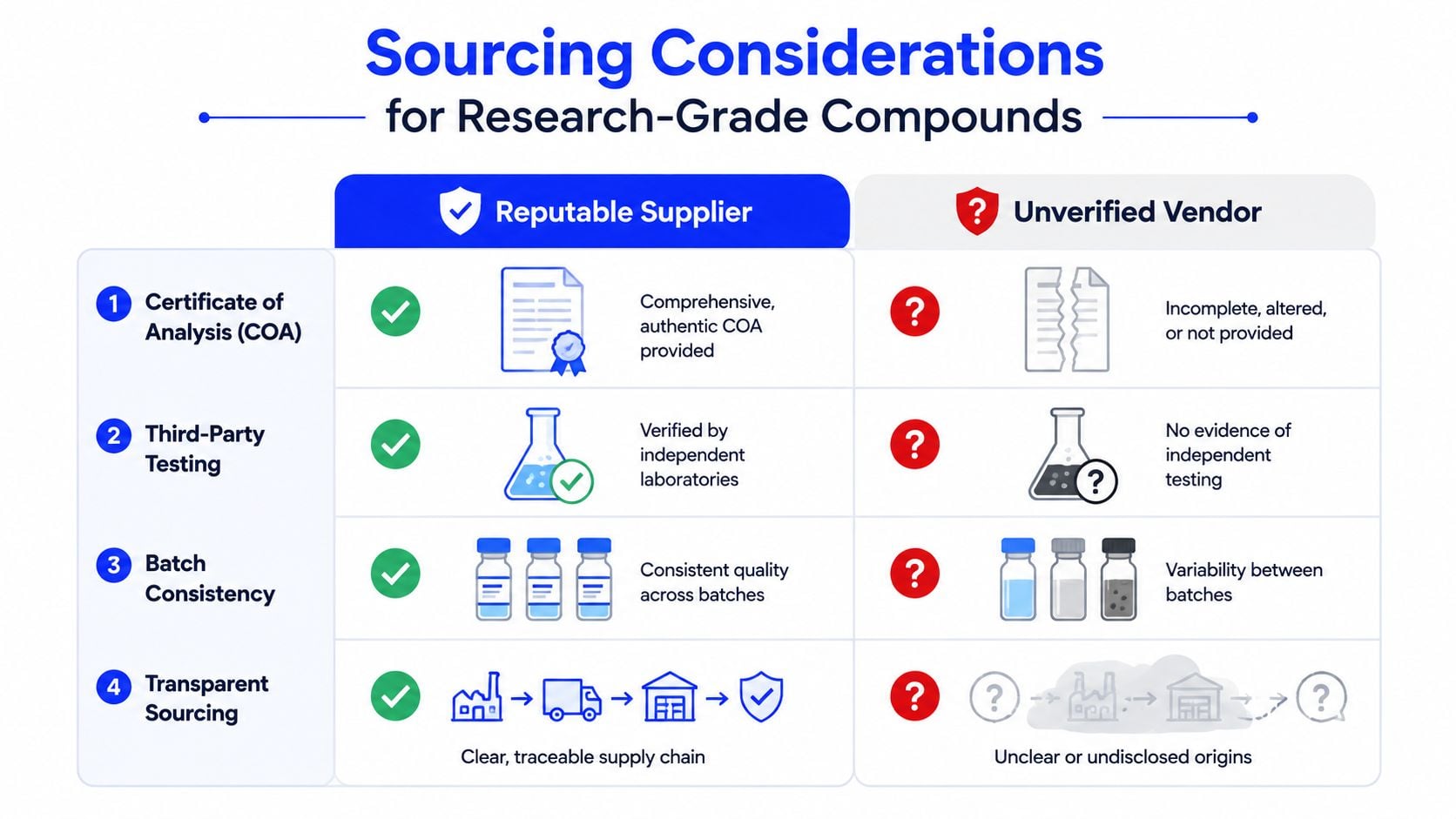
Before ordering, review four points:
Study design determines whether further documentation is needed. Microbial screening, endotoxin reports, stability information, and chain-of-custody records may matter for controlled analytical or preclinical workflows. These records improve accountability and reduce uncertainty about what enters the laboratory. They do not make an unapproved compound suitable for human use, and they cannot substitute for clinical safety evidence.
Receiving controls should be specific. Match the delivered label with the purchase order, inspect the container, photograph discrepancies, record the lot, and quarantine material when documentation is incomplete. Procurement teams should reject descriptions that present research chemicals as supplements, treatments, or performance products, since those claims blur the distinction between laboratory material and a product intended for human use.
The defensible sourcing choice is the one that provides enough identity, purity, and traceability information for researchers to interpret results and investigate unexpected findings.
RAD-140 sits outside the approved-drug framework. The FDA has identified RAD-140 Testolone among SARM products marketed for sale in the United States. A 2025 warning letter names RAD-140 and Testolone directly and describes the product as a SARM, according to the FDA warning letter naming RAD-140 and Testolone. This regulatory record matters because bodybuilding-style descriptions can imply a level of clinical validation that the human evidence does not establish.
The FDA states that SARMs, including RAD-140, are not approved for use and have been associated with serious safety concerns, including potentially life-threatening liver toxicity and increased risks of heart attack and stroke. Laboratories should treat that communication as a compliance input, not general background, as outlined in the FDA safety communication on SARMs.
Regulatory status also changes how supplier language should be read. “Research chemical” describes a commercial context. It does not demonstrate approval, clinical suitability, or safety. A laboratory purchasing RAD-140 should maintain records showing controlled procurement, defined authorization, and responsible handling, particularly when product identity or marketing materials conflict with laboratory use.
The bodybuilding narrative around RAD-140 runs ahead of its human evidence. Available clinical work can inform oncology exposure, pharmacokinetics, and observed adverse events, but it cannot justify bodybuilding dosage advice, performance guarantees, or claims that Testolone safely replaces approved therapies.
A defensible research decision begins with the question, not the testimonial. Confirm that the study population, exposure, and endpoint fit the proposed analysis. Treat liver-related signals and other adverse events as inputs to laboratory review, monitoring plans, and stop criteria.
Reproducibility also depends on material identity. Keep batch-linked analytical records, including supplier documentation and testing results, so findings can be traced to a defined material rather than a product name alone. Research-use-only handling must remain separate from human-use promotion and administration.
Teams can use this discussion of weak evidence pitfalls in medicine to assess why anecdotal fitness claims may appear more persuasive than clinical evidence.
Procurement should prioritize documentation quality over bodybuilding testimonials. Peptide Warehouse USA offers laboratory, analytical, and preclinical research materials with batch documentation, including COAs and microbial and endotoxin reports. Its products are sold for research use only and not for human consumption.
For a compliant procurement workflow, visit Peptide Warehouse USA to review available materials and records. Confirm institutional approval before ordering, request protocol-specific documentation, and keep RAD-140 work anchored to published evidence.