No products in the cart.



Oral delivery sounds simple. Put the peptide in a capsule, swallow it, and move on. For CJC 1295 capsules, that assumption is usually where the scientific misunderstanding starts.
CJC-1295 is a synthetic growth hormone-releasing hormone analog developed in both DAC and non-DAC forms, with the DAC version reported to have a 6 to 8 day half-life and the non-DAC form about 30 minutes, according to the documented compound overview. That long-acting design made the molecule notable in peptide research. It did not make it easy to deliver by mouth.
Procurement teams need to separate peptide identity from peptide formulation. A real CJC-1295 material can still be a poor oral product if the delivery system is weak, undocumented, or built around marketing language instead of formulation science. That distinction matters when you're evaluating capsule offerings, setting up studies, and deciding what kind of data you can realistically expect.
The appeal of capsules is obvious. They look easier to buy, easier to handle, and easier to build into a protocol than injectable peptides.
That convenience can be misleading. With CJC-1295, the hard part isn't identifying the peptide. It's getting a large, structurally fragile molecule through the gastrointestinal tract intact and then across the gut wall in a form that still does what researchers expect it to do.
For labs comparing formats, the right question isn't “Are CJC 1295 capsules available?” The right question is “What delivery problem has this formulation solved, and what evidence supports that claim?”
CJC-1295 is a synthetic growth hormone-releasing hormone analog, and that classification has direct purchasing implications. Labs are dealing with a modified peptide, not a conventional oral-active small molecule, so formulation choices affect stability, analytical testing, and route-of-administration feasibility from the start.
Its documented molecular formula is C165H271N47O46 and its molecular weight is 3,647.28 Da, as summarized in the compound reference entry. For procurement, those details are more than catalog data. A peptide in this size range already raises questions about degradation risk, excipient compatibility, and whether a supplier is selling a chemically characterized material or just a label.
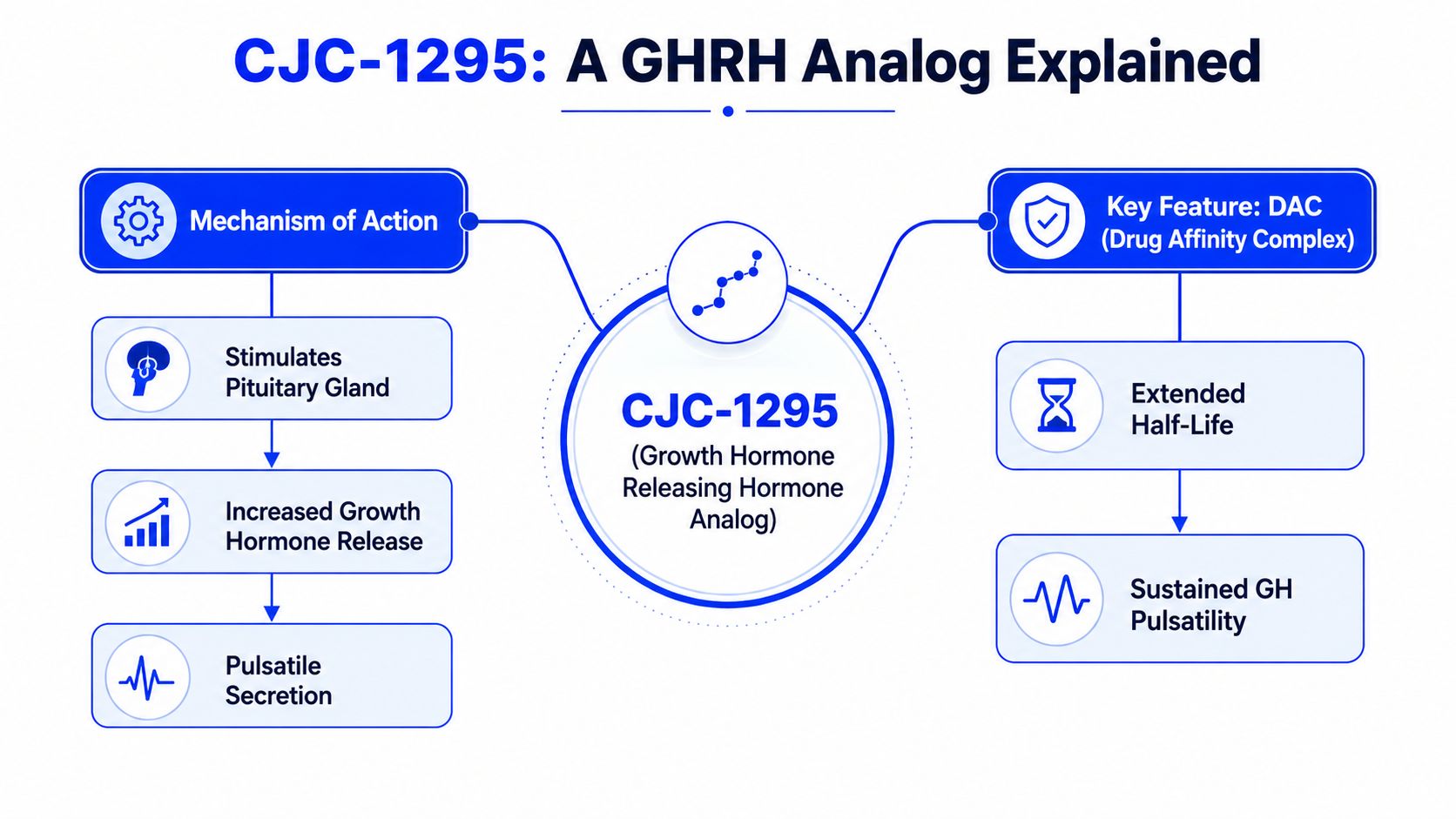
That is one reason the phrase CJC 1295 capsules needs careful scrutiny. The peptide identity may be real, but oral presentation creates a separate formulation question. A large peptide can be synthesized correctly and still be poorly suited to a standard capsule format if the delivery system does not protect the material or support absorption.
Three practical checks follow from that:
CJC-1295 is also discussed in two common research forms: DAC and non-DAC.
The DAC form is associated with a much longer reported half-life than the non-DAC form, based on the same compound summary. For study design, that difference matters because the attachment changes how long the peptide remains active in circulation and, in turn, how investigators build sampling schedules and dosing intervals.
From a formulation standpoint, DAC status is not a minor variant. It changes what the lab is buying. If a vendor lists "CJC-1295" without clearly stating whether the material is DAC-modified, the product description is incomplete for any serious research program.
Practical rule: Verify DAC or non-DAC status before comparing vendors, capsule claims, storage plans, or protocol fit.
This distinction matters even more in oral-format discussions. A longer-acting version does not solve the upstream problem of getting an intact peptide through the gastrointestinal tract. Procurement teams sometimes focus on the half-life claim because it sounds like the primary performance variable. In capsule form, the first question is still whether the formulation can deliver measurable intact material at all.
There is also a compliance point. CJC-1295 is generally described as an investigational compound not approved for therapeutic use in humans in the same source overview. Labs should treat that as a matter of regulatory status, with sourcing, documentation, labeling, and use restricted to appropriate research settings.
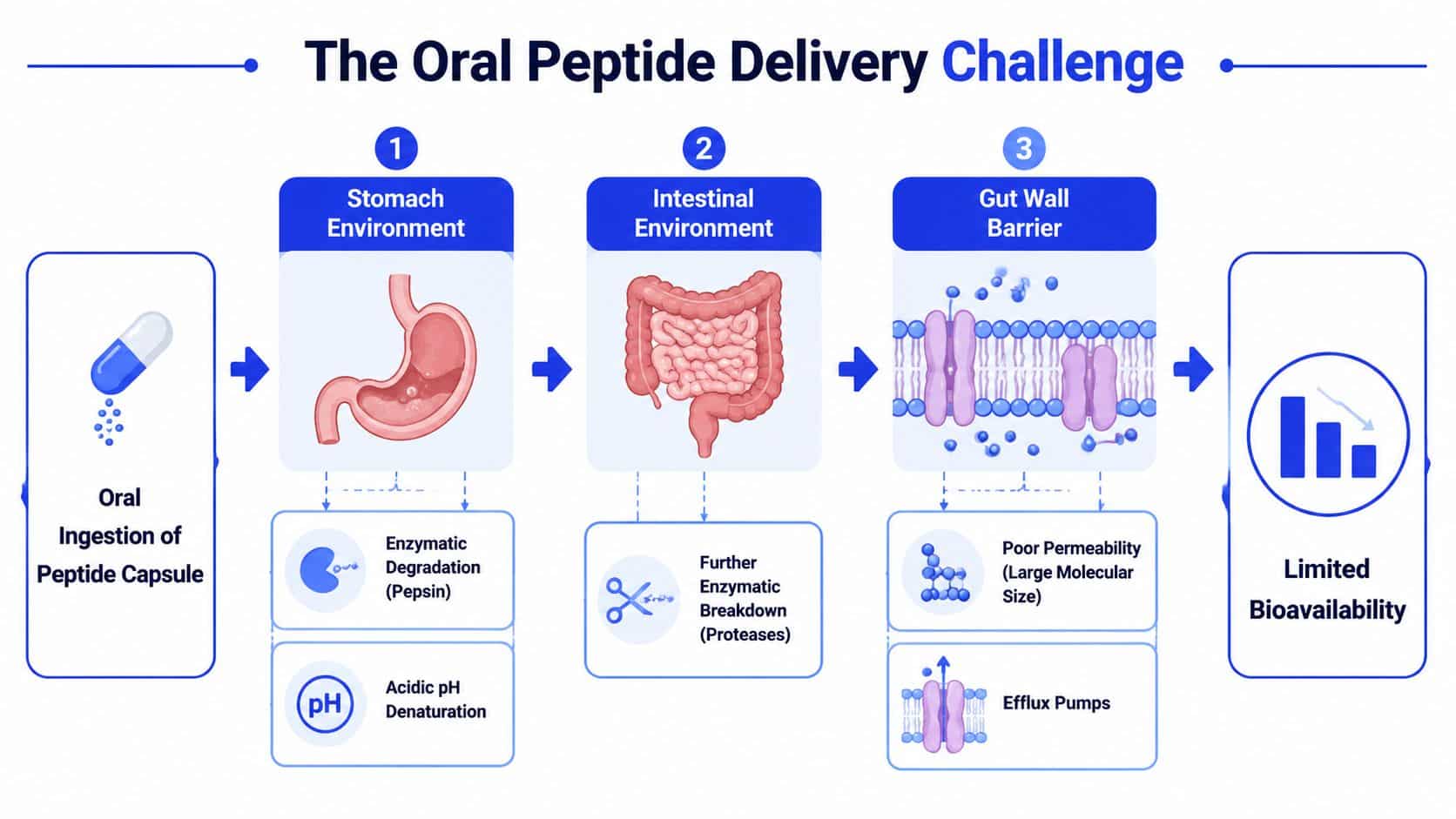
The central problem with CJC 1295 capsules isn't market availability. It's oral peptide bioavailability.
CJC-1295 is described as a 30 amino acid peptide whose structure is highly susceptible to hydrolysis in the acidic gastric environment, making oral bioavailability negligible without advanced encapsulation systems that aren't present in standard commercial capsules, according to the formulation-focused analysis from Paragon Sports Medicine. That same discussion notes that the established mechanism requires bypassing the digestive system via injection.
A standard capsule shell does very little on its own. It can hold material. It doesn't solve the biological barriers.
Those barriers come in sequence:
Stomach acid exposure
Acidic conditions can denature or damage peptide material before absorption is even possible.
Proteolytic digestion
Enzymes are designed to break proteins and peptides into smaller fragments. From the body's perspective, a peptide capsule often looks more like food than a precision research agent.
Intestinal permeability limits
Even if some intact peptide survives, the intestinal wall is selective. Large molecules don't cross it easily.
Here's a useful visual for teams thinking through that route-dependent loss:
A peptide in a capsule isn't automatically an oral delivery system. It's often just a peptide placed inside an oral container.
If a supplier claims oral CJC-1295 performance, the capsule should be treated as a delivery platform claim. That demands evidence.
A serious oral peptide system would usually need some combination of:
Most commercial capsule listings don't provide that level of documentation. They describe convenience, not transport chemistry.
That doesn't mean oral peptide research is impossible. It means a plain capsule should never be assumed equivalent to a validated oral delivery technology.
What is a lab really buying when it orders a "CJC 1295 capsule"? In many listings, the answer is simple encapsulation, not a validated oral peptide delivery system.
That distinction drives purchasing risk. Oral CJC-1295 is a formulation problem first. The peptide has to remain intact through manufacturing, storage, capsule fill, and gastrointestinal transit before absorption is even relevant. A capsule can improve handling and unit presentation, but those features do not establish functional oral delivery.
Current discussion around CJC-1295 often centers on injectable research. Oral versions sit on thinner ground, and the evidence gap around broad performance claims remains a concern, as noted in this overview of the evidence gap.
From a formulation review standpoint, procurement teams should separate capsule products into two very different categories.
| Formulation type | What it usually means | Procurement implication |
|---|---|---|
| Simple capsule fill | Peptide powder placed into a capsule shell | Convenient presentation, but no proven solution to oral delivery barriers |
| Engineered oral platform | Peptide paired with a protective and absorptive strategy | Requires strong supporting documentation before it deserves protocol consideration |
This is the point many listings blur. A filled capsule is a dosage form. An oral peptide platform is a delivery system with evidence behind it.
For CJC-1295, that difference is material. If a vendor does not disclose how the capsule handles peptide degradation, transit conditions, and post-formulation integrity, the buyer is evaluating packaging convenience more than delivery science.
A serious supplier should be able to answer formulation questions in plain technical language.
Use a checklist like this:
One practical warning sign stands out. If a supplier spends more space describing expected results than explaining excipients, stability, and analytical release criteria, the capsule is being marketed harder than it is being characterized.
For teams screening vendors, Peptide Warehouse USA is one example of a supplier that presents itself in research-use terms and discusses batch documentation practices for laboratory materials. That is the kind of operational framing procurement teams should look for, regardless of vendor.
Which route gives a lab the cleaner signal. The answer is usually injection, and the reason is straightforward. CJC-1295 is a peptide, so the comparison is not just convenience versus inconvenience. It is a comparison between a delivery route with established systemic access and a dosage form that has to survive the gastrointestinal tract, cross an absorption barrier, and still remain intact enough to matter in a study.
Earlier in the article, the injectable literature established the practical benchmark for CJC-1295 exposure and downstream response. That benchmark matters because capsule claims are often framed as if route were a secondary detail. For peptide work, route is part of the formulation itself.
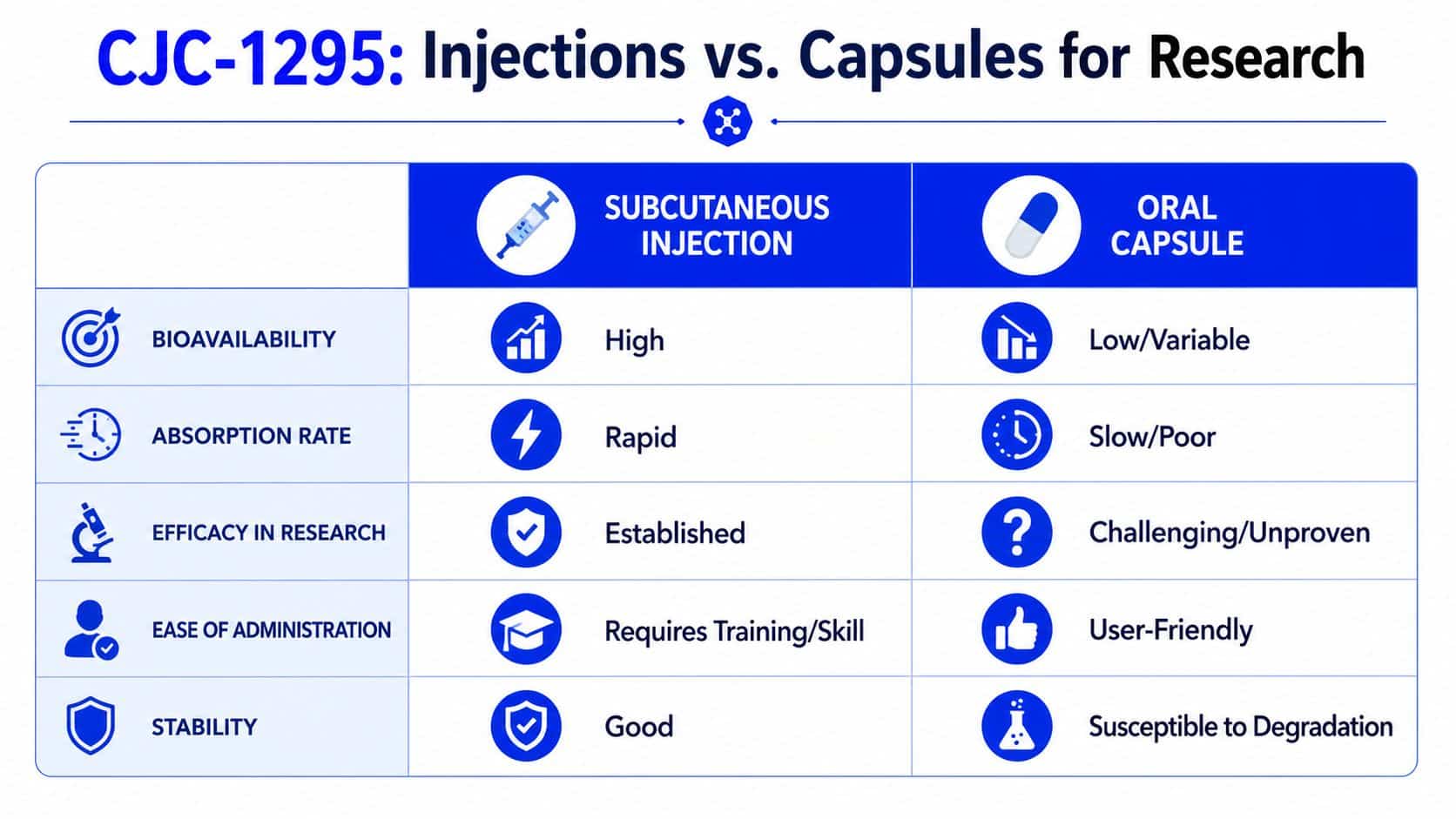
| Criterion | Injection-based research use | Capsule-based research use |
|---|---|---|
| Route reliability | Established route for peptide delivery | Depends on excipients, capsule design, and absorption assumptions |
| Dosing precision | Higher procedural control at administration | Administered dose may not reflect absorbed dose |
| Study reproducibility | Easier to standardize across cohorts | Greater variability if formulation performance is inconsistent |
| Material loss before action | Lower route-related loss | Potential degradation and pre-absorption loss |
| Operational burden | Requires trained handling and protocol discipline | Simpler distribution, but more formulation-related uncertainty |
The operational advantage of capsules is obvious. Packaging, allocation, and administration can be easier in some research settings.
That advantage has to be weighed against a harder scientific problem.
With injections, the lab mainly controls dose preparation, handling, and administration technique. With capsules, the lab is also inheriting every unresolved question in the formulation. Was the peptide protected from gastric conditions. Is any permeation strategy being used. Was the finished capsule tested after filling, or is the supplier only presenting raw-powder data. Those are not minor details. They determine whether the capsule is a usable research tool or just a convenient container.
This is why I treat injection and capsule procurement as different risk categories, not interchangeable SKUs. If the study depends on consistent exposure, injections usually give the cleaner experimental setup. If a team chooses capsules, it should do so with the understanding that formulation uncertainty may become a study variable.
For capsule procurement, stricter review is justified.
Confirm the finished dosage form
Ask what was tested on the capsule itself, not just on the input peptide.
Ask route-specific questions
Request a technical explanation for how the formulation is intended to limit degradation or improve uptake.
Review batch traceability
Lot number, manufacture date, and release records should match the packaged material.
Check analytical relevance
Identity and purity data should be tied to the finished product whenever the supplier is selling a formulated capsule.
Screen for route inflation
Treat any claim of injection-like performance with caution unless the vendor can show formulation and finished-product evidence that supports it.
Buy the route that fits the study design. Do not let packaging simplicity stand in for delivery science.
A procurement decision on CJC-1295 should begin with documents, not branding. If the supplier can't support the material with current analytical records, the product isn't ready for serious lab use.
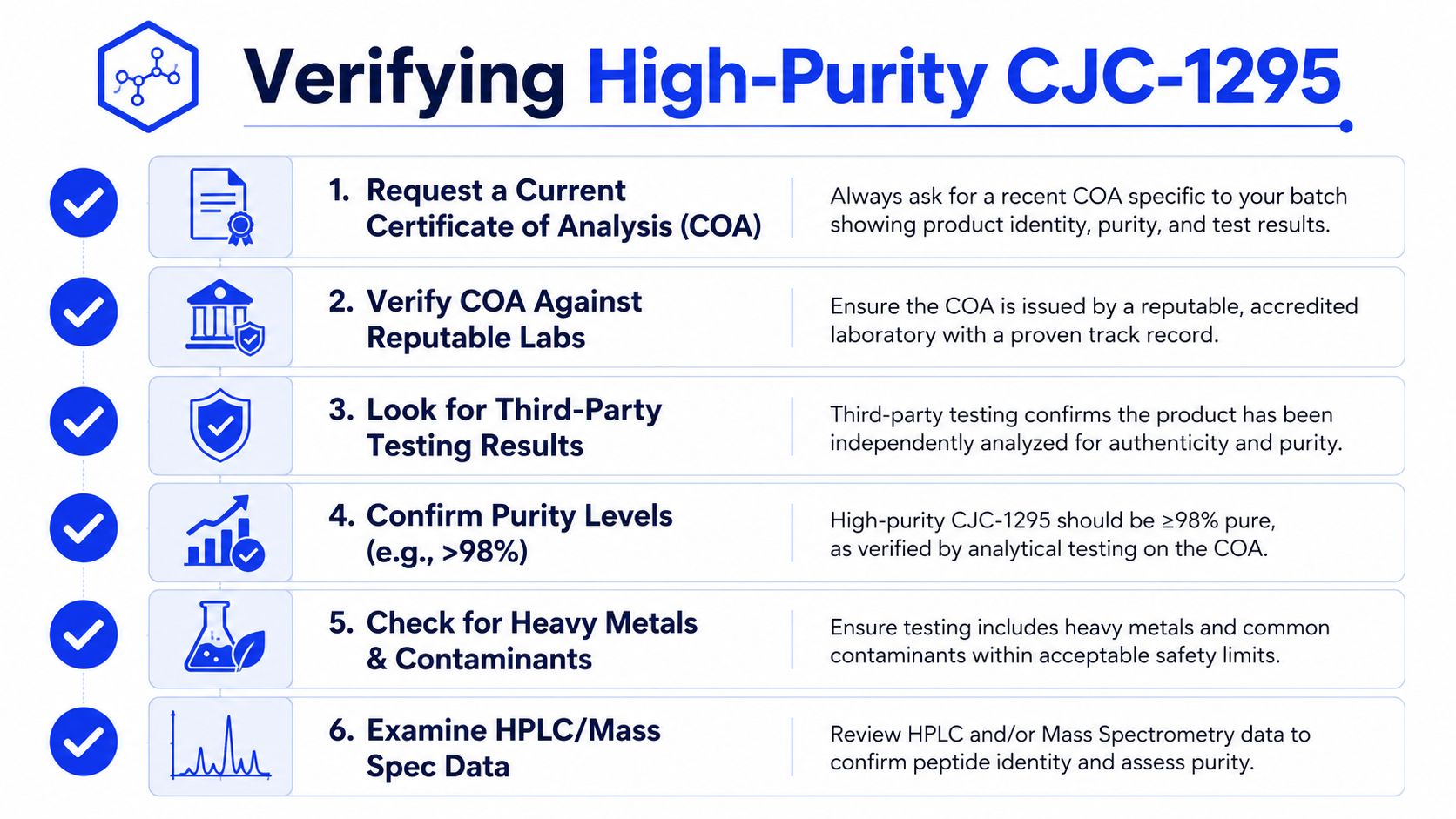
A Certificate of Analysis (COA) should let your team answer three basic questions. Is this the right molecule? Is it sufficiently pure for the stated research use? Can this batch be traced and reviewed later?
Look for these elements:
The infographic brief for this article mentions purity thresholds and contaminant review as examples of what buyers often expect to see. That's a sound procurement mindset. The key is to verify those points through actual lot documentation, not generic website claims.
Receiving the peptide is only half the job. Good labs preserve the chain of information.
Use a simple receiving workflow:
Storage planning should also begin at receipt. For lyophilized peptide material, protect from unnecessary heat, light, and moisture. For any reconstituted solution, document the solvent used, preparation date, and in-lab storage location.
That discipline matters more with peptide materials than many buyers expect. Degradation doesn't always announce itself visually.
Once CJC-1295 enters the lab, poor handling can erase the value of good sourcing. That is especially true for lyophilized peptide powders and any reconstituted preparations used in analytical or preclinical workflows.
Store lyophilized material in a cool, dark, dry environment and minimize repeated exposure during access. When reconstitution is part of the protocol, labs commonly use bacteriostatic water and then refrigerate the prepared solution under controlled internal handling procedures. The important part isn't just the solvent choice. It's documenting who prepared it, when it was prepared, and how long it remains in active use under your SOPs.
Peptides often move through multiple internal touchpoints after receipt. Secondary containment, sample segregation, and transport labeling reduce avoidable errors.
For labs shipping internal samples or staging materials across work areas, labels for safe delivery can be a practical reference for building clearer packaging and handling controls around fragile or temperature-sensitive items.
A simple handling checklist helps:
Investigational status also affects how teams should think about storage. “Research use only” isn't just a sales disclaimer. It should shape labeling, access control, training, and recordkeeping from receipt through disposal.
What does a capsule label change from a regulatory standpoint? Very little.
CJC-1295 remains an investigational peptide. For procurement teams, that means the dosage form does not alter the core classification, and an oral presentation does not convert a research material into an approved therapeutic product. That distinction matters even more with capsule products, because oral delivery can make a peptide appear closer to a conventional consumer item than the underlying formulation science supports.
Purchasing discipline is important. If a supplier presents CJC-1295 capsules with consumer-style wellness copy, broad performance claims, or vague oral-use language, treat that as a compliance warning. A serious research vendor should state research-use limitations clearly, separate investigational materials from retail supplement framing, and provide batch-level documentation that matches laboratory procurement practices.
The disclaimer is not filler text. It defines how the material should be bought, logged, reviewed, and used inside the lab.
For readers comparing research materials with ordinary retail products, this guide on how to safely take supplements is a useful contrast. The standards are different, but the procurement lesson is similar. Delivery format, capsule presentation, and marketing language do not substitute for formulation evidence, traceability, or a lawful research context.
CJC 1295 capsules sound straightforward, but the primary issue is oral peptide delivery. CJC-1295 is a notable research peptide, yet a standard capsule doesn't solve the core barriers of gastric degradation, enzymatic breakdown, and limited intestinal uptake.
For most research settings, injection-based work remains the more dependable reference point, while capsule products demand much deeper formulation scrutiny. Buyers who focus on route feasibility, lot documentation, traceability, and storage discipline make better procurement decisions and cleaner study designs. If you're evaluating peptide materials for laboratory use, learn more and explore options that come with clear research documentation and transparent batch support.
If you're sourcing research-use peptide materials and need clear documentation, lot traceability, and US-based fulfillment, Peptide Warehouse USA is one option to explore for laboratory, analytical, and preclinical procurement.