No products in the cart.


CJC-1295 with DAC is an investigational research compound, not an FDA-approved medicine, and human therapeutic benefits remain unestablished. The strongest human evidence shows temporary hormone changes, so a responsible purchase should be based on lot-specific laboratory documentation rather than marketing language.
That distinction matters because a search for CJC 1295 DAC buy often produces pages focused on convenience, wellness outcomes, or dosing. Those claims can make a research chemical look like an established treatment, even though the available evidence primarily concerns pharmacokinetics and endocrine responses in healthy adults.
A laboratory manager would approach procurement differently. Before comparing price or delivery speed, confirm what form the product is, what the supplier has tested, whether the documentation belongs to the specific lot, and whether the proposed work fits applicable institutional and legal requirements. This guide explains that process in plain language, without offering human-use instructions.
A purchase query doesn't automatically represent a consumer shopping decision. For CJC-1295 with DAC, it may represent a laboratory sourcing task involving an investigational peptide, an analytical reference material, or a preclinical research supply. Those uses require a different standard than choosing a conventional supplement.
The popular advice often starts with “where to buy.” The more useful first question is what exactly is being bought, and what evidence supports its intended research use? CJC-1295 with DAC is marketed around extended exposure, but that property doesn't establish weight loss, muscle growth, healing, or anti-aging effects.

A catalog may use “CJC-1295,” “CJC-1295 DAC,” and “long-acting CJC” as though the labels were interchangeable. They aren't automatically comparable. The DAC designation refers to a modified design associated with prolonged biological exposure, so identity and comparability matter before a researcher evaluates purity or price.
The 2006 Journal of Clinical Endocrinology and Metabolism study evaluated CJC-1295 in healthy adults through randomized, placebo-controlled, double-blind, ascending-dose trials. It measured hormone responses over limited study periods. It didn't validate consumer outcomes.
Practical rule: Treat a purchase as a research decision first and a shopping decision second.
A sound sourcing process therefore begins with evidence status, product identity, batch records, and research-use labeling. That mindset helps prevent a common mistake, treating an attractive product page as proof of clinical suitability.
“DAC” matters less as a selling label than as a structural claim a researcher needs to verify. In CJC-1295 with DAC, the term refers to a Drug Affinity Complex modification that binds covalently to serum albumin, a circulating blood protein. That binding is the reason researchers treat the DAC form differently from native GHRH or non-DAC analogs.
Published human data help clarify why. In a peer-reviewed study, investigators estimated a half-life of 5.8 to 8.1 days. After a single subcutaneous injection, mean plasma growth hormone concentrations increased about 2- to 10-fold for at least 6 days. Mean IGF-1 concentrations increased about 1.5- to 3-fold for 9 to 11 days. Those figures describe pharmacokinetics and pharmacodynamics under study conditions. They do not describe a consumer result.
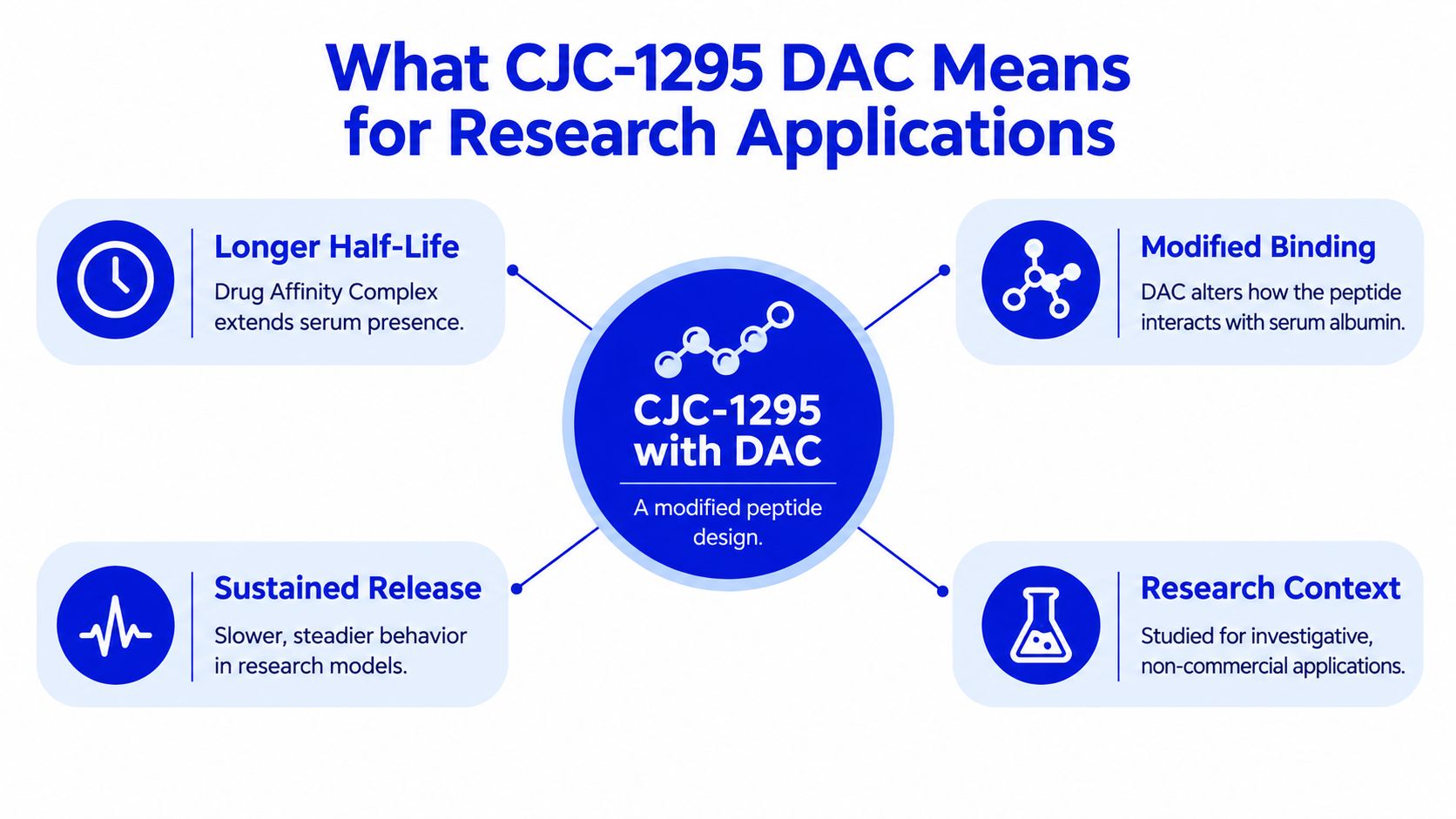
Extended exposure changes the design of the experiment first, and the procurement checklist right after that. The same study used trials lasting 28 and 49 days. With repeated weekly or biweekly dosing, average IGF-1 concentrations remained above baseline for as long as 28 days. For a new researcher, the practical reading is straightforward. A longer-acting analog can produce a longer observation window, so identity errors matter more because the exposure pattern is part of the research question.
That is why a DAC listing should trigger verification, not assumption. If a supplier describes a material as DAC, the researcher needs evidence that the product matches that modified structure and retains the intended conjugation. Price, branding, and a polished product page do not answer that question.
The same human study reported no serious adverse reactions and described the 30 and 60 microgram-per-kilogram dose groups as relatively well tolerated. Those findings came from healthy adults in limited early-phase research. They do not establish fat loss, muscle gain, repair, anti-aging, or any other consumer outcome.
Research interpretation: Extended exposure explains the compound's design interest. It does not turn pharmacokinetic evidence into a validated therapy.
The strongest human evidence for CJC-1295 with DAC remains early research in healthy adults. The FDA materials describe randomized, double-blind, placebo-controlled ascending-dose studies that evaluated pharmacokinetics, pharmacodynamics, and safety. That evidence can show how hormone concentrations changed under study conditions, but it can't establish an approved indication.
FDA briefing materials also reported that only one ClinicalTrials.gov study was identified in patients with HIV-associated visceral obesity, and that study was terminated. The materials noted that the specific CJC-1295 form intended for that study wasn't provided. A separate regulatory submission summarized a 12-week Phase II trial involving 192 HIV patients with lipodystrophy and reported one death from myocardial infarction, although the summary doesn't establish causation or prove that the administered form was CJC-1295 DAC. These limitations are described in the FDA briefing document.
| Research Finding | Common Consumer Interpretation | Practical Implication |
|---|---|---|
| Temporary GH and IGF-1 elevation was observed in healthy adults | The compound is proven for muscle growth or fat loss | Use the findings to understand exposure, not to claim a consumer outcome |
| The analog showed prolonged circulation | Longer exposure means better results | Extended exposure is a research characteristic, not a benefit guarantee |
| Early studies assessed pharmacokinetics and safety | A product can be used like an approved medicine | Procurement must remain separate from therapeutic marketing |
| Clinical evidence is limited and regulatory status is not approval | A supplier listing confirms medical suitability | Ask for documentation and verify the intended research purpose |
The FDA's reviewed materials stated that no studies were found in which any form of CJC-1295 had been administered to subjects with a disease or condition in the reviewed evidence. For anyone researching a CJC 1295 DAC purchase, that is the central boundary: research availability doesn't equal FDA approval.
The DAC label matters because CJC-1295 forms can differ in exposure behavior and research purpose. A catalog that treats CJC-1295 and CJC-1295 with DAC as interchangeable creates a comparability problem before a study even begins.
A high purity percentage doesn't resolve that problem. Purity reporting may describe the proportion of related material detected by a particular analytical method, but it doesn't by itself confirm correct identity, intact DAC conjugation, biological potency, sterility, or freedom from endotoxin.
A short-acting comparator and a long-acting DAC material shouldn't be substituted casually. The published human findings associated with CJC-1295 with DAC showed multi-day GH and IGF-1 responses, while the FDA materials described prolonged exposure and cumulative activity after repeat administration. That makes correct identification important for study interpretation.
A mislabeled or poorly characterized product could introduce an unintended exposure profile. Researchers might then attribute an observed result to a protocol variable when the underlying material wasn't what the label suggested.
Look for documentation that answers practical questions:
The following video can help new researchers think about the difference between a product name and a verified research material.
A certificate of analysis is supporting evidence, not clinical validation. It can strengthen traceability and reduce ambiguity, but it can't prove that a compound produces a desired human outcome.
A responsible supplier should make it possible to review the material before relying on it in a research workflow. Start with the lot number, then check whether each report, label, and shipment record refers to that same lot. Generic certificates detached from the shipped material provide weaker evidence than batch-specific documentation.
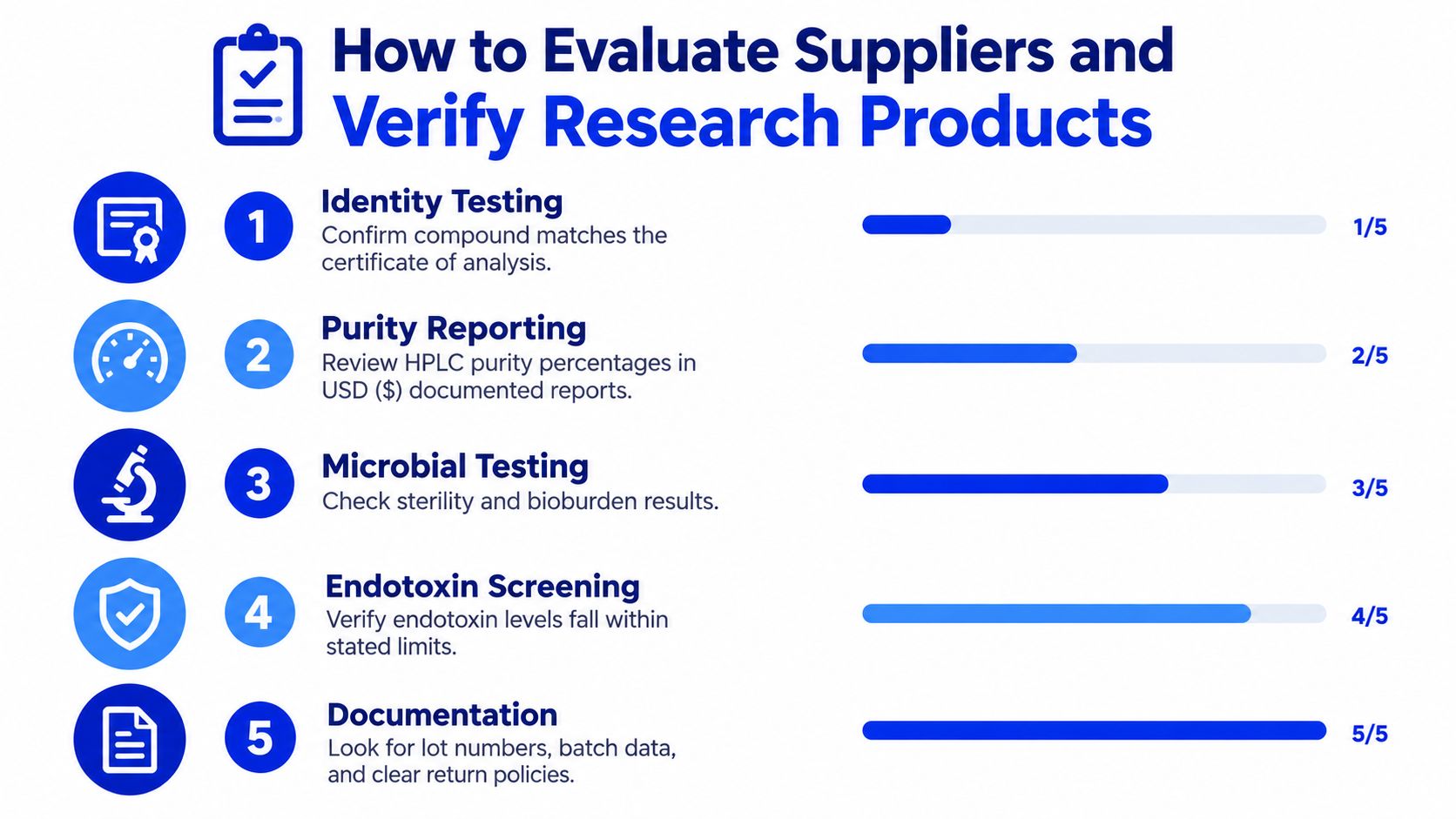
Confirm identity testing. Ask how the supplier distinguishes CJC-1295 with DAC from a non-DAC analog and whether the report is tied to the shipped lot.
Review purity reporting. Treat the reported purity as one analytical attribute. It doesn't establish legality, human suitability, therapeutic effectiveness, intact conjugation, or sterility.
Request microbial and endotoxin documentation where relevant. These records address additional quality questions that a purity chromatogram can't answer.
Check storage conditions. The supplier should state how the material is stored and what conditions apply during transport and laboratory handling.
Trace the chain of custody. Lot numbers, batch records, testing dates, shipment records, and return policies help the lab investigate discrepancies.
Ask whether the product is explicitly labeled for research use only, whether the COA identifies the test methods, and whether supporting microbial or endotoxin reports are available where relevant. Also ask how the company handles a mismatch between the vial label and the accompanying paperwork.
Price comparisons can be useful after quality criteria are fixed. Teams that monitor competing catalog prices may also consult a Best competitor price tracking tool, but price intelligence should never replace identity and compliance checks.
Documentation standard: If a supplier can't connect the paperwork to the lot, pause the purchase until the discrepancy is resolved.
High purity doesn't mean a compound is approved, clinically suitable, or safe for human administration. It only describes an analytical result for a tested lot, and even that result depends on the method and scope of the report.
FDA-related materials describe transient injection-site pain, swelling, induration, and occasional local urticaria among the more frequent adverse events in the early studies. Independent medical reporting also describes serious adverse events associated with CJC-1295, including increased heart rate and systemic vasodilatory reactions, as summarized by medical safety reporting on CJC-1295.
FDA materials state that CJC-1295 with DAC should be treated as an investigational research compound rather than an FDA-approved medicine. They also reported that the agency proposed not adding CJC-1295 DAC, including free-base and acetate forms, to the Section 503A bulk-drug list. Researchers should review current federal, state, institutional, and facility-specific requirements before ordering or distributing any research chemical.
That boundary protects more than regulatory compliance. It also protects data integrity. If a supplier presents an unapproved compound as a treatment, researchers may enter a study with unsupported assumptions about endpoints, risk, or expected outcomes.
Compliance reminder: Research-use labeling is a procurement safeguard, not permission for human administration.
A consistent decision framework can be simple. First, define the research question. Are you investigating prolonged exposure, analytical identity, endocrine response, or another laboratory endpoint? The answer determines what documentation and comparators the project needs.
Next, separate three questions that marketing pages often combine:
The 2006 study provides a useful baseline for understanding prolonged GH and IGF-1 responses, but it doesn't validate consumer claims. FDA documents provide the regulatory context, including limited clinical evidence and uncertain long-term human safety. Together, those sources support careful procurement, not a dosing protocol or therapeutic recommendation.
Before approving a supplier, document the intended research use, confirm research-use-only labeling, compare the COA with the vial and invoice, and record storage requirements. If any item is unclear, request clarification in writing and preserve the response with the purchasing record.
Peptide Warehouse USA describes itself as a U.S. supplier of research peptides and related compounds for laboratory, analytical, and preclinical applications. Its site states that products are sold for research use only and provides batch documentation such as COAs, microbial and endotoxin reports, and stated purity information. Researchers should still review each product's current documentation and ensure the purchase fits their own institutional requirements.
The best answer to “where can I buy CJC-1295 DAC?” isn't a promise of results. It's a documented sourcing process that matches the compound's identity, evidence status, and regulatory boundaries to the actual research objective.
Peptide Warehouse USA offers CJC-1295 with DAC as a research-use product supported by lot documentation for laboratory, analytical, and preclinical purchasing. Review the current product information, compliance details, and available testing records at Peptide Warehouse USA before deciding whether the material fits your research workflow.