No products in the cart.

A combined CJC-1295 (No DAC) + ipamorelin listing runs $69.99 at Peptide Warehouse USA, while advertised vial prices and clinic program quotes for the same compounds differ widely from one vendor to the next. Spread that wide, the sticker price alone says little about what a buyer really receives.
The cheapest vial on a product grid is the most misleading number in a CJC-1295 Ipamorelin cost comparison. Two listings can share a name and still differ in molecular form, milligrams, documentation, and what the invoice covers. A useful budget starts from landed cost per verified milligram, the figure that remains once testing and shipping enter the total.
Channel decides the quote before formulation does, and the spread runs to hundreds of dollars. A market compilation of peptide prices puts a 5 mg research-vendor vial of CJC-1295 at about $35 to $80 ($7 to $16 per milligram) and a 5 mg ipamorelin vial at about $30 to $70 ($6 to $14 per milligram). The same compilation estimates a 12-week research-grade stack at $250 to $550, against $900 to $1,800 for a 12-week wellness clinic program.
The two research vials sit within a few dollars of each other per milligram, so the sticker alone rarely settles the comparison. What each quote leaves out does.
| Channel | Advertised price | Quoted unit | Usually excluded |
|---|---|---|---|
| Research vendor, CJC-1295 vial | $35 to $80 for 5 mg | About $7 to $16 per mg | Testing, shipping |
| Research vendor, ipamorelin vial | $30 to $70 for 5 mg | About $6 to $14 per mg | Testing, shipping |
| Research-grade 12-week stack (market estimate) | $250 to $550 | Per program | Verification, shipping |
| Wellness clinic 12-week program | $900 to $1,800 | Per program | Consultation, labs, follow-up |
| Clinic recurring listing | Recurring monthly or quarterly fee | Per month | Introductory discounts applied separately |
These are advertised commercial ranges, not standardized medical prices. A clinic quote billed monthly or quarterly can lower the visible monthly figure while still omitting consultation fees, laboratory work, supplies, and follow-up, and introductory discounts sit outside the base rate.
The compounds aren't FDA-approved as a combined treatment, so a lower invoice isn't evidence of efficacy, insurance coverage, or cost-effectiveness. Buyers who conclude a clinic quote is really a service fee sometimes leave the peptide category entirely and compare other wellness purchases, including resources on safer alternatives to pituitary supplements. Any discussion of the benefits of peptides has to stay separate from what an advertised vial price proves.
Match the row to how you actually buy. A vial quote and a program fee answer different questions.
The same name can cover a single vial, a multi-vial pack, or a full program. Pick the row that matches your channel, then convert the quote into a cost per verified milligram before comparing it against anything else.
A 2026 comparison of 44 vendors found CJC-1295/ipamorelin products priced from $15.00 to $811.75, a spread no single vial price can explain, according to a vendor price census. Three drivers account for most of that gap, and the cheapest advertised vial is usually the least informative number in the range.
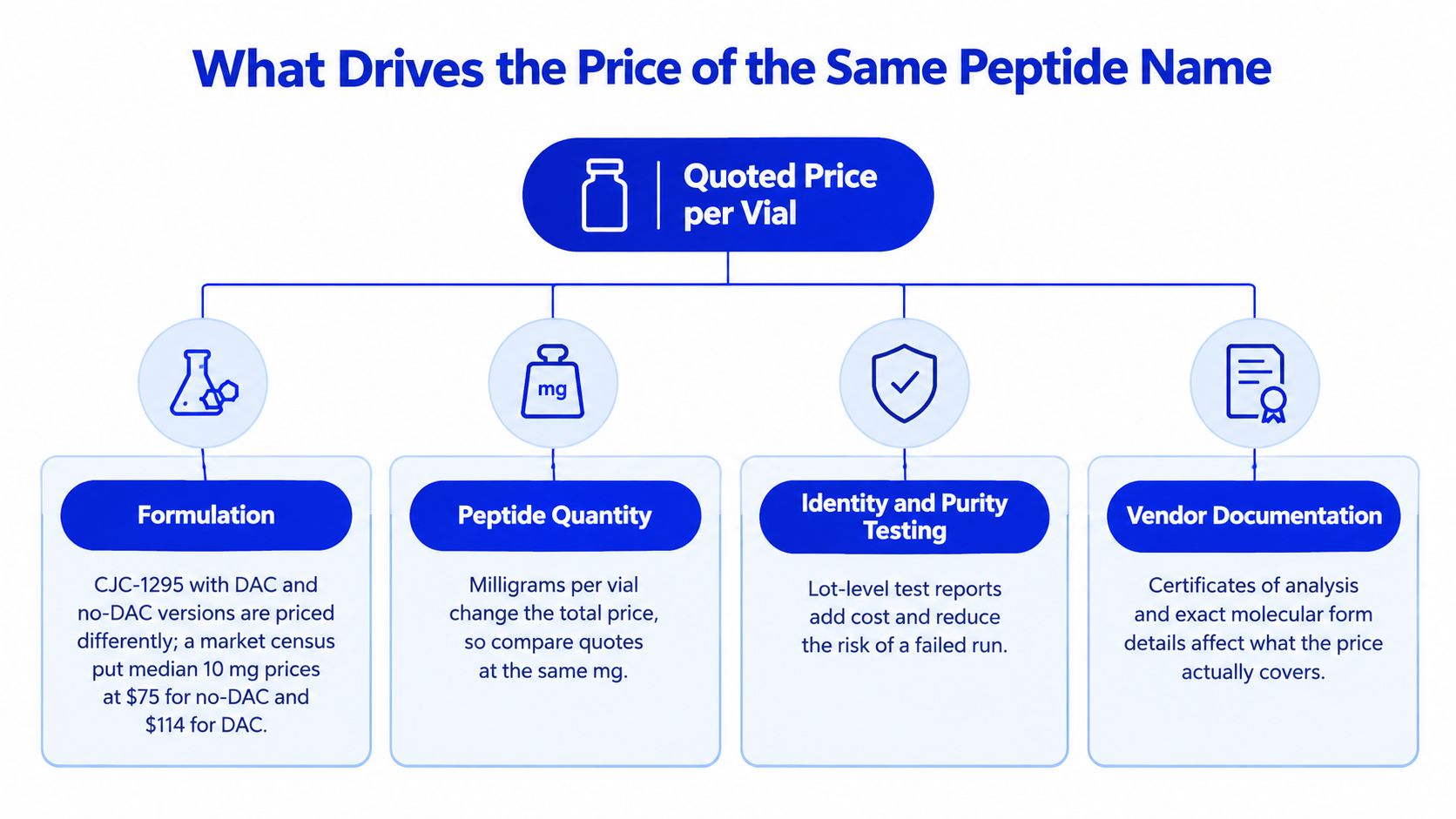
CJC-1295 with Drug Affinity Complex (DAC) is a different material from no-DAC CJC-1295, and the two sell at different medians: $75 for no-DAC against $114 for DAC at 10 mg in the same census. An FDA docket attachment reports a DAC terminal half-life of about 5.8 to 8.1 days, with single doses lifting mean growth hormone roughly 2 to 10 times for at least six days and IGF-1 about 1.5 to 3 times for 9 to 11 days, and repeated dosing holding IGF-1 above baseline for as long as 28 days, per FDA review materials. No-DAC material behaves as a short-acting modified-GRF analogue.
The pricing consequence runs opposite to the sticker. A DAC vial that costs more up front can still cost less per study period because the no-DAC version needs more frequent dosing. Cheapest label and cheapest experiment are different numbers.
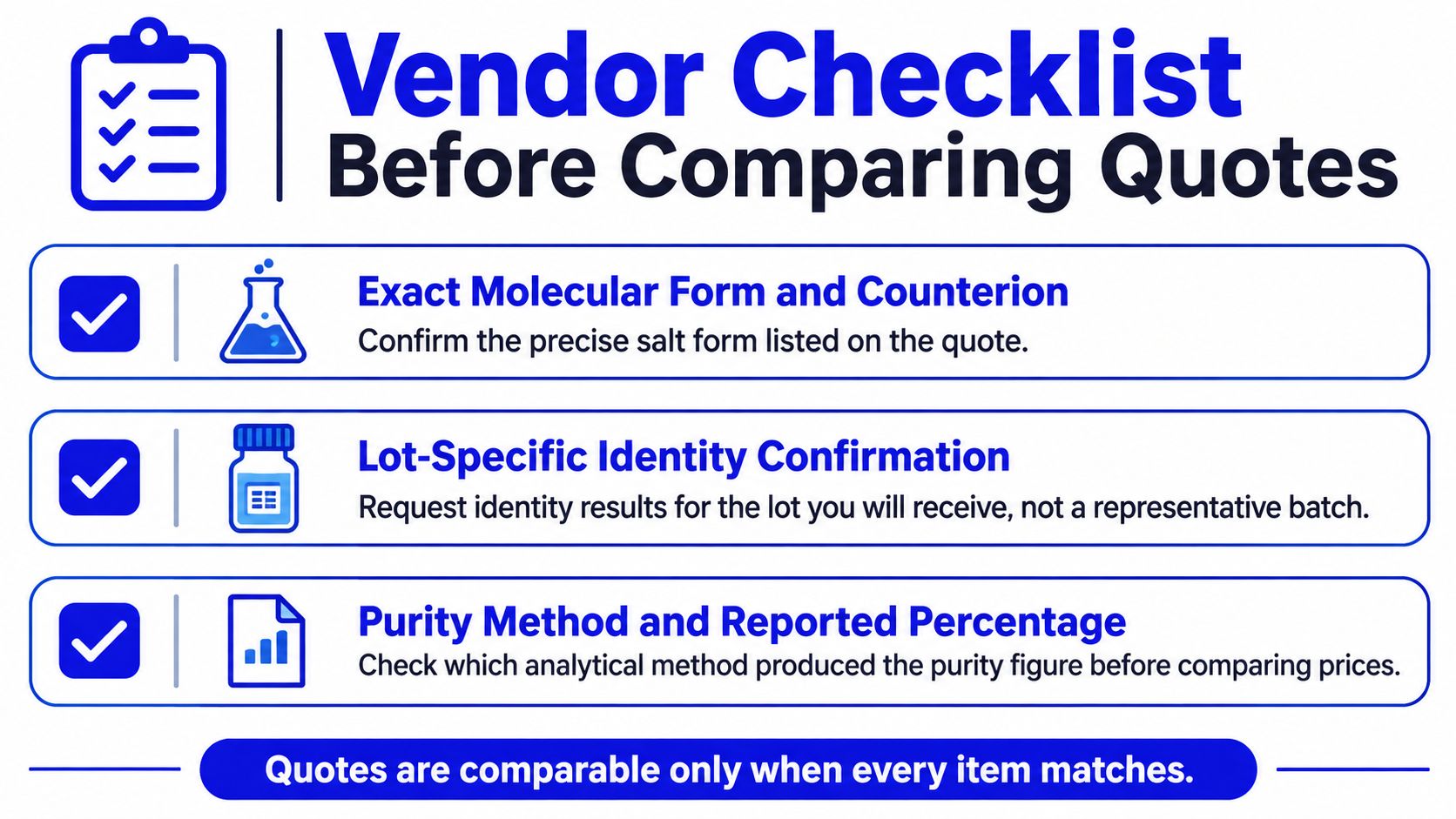
A blend's ratio is often missing, so two vials both labeled "CJC plus ipamorelin" stay incomparable until each active's milligrams are known. Lot-specific identity, chromatographic purity, and a certificate tied to the purchased lot change what the price buys. A representative-batch PDF leaves the vial you receive unverified.
Research-supply prices are not regulated prescription prices, and neither compound is an FDA-approved drug. No controlled human evidence shows the combination improves body composition, performance, healing, or longevity, so a premium quote rests on documentation and channel rather than proven outcomes.
Before ranking two quotes, write down molecular form and counterion, DAC or no-DAC, milligrams of each active, lot-level identity and purity method, and whether the price covers one vial, a pack, or a program.
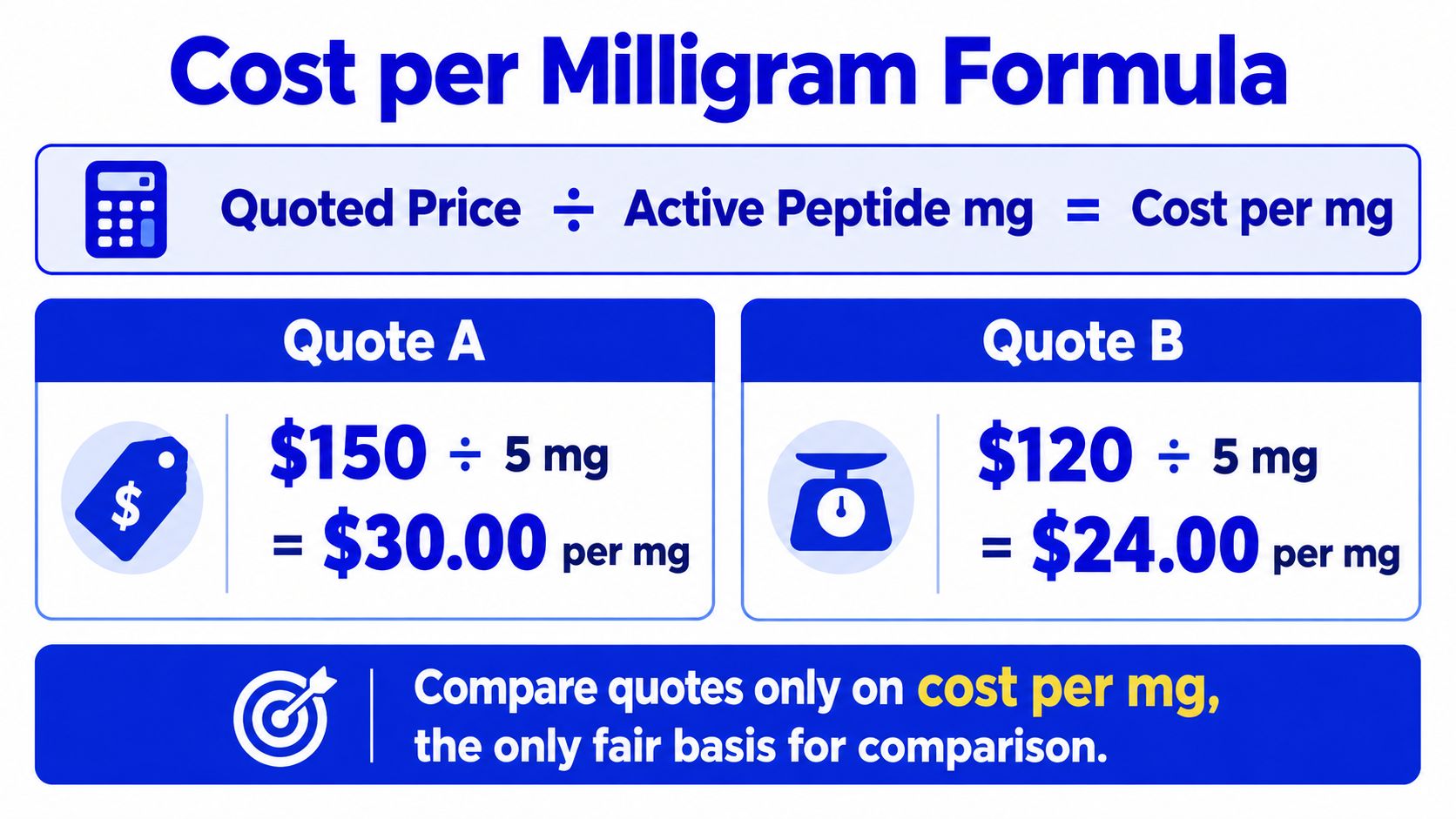
Fair comparison uses one division. Quoted price ÷ active peptide milligrams = cost per milligram. Anything still quoted per vial, per pen, or per month isn't ranked yet.
| Format | Quoted price | Peptide mass | Cost per mg |
|---|---|---|---|
| CJC-1295 no-DAC vial, market range | $35 to $80 | 5 mg | $7 to $16 |
| Ipamorelin vial, market range | $30 to $70 | 5 mg | $6 to $14 |
| CJC-1295 no-DAC, 10 mg market median | $75 | 10 mg | $7.50 |
| CJC-1295 with DAC, 10 mg market median | $114 | 10 mg | $11.40 |
| CJC 1295 (No Dac) plus Ipamorelin blend, Peptide Warehouse USA | $69.99 | Not stated on the listing | Not computable until mg is confirmed |
| Pepti all-in vial, monthly | $239 | Not published with the monthly price | Not computable from the listing |
| Pepti all-in pre-filled pen, monthly | $339 | Not published with the monthly price | Not computable from the listing |
Those 10 mg medians describe typical listings, not a price you can demand. The per-milligram column is just the quote divided by stated mass. The range rows make the same point from the other direction: two vials carrying an identical name and an identical 5 mg fill can differ by a factor of two per milligram, so the name alone tells you nothing about cost.
Peptide Warehouse USA prices CJC 1295 (No Dac) + Ipamorelin at $69.99. The public price doesn't state milligram content, so it stays out of a ranking until that mass is confirmed on the product page.
At 10 mg, $69.99 works out to about $7.00 per mg, just below the $7.50 no-DAC median shown above. At 5 mg it would be $14.00 per mg, near the top of the 5 mg market band. The sticker didn't change. The mass did. One confirmed figure moves the same listing from mid-market to the expensive end, which is why unverified mass is the single largest source of error in a per-milligram comparison.
In 2026, Pepti published an all-in $239 per month for a CJC-1295/ipamorelin vial and $339 for a pre-filled pen. The $100 gap is a format premium unless the pen lists more milligrams. Don't compare a pen price with a vial price until both are cost per milligram delivered.
Purity and identity are separate tests. A vial that looks inexpensive can cost several times its sticker once a small batch is verified.
Take a hypothetical $60 vial of 5 mg. Sticker math says $12 per mg. Add $150 of purity testing and $25 of shipping on a one-vial order and the outlay is $235, or $47 per mg, nearly four times the sticker figure. A larger batch, or extra vials linked to the same lot, spreads that fixed test cost.
Independent peptide testing benchmarks show why the add-on is large relative to a single vial:
| Cost item | Benchmark price | What it confirms | Applies to |
|---|---|---|---|
| CJC-1295 DAC purity testing | From $150 per sample | Reverse-phase HPLC purity | Each tested sample |
| CJC-1295 DAC bundled HPLC and identity | $200 to $400 | Purity and identity | Each bundle |
| CJC-1295 no-DAC purity and mass testing | From $200 | Purity and molecular mass | Each tested sample |
| Additional same-lot vial, non-differentiated results | $120 | Lot-level result | Each extra vial |
| Additional same-lot vial, linked to individual vial | $135 | Vial-level result | Each extra vial |
| Shipping | Request a written quote | Delivery and cold-chain handling | Each order |
| Reconstitution supplies | Request a written quote | Materials for preparing the research solution | Each batch |
| Endotoxin and microbial testing | Request a written quote where the protocol requires it | Sterility and endotoxin status | Each lot where required |
These testing figures are service benchmarks, not universal market prices. Shipping and reconstitution supplies don't have a reliable public benchmark, so ask for them in writing.
Divide that total by usable milligrams, or by completed experimental runs. Ask whether stated purity is chromatographic area percent, whether mass spectrometry confirmed identity, and whether results cover the purchased lot rather than a representative batch. Neither compound has FDA approval for human use, so purchasing and labeling stay limited to laboratory, analytical, or preclinical research.
A low per-milligram sticker on one vial is often a testing bill that hasn't been added yet.
Two quotes are comparable only when the paperwork matches. Ask every vendor the same questions in writing.
Peptide Warehouse USA supplies high-purity research peptides with third-party testing, including COAs, endotoxin reports, and microbial reports. We aren't a compounding pharmacy or compounding facility under Section 503A, and we aren't an outsourcing facility under Section 503B of the Federal Food, Drug, and Cosmetic Act. That status means our prices are research-supply prices, not 503A or 503B compounding fees, and they shouldn't be lined up against a clinic's medication-plus-visit bundle.
Quotes line up only when every checklist item matches. A missing milligram figure or a generic COA keeps that vendor out of the ranking.
The right metric follows the experiment, and regulatory status limits how any of these prices should be read.
A small academic lab running one assay should budget cost per verified milligram. Testing is a fixed cost on a tiny batch, and one identity failure can waste the run. A cheap vial that fails the check isn't cheap.
A preclinical team with several time points should use cost per planned exposure. DAC material and no-DAC material don't share a schedule. Ipamorelin's terminal half-life was close to two hours in an early pharmacokinetic study, while DAC activity is measured in days, as summarized in published pharmacokinetic notes. A lower vial price that ignores dosing frequency understates the no-DAC plan.
| Buyer situation | Best cost metric | Main trade-off | Where the headline price misleads |
|---|---|---|---|
| Small academic lab, single assay | Cost per verified milligram | Testing adds fixed cost to a small batch | A cheap vial may fail identity checks |
| Preclinical team, multiple time points | Cost per planned exposure | DAC versions run longer, no-DAC versions need more doses | Lower vial price ignores dosing frequency |
| Multi-site procurement | Landed cost per usable milligram | Requires one worksheet for all vendors | Vial sizes differ across suppliers |
| Cross-border buyer | Landed cost including currency and customs | Import risk and delivery delays | Domestic-looking prices exclude duties and conversion |
Multi-site buyers need one worksheet so a 5 mg vial is never ranked against a 10 mg vial. Cross-border buyers add currency conversion, customs, and delay. Headline prices usually omit all three.
CJC-1295 has never received FDA approval, and available regulatory reporting indicates it wasn't placed on the FDA's 503A bulk-drug list after a 2024 review, according to a summary of the development record. Online prices reflect research-supply or clinic markets, not regulated prescription pricing. A Phase 2 CJC-1295 study enrolled 192 participants with HIV-associated visceral obesity, and development reportedly stopped around 2006. Two Helsinn-sponsored ipamorelin Phase 2 studies enrolled 117 postoperative patients (2008 to 2009) and 320 patients after bowel resection (2011 to 2014). Those were separate investigational uses. They don't validate a combination, or its price, for weight loss, muscle growth, healing, or fat loss.
Not necessarily. A higher price can be testing, packaging, or channel cost. Read the lot-specific certificate, the purity method, and the identity confirmation before you treat price as a quality signal.
Only when cost per usable milligram falls after shipping and testing. A discount threshold can exceed what your plan needs, and unused vials still carry storage and, if you verify each one, more testing.
Treat the quote as unnormalized. Request the milligram content in writing and leave that vendor out of the ranking until it arrives. A dollar figure without mass can't be divided.
No. A clinic program bundles consultation, laboratory work, and follow-up, and its fee is a service-market price. Compare it only with another program quote, not with a research vial.
Set two ceilings before you pay: one per usable milligram, and one for the whole program. A single cheap vial can't pull the decision off those ceilings.
Keep one worksheet with the same columns for every vendor so a pen, a blend, and a single-ingredient vial stay in one format. Our catalog includes the CJC 1295 (No Dac) plus Ipamorelin blend, and package-size filters include 10 mg, 15 mg, and 30 mg. The shop also lists peptides, sprays, and creams, plus a calculator you can use while you fill the worksheet. Check milligram content and package size on each product page, run the numbers, and explore current options or learn more from the product documentation before checkout. These products are for laboratory and preclinical research only.
Peptide Warehouse USA supplies US-made research peptides with batch testing and third-party COAs, so you can price a documented lot instead of a bare vial sticker. If you're building a CJC-1295 and ipamorelin research budget, start from milligrams, formulation, and lot paperwork. Visit Peptide Warehouse USA to review current research listings and documentation.