No products in the cart.


You've found two peptide listings with nearly identical purity claims. One seller provides a polished PDF with a percentage, while the other provides a lot number, chromatogram, mass spectrum, test date, and named laboratory. At first glance, both products may appear equivalent. Under review, only one may give your lab enough evidence to connect the material in the vial with the material tested.
That's the practical meaning of COA tested peptides. A Certificate of Analysis isn't just a quality badge. It's a document that helps you verify identity, purity, batch history, and the limits of what the testing proves. This guide shows how to read a peptide COA, audit its authenticity, identify gaps that purity alone can hide, and match the documentation to your intended research use. The discussion is limited to laboratory, analytical, and preclinical research, not human or veterinary use.
A procurement decision often starts with a short product page. You compare peptide names, stated purity, price, and shipping information. If both listings use similar language, it's easy to assume the products have the same quality profile.
The difference usually appears in the supporting documentation. A meaningful COA should connect the product to a specific lot, identify the analytical methods used, show actual results, and name the laboratory or manufacturer responsible for testing. A generic PDF that lacks those details may repeat a marketing claim without giving your team a reliable way to verify it.
For researchers, that distinction matters because experimental results depend on more than the label. A sequence mismatch, oxidation product, residual solvent, or endotoxin issue can complicate interpretation even when a purity figure looks attractive. The COA doesn't eliminate every research risk, but it gives you a documented starting point for evaluating the material.
Practical rule: Treat a COA as evidence to audit, not as a decorative attachment to a product listing.
This article focuses on the questions buyers and lab managers need to answer:
A strong purchasing process turns “COA tested” from a vague selling point into a repeatable documentation check. That supports traceability, improves communication with research teams, and helps prevent a report from being mistaken for proof that a peptide is suitable for every application.
A useful way to understand a peptide COA is to think of it as both a birth certificate and a report card for one batch of material.
The identity side answers, “What is this lot supposed to be, and what testing supports that conclusion?” The quality side answers, “What did the laboratory observe when it tested this lot?” The document should connect both answers to the same product and lot number.
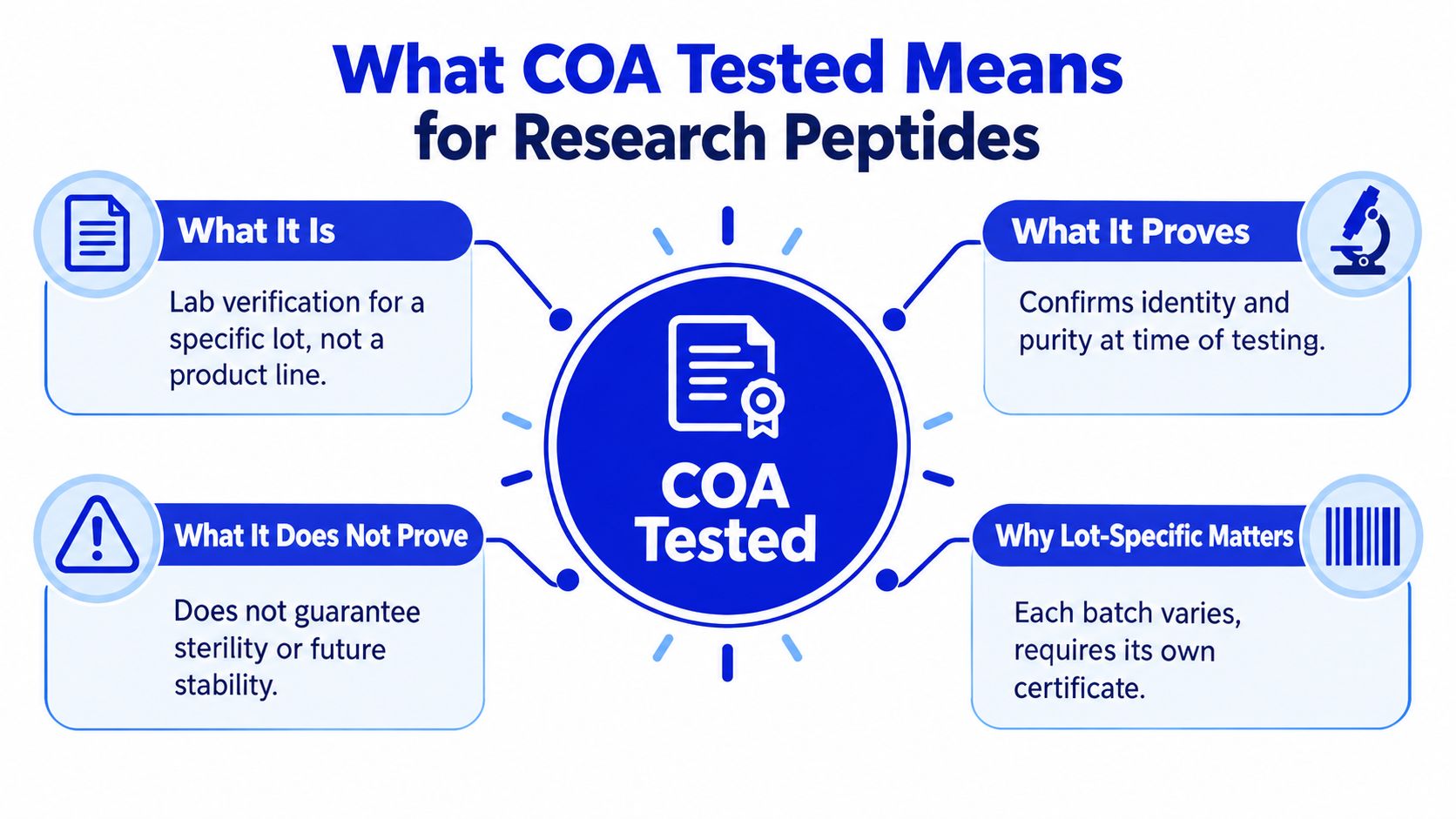
A COA applies to the material tested, not automatically to every vial sold under the same product name. In regulated pharmaceutical quality systems, COAs are tied to the exact batch, include test methods and acceptance criteria, and must be dated and authorized, as described in this overview of batch-specific peptide COAs.
That means the lot number on the certificate should match the lot number on the vial or packaging. The product name should also align, and the report should make clear which laboratory performed the analysis.
A supplier may sell the same peptide across multiple production runs. Each run can have its own analytical results, so a report from another lot doesn't establish the properties of the material you received. Batch-specific documentation is the foundation of traceability because it lets your team follow a defined sample back to its recorded test results.
“COA tested” doesn't automatically mean that every relevant test was performed. It also doesn't prove sterility, future stability, or suitability for a sensitive cell-based or preclinical protocol unless the report includes evidence relevant to that use.
A credible COA should normally show:
The FDA's compliance guidance for supplier COAs describes a COA as a supplier document containing the methods, test limits, and actual results. It also explains that relying on a supplier COA doesn't remove the need to confirm component identity by testing or examination.
The practical lesson is simple. A COA is a snapshot of a defined batch under defined testing conditions. It's valuable because it records what was examined, but its value depends on how complete, traceable, and relevant that record is.
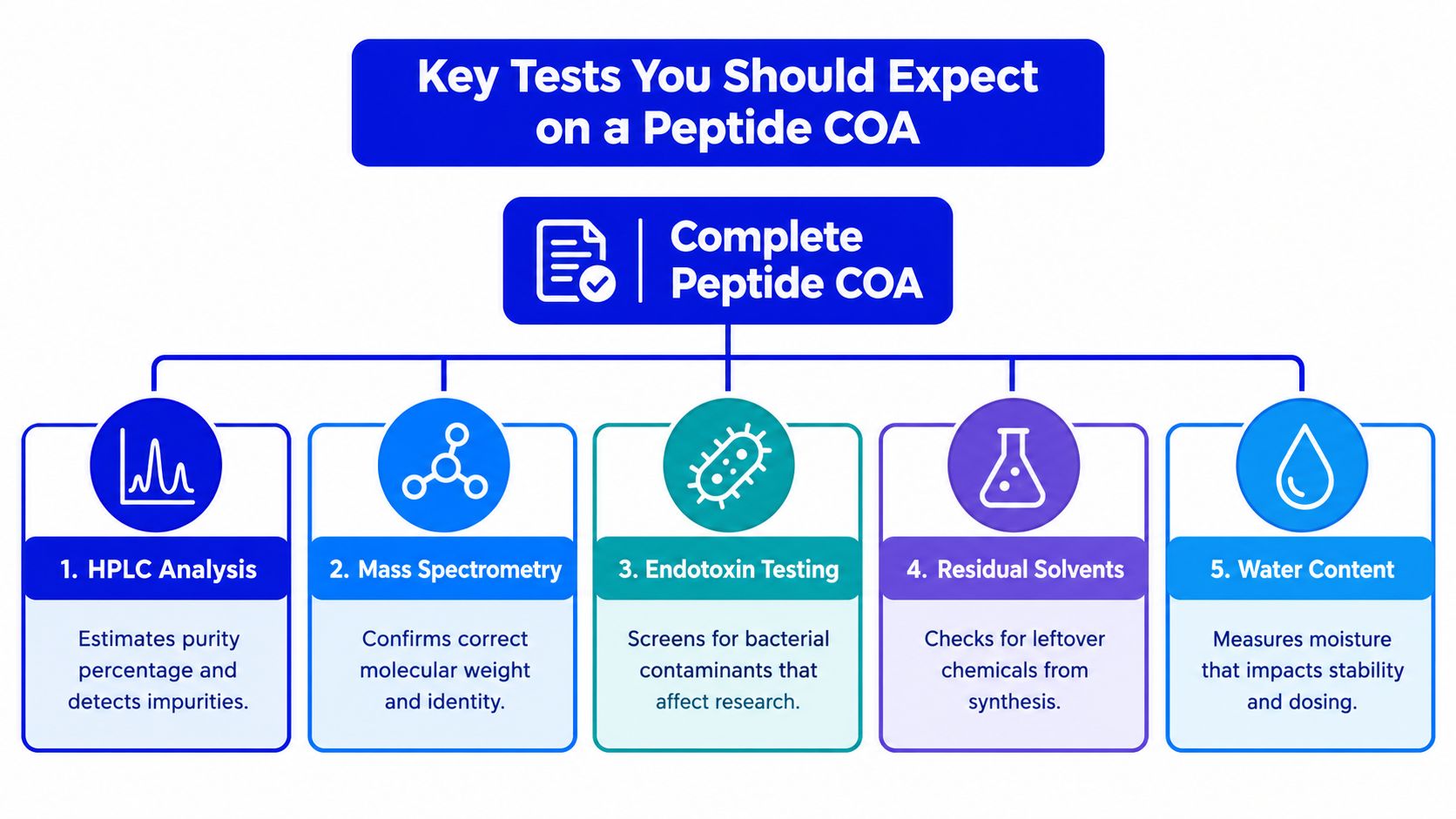
A complete peptide COA uses more than one analytical lens. HPLC helps estimate how much of the detectable material appears as the principal peak, while mass spectrometry helps confirm whether that principal species has the expected molecular mass. These methods answer different questions, so using them together is more informative than relying on either one alone.
Reversed-phase HPLC separates components as they move through a chromatographic column. The detector records peaks, and the main peak's integrated area is compared with the total detectable peak area. This produces an area-based purity estimate, not an absolute statement that every molecule in the vial is the intended sequence.
HPLC can reveal related impurities, but it may not fully distinguish compounds that behave similarly during separation. It also can't confirm molecular identity by itself. A clean-looking chromatogram needs identity data beside it.
Independent testing guidance commonly describes research-grade purity targets of 99% or higher for publication-grade work, with 95% to 98% more appropriate for preliminary screening. Material below 95% is generally considered unsuitable for reproducible research, according to this independent peptide testing guide. Those thresholds are decision aids, not substitutes for reviewing the method and raw analytical record.
Mass spectrometry measures mass-to-charge behavior and compares the observed mass with the theoretical mass expected for the peptide. This helps identify whether the principal species is consistent with the ordered compound.
It can expose issues that a purity chromatogram may not clearly resolve, including sequence swaps, oxidation, deamidation, or truncation products. The HPLC and mass spectrometry comparison from Janera Science explains why the two techniques are orthogonal. HPLC evaluates the relative size of chromatographic peaks, while LC-MS checks the observed mass against the theoretical mass.
Endotoxin, microbial, residual solvent, heavy metal, and water-content testing answer different questions from chemical purity. A peptide can show a strong HPLC result while the COA leaves these other categories undocumented.
For endotoxin, look for the method, such as LAL or recombinant factor C, the result in EU/mg or EU/mL, and the acceptance limit. The Peptide Express quality documentation identifies these fields as important because endotoxin is a separate risk from chemical purity and can matter in cell-based or preclinical work.
| Test | What It Confirms | Why It Matters | Limitation If Used Alone |
|---|---|---|---|
| HPLC | Relative chromatographic purity | Shows the principal peak and detectable related impurities | Doesn't prove molecular identity |
| Mass spectrometry | Consistency with expected molecular mass | Supports identity confirmation | Doesn't provide a complete purity percentage |
| Endotoxin testing | Endotoxin level under the stated method | Helps assess contamination relevant to sensitive assays | Doesn't replace chemical analysis |
| Residual solvent testing | Presence or absence of remaining process solvents | Adds process and application context | Doesn't confirm sequence or purity |
| Water-content testing | Moisture level under the stated method | Helps characterize material condition and handling needs | Doesn't establish identity or sterility |
Use the following video as a visual introduction to the relationship between peptide purity and identity testing:
The right panel depends on your protocol. For basic analytical work, HPLC and MS may form the central pair. For sensitive cell-based or preclinical work, ask whether endotoxin and microbial information are available, and whether residual solvents or other contaminant screens fit your method requirements.
Read every COA in the same order. A fixed review sequence reduces the chance that an impressive purity figure will distract you from a missing lot number or an unnamed testing laboratory.
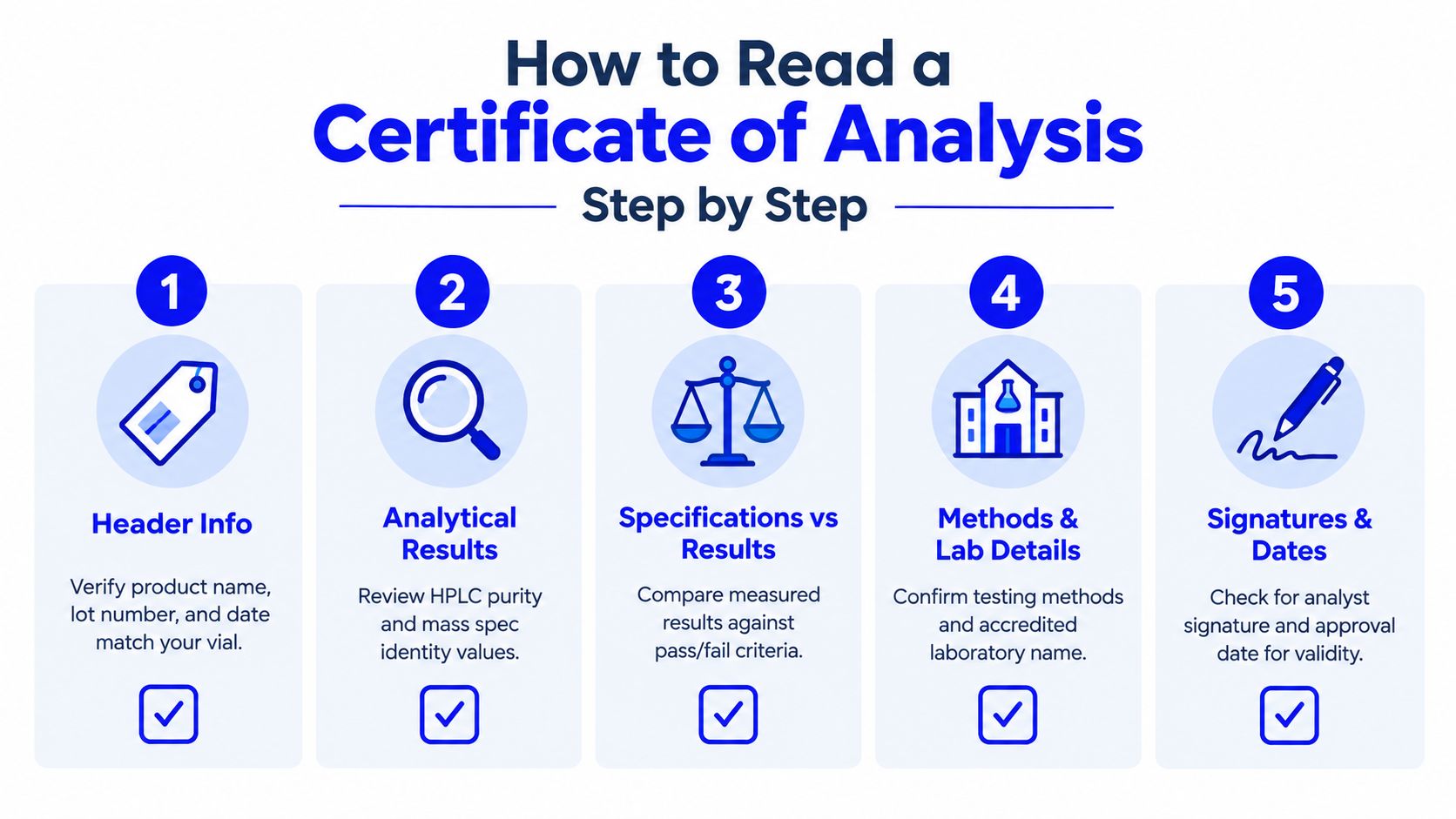
Check the product name, lot number, report or reference number, test date, and issue date. Compare the lot number character by character with the vial or shipping documentation. If the certificate doesn't identify the tested lot, you can't establish a direct connection between the report and your material.
Then find the laboratory name, address, analyst or approver, and signature or authorization. A document that lists only “QC department” gives your team less to verify than one that identifies the responsible organization.
A meaningful report distinguishes the acceptance criterion from the observed result. For example, a specification may state a required purity threshold, while the result records what the laboratory measured for that particular lot.
Look for the method beside each result. HPLC should be accompanied by the chromatogram or a clear way to access it. Mass spectrometry should show the observed and theoretical mass, ideally with the spectrum or supporting analytical output. A single percentage without method details is a weaker record because it doesn't show how the number was produced.
Read the report as a chain: product, lot, method, specification, result, laboratory, authorization.
For HPLC, the purity value generally represents the integrated area of the main UV peak relative to the detectable peaks in the chromatogram. That makes the trace important. It allows you to see whether the report contains a dominant peak, secondary peaks, unusual integration, or missing raw output.
For mass spectrometry, compare the observed mass with the theoretical mass for the stated sequence. A matching mass supports identity, but the report should still make clear what analytical method was used and whether the result applies to the same lot.
If endotoxin appears, check the method, units, measured result, and acceptance limit. The independent peptide COA audit guidance also recommends looking for the lot number, testing laboratory, report number, methods, chromatograms or spectra, and an issue date close to synthesis.
Before approving the material, ask whether every page refers to the same product and lot. Confirm that the dates, report number, laboratory identity, and test results align. If the certificate looks like a reusable template, request clarification and supporting records before treating it as batch evidence.
A high purity number can answer one narrow question while leaving several important questions open. HPLC may show that most detectable chromatographic material appears in the principal peak, but it doesn't by itself confirm the sequence, endotoxin status, microbial condition, residual solvents, heavy metals, or net peptide content.
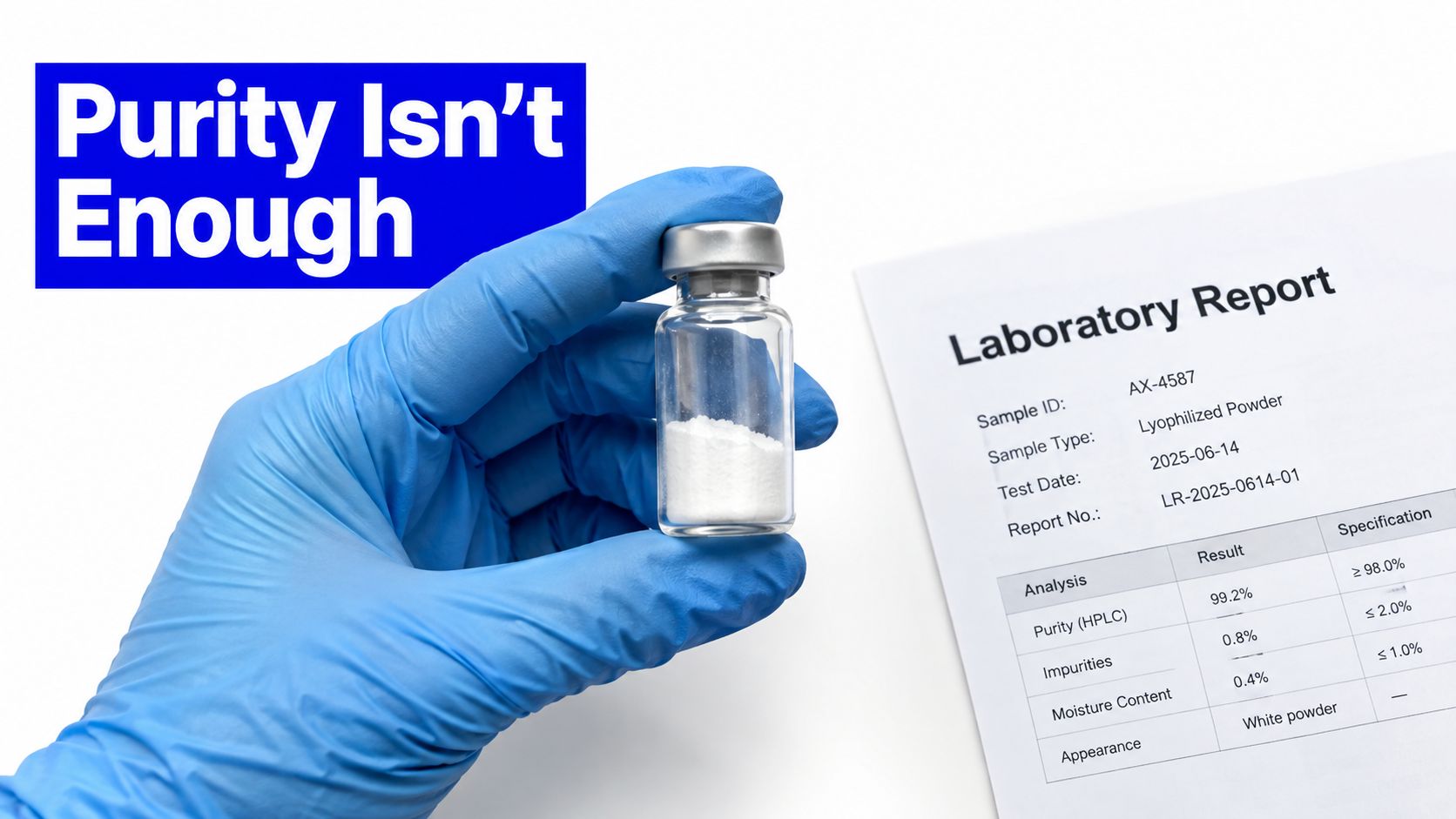
Consider two materials with similarly strong HPLC results. One has matching LC-MS data, a lot-specific chromatogram, and an endotoxin report. The other offers only a percentage on a one-page PDF. The first gives your team a broader evidence base, while the second leaves unresolved whether the dominant peak is the expected compound and whether a separate contaminant category could affect the assay.
A purity percentage describes the relationship among detected components under a stated analytical method. It doesn't necessarily tell you the net amount of peptide in the vial, the amount of counterion or salt, or the quantity of moisture and other non-target material.
That distinction matters during calculations and protocol preparation. If your work depends on accurate material characterization, ask whether the documentation reports relevant content and contaminant information rather than treating the HPLC figure as a complete composition statement.
The right documentation depends on what your lab will do with the material. A chemistry workflow may prioritize identity, chromatographic purity, and solvent information. A cell-based or preclinical workflow may require additional attention to endotoxin and microbial information because those factors can influence assay behavior independently of chemical purity.
Recent quality guidance increasingly emphasizes broader panels and digital access to batch reports. QR-linked records and public COA portals can improve access, but convenience doesn't guarantee completeness. The useful question remains, “Which tests were run, on which lot, using which methods?”
The Lotilabs guide to reading research peptide COAs highlights this fitness-for-purpose issue. A product can be “COA tested” without being documented for every intended application, especially when the report omits endotoxin, sterility, heavy metals, residual solvent, or traceability information.
A credible COA should survive a basic audit. Start with the physical material, not the supplier's general claims. Write down the product name, lot number, packaging details, and purchase record, then compare them with the report.
A generic report often has one or more warning signs:
A stronger report provides the lot number, product identity, report or reference number, test methods, acceptance criteria, numerical results, chromatogram, mass spectrum, laboratory details, and authorization. It should also be possible to ask the supplier how the report was linked to the vial and how the sample was handled before testing.
Third-party testing can provide useful independence, but the document still needs to identify the external laboratory. In-house testing isn't automatically meaningless, yet it carries a different evidentiary weight and should be described accurately rather than presented as independent verification.
Contact the laboratory directly when the report is central to a high-consequence procurement decision. Ask whether the report number exists, whether the laboratory issued it, and whether the listed methods correspond to the reported results. If the answers remain unclear, consider external retesting through a qualified analytical provider.
For teams managing many documents, a structured Matil traceability solution can help organize report versions, lot records, approvals, and links between documents and physical materials. The tool doesn't replace analytical judgment, but clear document control can reduce confusion when multiple batches and suppliers are active.
Approve a COA when the lot matches, the analytical evidence is visible, the laboratory is identifiable, and the panel fits the intended use. Hold the material for clarification when any of those links are missing. Reject the report as batch evidence when it cannot be connected to the lot you're purchasing.
A COA can look complete and still fail a basic procurement check. Review it like a chain of custody: confirm the lot first, then assess identity, purity, and tests that match your protocol.
Use this checklist when comparing suppliers:
A useful COA therefore supports fitness-for-purpose, not a high percentage. Treat transparent records, third-party testing, and batch traceability as procurement benefits, separate from medical claims. Follow institutional procedures, applicable regulations, and protocol-specific quality requirements.
Peptide Warehouse USA describes its research products as supported by batch-specific COAs, third-party documentation, and microbial and endotoxin reports. Compare those materials with the lot number and intended-use requirements, then learn more about available research compounds before purchasing. Ask the supplier to clarify any missing method, result, or contaminant information. A report that cannot be tied to the material in hand should remain unapproved until the gap is resolved.