No products in the cart.



Collagen is everywhere right now. You see it in powders, drinks, capsules, skin products, and social posts that make it sound like a shortcut to better skin, stronger joints, and healthier aging.
That leaves most thoughtful readers with a reasonable question. Are collagen peptide benefits supported by research, or is this mostly polished marketing?
The useful answer sits in the middle. There is meaningful clinical research behind oral hydrolyzed collagen peptides, but the effects depend on the tissue you're looking at, the dose studied, the time frame, and the quality of the material used. If you're trying to make sense of that without hype, this guide will help.
Many individuals start with the same experience. They hear collagen discussed as if it does everything, then run into labels that all look similar, claims that sound oversized, and very little explanation of how any of it is supposed to work.
A better way to understand collagen peptide benefits is to think in layers. First, learn what collagen peptides are. Then look at what human studies have observed in skin, joints, and bone. After that, the practical questions get easier. Which form makes sense, how long should a study or routine run, and why do some products look far more rigorous than others?
That matters because collagen isn't one simple story. Skin can respond on a different timeline than bone. Joint outcomes are often discussed in relation to function and comfort rather than dramatic overnight change. Research-grade materials also need tighter control than typical consumer products.
Practical rule: When collagen claims sound too broad, break them into three questions. What tissue, what dose range, and what study length?
If you're interested in the broader idea of preserving structural support over time, Achieve natural collagen banking offers a useful consumer-friendly companion read on that concept.
Collagen is the body's main structural protein. It helps form the framework for skin, cartilage, bone, tendons, and other connective tissues. If you want a plain-language analogy, collagen is part of the internal scaffolding that helps tissues keep their shape and resilience.
In its native state, collagen is a large, tightly organized protein. That structure is excellent for building tissue, but it's not ideal for easy use when taken orally in its intact form.
Think of native collagen like a long, heavy rope. It has strength, but it isn't already cut into manageable pieces.
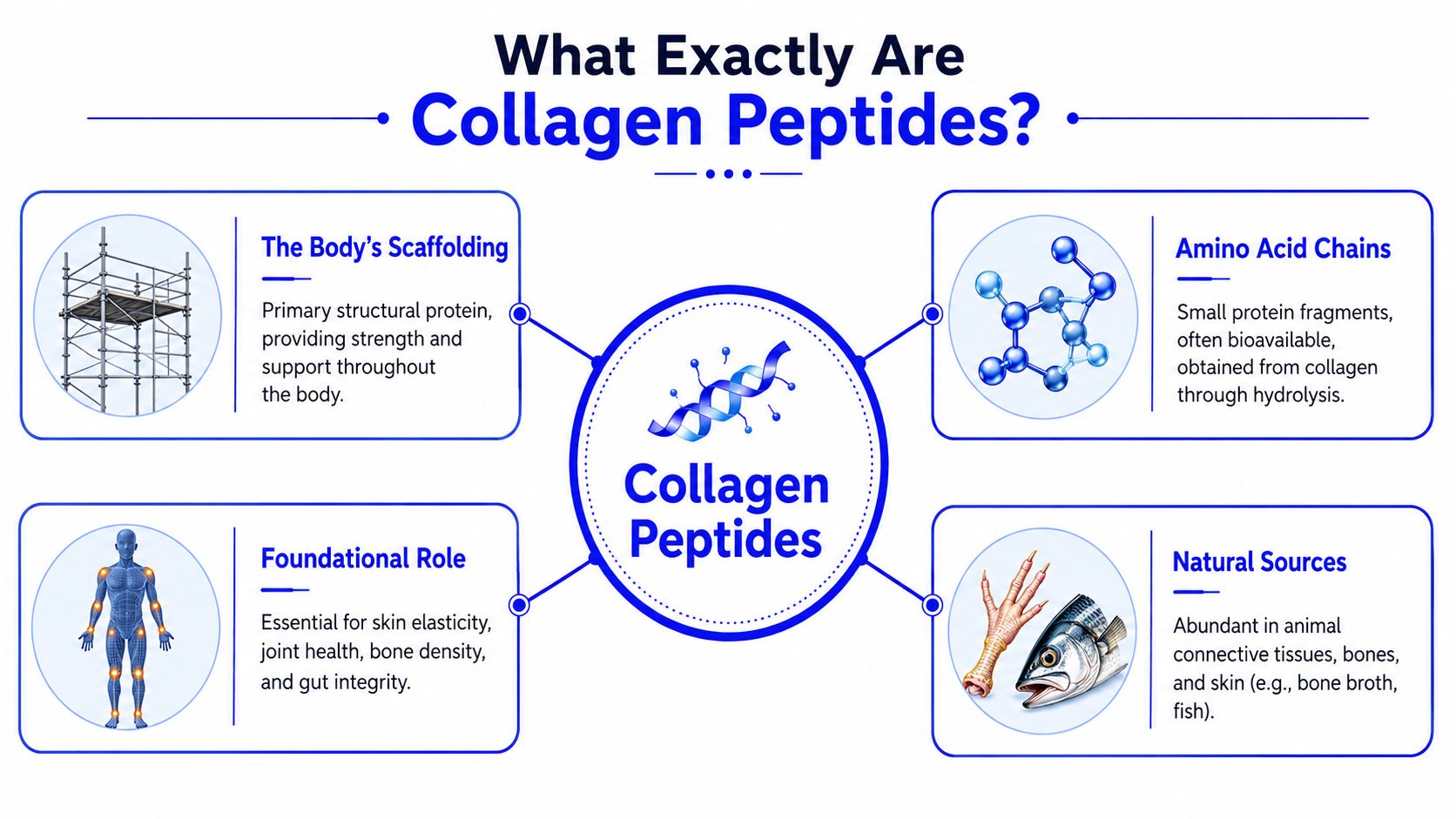
Collagen peptides, often called hydrolyzed collagen, are collagen proteins broken down into much smaller fragments. Hydrolysis is just the processing step that cuts that long rope into short sections.
Those smaller sections matter because they are easier to dissolve, easier to formulate, and more relevant to the way oral collagen has been studied. In other words, when research discusses oral collagen supplementation with measurable outcomes, it usually isn't talking about raw, whole collagen. It's talking about peptide forms.
A simple comparison helps:
Some readers also confuse oral collagen peptides with topical skincare. They aren't the same use case. If you're curious about how topical products fit into the broader anti-aging category, this overview of anti-aging collagen peptide serums helps separate skin-surface products from ingestible peptides.
Another point that gets missed is that collagen peptides aren't defined only by the word "collagen." Their molecular weight, peptide profile, and protein content all influence how closely a product resembles what has been used in controlled research.
You add collagen peptides to coffee for a few mornings and feel nothing obvious. That can make the whole topic sound vague. The research becomes easier to understand once you separate what happens soon after ingestion from what takes weeks or months to show up in tissue measurements.
Collagen peptides contribute amino acids, but that is only part of the story. After digestion and absorption, some small collagen-derived fragments appear in circulation in forms that have been studied for biological activity, including Pro-Hyp and Gly-Pro-Hyp. Experimental work has examined how these peptides interact with fibroblasts and other connective-tissue cells rather than acting only as generic dietary protein, as reviewed in this analysis of collagen-derived peptides and their physiological activity.
A useful comparison is a construction site. Protein supplies the bricks. Bioactive peptides may function more like work orders that tell specific cells where to focus maintenance. That does not mean the body inserts collagen directly into skin, cartilage, or tendon like a ready-made patch. It means peptide exposure may influence the way connective tissue is renewed over time.
That distinction matters when you read clinical studies or consumer summaries such as this overview of evidence on collagen effectiveness. Research usually tracks gradual changes in tissue properties, not instant visible effects.
Different tissues remodel at different speeds. Skin is under constant turnover. Tendons, ligaments, and cartilage change more slowly. Bone remodeling is slower still.
So the practical question is not whether collagen peptides "stimulate the body." A better question is where that stimulation is being studied and how long that tissue normally takes to renew itself. This helps explain why skin studies often report measurable changes sooner, while studies involving joint function, exercise recovery, or structural tissue markers usually require longer follow-up.
Purity also matters here. If two products both say "collagen peptides" but differ in peptide profile, molecular weight distribution, or contaminant control, they may not behave the same way in research settings. Reproducible results depend on using material that is well characterized, because the body responds to actual peptide composition, not just the front-label category.
A useful way to read the collagen literature is to ask two questions. Which tissue is being studied, and how long was the intervention? That framing turns a long list of advertised benefits into something more practical, because skin, joints, and bone do not respond on the same schedule.
Research also makes more sense when you separate outcomes that are measured directly, such as skin hydration or bone mineral density, from outcomes that are more subjective, such as comfort during activity. The pattern across studies is fairly consistent. Skin changes tend to show up first, joint-related outcomes usually need longer follow-up, and bone studies ask for the most patience. Product quality matters here too, because reproducible findings depend on using well-characterized peptides rather than a generic label.
Skin is the category with the clearest concentration of randomized trials and pooled analyses. A 2021 review in International Journal of Dermatology concluded that oral collagen supplementation was associated with improvements in skin hydration, elasticity, and wrinkling in the included clinical studies, especially after several weeks of daily use, according to this review of science-backed collagen benefits.
A second synthesis in Nutrients reached a similar conclusion. Across randomized controlled trials, hydrolyzed collagen was linked with improved hydration and elasticity after consistent intake, with stronger separation from placebo in studies that ran longer rather than shorter, based on this systematic review of oral collagen supplementation and skin aging.
The practical takeaway is simple. Skin-related effects in research are usually measurable before they are dramatic. Instruments used in trials can pick up shifts in hydration or elasticity earlier than a mirror can, which helps explain why study results may look encouraging while consumer expectations still need to stay realistic.
If you want a more consumer-facing explanation of the current evidence on collagen effectiveness, that resource does a good job translating dosage and study design into everyday language.
Joint studies often focus on people whose connective tissue is under repeated mechanical stress, such as athletes or adults with osteoarthritis. That matters because collagen is rarely studied as an isolated magic ingredient. It is usually tested in the context of movement, training, or long-term wear in weight-bearing joints.
Clinical trials and reviews summarized in a review on collagen derivatives and musculoskeletal health describe improvements in pain-related scores, function, and use of additional pain-management approaches in some studied groups after sustained collagen peptide intake. The strongest pattern is timing. These outcomes usually appear over months, not weeks, which fits the slower remodeling pace of tendon, cartilage, and other joint tissues.
A practical analogy helps here. Skin studies are like checking daily weather changes. Joint studies are closer to watching a season change. You can miss the pattern if you look too early or if the product used in a trial does not match the peptide profile used in the evidence base.
Bone research takes even longer to interpret because bone remodeling is slow and highly influenced by age, hormonal status, exercise, and nutrient intake. That is why many bone studies pair collagen peptides with calcium and vitamin D rather than testing collagen in isolation.
A recent clinical meta-analysis on collagen peptides and BMD reported that randomized trials have observed favorable changes in bone mineral density and bone turnover markers in postmenopausal women using oral collagen peptides over periods ranging from several months up to a year. The signal is more convincing in designs that control the background nutrition program, because that makes it easier to see whether collagen is contributing to the overall remodeling environment.
This is also the area where research-grade purity becomes especially important. If one study uses a clearly characterized peptide material and another uses a less defined ingredient, comparing outcomes becomes harder. Bone endpoints already move slowly. Extra variability from poorly characterized products only makes interpretation less reliable.
The evidence base is expanding into body composition, vascular markers, and metabolic measures. These findings are interesting, but they are less settled than the skin, joint, and bone literature.
One public-facing review summarizes early studies suggesting possible changes in fat-free mass, lipid markers, and blood pressure in some populations using daily collagen supplementation over several months, while also pointing out that larger outcome trials are still needed, as described in this overview of collagen peptide benefits.
That makes these areas worth following, but not the best starting point for judging what collagen peptides are most consistently associated with in clinical research.
| Benefit Area | Observed Effects in Studies | Typical Daily Dose (Research) | Time to Effect (Research) |
|---|---|---|---|
| Skin | Improved hydration, elasticity, and wrinkle-related measures in randomized trials and systematic reviews | 2.5 to 15 g/day | 4 to 12 weeks, often clearer in longer studies |
| Joints | Improvements in pain-related outcomes, function, and activity comfort in studied groups | 5 to 10 g/day | 12 weeks to 6 months |
| Bone | Favorable shifts in bone turnover markers and bone mineral density in selected populations, often alongside calcium and vitamin D | 5 to 15 g/day | 3 to 12 months |
| Metabolic and vascular markers | Early evidence suggests possible effects in some populations, but clinical guidance remains limited | Around 10 g/day in cited reviews | Several months in available studies |
Practical use starts with expectations. Most confusion around collagen comes from assuming all benefits show up on the same timeline or that any product form works the same way.
Powders are common because they make it easy to reach the intake levels used in studies. Liquids also exist and can be convenient for people who want ready-to-drink formats.
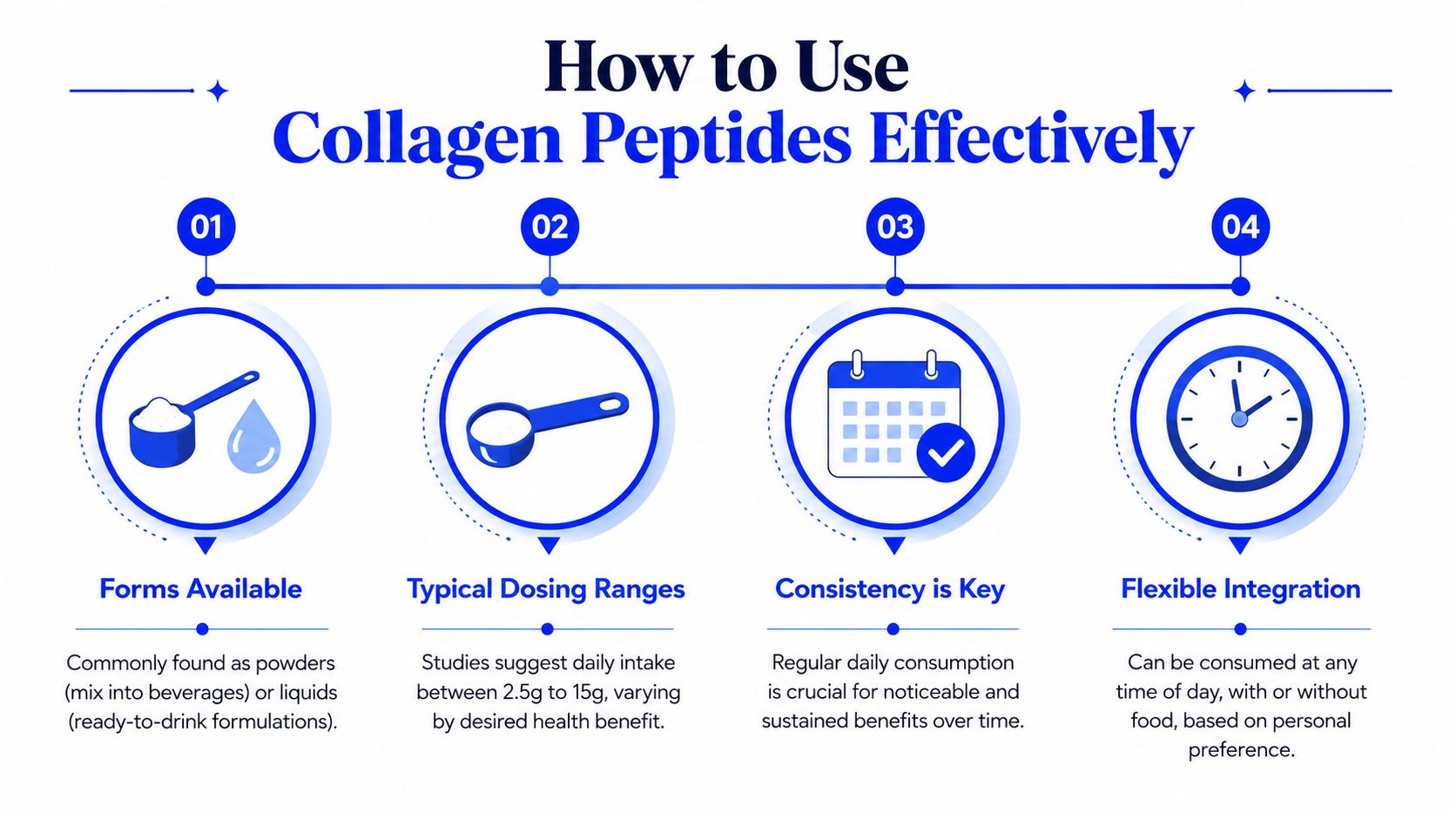
The key issue isn't whether a product is trendy or flavored. It's whether the form reliably delivers the peptide amount and profile close to what has been studied.
A useful range drawn from the clinical literature is 2.5 to 15 g/day, depending on the target outcome. Dermal studies often sit in the lower to middle part of that range, while joint and bone research commonly uses 5 to 10 g/day or higher in some designs.
One of the most important details in the literature is timing. A review discussing tissue-specific collagen kinetics notes that skin hydration can improve within 4 to 8 weeks, while bone mineral density and cartilage markers often require 3 to 6 months of continuous supplementation at 5 to 10 g/day.
That difference isn't a minor detail. It's the difference between reading the literature accurately and giving up too early because you're measuring the wrong thing at the wrong time.
Useful lens: Fast-turnover tissues can show earlier changes. Slow-remodeling tissues usually require longer, steadier intake.
Later in the same practical conversation, it helps to see the timing visually:
A complicated routine isn't necessary. A repeatable one is.
Two collagen products can look nearly identical on a label and still behave very differently in a study. That gap matters any time someone tries to compare a real clinical trial with a generic powder on a shelf.

Collagen research depends on knowing what was tested. "Hydrolyzed collagen" describes a category, not a single uniform ingredient. One material may contain mostly smaller peptide fragments, while another contains a broader mix. One may be highly purified protein. Another may include more non-protein material or show more lot-to-lot variation.
A practical comparison is coffee. "Coffee" can mean a carefully standardized brew or a random cup made with different beans, grind sizes, and extraction times. The label sounds the same, but the final product is not. Collagen works in a similar way in research. If peptide size distribution or protein concentration changes, absorption patterns and study reproducibility can change with them.
Technical reviews of collagen manufacturing and characterization, including this analysis of bioactive collagen peptide production and quality control, emphasize the importance of defined molecular weight profiles, high purity, and consistent processing when researchers want repeatable results: https://pmc.ncbi.nlm.nih.gov/articles/PMC6891674/
That may sound like a laboratory detail. In practice, it shapes whether one trial can be meaningfully compared with another.
A serious research-grade material should come with clear documentation. Without it, the product is difficult to map onto published findings.
Use this checklist:
One more point often gets missed. Purity is not only about safety screening. It is also about interpretability. If a study uses a material with a stable peptide composition, researchers can connect outcomes over time to a defined ingredient. If the composition drifts between lots, the timeline of effects becomes harder to interpret because the input changed.
Reproducible collagen research starts with a material whose composition is known well enough to compare across studies, batches, and time points.
For laboratory and preclinical work, purity is part of the experimental method. Without it, "collagen peptide benefits" becomes a moving target instead of a reproducible research question.
Collagen peptides are proteins, but they aren't interchangeable with standard protein powders. Their value isn't just total protein content. It's the specific collagen-derived peptide profile and the way those fragments have been studied in connective tissue contexts.
Whey is commonly discussed for general protein intake and muscle protein synthesis. Collagen peptides are more often studied for skin, joints, and extracellular matrix support.
Usually, "vegan collagen" does not mean animal-free collagen that is identical to conventional collagen peptides. In most consumer products, it refers to nutrients or amino acid blends intended to support the body's own collagen production, not true collagen itself.
That doesn't automatically make such products useless. It just means the label can blur two different ideas, and readers should look closely at what the product contains.
Collagen peptides are generally discussed as having a favorable safety profile in the studies summarized earlier, especially compared with more aggressive interventions. Still, mild digestive discomfort can happen for some people, and source material matters for anyone with dietary restrictions or sensitivities.
A cautious approach makes sense if someone is managing complex medical conditions, using multiple medications, or needs strict allergen control. Product transparency helps here too. The cleaner the sourcing and specification, the easier it is to evaluate fit.
The most credible view of collagen peptide benefits is straightforward. Oral hydrolyzed collagen peptides are small collagen fragments studied for their effects on skin, joints, and bone, and the evidence is strongest when dose, time frame, and product quality match the conditions used in clinical research.
The biggest mistake is expecting one outcome timeline for every tissue. Skin-related changes may appear sooner. Joint and bone outcomes usually require longer, more consistent use. The other mistake is ignoring composition. If purity, peptide size, and batch consistency aren't clear, it's harder to connect a product to published findings.
For scientists and researchers seeking high-purity compounds for preclinical studies, explore our catalog of third-party tested peptides to find materials suitable for your laboratory's needs.
If you're sourcing materials for laboratory, analytical, or preclinical work, Peptide Warehouse USA offers a catalog of high-purity research peptides with transparent lot documentation, including COAs and supporting test reports. Learn more and explore options suited to your research workflow.