No products in the cart.



Typing delta sleep inducing peptide buy into a search engine can make DSIP look like a routine sleep product. It isn't. The central purchasing question is not just where to order a vial, but whether the material is appropriate for a legitimate laboratory project, whether the supplier can document its identity and quality, and whether the evidence justifies the research hypothesis in the first place.
DSIP has a real scientific history, but it doesn't have the certainty that many sales pages imply. This guide separates its discovery from its proposed benefits, distinguishes early sleep findings from clinically meaningful evidence, explains the regulatory position reported for 2026, and provides a practical supplier and handling framework for research use only.
Researchers searching for delta sleep inducing peptide buy options usually have two needs. They may be assessing whether DSIP belongs in a sleep, neuroendocrine, or stress-pathway study, or they may already have a protocol and need a traceable source. Commercial pages often collapse those two questions into a product description, leaving out the scientific and compliance issues that determine whether a purchase is defensible.
The first problem is evidence inflation. DSIP is frequently presented as though its name proves its function. Yet the compound remains poorly characterized, and the historical record includes both promising observations and later conclusions that limit its clinical relevance. A research buyer should treat “sleep-inducing” as a historical label, not as proof of a reliable outcome.
The second problem is regulatory ambiguity. DSIP isn't FDA-approved for human use, but it also isn't described as a controlled substance in the recent regulatory coverage cited below. That distinction doesn't turn it into a supplement or medicine. It means the buyer must understand the difference between research-use-only supply and marketing for human consumption.
Practical rule: Buy the evidence trail, not the promise on the product page.
A sound decision therefore combines three checks:
The rest of the evaluation should follow that order. Starting with price or shipping speed encourages the wrong comparison.
DSIP's story begins in 1977, when the Schoenenberger-Monnier group in Basel, Switzerland, isolated a sleep-associated peptide from rabbit cerebral venous blood after electrically induced slow-wave sleep. The researchers identified it as a nonapeptide, meaning it contains nine amino acids, with a molecular weight of 849. This early isolation became a foundational event in sleep-peptide research. The historical account of DSIP's isolation places the discovery in the context of attempts to identify biological signals associated with slow-wave sleep.
The synthetic molecule is described as Trp-Ala-Gly-Gly-Asp-Ala-Ser-Gly-Glu, with a molecular weight of about 849 Da. PubChem's DSIP record identifies the sequence and molecular characteristics while also emphasizing the unresolved nature of the compound's biology.
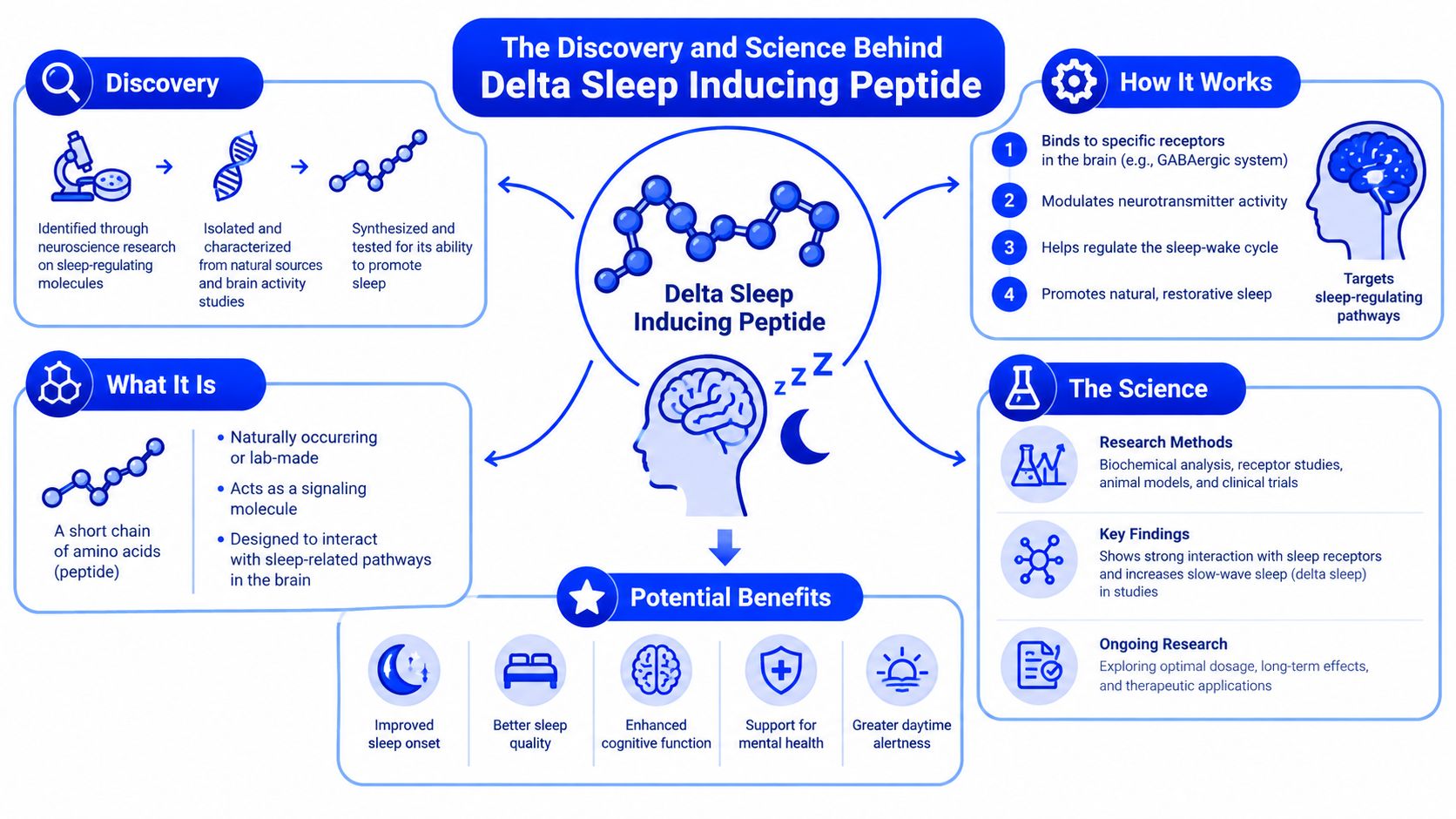
The name delta sleep-inducing peptide came from the molecule's apparent association with delta-frequency sleep patterns. That label helped direct decades of investigation, but it also created a marketing shortcut. Researchers still haven't identified a confirmed precursor peptide or specific receptor for DSIP, so its exact mechanism remains unresolved. The PubChem summary describes DSIP as a poorly characterized sleep-modulating neuropeptide rather than a validated sleep drug.
That uncertainty changes how the molecule should be positioned in a protocol. DSIP may be useful as a probe of sleep regulation, endocrine signaling, or broader neuromodulation. It shouldn't be described as a predictable hypnotic without stronger mechanistic and clinical evidence.
A useful parallel is the distinction between sleep architecture and everyday sleep goals. Researchers studying deep sleep for athletes can use that broader context to separate physiological concepts such as slow-wave sleep from practical claims about recovery or performance.
A 2006 review in the Journal of Neurochemistry described DSIP as a still-unresolved peptide and concluded that it may function as a regulatory peptide involved in endocrine regulation rather than as a clearly proven sleep hormone. The Journal of Neurochemistry review is important because it shows that the central scientific question hasn't been settled by the molecule's long research history.
For a lab, this is not a reason to dismiss DSIP. It is a reason to define the experiment more carefully. A study that asks how DSIP affects a measured sleep or signaling endpoint is more defensible than a project built around the assumption that DSIP will improve sleep.
The human evidence is historically notable but too limited to support broad purchasing claims. An early double-blind crossover experiment involved only six healthy volunteers. Participants received a 25 nmol/kg slow intravenous infusion, and the study reported a median 59% increase in total sleep time within a 130-minute interval compared with placebo. The PubMed record for the human DSIP study records both the small sample and the reported result.
That finding attracts attention because it appears unusually large. It also needs to be read alongside the study design, infusion route, brief observation interval, and small sample. A later controlled insomnia study reached a less encouraging conclusion, reporting that sleep improvement under DSIP treatment was of little clinical significance. The combined record supports continued investigation, not a reliable consumer sleep claim.
Preclinical pharmacology adds another layer of uncertainty. One study reported that 25 micrograms/kg IV augmented spindle-dominated non-REM sleep in rabbits, while the same dose preferentially increased REM sleep in cats. The comparative animal study also described bell-shaped dose-response behavior and effects involving morphine suppression and naloxone-induced withdrawal.
Those observations matter because they don't resemble the profile of a simple, uniform hypnotic. Different species showed different sleep-stage effects, and the bell-shaped response suggests that increasing exposure may not produce a straightforward increase in the desired endpoint. DSIP may be acting as a broader neuromodulator, with effects that depend on species, dose, route, baseline state, and experimental conditions.
A practical evidence table looks like this:
| Evidence category | What it supports | What it doesn't establish |
|---|---|---|
| Early human infusion work | DSIP can influence measured sleep variables under controlled conditions | Predictable results from other routes or populations |
| Rabbit and cat studies | DSIP can alter sleep architecture in animal models | Equivalent human effects |
| Later controlled insomnia research | Initial enthusiasm requires qualification | A clinically meaningful insomnia treatment |
| Mechanistic reviews | DSIP remains biologically interesting | A confirmed receptor or settled pathway |
Research interpretation: A positive sleep-lab signal is a reason to refine the hypothesis, not permission to skip validation.
This distinction also helps prevent a common category error. General information about peptide therapy in Ashburn may help readers understand how peptide-based interventions are discussed in broader health contexts, but DSIP research evidence must still be judged on its own route, model, controls, and endpoints.
The strongest current conclusion is modest. DSIP has enough historical and preclinical activity to justify carefully designed laboratory research, but the evidence remains thin, inconsistent, and mechanistically incomplete. It doesn't establish a dependable clinical sleep benefit or an evidence-based self-administration protocol.
A delta sleep inducing peptide buy decision requires a compliance review, not ordinary supplement-shopping judgment. DSIP is not FDA-approved for any indication, and a research supplier's label cannot turn an unapproved compound into a legal treatment product.
Independent coverage reports that DSIP was not recommended for inclusion on the FDA 503A bulk drug substances list at the July 2026 advisory meeting. The same coverage describes DSIP as not being a controlled substance. The recent DSIP regulatory guide explains the distinction between research-only sale and marketing directed at human use.
A qualified laboratory may obtain a compound for research while the same product remains unsuitable for sale with dosing instructions, sleep-improvement claims, or human-use packaging. The reported position also indicates that no routine compounding pathway has been established, leaving DSIP outside ordinary pharmacy access.
Before ordering, the lab should record:
Absence from controlled-substance scheduling does not establish approval, safety, or clinical legality. Keep those categories separate in purchase records, protocol documents, and internal communications.
Supplier selection should begin with the batch file, not the product photograph. A serious vendor should be able to identify the lot, explain what was tested, and provide records that allow the receiving lab to compare the material with its protocol requirements.
Request a Certificate of Analysis tied to the exact lot. The document should identify the material as DSIP, report the analytical method, and show how the supplier verified both identity and purity. A purity statement without supporting chromatographic information is weaker than a complete report with traceable test data.
Look for documentation covering:
A vendor-generated document with no named testing laboratory, no lot number, or no analytical detail shouldn't carry the same weight as independent, batch-specific documentation.
Documentation doesn't replace supplier diligence. Check whether the company provides a stable business identity, responsive support, order tracking, shipping information, and a defined process for discrepancies. Clear records make it easier to investigate an unexpected assay result or damaged shipment.
Domestic manufacturing can simplify communication and shipping logistics, but location alone doesn't prove quality. Similarly, low pricing may reflect efficient procurement, or it may signal limited testing. Compare the total evidence package, not just the price per vial.
The most useful supplier is the one that makes an independent review of the material possible.
For researchers comparing delta sleep inducing peptide buy options, Peptide Warehouse USA lists a lyophilized DSIP research peptide for laboratory use and describes batch documentation, microbial and endotoxin reports, and stated purity data. It should be evaluated alongside other suppliers using the same criteria, especially lot traceability and the credibility of its supporting records.
A well-characterized peptide can still become a poor research input if the receiving and storage process is careless. Lyophilized DSIP should be kept in a cool, dry environment, protected from direct light and moisture, with the supplier's storage specifications treated as the controlling instructions.
Assign responsibility for receipt before ordering. The receiving person should record the delivery date, package condition, lot number, label details, and any temperature or shipping information supplied by the vendor. If the package arrives damaged or the material appears compromised, quarantine it until the responsible researcher reviews the documentation.
Reputable shipping practices should match the material and transit conditions. Ask the supplier how it protects the package from temperature excursions, moisture, and light, and whether the shipping timeframe is compatible with the lab's receiving schedule.
Before reconstitution, follow the supplier's written storage instructions and protect the vial from unnecessary light exposure. After reconstitution, use appropriate laboratory technique, label the container with the concentration and preparation date, and return it to the specified storage conditions promptly.
Avoid repeated freeze-thaw cycles. If a protocol requires frozen aliquots, prepare them in a way that limits each aliquot to a single thaw, then document every handling event in the experiment record.
These controls support more than chemical stability. They preserve traceability, help explain unexpected results, and prevent a lab from attributing handling failure to DSIP biology.
The right DSIP purchase begins with a research question, not a promise of deeper sleep. The molecule's discovery and experimental history justify scientific interest, but they don't resolve the mechanism, establish a standard human-use dose, or demonstrate predictable clinical benefit.
A defensible purchasing decision brings four elements together:
The main trade-off is clear. DSIP offers a distinctive and unresolved research question, while established sleep interventions have a much larger clinical evidence base. That makes DSIP more appropriate as a controlled research compound than as a shortcut around conventional evaluation.
Keep regulatory monitoring active as well. The reported July 2026 advisory outcome is relevant to procurement decisions, but rules and interpretations can change. A laboratory should verify current requirements with its compliance personnel and the applicable authorities before ordering or using the material.
Peptide Warehouse USA offers a DSIP research peptide in lyophilized form for laboratory, analytical, and preclinical applications, with stated batch documentation and U.S. shipping options. Visit Peptide Warehouse USA to review the product information, documentation, and research-use terms before comparing it with other qualified suppliers.