No products in the cart.



What if the question about DSIP for sleep isn't whether it can knock someone out, but whether it can meaningfully change sleep architecture when the peptide itself is short-lived and hard to deliver? That gap matters because the early human literature is small, the results are mixed, and the newer translational work points to a different issue altogether, namely whether native DSIP is under-delivering because of stability and brain access limits.
Readers trying to evaluate DSIP usually run into the same confusion. One set of papers shows measurable sleep changes, another set tempers the excitement, and newer work suggests the conversation may need to shift from “Does DSIP work?” to “What form of DSIP, delivered how, reaches a target in the first place?” This article walks through that evidence carefully, starting with the molecule itself and ending with what a researcher or buyer should know before sourcing it.
DSIP stands for Delta Sleep-Inducing Peptide, and at the chemical level it's a nonapeptide, which means it has 9 amino acids. Its sequence is Trp-Ala-Gly-Gly-Asp-Ala-Ser-Gly-Glu (WAGGDASGE), and its molecular weight is about 848.8 to 849 Da. Those numbers matter because they tell you you're dealing with a small peptide, not a large protein with long circulation time.
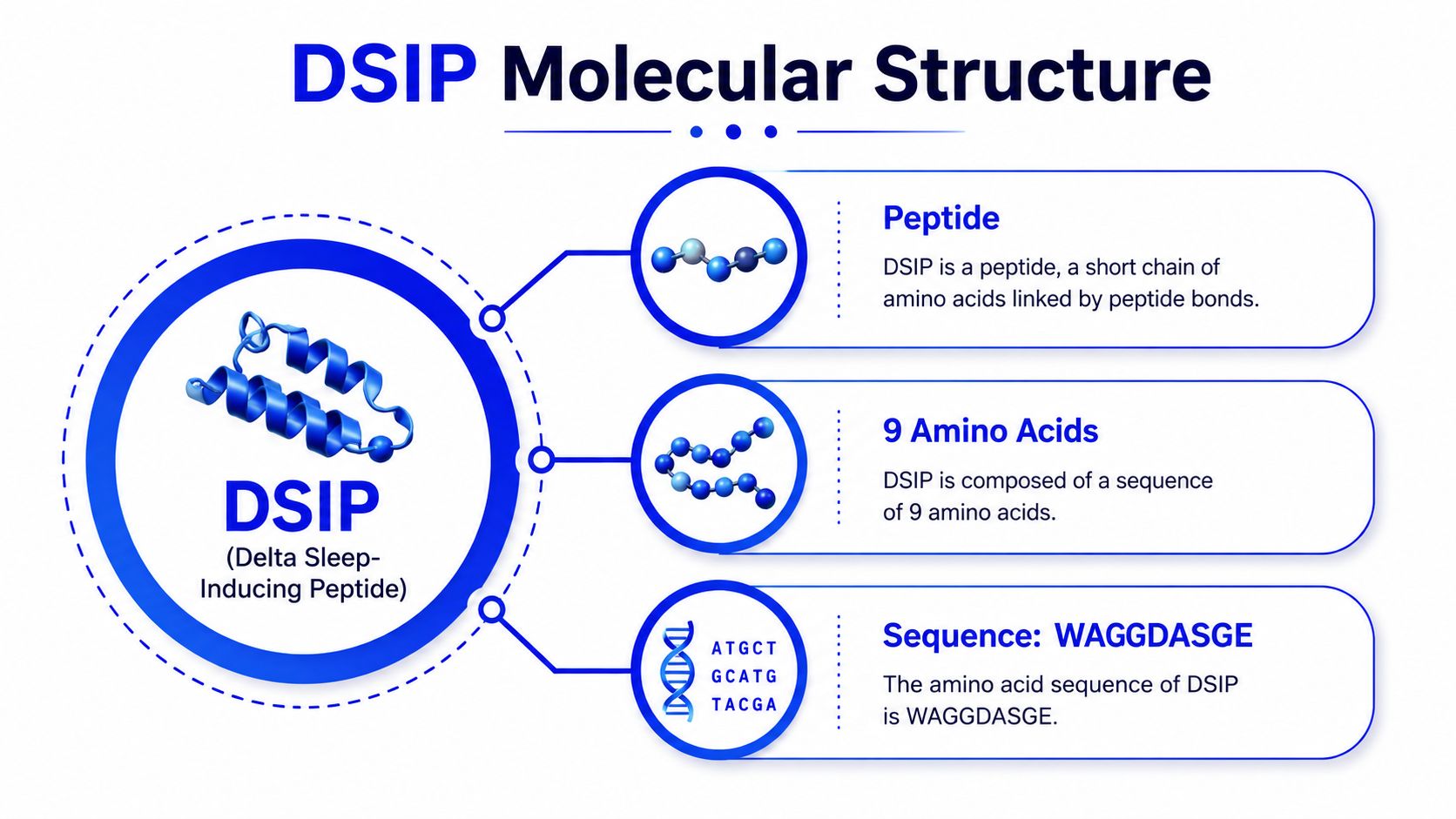
A peptide this small can disappear from circulation quickly. One technical profile reports a plasma half-life of 7 to 8 minutes source, which helps explain why timing and formulation show up again and again in DSIP research.
That short lifetime means the exposure window is narrow. If a lab wants to observe a sleep-related signal, it can't treat DSIP like a long-acting biologic and hope the effect appears later on its own.
Practical rule: with a rapidly cleared peptide, the study design is part of the intervention.
The same logic also explains why researchers pay close attention to route of administration, pre-sleep timing, and even how the peptide is reconstituted. In practice, a small amphiphilic peptide like DSIP is often discussed less like a conventional sleep aid and more like a timing-sensitive research tool.
The technical identity of DSIP is useful only if the product in hand matches it. A claimed peptide name without sequence verification, purity data, or stability controls doesn't tell you much about the actual sample being tested.
That's why DSIP discussions in sleep research usually separate the molecule from the product. The molecule is straightforward enough, a nine-amino-acid peptide with a distinctive sequence. The product side is where interpretation can get messy, especially when a peptide is sensitive to degradation and handling.
DSIP's mechanism is still not settled, which is exactly why so many summaries overstate it. The safest way to think about it is as a peptide with proposed central and peripheral effects, not as a single-target sedative.
The classic sleep-research framing treats DSIP as a modulator of slow-wave sleep and REM sleep. That fits the kinds of changes reported in the human studies, where the signal was not “instant knockout” but shifts in sleep depth, latency, continuity, and later-night architecture.
It's also been linked in the literature to GABAergic signaling and to changes in stress-related neuroendocrine activity. Those ideas are plausible because sleep and stress regulation overlap heavily, but plausible doesn't mean fully resolved.
The problem is that different studies have pointed in different directions. Some effects look central, some look broader, and some may depend on whether the peptide reaches the brain in a meaningful way.
The 2024 mouse insomnia-model work sharpened that point by showing that a DSIP fusion peptide designed to improve blood-brain-barrier crossing outperformed DSIP alone in modulating neurotransmitters tied to sleep, including serotonin, glutamate, dopamine, and melatonin source. That doesn't prove native DSIP is ineffective. It does suggest the delivery problem may be central.
DSIP may not be a simple “sleep peptide” problem. It may be a delivery problem dressed up as a mechanism problem.
That interpretation matters because it changes how you read the older evidence. If a peptide has a very short circulating lifetime, then weak or inconsistent human findings might reflect exposure limitations rather than a lack of biological activity.
Animal work is where DSIP got its name and its early reputation. The basic theme was always the same, a peptide associated with sleep-like changes, especially in slow-wave sleep and sleep continuity.
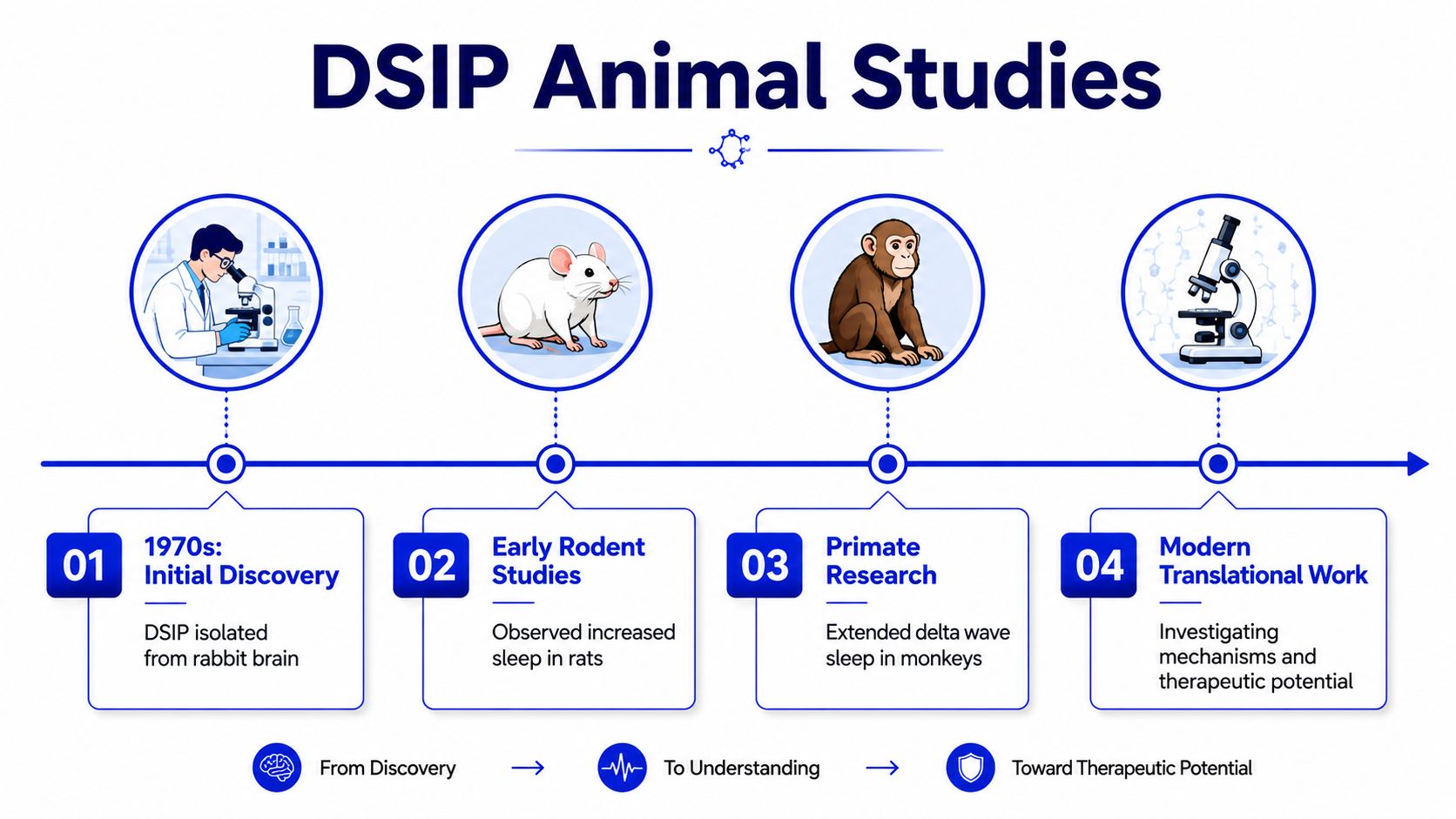
The old animal literature didn't frame DSIP as a knockout drug. It was discussed more as a compound that shifted sleep architecture, especially delta-like activity and restoration-related sleep stages. That distinction still matters because it separates DSIP from common sedatives.
A modern summary of the historical record notes that the peptide was first isolated in sleep-related research programs and then carried through rodent, rabbit, and primate work before interest declined and later reappeared in translational discussions source.
The 2024 fusion-peptide study in a mouse insomnia model is the more interesting part for current readers. It didn't just ask whether native DSIP had a sleep effect. It asked whether DSIP may have been limited by delivery, then tested a construct designed to cross the blood-brain barrier more effectively.
That distinction is important. If a modified version reaches the target better and changes sleep-linked neurotransmitters more effectively, then the historical question changes from “Is DSIP dead?” to “Was native DSIP never optimized for the tissue it needed to reach?”
The image of the field is no longer just old animal naming history. It's a translational split between native peptide and delivery-enhanced construct.
If someone treats the animal literature as proof that DSIP already solved insomnia, they're overstating it. If they dismiss the animal literature entirely, they miss why the peptide became interesting in the first place.
The better reading is narrower. Animal studies made DSIP a legitimate sleep-research candidate, while the newer fusion-peptide work suggests the next useful question may be about formulation and brain delivery, not just the native sequence itself.
The human evidence base for DSIP is small, and that size matters. A few early studies suggest a signal, but the sample counts are low enough that each result has to be read as a clue, not a conclusion. The newer translational question is also different now. If native DSIP underperforms because delivery or stability is weak, then the classic studies may be showing biology that was only partly reached, not biology that was fully tested.
One early report described 6 normal subjects who received a single 25 nmol/kg DSIP injection, after which total sleep increased by a 59% median. The largest change happened in the 2 hours after dosing, and later that night the study also noted more slow-wave sleep and REM sleep source.
Another controlled report in 6 middle-aged chronic insomniacs found that acute intravenous DSIP at 25 nmoles/kg body weight produced longer sleep duration, fewer interruptions, and slightly more REM sleep, with the effect lasting for up to 6 hours of night sleep and no daytime sedation or other side effects source.
An open clinical study of 7 patients with severe insomnia treated with a series of 10 DSIP injections reported that sleep normalized in all but 1 case, and the improvement persisted for 3 to 7 months, with daytime mood and performance also improving source.
A later double-blind human study of 16 chronic insomniacs found that DSIP produced higher sleep efficiency and shorter sleep latency than placebo, but the authors still concluded that the short-term benefit was not likely to be of major therapeutic benefit source.
The pattern is familiar to anyone who reads early peptide papers carefully. The direction of effect is consistent, but the studies are small, methods vary, and open-label improvement can be inflated by expectation, regression to the mean, or the natural fluctuation of insomnia symptoms.
| Study | Design | Participants | Dose | Key sleep finding | Source |
|---|---|---|---|---|---|
| Early human volunteer work | Controlled human study | 6 normal subjects | Single 25 nmol/kg injection | 59% median increase in total sleep, more slow-wave sleep and REM sleep later that night | Review summary |
| Chronic insomnia trial | Controlled intravenous study | 6 middle-aged chronic insomniacs | 25 nmoles/kg body weight | Longer sleep duration, fewer interruptions, slightly more REM sleep, effects up to 6 hours | PubMed record |
| Severe insomnia series | Open clinical study | 7 patients | Series of 10 injections | Sleep normalized in all but 1 case, with follow-up improvement lasting 3 to 7 months | PubMed record |
| Double-blind insomnia trial | Double-blind placebo-controlled human study | 16 chronic insomniacs | DSIP vs placebo | Higher sleep efficiency and shorter sleep latency, but not likely major therapeutic benefit | PubMed record |
For readers comparing DSIP with broader insomnia resources, a practical overview like insomnia relief for entrepreneurs can help separate symptom management from experimental peptide research.
The total pattern is a modest sleep signal, not a settled treatment story. DSIP looked interesting in early human work because it changed sleep continuity and sometimes sleep architecture without obvious daytime sedation, but the evidence never grew large enough to justify strong clinical claims.
That is why the modern reading should hold two ideas at once. The classical human studies deserve respect because they did show measurable effects. The newer fusion-peptide work matters because it raises a different possibility, that native DSIP may have been limited by delivery and stability before the biology was fully captured.
The published DSIP literature gives a usable map, but it does not give a single clinical protocol. That matters, because a peptide can look promising in a controlled study and still be hard to translate into routine use if the exposure window is narrow or the outcome measures are inconsistent.
The early human studies repeatedly used 25 nmol/kg or 25 nmoles/kg body weight, usually delivered intravenously in the controlled insomnia work and in the broader review of early human research. That consistency is useful because it shows the signal was built around one fairly specific exposure pattern, not a scatter of unrelated dosing ideas.
The practical limitation is obvious once you look at DSIP's reported plasma half-life of 7 to 8 minutes source. A compound that clears that quickly has a short window for observing sleep-related effects, so pre-sleep administration is the timing choice that best matches the biology. If the goal is to see whether DSIP changes sleep continuity, the dose has to be in place when sleep onset is beginning rather than long before or after the subject is already asleep.
The common endpoints were concrete, not vague impressions of “better sleep.” Investigators looked at:
Those measures matter because they separate sleep architecture from sedation. A peptide can alter how consolidated sleep looks on polysomnography without acting like a classic hypnotic, and that distinction is easy to miss if the protocol only asks whether the subject felt more rested.
Research takeaway: a protocol that does not specify timing and sleep architecture endpoints is too loose to interpret with confidence.
A DSIP protocol can look tidy on paper and still fail if the material changes before it reaches the subject. With a small peptide and a short biologic window, storage and handling are part of the dose, not a side issue.
That is why study-quality handling matters alongside nominal dose. The most useful protocols keep storage, thawing, and reconstitution conditions under control so the exposure the subject receives stays close to the exposure the investigator intended. In a field where delivery and stability may be limiting the effect of native DSIP, careful handling is one way to reduce noise before making claims about the sleep response.
For DSIP, product quality is part of the experiment, not a side note.
Independent product documentation describes DSIP as lyophilized powder with >97% RP-HPLC purity, and another manufacturing profile lists ≥98.5% purity, <0.5% single impurity, and <0.25 EU/mg endotoxin. Those specifications matter because impurity burden can blur sleep-related readouts, and endotoxin can change behavior in ways that have nothing to do with DSIP itself.
The same documentation recommends storage below -18°C, using 0.1% HSA or BSA as a carrier protein for long-term storage, and avoiding freeze-thaw cycles. In practical terms, those steps reduce batch drift and make repeated assays easier to compare.
A lab buyer or PI usually wants a simple standard. With DSIP, the standard should include the following:
The reason to care about all this is straightforward. If sleep outcomes shift, you want to know whether the signal came from DSIP, not from inconsistent storage or contaminated product.
The 2024 fusion-peptide work makes the quality conversation even more relevant. If native DSIP under-delivers because of stability or delivery, then the next step is better-characterized material, better delivery logic, and a clearer separation between native peptide and modified construct. That framing keeps the classical human evidence in view while also explaining why modern studies may need to ask whether the peptide is reaching the target in a form that can still act.
DSIP sits in the research-only category. In the United States, it isn't FDA-approved as a drug, and the practical market position is still laboratory, analytical, or preclinical use rather than consumer sleep therapy.
A research supplier should provide the basics clearly, including a stated purity level, batch records, and documentation that supports internal verification. In the peptide market, that often means a Certificate of Analysis, microbial and endotoxin reporting, and transparent lot information.
If a team is comparing peptide products alongside non-peptide sleep tools, a simple reference point like 020 melatonin by Lila can help distinguish a conventional supplement route from a peptide-research route.
Research-grade acquisition should never rely on label trust alone. The practical checklist is simple:
Buyer's rule: the label tells you what the supplier says it is, the COA tells you what the lot was tested to be.
DSIP still attracts attention because it sits at the intersection of sleep architecture, delivery problems, and peptide formulation. That makes it interesting, but it also makes documentation and sourcing more important than in a lot of simpler research compounds.
Peptide Warehouse USA supplies DSIP for research, laboratory, and analytical use, along with batch documentation that helps teams evaluate purity and traceability before a study begins. If you're sourcing DSIP for sleep-related research, visit Peptide Warehouse USA to review product documentation and explore options that fit a compliant research workflow.