No products in the cart.



Most online advice about the Follistatin 344 peptide gets the first question wrong. People jump straight to “results,” “cycles,” or “stack ideas” before they establish what the compound is, which isoform they're dealing with, and whether the vial in hand even contains authentic follistatin.
That's backwards.
In a real lab setting, Follistatin 344 matters because it's a useful research tool for studying myostatin and activin pathway modulation, not because it fits internet hype. Its value comes from mechanism, isoform biology, durability in preclinical systems, and the discipline required to generate interpretable data. If those pieces are missing, the experiment is shaky before it begins.
A new researcher usually gets confused in three places. First, they mix up FST-344, FST-315, and gene-delivery constructs. Second, they assume all “follistatin 344” products are interchangeable. Third, they treat preclinical findings as if they automatically answer questions about retail injectable fragments. They don't.
A surprising amount of confusion around Follistatin 344 peptide starts with the label itself. In lab practice, the useful question is not “does follistatin build muscle,” but “what exact material are we studying, in what system, and what pathway readout are we trying to measure?”
That shift in framing matters. Follistatin interacts with members of the TGF-β family, with particular relevance to activins and myostatin, so it appears in muscle biology, developmental signaling, fibrosis models, and pathway-focused assay work. If you treat it like a generic growth agent, the experiment starts on the wrong footing.
The name deserves careful handling. Follistatin-344 refers to the human follistatin transcript product associated with a 344-amino-acid isoform. For a new lab member, the easiest way to view that detail is as part number, not branding. If the isoform is undefined, comparisons across papers, suppliers, and model systems can drift fast.
A second source of confusion is that researchers use the term FST-344 for two very different types of tools:
It is important to distinguish between those intervention types, because they differ in delivery, exposure profile, tissue distribution, and the kind of conclusions an experiment can support.
Practical rule: Before interpreting any “Follistatin 344 peptide” claim, identify the exact experimental form. Protein material, peptide-fragment terminology, and AAV-mediated expression each answer a different research question.
Online summaries often fail the reader, collapsing isoform biology, recombinant material, and gene transfer studies into one story line. In a laboratory setting, that shortcut creates avoidable noise. A cell-culture assay using exogenous material and an in vivo gene-expression study may involve the same pathway family, but they do not test the same thing.
The most reliable way to approach FST-344 is with basic molecular discipline. Confirm the isoform. Confirm the format. Confirm what the vendor measured. Those steps sound simple, but they often determine whether a result is interpretable or merely interesting-looking.
A careful researcher also separates established preclinical findings from broader claims that travel online without context. For FST-344, that habit is less about skepticism for its own sake and more about clean experimental design.
A common mistake is to treat follistatin as one fixed reagent. At the molecular level, it is a small family of closely related forms produced from the same gene, and that distinction shapes how you should read any experiment built around FST-344.
Follistatin is encoded by the FST gene. That gene gives rise to multiple isoforms, which are related protein products with different structural endpoints. A good lab analogy is a shared plasmid backbone with different inserts. The backbone tells you the constructs are related. The insert determines what the construct will do in the system.
For FST-344, the name refers to the 344-amino-acid precursor form. That precursor status matters because processing changes the final species present in circulation and can alter how the protein distributes and persists. In practical terms, a label that says only “follistatin” leaves out information you need for interpretation.

That is not a naming technicality. It is an experimental variable.
If your study depends on tissue exposure, residence time, or which ligand pools are being intercepted, the isoform belongs in the methods section with the same level of care you would give antibody clone, passage number, or vector serotype.
New researchers often group FST-344 and FS-315 together because they sit in the same biological pathway. That shortcut causes trouble. Related does not mean interchangeable.
A cleaner way to frame the relationship is this:
The practical consequence is simple. If the isoform is undefined, conclusions about potency, localization, or exposure become harder to trust.
This also explains why product characterization matters so much in this area. A vendor may market “follistatin 344 peptide,” while the underlying material could differ in expression system, processing state, purity profile, or formulation. For bench work, those details are not background information. They help determine whether two studies are even testing comparable materials.
One more point helps anchor the biology. Secondary summaries describe follistatin as a protein in the roughly 38 kDa range and note relatively short circulating persistence for direct protein exposure. That helps explain why the literature contains both direct protein-based experiments and gene-delivery approaches. Those are different intervention formats with different kinetics, and they should not be merged into one mechanistic story.
For a new lab member, the safest habit is straightforward. Before you interpret any result, confirm which follistatin isoform was used, what physical form entered the system, and whether the reagent was characterized well enough to support the conclusion.
The popular version of this mechanism is too neat. In bench work, the useful description is narrower and more testable. Follistatin 344 peptide binds selected extracellular ligands, especially myostatin and activin-family members, and lowers their access to the receptor complexes that would otherwise start signaling.
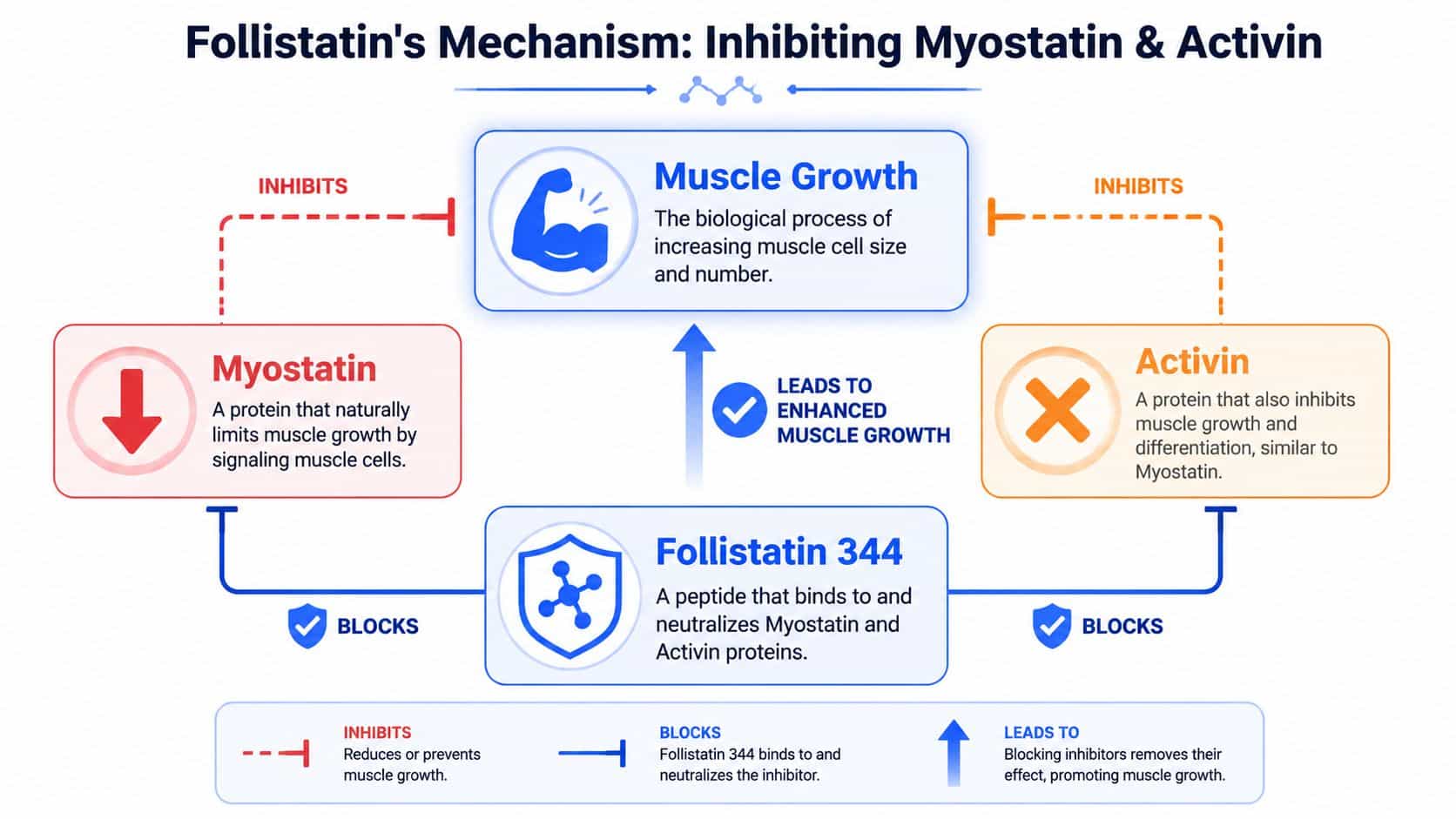
Myostatin and activin are often described as brakes on growth-related signaling. That shorthand is useful if you remember what it leaves out. These are not abstract “off switches.” They are secreted ligands that must reach the right receptors at the cell surface. Follistatin changes that first step. It works like a ligand trap in the extracellular space, reducing how much free ligand is available to engage activin type II receptors.
That distinction matters because it tells you where to look for evidence. The first measurable event is not larger cells or tissue growth. It is reduced ligand-driven receptor activation.
Once ligand availability drops, signaling through the activin type II receptor pathway decreases, and downstream SMAD2/3 signaling is correspondingly reduced. For a new lab member, this is the clean causal chain to keep in mind: ligand sequestration first, receptor engagement second, intracellular transcriptional response after that, phenotype last. If your assay only measures the last step, you are inferring the mechanism rather than showing it.
A practical way to study the pathway is to build readouts at more than one distance from the binding event:
Many online summaries often mislead new researchers. They jump from “binds myostatin” to “causes muscle growth” as if no experimental distance exists between those statements. In reality, several variables sit in between. Free ligand concentration, receptor expression, exposure time, matrix interactions, and reagent quality can all change the observed effect. A clean cartoon of the pathway does not remove those sources of variation.
Later in the section, a visual explanation can help if you're onboarding a new team member.
A clean mechanism does not guarantee a clean experiment. With follistatin work, interpretation depends on whether your material is authentic, your controls are appropriate, and your readouts sit close enough to the pathway to be meaningful.
That is the laboratory-centered view of the mechanism. The biology is straightforward at the diagram level. Reliable demonstration depends on whether the experiment captures ligand sequestration and pathway suppression clearly enough to support the conclusion.
The preclinical record that gets cited most often is not a vial study and not a short-term cell assay. It is the 2009 primate gene-delivery work using AAV1-FS344. That distinction matters because it changes what the results can support. The study is best read as a long-duration expression model that tested whether sustained follistatin pathway manipulation could alter skeletal muscle structure in a large animal.
In that setting, investigators reported enlarged muscle fibers in treated quadriceps and described the effect as durable over the study period, without the specific cardiac or reproductive safety signals that many researchers would have worried about first in a primate model, as noted earlier in the article.
That made the study important for one reason above all others. It moved follistatin research out of the "binding partner on a pathway diagram" stage and into a whole-animal context where tissue response, persistence, and distribution could be observed together.
A useful way to frame it is this: a cell assay asks whether the key fits the lock. A primate gene-transfer study asks what happens when the lock is held open for months in a living system. Those are related questions, but they are not interchangeable.
Another point from the same line of preclinical discussion is easy to miss if you only read internet summaries. Expression persisted over a long observation window, while the visible muscle-growth phase appeared earlier and then leveled off. For experimental planning, that pattern matters more than hype-heavy phrases about "rapid gains." It suggests a system with an early remodeling phase followed by a different steady state, which means endpoint choice can change the conclusion.
The practical lesson is narrow and useful. FS344 became a serious research tool because sustained expression in a relevant animal model produced measurable skeletal-muscle effects. That does not mean every material sold under the label "follistatin 344 peptide" will reproduce those outcomes.
A gene-transfer construct, a recombinant protein preparation, and a peptide-labeled commercial reagent do not create the same exposure profile. They differ in residence time, tissue access, processing, and likely bioactivity. If a new lab member treats them as equivalent, the experiment starts with a category error.
The tissue-localization point is also more subtle than many summaries suggest. In the macaque context, the observed effect was centered in skeletal muscle. Researchers have discussed that pattern in relation to how the processed product interacts with cell-surface binding environments, including heparan sulfate proteoglycan sites. In plain terms, where the molecule spends time can be as important as what it binds. A reagent with the right nominal identity can still produce very different biology if its distribution changes.
For a lab notebook, three rules follow from that literature:
Interpretation note: The strongest FS344 findings remain preclinical. They support mechanistic and translational research use, but they do not justify broad product claims outside controlled experimental settings.
That is the part online summaries often skip. The headline result came from a carefully defined large-animal expression study. Reliable follow-up work depends less on repeating the headline and more on controlling the variables that produced it.
The phrase "follistatin" causes trouble in labs because it sounds more specific than it is. It is not a single, interchangeable reagent label. If a vendor, manuscript draft, or slide deck says only "follistatin," the first question should be: which isoform, in what format, and processed to what state?
For FST-344, the defining point is straightforward. It is the 344 amino acid precursor isoform. In biological systems, that precursor can be processed to FS-315, so the comparison is not merely a length difference. It is a difference in molecular state, and that difference affects how you interpret any binding, localization, or exposure data.
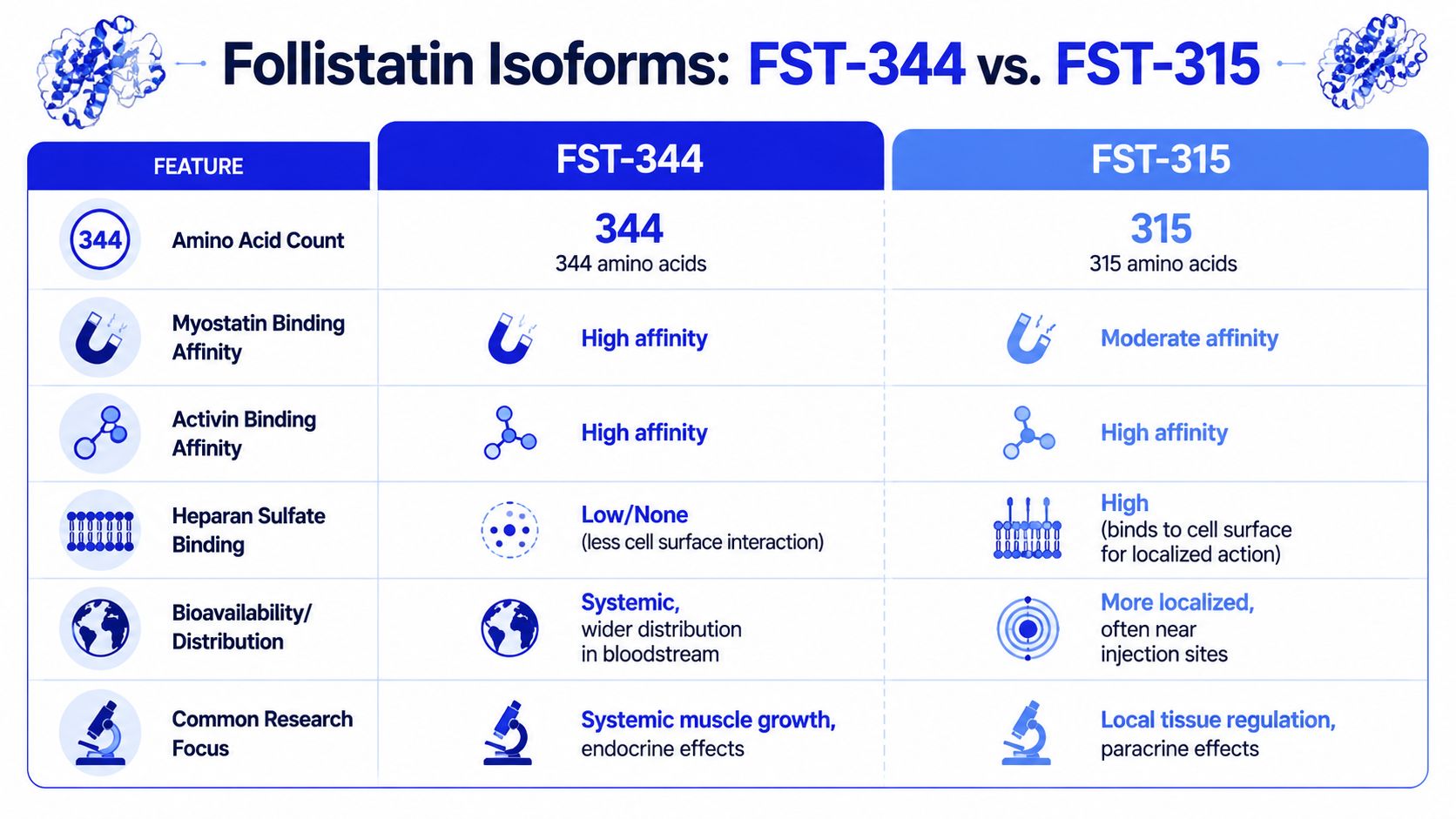
A useful lab analogy is preprotein versus mature product. The precursor gives you information about biosynthetic context and downstream processing. The processed form gives you a cleaner view of the species more often discussed in circulation. If those two are treated as equivalent inputs, the experiment can answer a different question than the one written in the protocol.
| Feature | Follistatin-344 (FST-344) | Follistatin-315 (FST-315) |
|---|---|---|
| Core identity | Full-length precursor isoform | Processed circulating form |
| Amino acid count | 344 amino acids | 315 amino acids |
| Relationship | Parent isoform discussed in expression and precursor biology contexts | Generated by processing of FST-344 |
| Common research framing | Useful when the study question includes precursor handling, expression products, or downstream conversion | Useful when the study question centers on processed follistatin species in circulation |
| Interpretation risk | Commonly confused with generic "follistatin" labels or with expression-based formats | Commonly treated as interchangeable with FST-344 despite different biological context |
The practical consequence shows up during study design. A cell assay using one isoform and an animal study interpreted with assumptions from another can produce a clean-looking but misleading narrative. The assay may still be technically successful. The biological claim is what drifts.
That is why experienced groups write the material name with full specificity in notebooks, sample sheets, and figure legends. "FST-344" and "FS-315" should not be shortened to "follistatin" once work begins. Small labeling shortcuts create large interpretation errors later, especially when results are compared across lots, platforms, or collaborators.
A better team question is: which isoform matches the biological question, the assay matrix, and the readout you plan to trust? That framing improves procurement decisions and reduces avoidable noise before the first sample is run.
Good follistatin work starts before the first pipetting step. When a vial arrives, treat it like any sensitive research reagent whose value depends on identity, cleanliness, and stable handling.
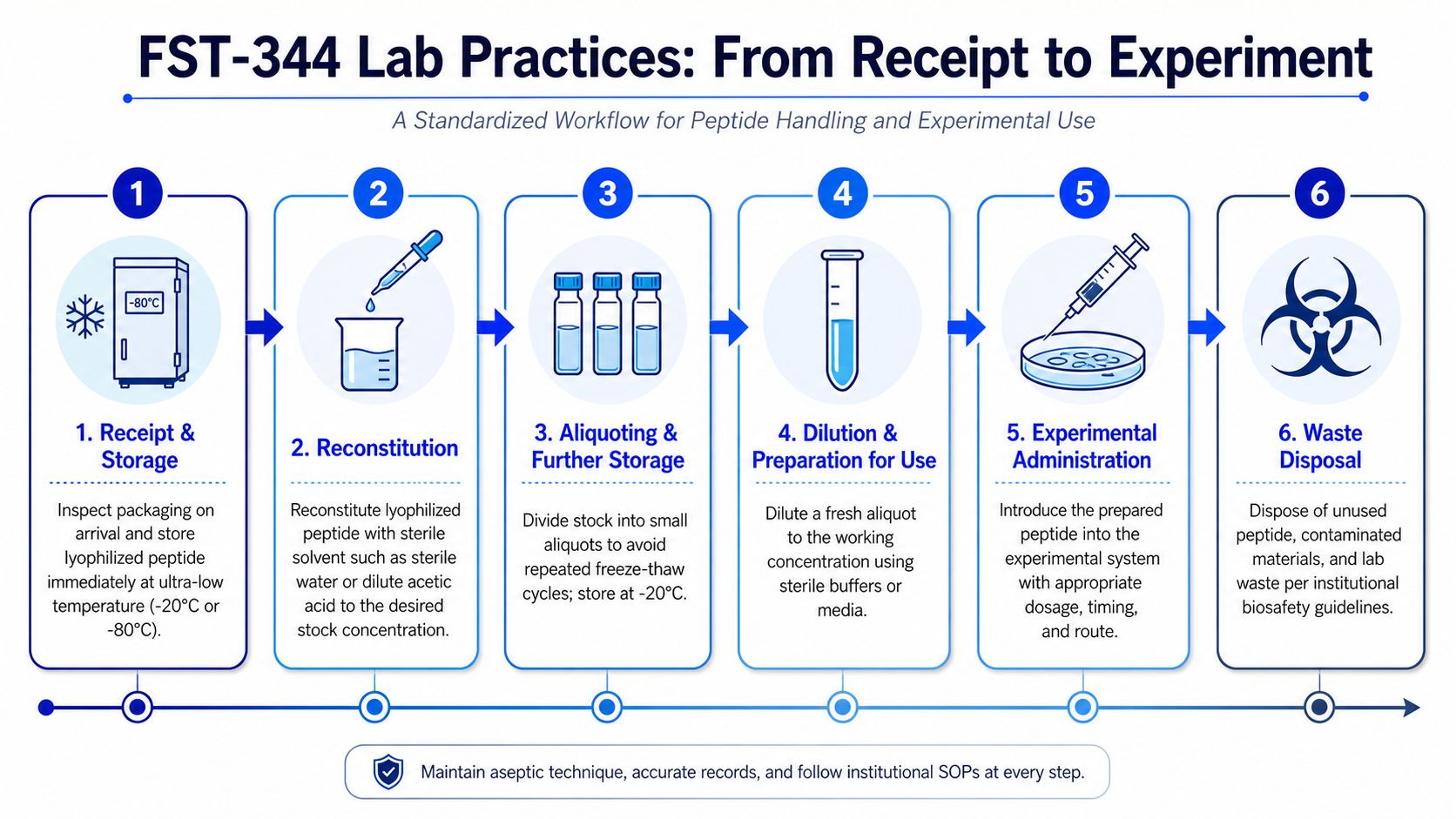
A disciplined workflow usually includes:
Those steps aren't glamorous, but they prevent a common failure mode. A lab sees inconsistent results, assumes the biology is complicated, and misses that the reagent was handled inconsistently across runs.
Small handling errors can look like biology. With a pathway-active reagent, that's a dangerous mistake.
Follistatin experiments work best when the question is narrow. “Does it work?” is not a good research question. “Does FST-344 alter a defined activin or myostatin pathway readout in this model under these conditions?” is much better.
A practical design checklist helps:
Define the intervention form
Is the experiment using purified material, a fragment sold as research-use-only, or a gene-delivery construct? Don't mix those categories in your interpretation.
Choose pathway-relevant controls
Vehicle controls are essential, but they're not enough by themselves. You also want controls that help distinguish ligand sequestration from nonspecific stress responses.
Build a concentration-response strategy
Since follistatin binds target ligands with very high affinity, broad but rational concentration planning is more useful than a single-point test.
Separate identity from activity
Confirm that the material is what the label says first. Only then interpret biological activity.
Predefine your primary readout
If the central question is pathway inhibition, prioritize a direct signaling endpoint rather than a late-stage phenotype alone.
A strong experiment with the Follistatin 344 peptide should let another scientist understand not just what changed, but why you believe the change came from authentic target engagement.
The most underappreciated issue in this category isn't dosage chatter. It's product identity. A compound can have a compelling mechanism on paper and still be useless in practice if the vial is mislabeled, contaminated, or inconsistent across lots.
That concern isn't theoretical. WADA cited a study of black-market FS344 products in which only 9 of 17 tested samples contained follistatin, as described in WADA's follistatin doping detection research summary. For any researcher, that should reset the conversation immediately.
If you're vetting a supplier, ask for documentation that addresses three separate questions:
Identity
Does the analytical package support that the material is follistatin and not just a labeled vial?
Purity
Is there a clear chromatographic profile such as HPLC information that supports the stated purity claim?
Biological cleanliness
Are microbial and endotoxin reports available when the material is intended for sensitive cell or animal research?
Don't treat a Certificate of Analysis as a decorative PDF. Read it like a scientist. Look for lot-specific reporting, traceability, and test methods that align with the material type.
There's also a compliance boundary that shouldn't be blurred. Neutral coverage notes that injectable follistatin products are not FDA-approved, that no published Phase 1 human safety data exist for injectable follistatin fragments, and that human trial evidence is limited to AAV1-FS344 gene-therapy studies in specific neuromuscular disease settings, as summarized in this neutral review of follistatin evidence and regulatory status.
That's why these materials belong in a research-use-only frame. If a seller collapses that distinction, move on.
No. Follistatin is a protein with a ligand-binding mechanism that differs from steroids and SARMs. The most useful way to categorize it is by what it does molecularly: it binds activins and myostatin and alters downstream signaling, rather than acting as an androgenic agent.
That distinction matters because sloppy category labels lead to sloppy expectations. If a reader treats follistatin as just another anabolic shortcut, they'll miss the true research value and the genuine experimental risks.
This is one of the most important distinctions in the entire topic. A research vial labeled as follistatin material is not the same thing as AAV1-FS344 gene therapy used in disease-focused human trials.
The gene-therapy approach delivers genetic instructions so cells can produce the target over time. A direct material approach introduces the compound itself. Those are different delivery systems with different kinetics, exposure patterns, and evidence standards.
Don't borrow credibility from gene-therapy literature and apply it to retail injectable fragments. That leap isn't supported.
Because contamination can ruin the interpretation of an otherwise well-designed experiment. If bacterial endotoxin is present, cells or animal models may react to the contaminant rather than to follistatin biology.
In practice, endotoxin problems can create false pathway signals, inflammatory artifacts, poor reproducibility, or unexplained model stress. That's why experienced researchers don't stop at purity alone. Identity, purity, and cleanliness each answer a different question.
A short checklist helps here:
The Follistatin 344 peptide is best understood as a specialized research tool for studying myostatin and activin pathway inhibition. Its scientific value comes from clear mechanism, meaningful preclinical history, and careful use in well-controlled laboratory systems.
The biggest mistake people make is treating it like a generic performance compound. Serious researchers do the opposite. They verify isoform identity, separate direct material from gene-delivery evidence, and insist on documentation that supports reliable experimental outcomes.
If you want clean data, the procurement standard has to match the biological sophistication of the molecule.
For researchers who want verified, US-made materials backed by transparent batch documentation, Peptide Warehouse USA offers research-use-only peptide products with COAs and supporting analytical reports. If you're evaluating sourcing options for your next study, learn more and explore the available catalog with a focus on identity, traceability, and reproducibility.