No products in the cart.



A useful way to think about the FOXO4 DRI peptide is this. It became scientifically interesting not because it was marketed as an anti-aging shortcut, but because preclinical work suggested it could push certain senescent cells toward apoptosis while sparing normal cells. That’s a narrower, more disciplined claim than many readers expect, and it’s exactly why the molecule still matters in research.
For scientists working on senescence, tissue aging, or cell-state control, that distinction is critical. The strongest evidence sits in cell and mouse studies, not in established human outcomes. If you’re evaluating FOXO4-DRI for preclinical work, the right question isn’t “Does it reverse aging?” It’s “What does the published evidence show, what does it not show, and how should a lab handle the compound responsibly?”
Senolytics aim to remove senescent cells, which are cells that no longer divide normally but also don’t die when they should. These cells can persist in tissues and alter the local environment through inflammatory and remodeling signals, which is why they’ve become a major focus in aging biology and regenerative research.
The FOXO4 DRI peptide sits in that conversation as a targeted senolytic research tool. Rather than acting as a broad toxin, it was developed to interrupt a specific intracellular interaction associated with senescent-cell survival. That specificity is what makes it conceptually important.

A practical reason this matters is that senescence research spans many tissues, from cartilage to vascular biology to epithelial turnover. If you’re interested in how tissues renew themselves over time, a related explainer on skin cell turnover is a helpful example of how cell replacement and cellular aging intersect at the tissue level.
Senescent cells are more than “old” cells. They occupy a distinct biological state.
That state can be useful in some contexts, such as damage responses, but problematic when senescent cells accumulate and remain in place. Researchers therefore look for tools that can distinguish these cells from healthy, proliferating populations.
Senolytic research is compelling because it asks a very precise question. Can a lab remove damaged, non-dividing cells without broadly harming the rest of the tissue system?
FOXO4-DRI is most relevant when a study needs to probe whether disrupting senescent-cell survival pathways changes tissue behavior. That makes it valuable for mechanism-focused work, especially in cell culture and animal models.
It’s also a compound that attracts confusion. Some readers jump from “senescent-cell clearance in mice” to “proven human anti-aging effect.” The evidence doesn’t support that leap, and keeping those categories separate is essential for good science.
FOXO4-DRI is defined as much by its architecture as by its target. For preclinical researchers, that point matters because peptide structure determines whether a molecule can persist long enough, and in the right form, to test a specific intracellular interaction under controlled experimental conditions.
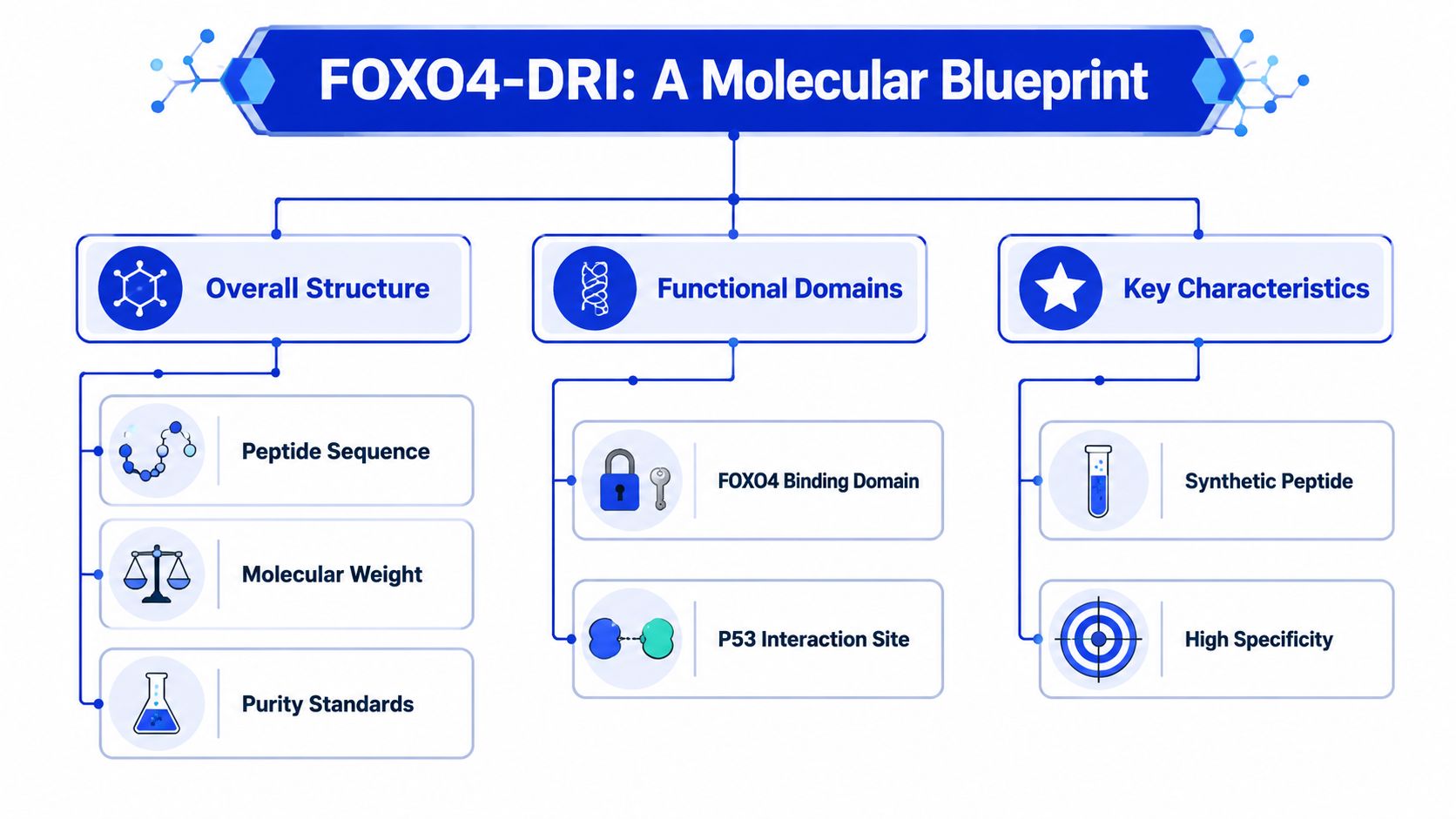
FOXO4-DRI is a retro-inverso, all-D peptide. In practical terms, that means the sequence is built from D-amino acids rather than the more common L-amino acids, and the order is arranged to preserve the key side-chain presentation needed for target binding. The design is intended to mimic the interaction surface of the parent peptide while making the molecule less easily processed by many proteases.
A useful comparison is a key cut from a different material but shaped to fit the same lock. The lock, in this case, is the target protein interface. The altered material does not change the intended binding logic, but it can change how the peptide behaves in a biological environment.
This design choice makes FOXO4-DRI a more practical research molecule for experiments focused on protein interaction disruption. It does not justify broad claims about clinical performance. It does explain why investigators use this format in cell and animal studies where peptide integrity can strongly affect readouts.
The published sequence is:
H-D-Leu-D-Thr-D-Leu-D-Arg-D-Lys-D-Glu-D-Pro-D-Ala-D-Ser-D-Glu-D-Ile-D-Ala-D-Gln-D-Ser-D-Ile-D-Leu-D-Glu-D-Ala-D-Tyr-D-Ser-D-Gln-D-Asn-D-Gly-D-Trp-D-Ala-D-Asn-D-Arg-D-Arg-D-Ser-D-Gly-D-Gly-D-Lys-D-Arg-D-Pro-D-Pro-D-Pro-D-Arg-D-Arg-D-Arg-D-Gln-D-Arg-D-Arg-D-Lys-D-Lys-D-Arg-D-Gly-OH
Its published molecular formula is C228H388N86O64, and its molecular weight is about 5358.05 g/mol, as noted earlier in the same source.
Those details are not cosmetic. They are the basis of compound identity.
A graduate student can think of them as the molecular equivalent of a reagent label, certificate of analysis, and fingerprint combined into one. If the sequence, formula, or expected mass is unclear, it becomes much harder to verify that two lots represent the same test article or to interpret why one dataset differs from another.
Three research implications follow from that molecular identity:
| Molecular feature | FOXO4-DRI detail | Why it matters |
|---|---|---|
| Peptide class | Retro-inverso, all-D peptide | Indicates a stability-oriented design for preclinical use |
| Formula | C228H388N86O64 | Supports analytical verification |
| Molecular weight | About 5358.05 g/mol | Informs batch confirmation and solution preparation |
| Sequence type | Published full sequence available | Reduces ambiguity during sourcing and QC |
For researchers evaluating FOXO4-DRI, the main takeaway is straightforward. The molecule is best understood as a deliberately engineered preclinical tool. Mouse and cell data can be used to study mechanism. Human anti-aging conclusions cannot be drawn from molecular design alone.
The scientific interest in FOXO4-DRI comes from mechanism, not branding. Its reported activity centers on a protein interaction that helps senescent cells resist apoptosis.
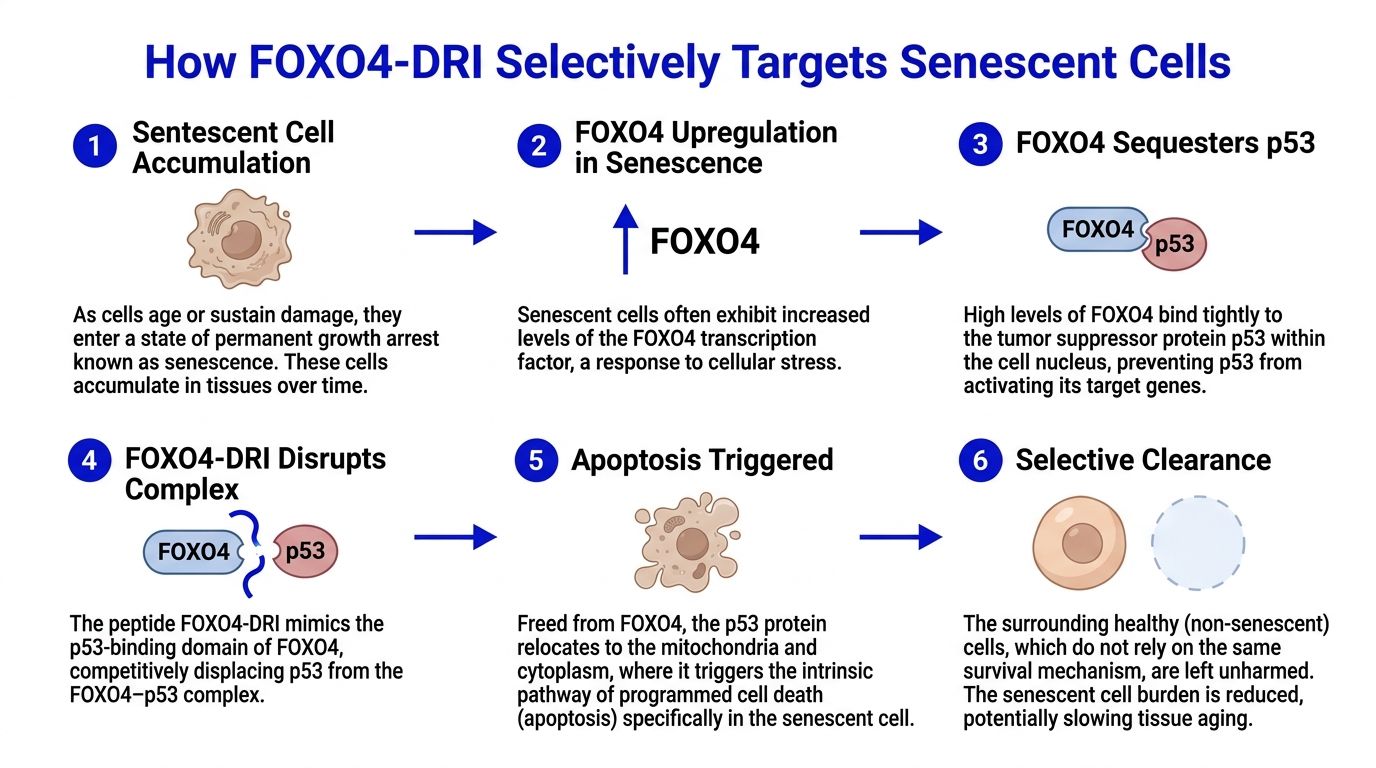
Mechanistically, FOXO4-DRI acts as a FOXO4/p53 interaction blocker. It competes with endogenous FOXO4 for p53, drives nuclear exclusion of active p53 in senescent cells, and shifts p53 toward mitochondrial apoptosis signaling, an effect linked to selective elimination of senescent fibroblasts while sparing normal cells in published Aging research.
If that sounds abstract, use a lock-and-key model. In senescent cells, FOXO4 helps keep p53 functionally restrained in a way that supports survival. FOXO4-DRI interferes with that arrangement. Once the interaction is disrupted, p53 is no longer held in the same way, and apoptosis signaling can proceed.
A brief visual explanation can help here:
Selectivity is the difference between a useful senolytic probe and a blunt cytotoxic reagent. If a compound kills everything, it doesn’t tell you much about senescent-cell biology.
FOXO4-DRI is interesting because the published work links its effect to senescent cell survival machinery, not indiscriminate damage. That makes it a better fit for experiments asking questions such as:
Practical rule: When interpreting FOXO4-DRI data, always ask whether the observed change tracks with senescent-cell depletion or with nonspecific stress from the experimental setup.
One place readers get confused is the role of p53. FOXO4-DRI does not “turn off” p53 in a simple global sense. The key idea is redistribution and signaling context inside senescent cells. That’s why experimental design, controls, and cell-state confirmation are so important when you use the peptide.
FOXO4-DRI matters in research because it gave senescence biology something more useful than a broad theory. It gave investigators a testable intervention. That distinction is important. A peptide can be interesting on paper yet still fail to produce interpretable results in cells or animals. FOXO4-DRI remained part of the senolytics discussion because the early studies linked a defined molecular interaction to measurable preclinical outcomes.
The evidence base is still limited to preclinical settings. That means cell culture systems, injury models, and mouse studies. It does not mean established human benefit, and researchers should keep that boundary clear when interpreting the literature.
FOXO4-DRI drew wide attention in 2017, when preclinical studies demonstrated that interfering with the FOXO4-p53 interaction could trigger apoptosis in senescent cells, as summarized in Cancer Discovery coverage of the study.
Why did that study matter so much? Because it moved the field from association to intervention. Instead of only observing that senescent cells accumulate with age or damage, investigators could ask a sharper question: what happens if you selectively disrupt one of the survival mechanisms those cells rely on?
A related mouse chemotoxicity study extended that idea into a defined injury setting. In the same summary, FOXO4-DRI was reported to improve body weight and reduce the liver injury marker AST in doxorubicin-exposed mice. For researchers, that is more informative than a vague claim about “anti-aging” effects. It suggests the peptide may alter tissue outcomes in models where treatment-induced senescence is part of the pathology.
That point often gets blurred in secondary discussions. The early literature did not establish a general rejuvenation effect. It established a preclinical basis for using FOXO4-DRI as a tool to test whether senescent-cell persistence contributes to a phenotype.
Later studies expanded the experimental contexts in which FOXO4-DRI was examined. One tissue-focused report described senescent-cell clearance in cultured chondrocytes and reduced expression of senescence-associated secretory factors in newly formed cartilage, according to the PMC study report.
That result is useful for a simple reason. Senolytic claims are stronger when they are paired with cell-state readouts, not just gross tissue appearance. In cartilage-related systems, the question is not only whether cells die, but whether senescence markers and secretory programs shift in the expected direction after treatment.
The same report also describes a 2025 vascular-aging study in naturally aged and induced-aging mice. FOXO4-DRI was associated with improved aortic function and reduced aortic aging features, with the authors linking the effect to p53 nuclear exclusion and activation of the BAX/caspase-3 apoptosis pathway. Mechanistically, that gives researchers a more specific path to examine. The peptide is not acting like a nonspecific toxin in this framing. It is being studied as a targeted perturbation of a survival axis used by senescent cells.
| Study model | Key outcome | Reported mechanism | Reference year |
|---|---|---|---|
| Preclinical senescence work | Apoptosis in senescent cells after FOXO4-p53 disruption | Senescent-cell targeting through FOXO4-p53 disruption | 2017 |
| Mouse chemotoxicity model | Increased body weight and reduced AST | Senescence-linked effect in doxorubicin-induced chemotoxicity | 2017 follow-up |
| PDL9 chondrocytes | Marked reduction in senescence-associated cells | Senescent-cell removal with lower senescence-associated factors | Not specified in the verified summary |
| Naturally aged and induced-aging mice | Improved aortic function and reduced aortic aging features | p53 nuclear exclusion and BAX/caspase-3 activation | 2025 |
The pattern across these studies is fairly consistent. FOXO4-DRI is most defensible as a preclinical probe for senescence-dependent biology.
That is the right level of confidence. Mouse and cell findings can justify mechanistic research, replication, and better-controlled comparative studies. They do not justify assuming clinical utility in humans, especially when dosing, delivery, off-target effects, and long-term safety remain unresolved.
When a peptide experiment fails, the biology often gets blamed first. In practice, sourcing problems are just as likely to be responsible. Poor identity control, incomplete documentation, contamination, or degraded material can turn a clean mechanistic experiment into noise.
The first filter is documentation. A serious supplier should provide batch-linked records that support identity and quality review.
Look for:
A Certificate of Analysis isn’t just a formality. It’s the bridge between the vial on your bench and the analytical work that says what should be in it.
For FOXO4-DRI specifically, sequence fidelity matters because the peptide’s function depends on a precise structural design. If the material differs from the published molecular identity, your mechanism study may no longer be testing FOXO4-DRI in any meaningful sense.
Use a simple decision framework before procurement:
A peptide with weak documentation doesn’t just add uncertainty. It can invalidate comparisons across experiments, operators, and time points.
Researchers also benefit from consistency in packaging and labeling. Clear lot IDs, storage guidance, and analytical attachments reduce preventable handling errors before the experiment even starts.
A well-made peptide can still produce poor data if the lab handles it carelessly. FOXO4-DRI should be treated like any sensitive research reagent. Control temperature, minimize repeated handling, and document each step.
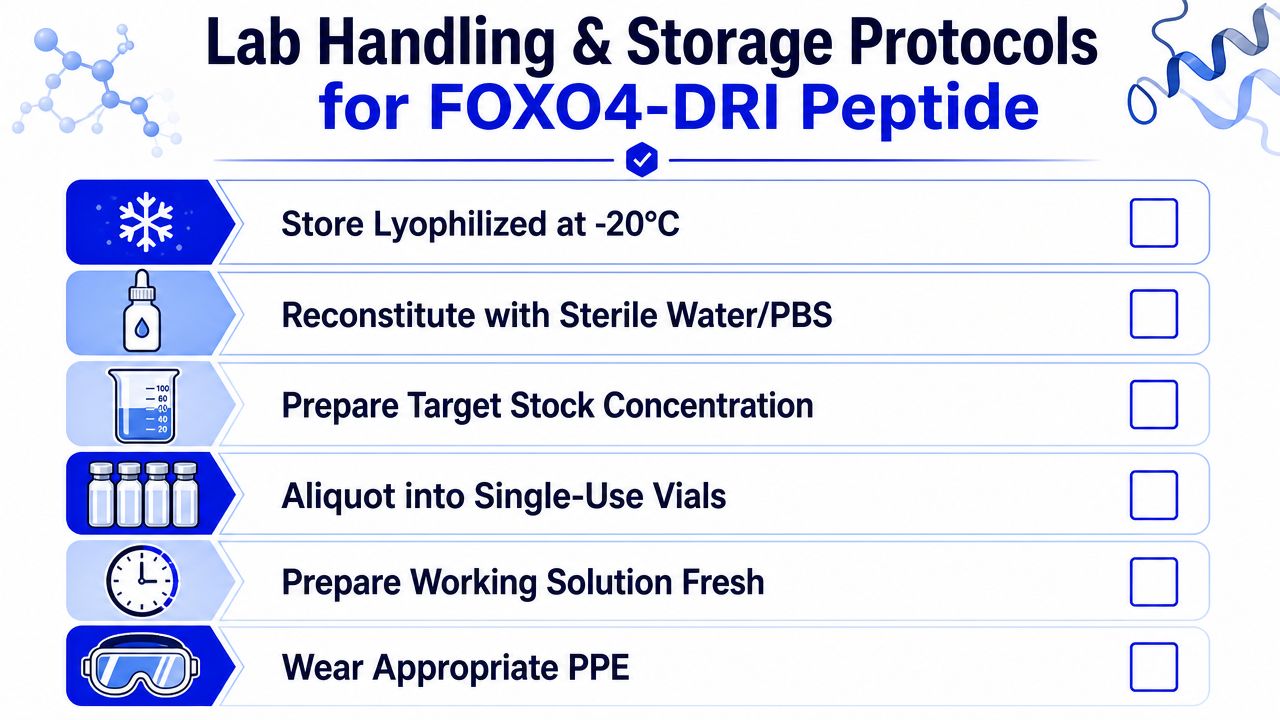
Start with the basics. Inspect the vial, lot label, and accompanying paperwork as soon as the shipment arrives.
Best practices include:
The infographic above includes one common benchmark used in labs, store lyophilized at -20°C, but your actual storage decision should follow the supplier’s documentation and internal SOPs.
Reconstitution should be deliberate, not improvised. Many labs use sterile water or PBS depending on the assay context, required stock concentration, and downstream compatibility.
A practical workflow looks like this:
Why aliquot? Because repeated freeze-thaw exposure can introduce avoidable variability. Small, clearly labeled aliquots help protect the main stock and make workflow cleaner across multiple assays.
A few habits improve reliability:
If your lab is scaling from pilot assays to broader preclinical work, consistency in handling matters as much as the peptide itself. Standardized reconstitution notes often explain result differences more effectively than post hoc theory.
FOXO4-DRI sits in a category that often attracts more enthusiasm than discipline. The evidence base supports serious preclinical interest, but it does not support claims of established human benefit.
That distinction matters because the path from a mechanistic result in cells or mice to a validated human intervention is long and failure-prone. A peptide can perform exactly as intended in a controlled model system and still leave key translational questions unanswered.
Current summaries of senolytic development describe FOXO4-DRI as investigational, with limited human validation, as discussed in independent coverage of senolytic development.
A useful way to frame this is to separate three levels of evidence. First, there is mechanistic evidence, which asks whether the peptide disrupts the intended interaction and induces the expected cellular response. Second, there is preclinical efficacy evidence, which asks whether that mechanism changes tissue or organism-level outcomes in animal models. Third, there is clinical evidence, which asks whether those effects translate into acceptable safety, dosing, and meaningful benefit in humans. FOXO4-DRI has support in the first two categories. The third remains largely unresolved.
The same discussion also highlights the translational questions that still matter most. Researchers do not yet have established human answers for dosing strategy, durability of effect, or long-term safety.
This is normal drug development science, not a defect unique to FOXO4-DRI. Senolytic biology is complex. Senescent cells are heterogeneous across tissues, disease contexts, and age states, so a result in one model should not be treated as a universal rule.
The most defensible position is straightforward. FOXO4-DRI should be treated as a research compound intended for laboratory and preclinical investigation, not as an approved therapy and not as a substance established for human use.
For research groups, that means keeping a few boundaries clear:
A good analogy is early-stage target validation in oncology. If a compound shrinks a signal in a model system, that finding can be biologically important without answering whether the same intervention will be safe, durable, or useful in patients. FOXO4-DRI belongs in that same evidence-aware frame.
Good translational science depends on separating what has been shown in controlled preclinical systems from what remains hypothetical in humans.
The strongest contributions in this area will come from researchers who preserve that separation, report methods carefully, and resist the urge to turn promising senolytic data into clinical language before the evidence can carry that weight.
FOXO4-DRI stands out because it combines a precise molecular design with a specific biological target. It is a retro-inverso, all-D peptide created to disrupt the FOXO4-p53 interaction, and that mechanism gives researchers a way to test how senescent-cell persistence shapes tissue behavior.
The preclinical picture is strong enough to justify continued scientific interest. Published work has linked FOXO4-DRI to senescent-cell apoptosis in early studies, measurable reduction of senescence in PDL9 chondrocytes to less than 5% in one analysis, and improved vascular outcomes in mouse models reported in later research. Those findings make it a serious senolytic research tool.
At the same time, the translational boundary matters. Human validation remains limited, and current evidence doesn’t establish clinical dosing, durability, or long-term safety. Researchers who keep that distinction clear are more likely to generate useful data and avoid overstating what the compound can do.
The practical takeaway is simple. If you’re evaluating the FOXO4 DRI peptide for preclinical work, focus on three things: the molecular identity of the material, the quality of the documentation behind each lot, and disciplined lab handling from receipt through reconstitution. That’s how you turn an interesting peptide into a reliable research input.
If you’re ready to learn more or explore options for well-documented senolytic research materials, start with sourcing standards and batch transparency rather than marketing language.
Individuals seeking high-purity, well-documented peptide materials can explore Peptide Warehouse USA for laboratory and preclinical applications. Their emphasis on batch documentation, COAs, and research-use-only positioning makes them a practical option for teams that want traceable sourcing and a more disciplined procurement process.