No products in the cart.



The most popular advice about GHK-Cu glow usually starts with an attractive promise: add a copper peptide to your routine and expect broad, visible rejuvenation. The research supports a narrower conclusion. GHK-Cu is a specific copper-binding tripeptide with evidence connected to local skin structure, collagen production, wound repair biology, and cosmetic changes such as firmness, elasticity, skin density, and wrinkle appearance, but it doesn't support a general whole-body anti-aging claim.
That distinction matters if you're comparing a standalone GHK-Cu product with a broader peptide blend, assessing a topical serum, or trying to understand what “glow” means. The useful question isn't whether GHK-Cu is a miracle ingredient. It's whether a particular formulation can support measurable changes in skin quality, and whether those changes match the evidence available.
“Glow” is a convenient skincare word, but it can hide several different outcomes. A brighter-looking complexion might reflect better surface hydration, smoother texture, more even light reflection, reduced dullness, or changes in deeper skin structure. Those aren't interchangeable, and research on GHK-Cu doesn't prove all of them equally.
The strongest interpretation is local and cosmetic. Reviews describe GHK-Cu as a naturally occurring copper-binding tripeptide studied in relation to wound healing, tissue remodeling, skin renewal, and collagen-related activity across laboratory, animal, and human research settings (review literature on GHK-Cu). That history gives the ingredient a credible biological rationale, but it doesn't turn every “glow stack” claim into a clinical finding.
For skin-focused use, the most defensible discussion centers on:
The evidence is much weaker for broad systemic rejuvenation. There isn't human clinical evidence establishing that topical GHK-Cu reverses aging throughout the body or produces generalized anti-aging effects.
A practical reading rule: Treat “glow” as shorthand for local skin-quality changes, not proof of whole-body regeneration.
This approach isn't cynical. It makes the product question clearer. If your goal is cosmetic skin appearance, GHK-Cu may be relevant because its research connects to collagen and tissue remodeling. If a seller promises dramatic systemic effects, the claim has moved beyond the narrow human evidence.
For a useful overview of how peptide ingredients are discussed in skincare, readers can also consult peptides skincare benefits explained. The key is to separate general peptide education from evidence specific to GHK-Cu.
GHK-Cu began as a biological finding, not a beauty trend. Glycyl-L-histidyl-L-lysine copper was first isolated from human plasma in 1973 by Loren Pickart, giving researchers a naturally occurring molecule to study rather than a compound created solely for cosmetic marketing (historical review of GHK-Cu).
Its name identifies the chemistry. GHK is a tripeptide made of glycyl, histidyl, and lysine. Copper binds to this three-amino-acid sequence, forming GHK-Cu. Reviews published in 2012 and 2018 describe the molecule as present in human plasma and potentially released from tissues after injury. They also summarize research involving wound healing, tissue remodeling, skin renewal, and protective activity in several tissue types.
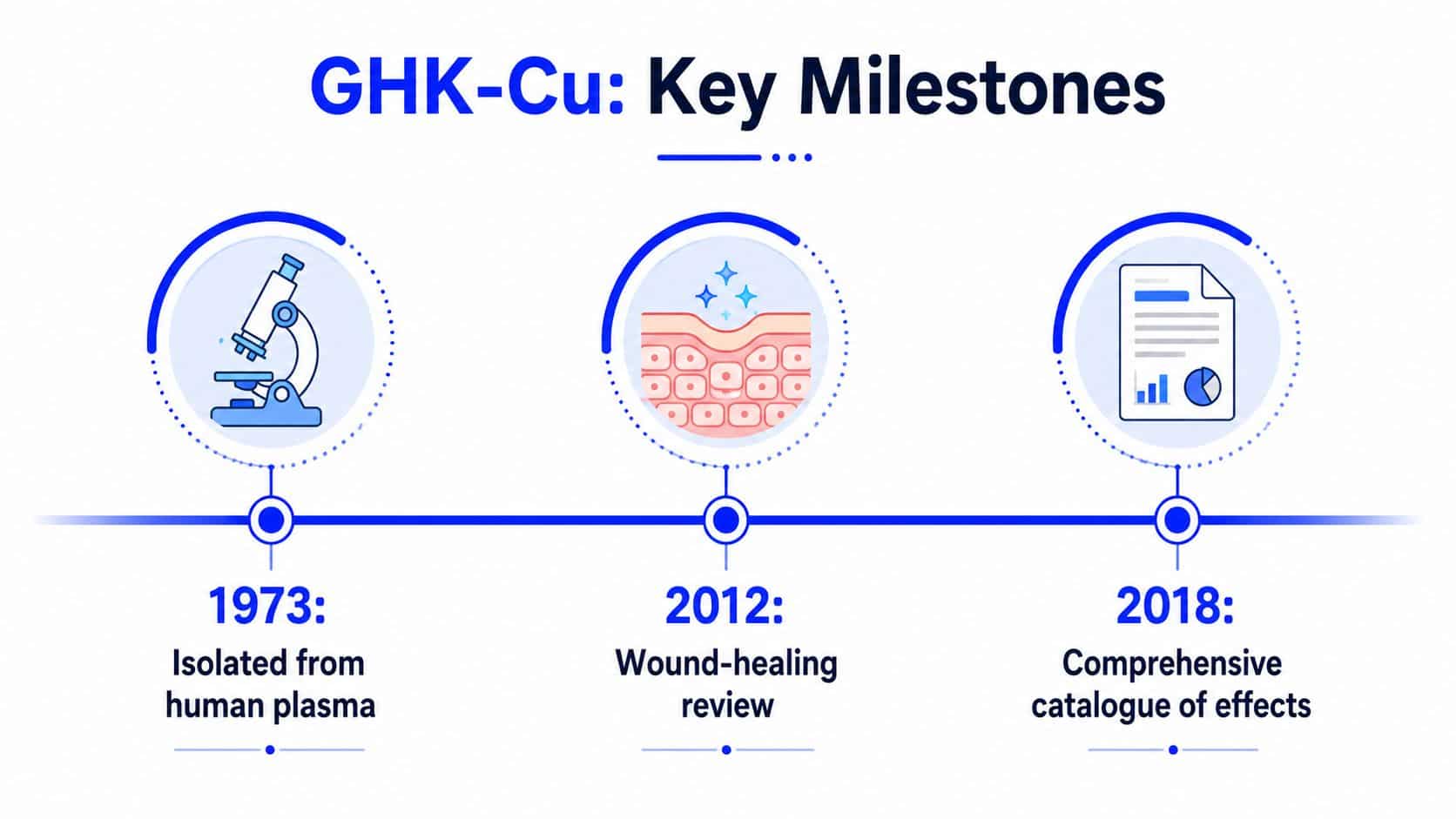
A research history spanning more than four decades does not establish that every modern product works. It does show why GHK-Cu remains under investigation. The same core molecule has appeared in wound models, skin studies, tissue biology, and cosmetic formulations, giving researchers more context than the label “trending peptide” suggests.
The history also separates GHK-Cu from the generic label “copper peptide.” A product using that broader term might contain another copper-bound peptide, a blend, or a formula with different delivery properties. GHK-Cu refers specifically to this copper-bound tripeptide.
Readers seeking broader background can consult peptides skincare benefits explained. For cosmetic use, the practical question is narrower: whether the named compound reaches the skin in a form that can affect local appearance. That evidence should not be stretched into proof for broad anti-aging claims or untested GHK-Cu, BPC-157, and TB-500 combinations.
A GHK-Cu glow is easier to explain as a local skin-structure effect than as a general anti-aging transformation. Skin appearance reflects the surface, the extracellular matrix beneath it, collagen organization, and the tissue's ability to recover from everyday stress.
GHK-Cu has been studied in pathways linked to collagen production, wound healing, extracellular matrix accumulation, blood-vessel formation, and antioxidant-enzyme activity. These findings offer a biological rationale for studying the peptide in skin models. They do not establish that every topical formula produces a visible glow.
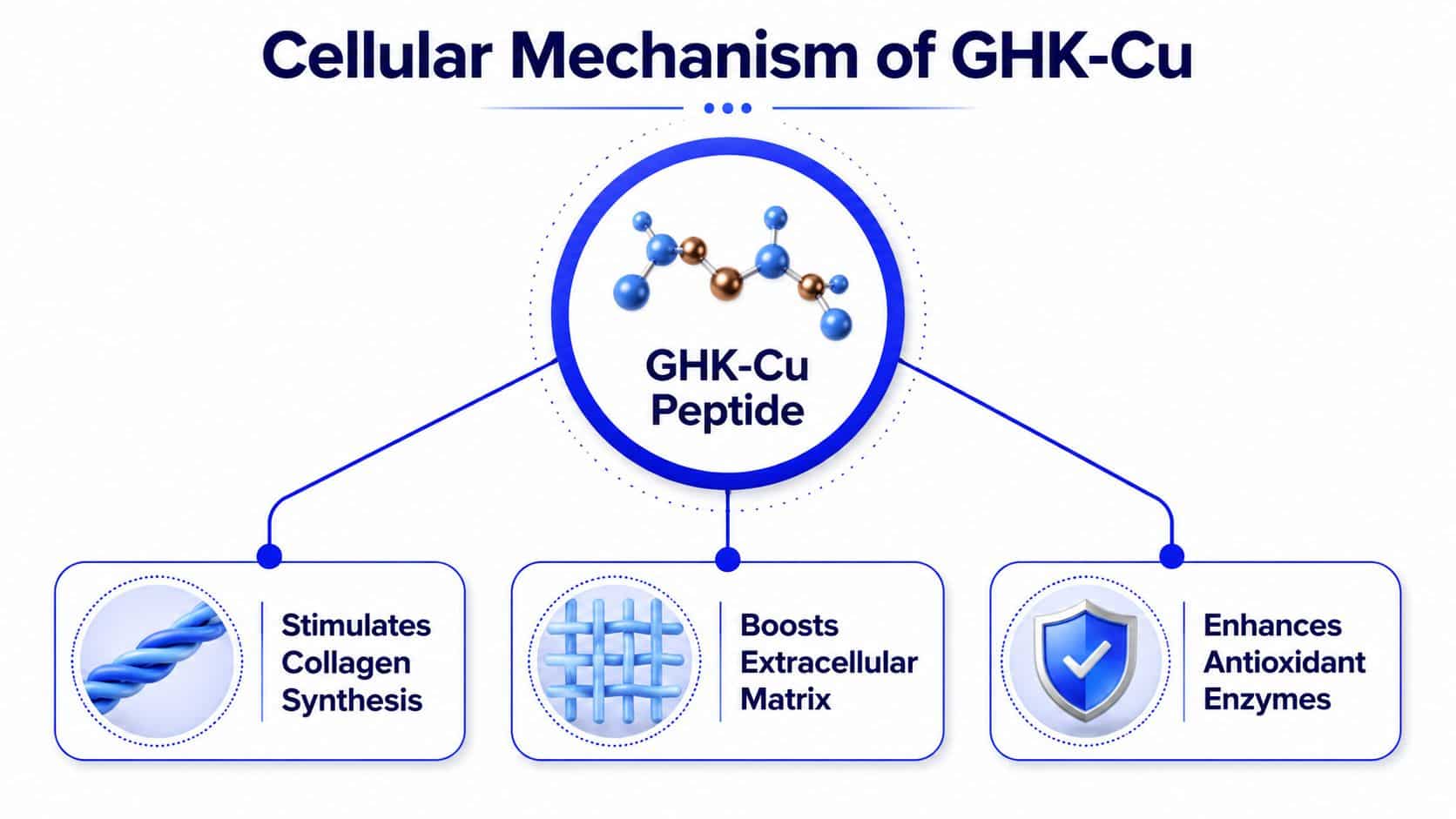
A 1993 in vivo wound-chamber study found that GHK-Cu increased dry weight, DNA, total protein, collagen, and glycosaminoglycan content in wounds in a concentration-dependent manner (1993 wound-chamber study). In practical terms, treated wound models accumulated more of the materials involved in forming and organizing repair tissue.
Collagen provides part of that framework. Glycosaminoglycans help support the surrounding network, while proteins and cellular material contribute to the structure cells use during repair. This resembles rebuilding a scaffold: collagen supplies important framework material, but the surrounding matrix determines how that framework is supported and arranged. A wound model, however, does not equal routine cosmetic use.
A review also describes a skin-biopsy study in which one month of GHK-containing cream significantly increased collagen production in thigh skin (review of GHK-Cu mechanisms and skin findings). That result is more relevant to cosmetic skin biology than a wound model, though it remains too narrow to support dramatic rejuvenation claims.
The same review discusses models reporting faster wound closure, increased blood-vessel formation, and greater antioxidant-enzyme activity. Re-epithelialization, the restoration of the outer skin layer, may help recovering tissue regain normal appearance and function. Antioxidant enzymes may help cells manage oxidative stress within the studied biological setting.
The reasonable cosmetic interpretation is limited. GHK-Cu may support processes associated with healthier-looking skin, especially local matrix remodeling and collagen-related changes. The visible outcome still depends on concentration, formulation, skin condition, and study design.
Readers comparing ingredients can find the best anti aging peptides for broader context. GHK-Cu's strongest rationale remains local skin biology, not whole-body rejuvenation. Evidence for popular GHK-Cu, BPC-157, and TB-500 stacks is not established by these individual mechanisms.
The GHK-Cu glow claim is narrower than the anti-aging promise often attached to it. Human cosmetic evidence mainly concerns local skin appearance, while whole-body rejuvenation remains unestablished.
| Outcome | Evidence Level | Notes |
|---|---|---|
| Wrinkle appearance | Limited human cosmetic evidence | Small clinical studies have reported improvements in wrinkle depth, but that does not demonstrate systemic anti-aging. |
| Firmness | Limited human cosmetic evidence | Topical copper-peptide findings support further study of firmness and related skin-quality measures. |
| Elasticity | Limited human cosmetic evidence | Elasticity is a plausible local outcome, although formulation and study design affect the result. |
| Skin density | Limited human cosmetic evidence | Skin density fits the collagen and extracellular-matrix rationale, but the evidence remains narrow. |
| Whole-body rejuvenation | Not established in human clinical evidence | Topical skin findings cannot be generalized to systemic anti-aging. |
| Treatment of a medical condition | Not a cosmetic conclusion | Clinical testing shows that GHK-Cu gel has been studied, not that readers should self-treat. |
A useful analogy is a repair crew working in one room. Evidence that GHK-Cu may influence collagen-related skin structure in that area does not show that it can renovate the entire building. Cosmetic claims should therefore stay close to observable endpoints such as wrinkle appearance, firmness, elasticity, and skin texture.
Clinical research adds context because it moves beyond laboratory models. A multicenter, randomized trial evaluated topical GHK-Cu gel for diabetic neuropathic ulcers. Topical GHK-Cu is also being evaluated in a Phase 2, randomized, double-blind, vehicle-controlled, split-wound clinical study involving standardized acute skin wounds in healthy adults (clinical trial record for topical GHK-Cu). These designs show controlled testing in clinical settings, but they do not establish that a cosmetic serum will produce the same result.
A wound-healing protocol, prescription-style gel, and over-the-counter cream may differ in concentration, vehicle, application conditions, and measured endpoint. Those differences make direct product comparisons unreliable.
Look for the named compound and its formulation, rather than a label that only says “copper peptide.” A careful product description should focus on skin appearance, texture, firmness, elasticity, and wrinkle-related outcomes. Claims about generalized rejuvenation go beyond the available cosmetic evidence.
Basic skincare habits also affect dull-looking skin. This brighter skin routine guide provides broader routine context. A peptide product supports a routine; it does not replace consistent skin-care practices.
A label can name the right molecule and still leave an important question unanswered: how does the GHK-Cu reach the skin? Available coverage notes that free GHK-Cu penetrates the stratum corneum poorly, so the delivery vehicle may matter as much as the active ingredient itself (GHK-Cu cosmetic formulation research).
The stratum corneum is the outermost barrier of the skin. It protects the body by limiting entry, which is helpful for health but challenging for topical ingredients. Two products can both list GHK-Cu and still behave differently because their solvents, carriers, encapsulation systems, stability, and application bases aren't identical.
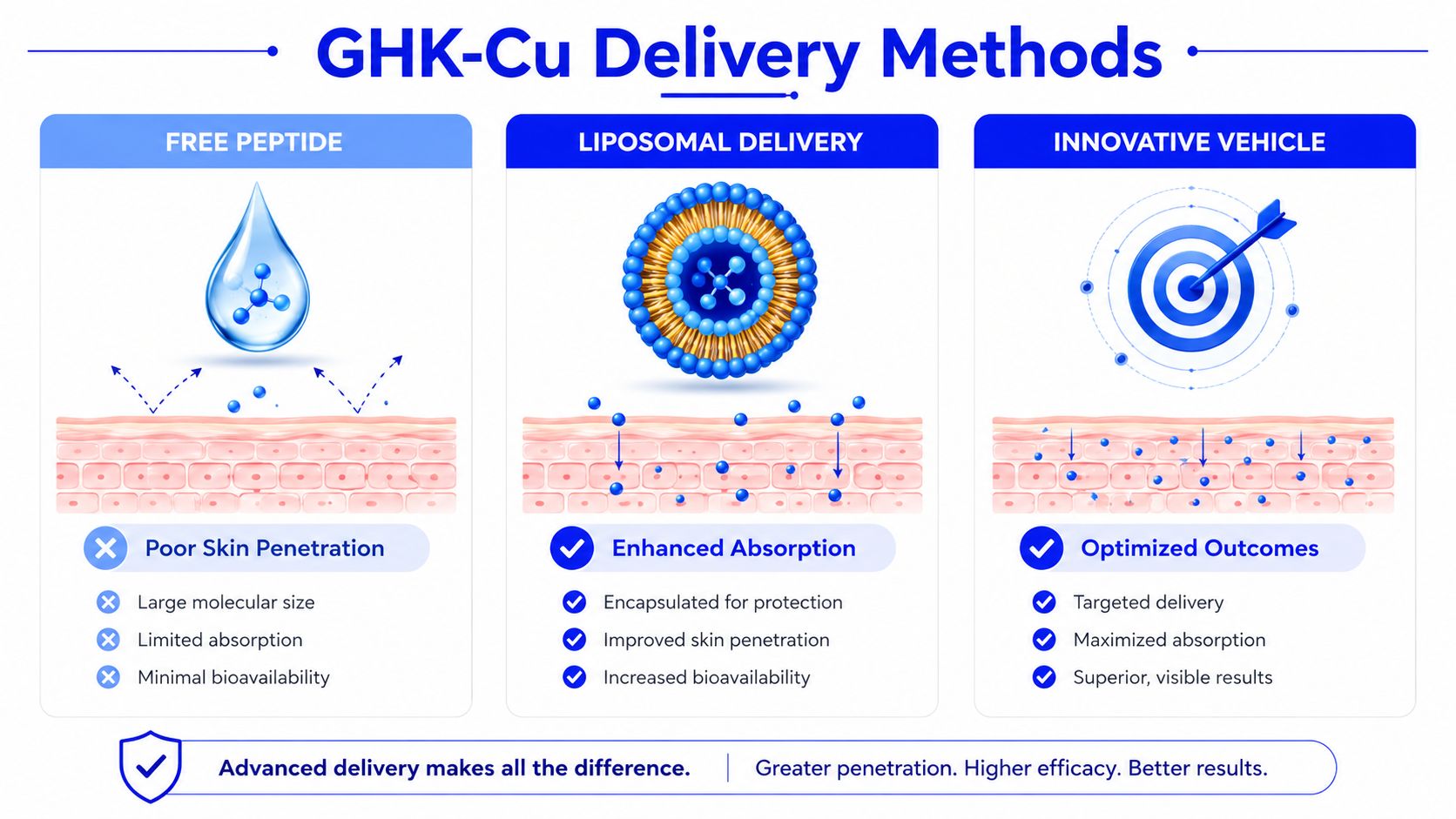
Free GHK-Cu is the simplest concept, but poor stratum-corneum penetration creates a practical limitation. A product can contain a well-studied peptide without delivering much of it beyond the surface.
Liposomal GHK-Cu uses lipid-based carriers designed to change how the compound is presented to tissue. In a mouse scald-wound study, GHK-Cu liposomes shortened wound healing time to 14 days post-injury and increased angiogenesis markers such as CD31 and Ki67 compared with free GHK-Cu (GHK-Cu liposome wound model).
GHK-Cu in a cosmetic cream may be easier to apply and can support a consumer-friendly routine, but its results depend on the full formula. The skin-biopsy finding involving GHK-containing cream supports interest in topical delivery, yet it doesn't mean every cream produces the same effect.
The mouse result is useful for understanding formulation, not for predicting a guaranteed human outcome. Animal wound healing and cosmetic skin appearance are different endpoints.
The label tells you what is present. The formulation helps determine what the skin can actually receive.
The popular GHK-Cu plus BPC-157 plus TB-500 GLOW blend is often presented as though the combination has a proven, unified effect. That conclusion goes further than the evidence allows.
GHK-Cu has its own research history involving skin quality and tissue remodeling. BPC-157 and TB-500 are discussed in research contexts involving repair-related biology, but separate evidence for individual ingredients doesn't demonstrate that the three compounds work better together.
There is no published human trial of the common GHK-Cu plus BPC-157 plus TB-500 GLOW blend, so claims about the combined effect remain extrapolations from separate ingredients rather than direct evidence (discussion of the GHK-Cu cosmetic evidence gap). That missing trial matters because combinations can change exposure, interactions, tolerability, and biological effects.
A stack may be a reasonable research hypothesis. It isn't the same as a validated clinical protocol.
When evaluating a blend, ask:
For a reader focused primarily on cosmetic skin appearance, standalone GHK-Cu offers a cleaner evidence question. A blend introduces additional variables and a broader theory, but not automatically stronger proof.
Topical safety evidence is more reassuring than evidence for systemic use, but its limits matter. Safety-oriented summaries describe decades of cosmetic use of topical GHK-Cu without documented long-term toxicities or serious adverse events. They also identify limited evidence for systemic use, pregnancy, lactation, and pediatric populations (topical GHK-Cu safety summary).
The Cosmetic Ingredient Review Expert Panel has assessed copper peptides as safe for use in cosmetic formulations at currently marketed concentrations (copper-peptide safety assessment summary). That assessment concerns cosmetic formulations and marketed concentrations. It does not establish the safety of every research product, administration route, or unapproved use.
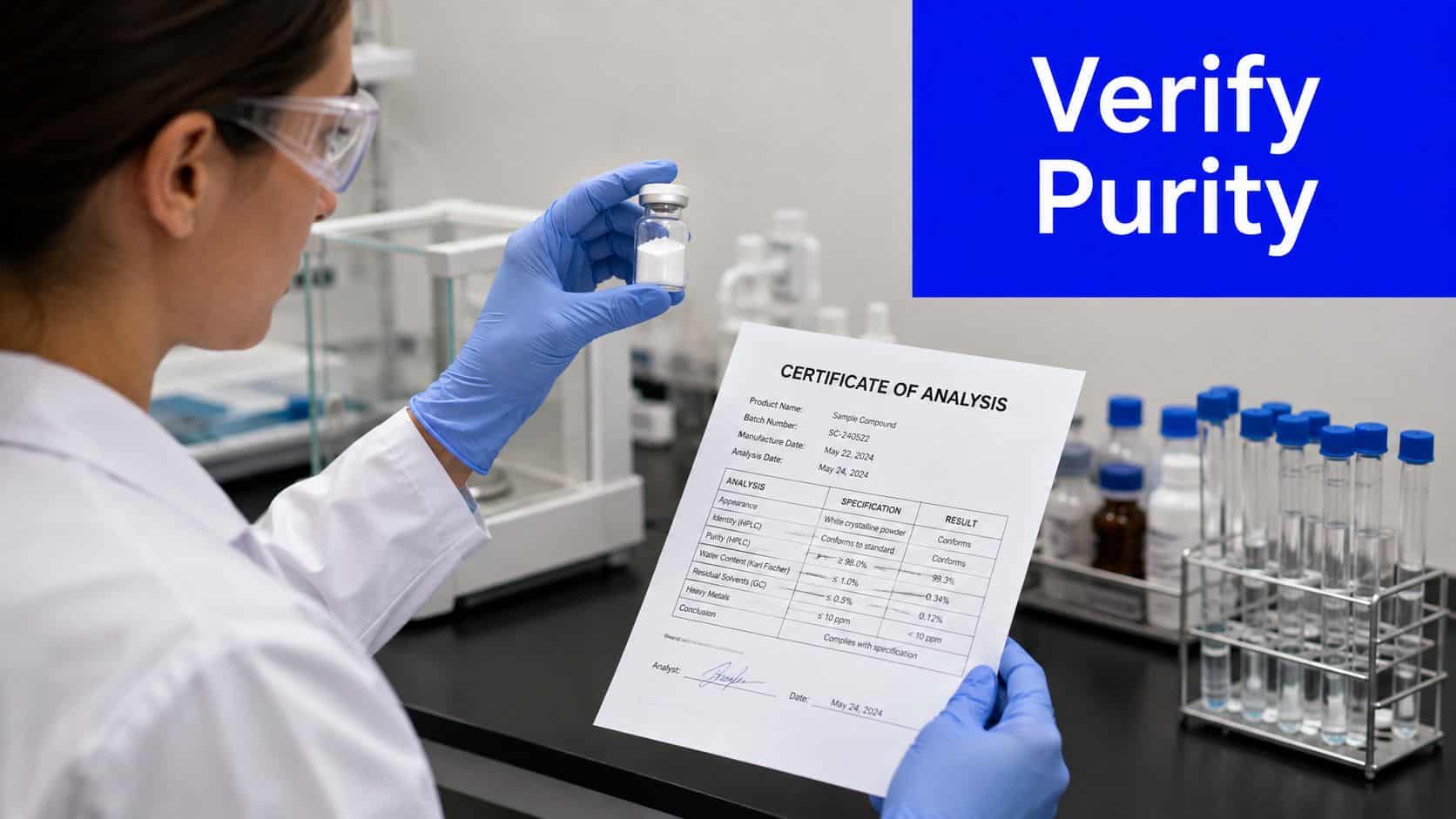
For laboratory, analytical, or preclinical work, judge the documentation rather than the label “research grade.” Useful checks include:
Peptide Warehouse USA is one source listing standalone GHK-Cu, a GLOW BLEND containing BPC-157, GHK-Cu, and TB500, and related research compounds. Treat catalog descriptions as product information, then verify the specific batch records relevant to your work.
For controlled laboratory or preclinical research, review the available formulations and documentation at Peptide Warehouse USA. Compare standalone GHK-Cu with the GLOW BLEND according to the experimental question, and request the relevant batch records before purchasing.