No products in the cart.


You're probably here because someone on your team said, “Find a reliable GHK-Cu supplier,” and the search results all look the same. Every listing says “high purity,” every seller claims premium quality, and very few explain how to tell whether the material is the copper complex you need for research.
That's the problem with searching for GHK Cu peptide for sale. A peptide can look clean on paper and still fail the one test that matters for this compound: proving the copper is chelated. If procurement misses that point, your assay may be built on the wrong material from day one.
This guide takes the buyer's view. It focuses on what a new procurement officer or lab coordinator needs to verify before placing an order, how to read a COA without guessing, how to spot weak documentation, and how to preserve sample integrity after receipt.
Buying research peptides isn't hard. Buying the right research peptide is where teams get into trouble.
With GHK-Cu, most purchasing mistakes happen because buyers stop at the purity percentage. They see a high HPLC value, assume the material is correct, and move on. For many compounds that might be a reasonable first screen. For GHK Cu peptide for sale, it's not enough.
A procurement workflow needs to answer four separate questions:
That's why strong peptide procurement looks more like reagent qualification than ordinary online shopping. The best buyers don't ask, “Is this vendor popular?” They ask, “Can this vendor prove chemical identity in a way my lab can defend?”
Practical rule: If a seller talks at length about purity but says almost nothing about copper confirmation, slow the process down.
That single pause can save weeks of rework.
A bad batch doesn't just waste budget. It can distort cell response, confuse repeatability, and force the team to question otherwise sound experimental design. Procurement officers often think their role ends at price, lead time, and vendor setup. In peptide work, your role also includes protecting downstream data quality.
A new batch arrives, the label says GHK-Cu, and the paperwork looks tidy at a glance. If the material is plain GHK, partially chelated peptide, or a weakly documented copper mixture, the error will not stay in receiving. It will show up later as unstable assay behavior, poor repeatability, and arguments over whether the biology or the input material failed.
GHK-Cu is the copper complex of the tripeptide glycyl-L-histidyl-L-lysine. Researchers study the copper-bound form because the metal is part of the chemical identity being tested, not an optional add-on. That distinction matters in procurement. A bottle can carry the right name and still fail to represent the molecule your protocol assumes.
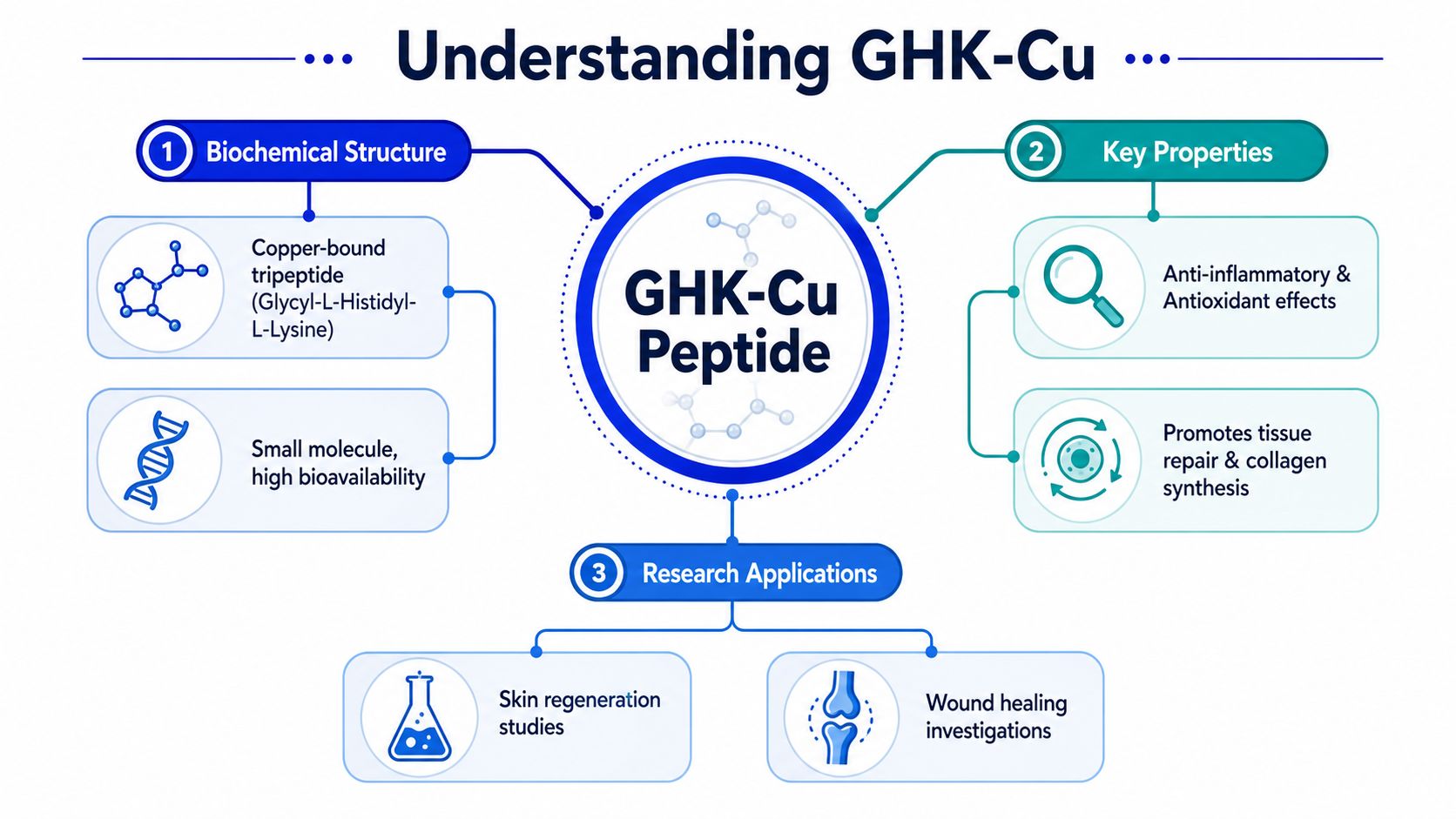
In laboratory work, GHK-Cu is usually discussed as a signaling-active peptide complex with broad relevance to tissue response, remodeling, and cell behavior. Researchers encounter it in studies involving skin biology, fibroblast activity, and repair-related pathways. That broad interest is exactly why buyers need a clean understanding of what they are ordering. A widely studied compound attracts both serious suppliers and sellers who copy specifications without proving the batch in hand.
A useful comparison is a calibrated reference standard versus a bottle with a familiar label. The label may be correct. The experiment only cares whether the contents are correct.
That is why basic molecular literacy matters for procurement officers. You do not need to become the assay scientist. You do need to know which parts of the product definition are fixed and which shortcuts in vendor documentation should trigger questions.
Confusion usually starts with the naming. GHK refers to the peptide sequence alone. GHK-Cu refers to that same sequence coordinated with copper. In research purchasing, those are different materials with different implications for identity testing.
The copper is not a marketing detail. It affects mass, chemical behavior, and how the compound should be verified. If a supplier sells "GHK-Cu" but only demonstrates peptide purity, your lab still does not know whether the peptide is properly copper-bound. That gap is one of the most common failure points for non-expert buyers.
This is why experienced labs treat GHK-Cu more like a metal-peptide complex than a simple peptide SKU. The right question is not only "how pure is it?" The right question is "what evidence shows that this batch contains the intended copper-chelated form?"
These reference details help you screen listings and spot obvious inconsistencies before a quote ever reaches approval:
| Item | Verified detail |
|---|---|
| Chemical identity | Copper Tripeptide-1 |
| Formula | C₁₄H₂₂N₆O₄Cu |
| Molecular weight | 401.91 Da |
| Half-life | Approximately 105 minutes |
| Cell culture concentration range noted in research | 10⁻⁷ to 10⁻⁹ M |
Use that table the way a receiving team uses a packing spec. It is a first-pass check, not final proof. If a product page lists a different molecular weight, omits copper from the formula, or mixes the names GHK and GHK-Cu without explanation, you are likely looking at copied or low-discipline documentation.
One caution for new buyers. A correct formula on a webpage does not confirm correct chelation in the vial. It only tells you the seller knows the expected answer. Research integrity depends on batch-specific analytical proof, which is why fake or decorative COAs cause so many downstream problems.
Buyers protect data quality when they verify the copper complex itself, not just the peptide name on the label.
Your receiving team has a vial labeled GHK-Cu, a polished COA PDF, and a project timeline that leaves no room for batch failure. The risk starts when procurement treats that PDF as a formality instead of a test record. For this material, the COA has to answer a narrower and more important question. Does this batch contain the copper-chelated peptide your study expects, or only documentation that looks convincing at first glance?
A Certificate of Analysis, or COA, should verify batch-specific purity, identity, and copper association. For GHK-Cu, those three checks work together. HPLC can show a dominant peak. Mass spectrometry can help confirm the expected molecular species. A copper assay helps establish that the peptide is not being sold as a copper complex on name alone.
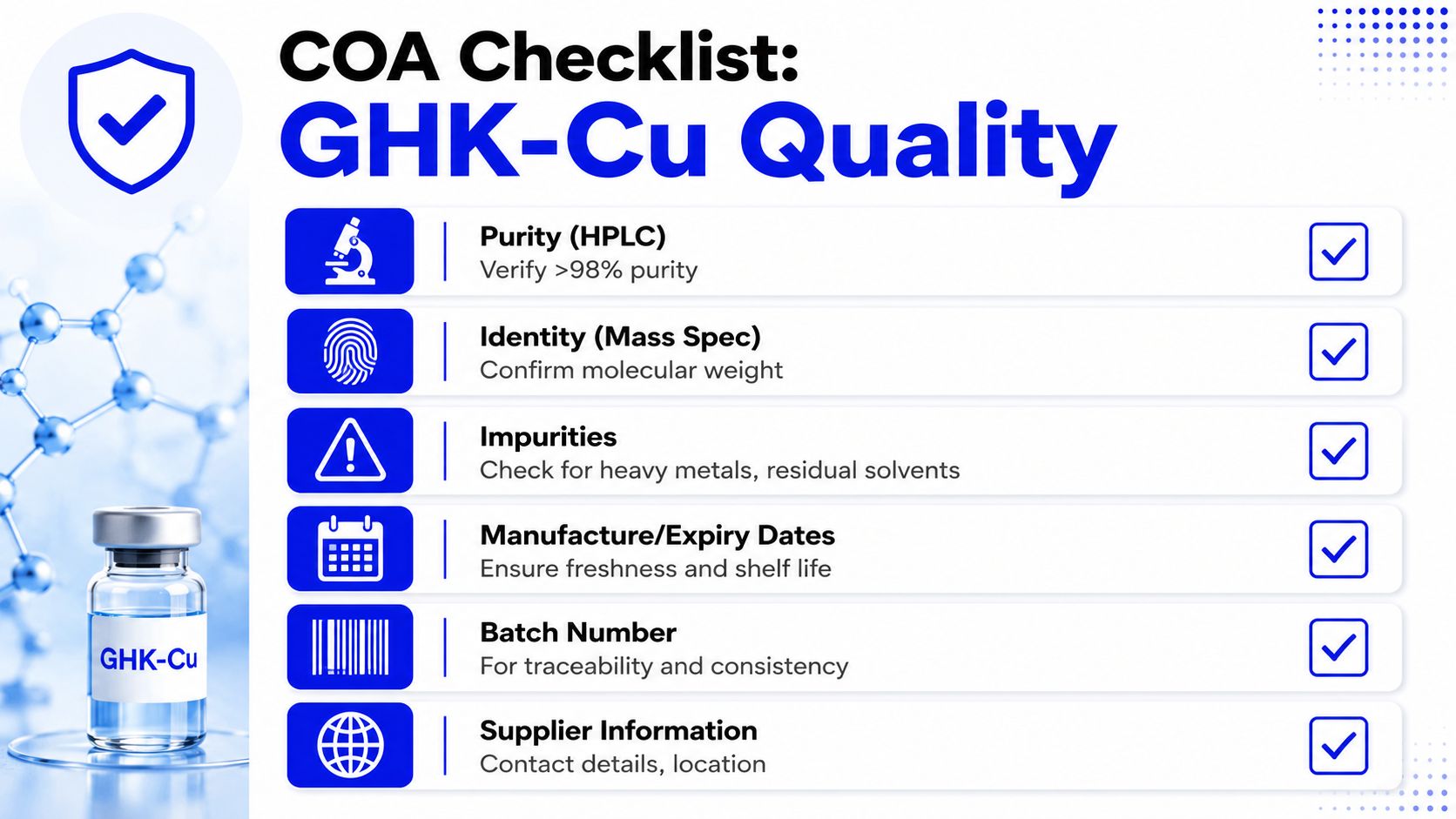
A useful COA for research-grade GHK-Cu should clearly report peptide purity by HPLC, molecular weight confirmation by ESI-MS or MALDI-TOF, and copper content testing by ICP-MS or AAS. Sequence-level checks also matter. Researchers should verify the expected Gly:His:Lys composition, as outlined in this analytical verification guide for GHK-Cu research samples.
Read those tests the way a quality unit reads a chain-of-custody file. No single page gives the full answer. The record becomes persuasive only when the methods, values, and batch identifiers line up across the packet.
HPLC is a separation tool. It estimates how much of the sample appears as the main component compared with smaller impurity peaks.
That is useful, but limited.
A high purity percentage does not prove the copper-chelated form is present. A clean chromatogram can still describe the wrong material, degraded material, or copper-free GHK. One source discussing cell culture and animal model sourcing notes that buyers often look for very high HPLC purity alongside mass confirmation, according to Palmetto Peptides on GHK-Cu purity testing.
For procurement, the practical check is simple. Ask for the chromatogram, the integration table, and enough method detail to see that the result came from an actual run rather than a copied summary line.
Mass spec should report a measured value, not a vague statement such as “identity passed.” That distinction matters because copied COAs often keep the word “passed” and remove the number that could be checked.
For a new buyer, mass spec works like a badge scan at controlled entry. The label on the badge is helpful. The scan confirms who came through the door. If the supplier cannot provide the observed mass for the batch, you do not have identity confirmation in a form your lab can audit.
This is also one of the easiest ways to spot decorative documentation. Fake COAs often include a table of tests but no spectra, no measured mass, and no analyst signoff tied to the batch.
This is the step many non-specialist buyers miss. A peptide can be pure and still fail the research need if the copper chelation is absent, incomplete, or unstable.
Some suppliers also use UV-Vis data to support copper-complex verification, while others rely on elemental copper assays and mass confirmation. The method matters less than the logic connecting the methods. The vendor should be able to explain how the reported copper result supports the claimed complex for that batch, and how the batch was distinguished from copper-free GHK or a simple post-mix of peptide and copper salt.
If the answer is unclear, treat that as a procurement risk, not a technical footnote.
Weak documentation usually looks polished. Its problem is not formatting. Its problem is missing accountability.
Check for these warning signs:
A real COA should make challenge easier. It should give your QC reviewer enough detail to ask hard questions and get clear answers.
Supplier controls around document review matter here too. Procurement teams that standardize how COAs are checked, approved, and escalated usually catch these issues earlier. If your group is formalizing that process, this legal guide for vendor management is a useful reference for building cleaner review practices and accountability.
Some manufacturers publish tighter release frameworks that include retention-time matching, microbial limits, endotoxin thresholds, and other batch controls, according to Peptide Forge manufacturing criteria for GHK-Cu. Those details do not replace identity and copper verification. They show what disciplined documentation looks like. For GHK-Cu, that level of discipline is what protects research integrity.
A strong COA matters. A trustworthy supplier matters just as much.
Anyone can upload a PDF. Procurement officers need to decide whether the vendor behind that PDF operates with enough discipline to support repeat ordering, batch traceability, and technical follow-up when something doesn't line up.
The biggest sourcing mistake with GHK-Cu is assuming purity alone proves suitability. It doesn't.
A buyer's guide on chelation integrity points out that most buyers focus on HPLC purity while ignoring the molecular-weight confirmation needed to prove the copper complex is present. It states that mass spectrometry should confirm a molecular weight of about 403.93 Da, not about 340 Da for copper-free GHK, as noted in this GHK-Cu buyer's guide on copper chelation integrity.
That single distinction changes the whole purchasing decision. A supplier who can't explain it probably isn't screening inventory at the level your lab needs.
Use the vendor review process the same way legal and compliance teams review higher-risk vendors in other categories. If your institution needs a general framework for that process, this legal guide for vendor management is useful because it reinforces documentation, accountability, and clear escalation paths.
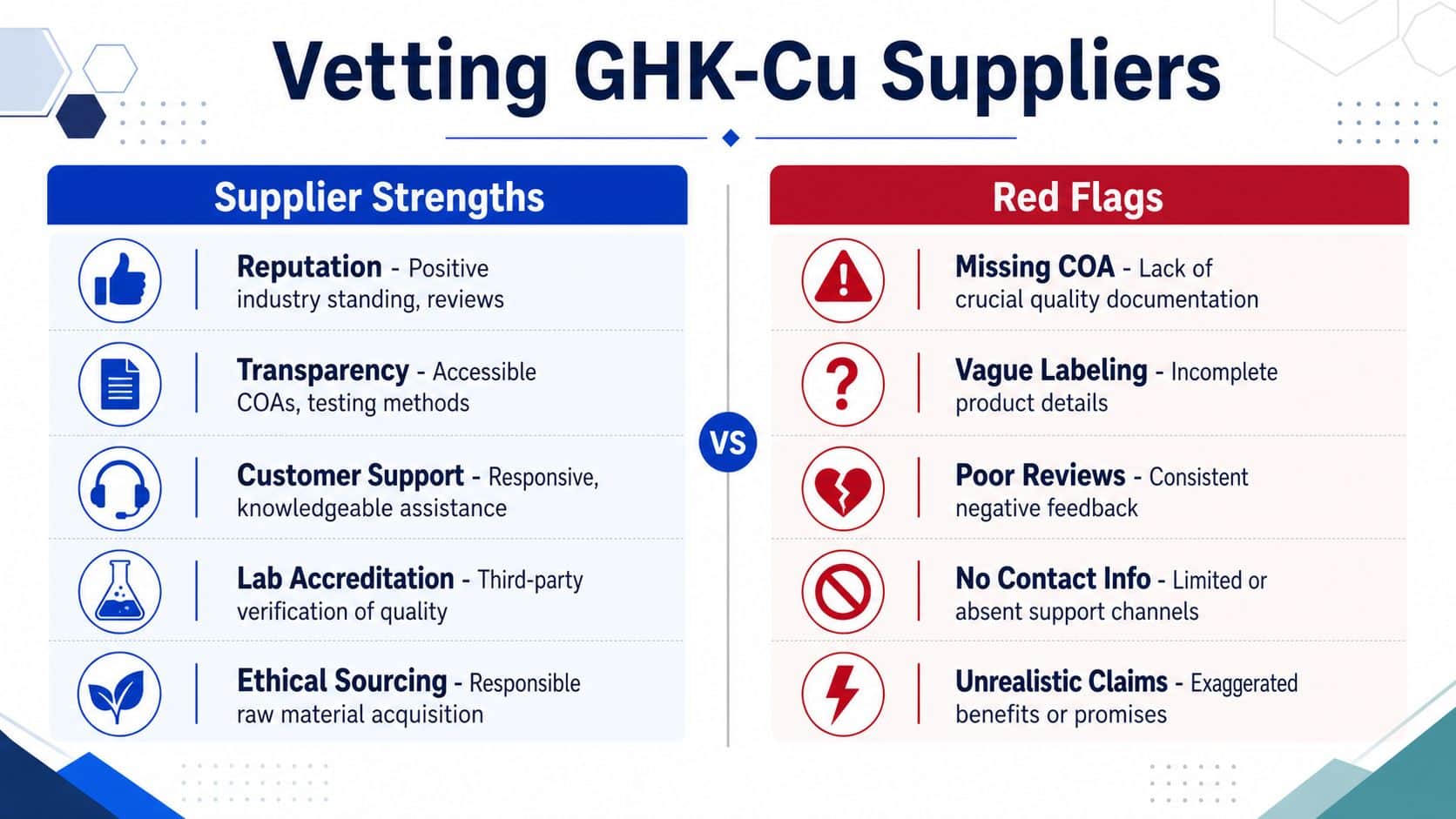
For GHK-Cu specifically, screen suppliers against these criteria:
A quick qualification call often tells you more than the marketing copy. Ask one technical question that can't be answered with a script. For example: “How do you confirm this batch is copper-chelated rather than free GHK?” A real supplier will answer with test methods. A weak one will answer with adjectives.
| Red flag | Why it matters |
|---|---|
| Only purity is discussed | The vendor may not understand GHK-Cu's key identity risk |
| COA lacks batch specificity | You can't tie the document to the material received |
| Support avoids technical questions | Procurement may be dealing with a reseller, not a controlled supply chain |
| Claims feel inflated | Exaggerated promises often correlate with weak quality systems |
If a supplier can't defend the batch before purchase, don't expect better answers after payment.
A common receiving problem starts with a vial that looks polished, ships on time, and even includes a COA. Then the label reads more like a cosmetic product than a research reagent. That is not a branding issue. It is a control failure that can complicate receiving, inventory records, internal approval, and downstream audit trails.
For procurement, legal status and technical quality are separate checks. A batch can appear chemically acceptable and still be packaged or marketed in a way that creates avoidable compliance risk. GHK-Cu sold for laboratory work should be labeled and documented as Research Use Only, with the same discipline you would expect for any other controlled research reagent.
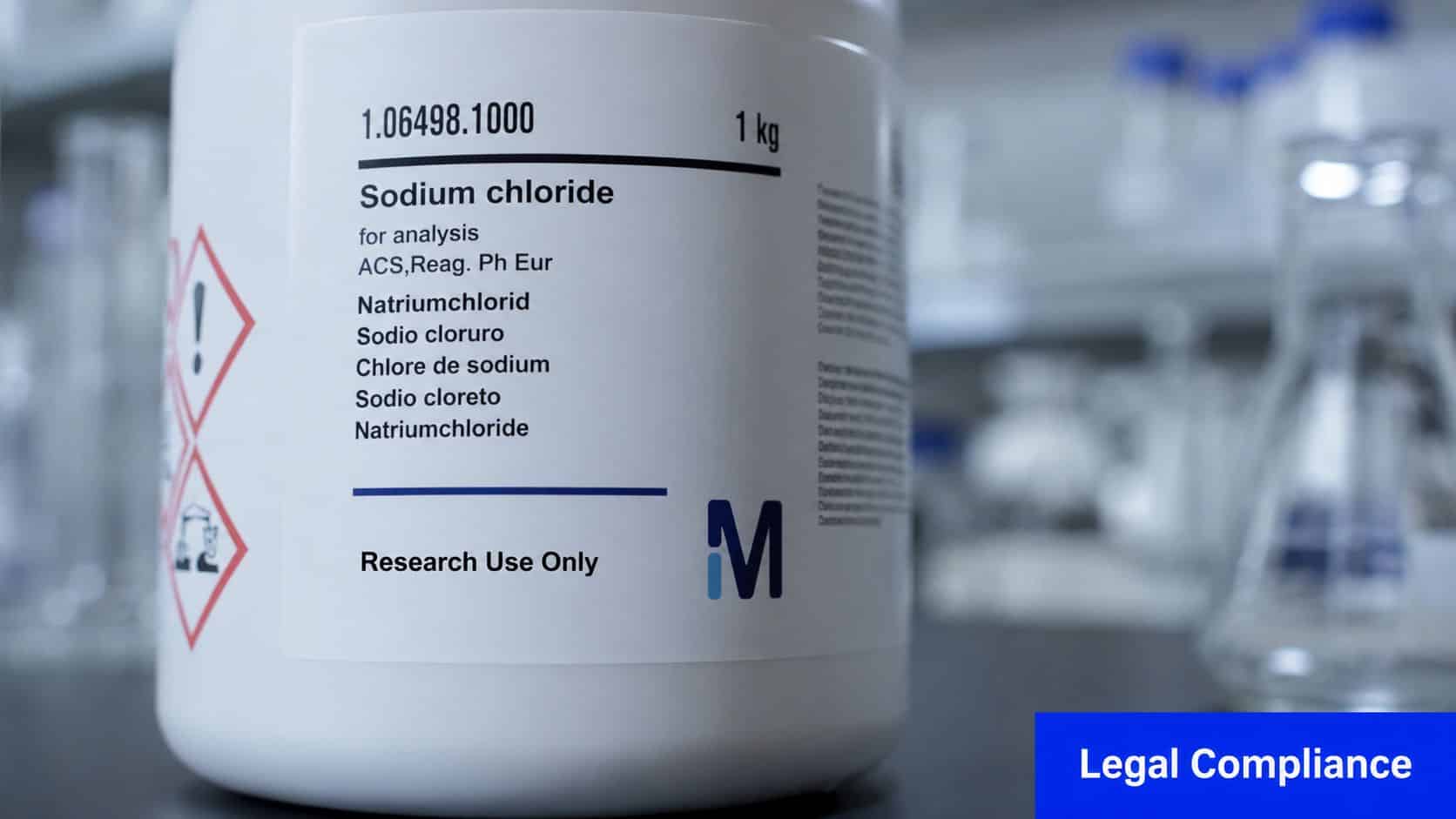
Research Use Only is a boundary statement. It defines how the product is presented, what claims can appear around it, and how your institution should classify it internally. A supplier that mixes laboratory labeling with consumer-style benefit claims is showing you that its quality system may be weak in places that are harder to see.
That matters because labeling is part of traceability. If the vial label, website listing, packing slip, and safety documentation do not match, your team cannot document the material cleanly at intake. In a well-run lab, the label works like the cover page of a batch record. It should identify the material clearly, tie it to the right lot, and tell staff how to store it before anyone opens the vial.
As noted earlier, research-grade GHK-Cu should be labeled with the Research Use Only statement, a batch identifier, storage instructions, and other details that support lot control and inspection readiness.
Treat the label check as an identity control, not clerical cleanup. Before the vial is released into stock, compare the physical label to the purchase record and the COA line by line.
Confirm these items:
A weak label often predicts other problems. If the supplier is casual about lot identity, it may also be casual about batch release controls. If the label includes dosing language, human-use framing, or promotional claims, procurement should pause the order and escalate for review.
New buyers often focus on purity and overlook presentation. That is a mistake with GHK-Cu, because fake or low-discipline suppliers frequently copy technical terms while missing the basic rules of reagent labeling.
Watch for these warning signs:
| Labeling issue | Why procurement should care |
|---|---|
| No clear RUO statement | The product may be marketed outside a research-only framework |
| Lot number missing or generic | You cannot tie the vial to a batch-specific COA |
| Consumer-style claims on the label or product page | The supplier may be operating with poor regulatory discipline |
| Storage language is vague | Receiving staff may mishandle the material before it reaches the lab |
| Product name does not clearly identify GHK-Cu | Identity confusion increases the risk of stocking the wrong material |
One more practical point. Labeling cannot prove that the copper is authentically chelated, and it cannot rescue a fake COA. It does, however, tell you whether the supplier understands basic reagent control. In procurement, that distinction matters. Good labels do not guarantee a good batch, but poor labels are often an early warning that deeper verification is needed.
A verified peptide can still fail in practice if the storage plan is poor. That's why receiving, inventory, and bench handling need just as much attention as vendor qualification.
GHK-Cu doesn't have one storage rule. It has two, depending on whether the material is still lyophilized or already reconstituted.
According to Palmetto Peptides storage guidance for GHK-Cu, reconstituted solutions must be stored at 2 to 8°C and used within 30 days, while lyophilized powder remains stable for 12 to 24 months when kept at -20°C, sealed, and protected from light. The same source states that the standard reconstitution solvent for multi-day use is bacteriostatic water containing 0.9% benzyl alcohol.
That split matters operationally. Procurement should align vial size with expected lab usage so the team doesn't reconstitute more material than it can use within the recommended window.
Storage is only part of the picture. Daily handling also changes outcomes.
Use these habits in the lab:
Good procurement ends when the peptide arrives. Good research procurement ends when the sample performs as documented.
Buying GHK-Cu gets easier when the lab standardizes its questions. Most ordering delays come from preventable gaps in documentation or confusion about what should be confirmed before approval.
Ask for the batch-specific COA, the analytical methods used, the lot number format, the SDS, and a clear explanation of how copper chelation is verified. If the vendor can't answer those points cleanly, don't move the file forward.
You should also ask whether the documentation is tied to the exact lot being shipped. Generic example COAs are useful for format review, but they aren't enough for final approval.
Treat shipping as part of quality control, not just logistics. The receiving team should know whether the product is shipping as lyophilized powder or in reconstituted form, because storage actions begin the moment it arrives.
A useful receiving checklist includes:
Academic labs, biotech teams, and contract research settings usually need more than a shopping cart checkout. They may need quotes, tax documentation, account setup, purchasing approval, and support for repeat orders.
The practical questions to resolve early are:
| Procurement issue | What to confirm |
|---|---|
| Bulk ordering | Whether the supplier can support repeat lot documentation and inventory consistency |
| Payment workflow | Whether institutional payment methods and account records are supported |
| Support access | Whether procurement can reach someone who understands technical documentation |
| Returns or discrepancies | How deviations are handled if the received lot doesn't match paperwork |
If your lab is comparing options, focus less on flashy product copy and more on repeatability. Good peptide sourcing isn't about finding the loudest listing for GHK Cu peptide for sale. It's about finding a vendor whose documentation can survive internal review, receiving inspection, and scientific scrutiny.
If you want a U.S.-based source built around batch testing, traceability, and research-only compliance, learn more at Peptide Warehouse USA. Their catalog is designed for laboratory, analytical, and preclinical buyers who need clear documentation, fast fulfillment, and a procurement process that supports serious research. Explore options, review available product details, and choose a supplier that treats quality verification as part of the product, not an afterthought.