No products in the cart.


A review of GHK-Cu research identified 11 human studies, but most didn't directly test the peptide, and none established the safety or efficacy of systemic, subcutaneous, or intramuscular GHK-Cu injection. That gap reframes the central question for anyone evaluating a GHK-Cu peptide injection. The problem is not locating a commonly circulated dosing schedule. The gap is that human dose, pharmacokinetics, and copper-related safety thresholds remain unvalidated. The evidence review makes a high-purity certificate of analysis relevant to procurement, though it cannot substitute for the human data that would establish whether a product is safe to inject.
GHK-Cu carries a substantial research history in skin and wound repair, yet topical studies, cell experiments, and animal models do not transfer to injected use in people. The practical discipline for procurement-side readers is separating what a molecule does in a controlled model from what a supplier's paperwork can establish. A clean assay result addresses identity and purity. It says nothing about whether the dose, route, or copper exposure has been validated in humans.
GHK-Cu is glycyl-L-histidyl-L-lysine, a three-amino-acid peptide that binds copper ions tightly. The peptide supplies the biological context, while the bound metal is part of what distinguishes the complex from an ordinary tripeptide. That copper load is itself a research variable: any injected preparation delivers a metal whose human toxicity threshold by that route has never been established.
Biochemist Loren Pickart isolated GHK-Cu from human albumin in 1973, after observing that it could stimulate older human liver tissue to produce proteins associated with younger tissue. That early observation was a starting point for research, not evidence that injecting the peptide produces an anti-aging effect in people. A review of GHK-Cu's research history describes how later laboratory work examined its activity in connective-tissue processes.
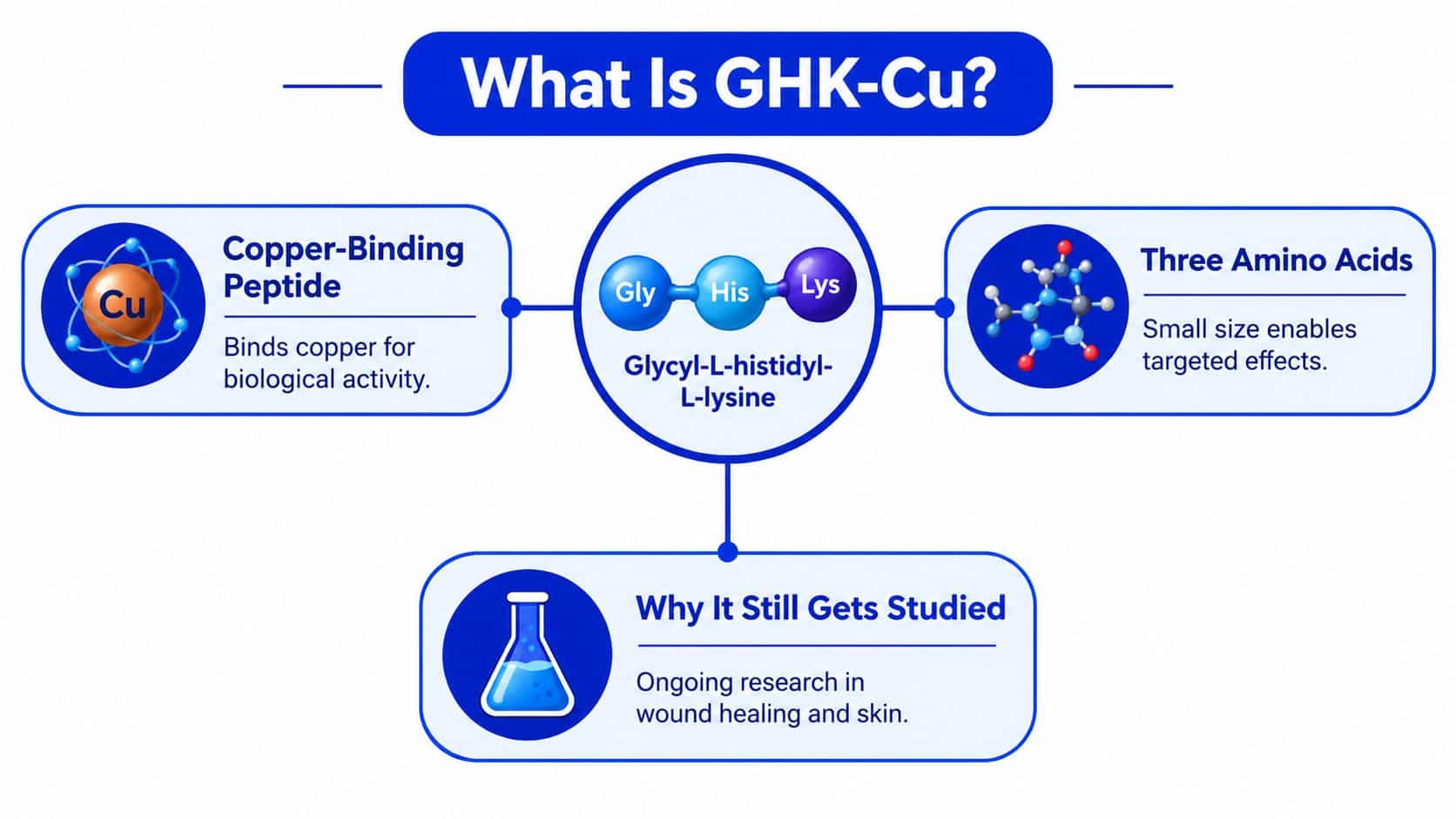
The same historical review describes experiments in which approximately 1–10 nanomolar GHK-Cu stimulated synthesis and breakdown of collagen and glycosaminoglycans, connective-tissue components involved in skin structure and repair. That concentration describes laboratory activity. It is not an injectable dose, a target blood level, or a human treatment recommendation. The review also situates most GHK-Cu research in wound healing and skin regeneration, long before the compound's newer association with injectable protocols.
The useful distinction is between the molecule's biological activity and the evidence for a specific route. GHK-Cu has a long record in topical formulations and animal models. The injectable record in humans is thin, and a tissue response in a controlled model cannot by itself establish injectable safety, dose, or effectiveness.
Animal and mechanistic research offers a plausible explanation for why GHK-Cu attracts interest in wound repair. In an in-vivo wound-chamber model, injected GHK-Cu produced concentration-dependent increases in dry tissue mass, DNA, total protein, collagen, and glycosaminoglycan content. Those endpoints indicate greater cellular activity and extracellular-matrix accumulation at the treated site. They do not show that the same response occurs in human skin after an injection, which is why the cited wound-model research belongs in the preclinical column rather than the clinical one.
A concentration-response curve can confirm that the measured response changed with the amount of compound used inside that model. It cannot identify a safe human dose, because no validated human NOAEL, dose range, or copper-toxicity threshold exists for injected GHK-Cu. The translational bottleneck sits upstream of the dosing question. Without those human thresholds, even a precise animal dose response has nowhere to land clinically, and a clean assay result on a vial does not fill the gap.
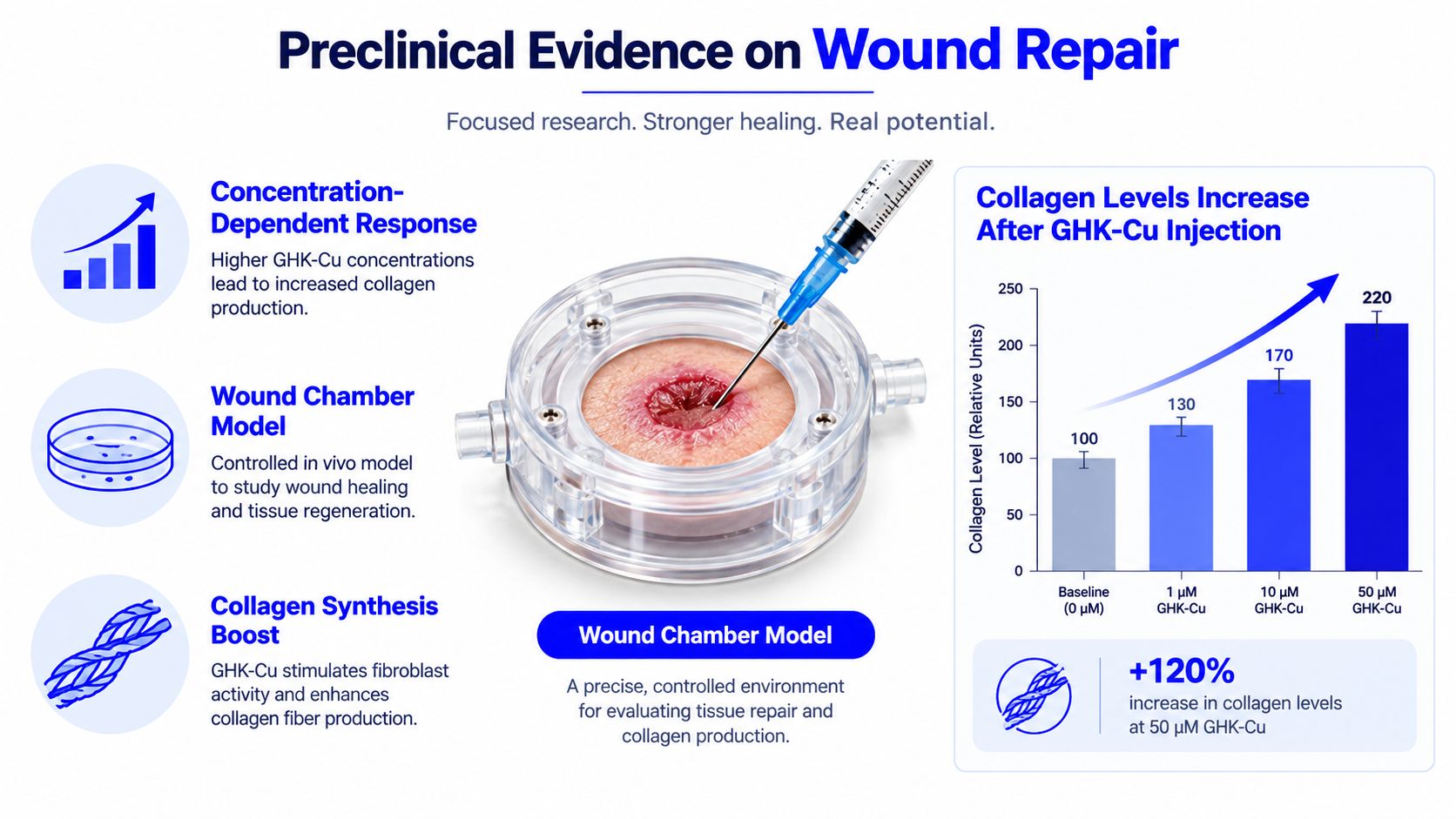
A porcine systemic-wound model used approximately 1.1 mg/kg. That figure belongs to that animal experiment; species differences in absorption, distribution, copper handling, and peptide stability make extrapolation to a human injection schedule unreliable. The same wound-chamber study supports biological plausibility, not human dosing.
For readers comparing repair-related research with consumer-facing discussion, Spa Black's collagen filler guide offers context on collagen-stimulating approaches. It should not be read as evidence that GHK-Cu injections have established human outcomes.
The following overview walks through the wound-chamber methodology behind these endpoints:
The practical reading rule is simple: check whether a claim comes from a cell experiment, an animal wound model, a topical human study, or an injectable human trial. These are not interchangeable evidence categories.
Eleven human studies sounds like a working evidence base until the roles are separated. The evidence review introduced above counted 11 human studies within its defined literature search, 17.2% of included studies. Eight of them used GHK-Cu only as an active comparator. Direct evaluation of the peptide rests on one pilot trial, one split-face study, and one case series.
| Study role | Count | Route studied | What it shows |
|---|---|---|---|
| Human studies identified by the review | 11 | Mixed; largely topical or wound-care research | Human research exists, but the count alone doesn't establish injectable evidence |
| Studies using GHK-Cu as an active comparator | 8 | As reported in the studies | The peptide wasn't the direct subject of evaluation |
| Direct human evidence | One pilot trial, one split-face study, and one case series | Topical or wound-care contexts | Limited direct evaluation without a confirmed injectable standard |
| Peer-reviewed phase II or phase III randomized trials | None identified | No established injectable indication | No advanced randomized trial evidence for injection |
The table compresses a structural problem. Human research on topicals and wound care exists, yet none of it measures what an injection delivers systemically. The 1994 diabetic-ulcer study applied GHK-Cu to the skin rather than administering it subcutaneously or intramuscularly, and the review reported no peer-reviewed phase II or phase III randomized trial, with or without microneedle delivery. As noted earlier, its conclusion is that injectable GHK-Cu remains investigational.
Three pieces of human evidence would change that classification, and all three are absent. There is no published human pharmacokinetic profile defining absorption, distribution, and clearance of the copper complex. There is no dose-finding program and no established NOAEL. There is no defined copper-toxicity threshold for repeated parenteral exposure. Without those anchors, a milligram amount repeated across vendor protocols stays unvalidated no matter how often it circulates.
For procurement teams, this reframes what a COA can certify. Assay purity confirms what is in the vial. It cannot supply the missing human dose, exposure, or toxicity data, so a high purity figure does not by itself justify human injection. The gap is evidence, and current literature has not closed it.
An injectable GHK-Cu product is not a topical peptide in a different package. Parenteral administration introduces systemic copper exposure and places new demands on formulation quality and safety evaluation. The open questions are quantitative: total copper delivered per dose, where the complex distributes, whether repeated exposure accumulates, and how the body clears it.
An assay-purity percentage, by itself, does not settle the safety question. A purity result describes one analytical measurement. It cannot establish sterility, endotoxin burden, stability after reconstitution, peptide aggregation, immune responses to impurities, or how much copper becomes available in the body.
Procurement rule: Treat purity as one quality attribute, not a substitute for route-specific safety evidence.
Route changes the risk model. The technical review identifies burst release, depot residence, local persistence, and systemic copper exposure as important pharmacokinetic variables for injectable formulations, and describes a preclinical hydroxyapatite-microsphere system with release sustained for roughly seven days. That is a delivery-system finding. It does not supply evidence for routine human injection or a recommended duration of exposure, which is why formulation design and human outcomes have to be evaluated separately.
Copper risk needs its own scrutiny. The review on copper-related risk and product quality reports that no validated GHK-Cu-specific human no-observed-adverse-effect level, dermal exposure limit, or labile-copper safety threshold exists. It identifies repeat-dose toxicokinetic studies tracking both peptide and copper, with attention to hepatic, neurological, renal, and tissue copper accumulation, as important research needs. It also discusses theoretical concerns about excessive systemic copper delivery, including disruption of copper homeostasis, oxidative stress, and possible hepatotoxicity. The review does not establish that these outcomes occur with a particular product or dose; it explains why they need testing.
For general context on how injectable products differ from cosmetic services, readers can consult the Luxe Aesthetic Surgery filler page. That information does not supply GHK-Cu-specific clinical evidence or resolve its copper-related uncertainties.
A Certificate of Analysis tells a laboratory what is in a batch of material. For GHK-Cu, that is where its evidentiary value ends. The procurement trap is treating a high assay-purity figure as a safety signal, when purity testing only describes chemical composition. The previous section established that no validated human no-observed-adverse-effect level, exposure limit, or labile-copper threshold exists for this peptide. No certificate can certify around that gap.
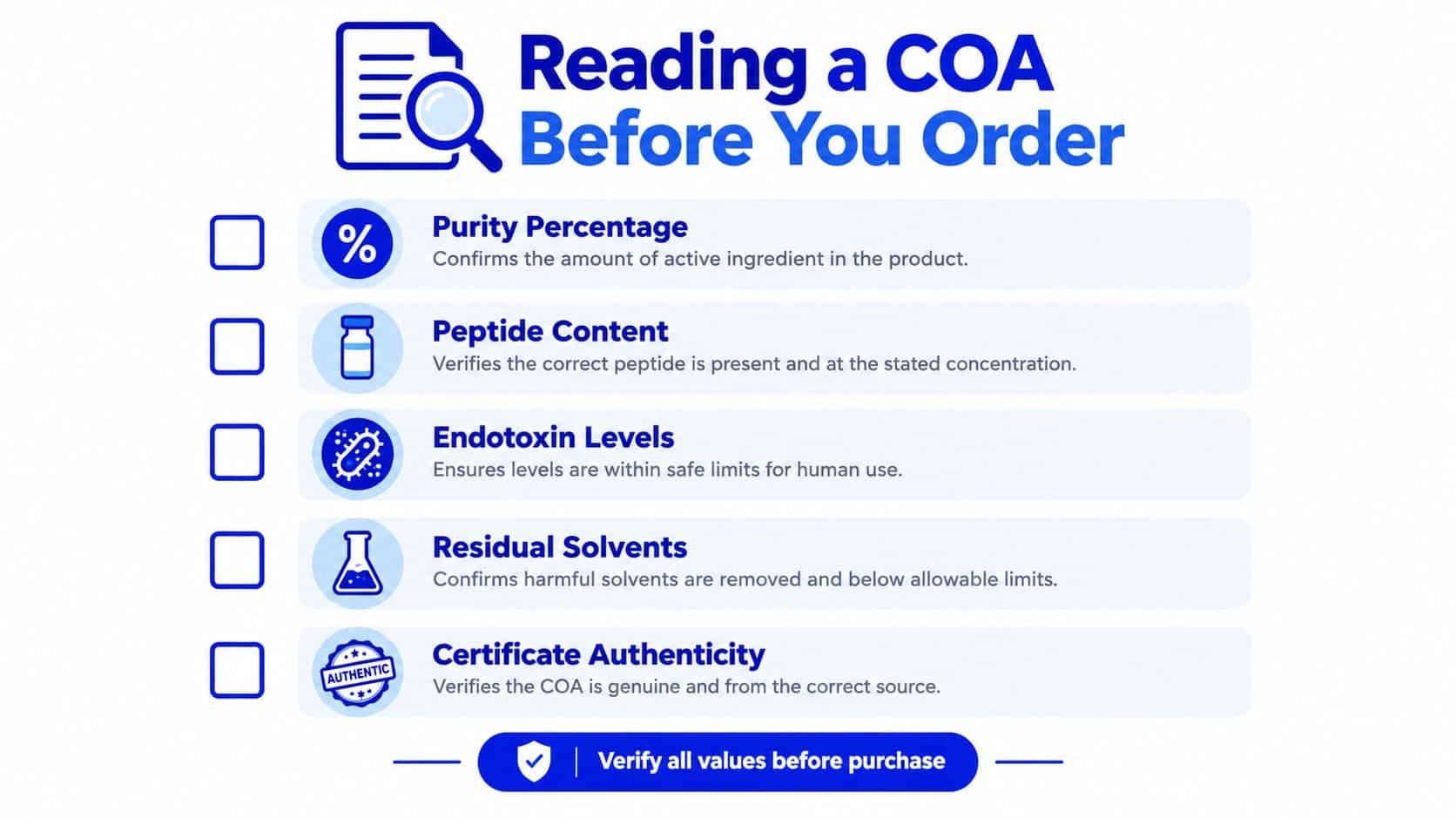
Start with confirmation that the material is the intended peptide. Ask whether the supplier provides identity data using HPLC, mass spectrometry, or both, and whether the report includes an analytical trace, stated methods, and reference information. A purity percentage quoted without that context tells a buyer very little about what was measured.
Then look for the lot number and a clear link between the report and the specific batch being offered. Ask for the chain of custody back to the synthesis batch when available. A document that cannot be tied to the vial in hand has limited use for troubleshooting or comparing results across studies.
Residual solvent and counter-ion information adds context about composition. For research involving injectable formulations, reviews and technical analyses emphasize lot-specific identity and purity testing plus microbial and endotoxin documentation. The quality-control review cited in the previous section also cautions that a high assay-purity result cannot establish safety, sterility, pharmacokinetics, or clinical effectiveness.
Use this checklist when reviewing a supplier's documentation:
If a supplier cannot provide a requested document, treat that as an information gap rather than proof of a defect, and ask again or look elsewhere. The subtler failure runs the other direction: letting a percentage figure answer questions it was never designed to answer.
Handling a lyophilized peptide is a laboratory workflow, not a shortcut to clinical preparation. The supplied evidence doesn't establish a validated GHK-Cu storage temperature, reconstitution recipe, or human-use preparation method. Laboratories should therefore follow the product-specific handling documentation and their own approved procedures, rather than applying an unsupported universal protocol.
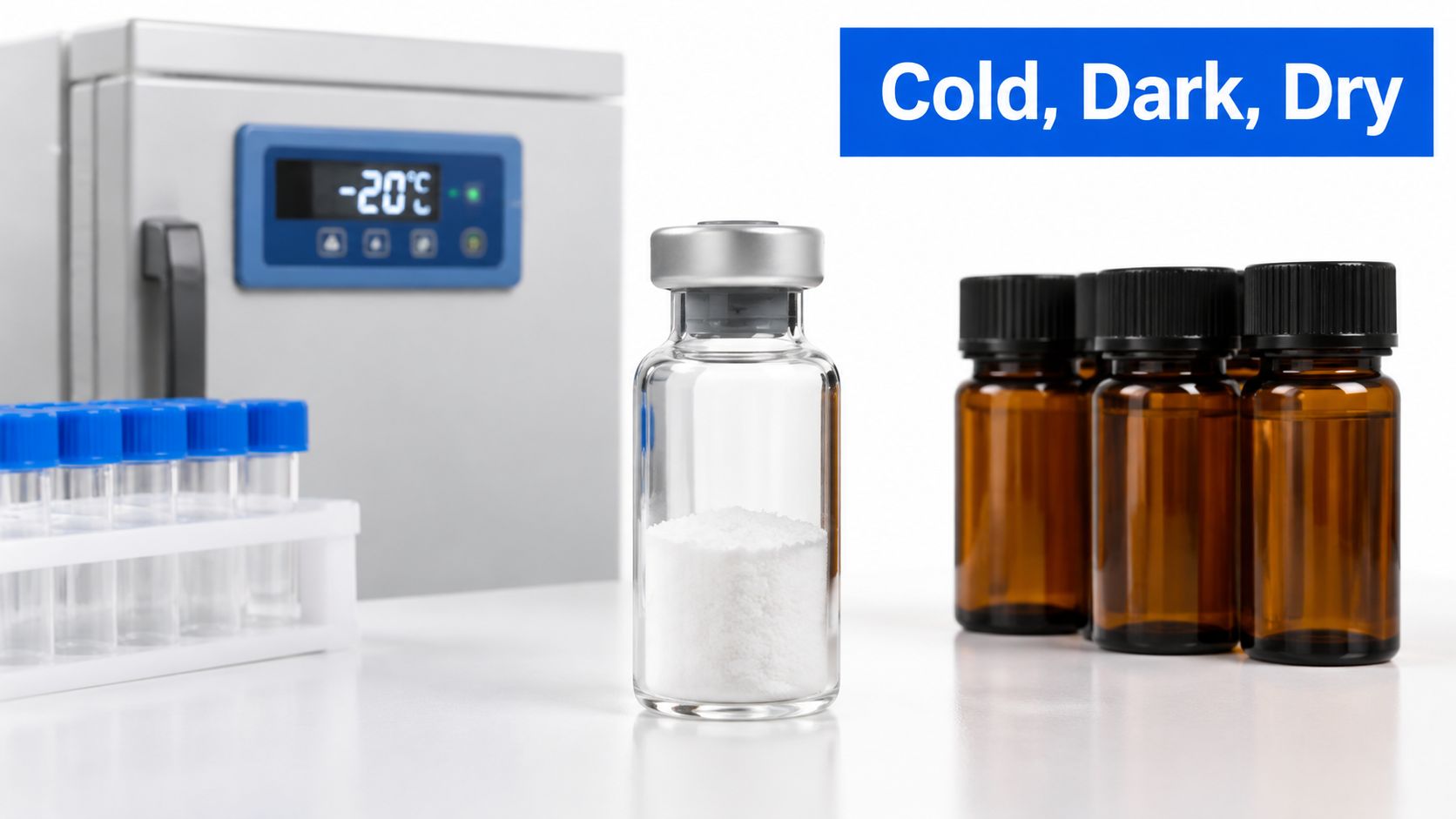
For analytical or preclinical work, protect material from conditions that could undermine reproducibility. Record the lot, storage conditions, date opened, solvent or buffer used, and any handling deviations in the lab record. When an experiment requires reconstitution, use the protocol and compatible materials established for that study, and document concentration and preparation details so another researcher can interpret the result.
Repeated opening and handling can create avoidable variability. A lab may choose to plan aliquots and limit repeated freeze-thaw exposure where the validated study procedure supports that approach, but the precise storage conditions and stability period must come from product-specific data. Don't infer stability from appearance alone.
Research-grade storage and clinical preparation are different standards. A COA, even one with identity and purity data, doesn't certify that a product is sterile or suitable for administration to a person. A research workflow can preserve analytical consistency; it can't substitute for clinical manufacturing controls, human pharmacokinetic studies, or medical oversight. Keep that boundary explicit in lab records, purchasing decisions, and any communication about results.
A catalog comparison is useful only if it distinguishes compounds by evidence and route, not by promises. GHK-Cu, BPC-157, and TB-500 may appear in similar research settings, but a shared “repair” label doesn't mean they have the same mechanism, evidence base, or quality requirements. The available evidence in this article supports specific statements about GHK-Cu; it doesn't establish a head-to-head comparison of those compounds.
| Comparison point | GHK-Cu | BPC-157 and TB-500 |
|---|---|---|
| Research framing | Copper-binding tripeptide studied in tissue repair and skin-related research | Often grouped in research discussions around repair, but claims need compound-specific support |
| Route distinction | Human evidence has focused mainly on topical applications and wound care; injectable evidence remains limited | Don't assume a route or outcome for one compound applies to another |
| Evidence question | Separate topical, animal, and human injection findings | Check the specific model, route, and endpoint for each compound |
| Procurement question | Verify identity, purity, lot traceability, microbial and endotoxin documentation | Apply the same compound- and route-specific documentation discipline |
Topical GHK-Cu is a useful comparator because it highlights the importance of route. A topical human result may answer a question about a product used on skin; it doesn't demonstrate that an injection has the same exposure or outcome. By the same logic, animal repair findings shouldn't be ranked as though they were controlled human injection studies.
For a broader discussion of injury-recovery approaches, Dr. Elizabeth Yurth's injury recovery tips can provide general context. It shouldn't replace compound-specific evidence review or be read as validation of a GHK-Cu injection protocol.
A procurement team should compare records, not marketing categories. For every compound, ask what the cited evidence studied, whether the product documentation matches the lot, and whether the route being considered has its own safety and pharmacokinetic support.
GHK-Cu is a biologically active research peptide with a history of mechanistic, topical, and animal work involving connective tissue and wound repair. Its association with injection has moved faster than the human evidence supporting injectable use. That distinction is central: biological plausibility can justify further study, but it can't establish a human dose, an acceptable copper exposure, or clinical effectiveness.
The unanswered research questions are concrete. Human studies would need to characterize peptide and copper exposure, determine how the body handles repeated administration, assess route-specific safety, and evaluate outcomes in well-designed controlled trials. Until those gaps are addressed, a commonly shared schedule and a strong purity result remain insufficient grounds for concluding that injection is validated.
Researchers and procurement teams can act now by scoping work to appropriate topical or preclinical questions, checking that lot documentation is traceable, and confirming that microbial and endotoxin records and product-specific storage information are available. These steps improve research accountability; they don't make a product suitable for human use.
The practical conclusion: GHK-Cu's research promise and injectable readiness are separate questions. Evaluate the evidence and documentation for the route and purpose actually under consideration.
Peptide Warehouse USA offers US-manufactured research peptides, including GHK-Cu, with lot-specific documentation such as COAs, microbial and endotoxin reports, and stated purity levels. Explore the documentation and research-use catalog at Peptide Warehouse USA, and confirm that any product is intended for laboratory, analytical, or preclinical research only, not human consumption.