No products in the cart.



GHK-Cu sits at an unusual intersection of basic biochemistry, regenerative medicine, and practical lab procurement. One of the clearest signals that it matters biologically is the age-related decline in circulating levels, from about 200 ng/ml at age 20 to 80 ng/ml by age 60, a drop of roughly 60% according to the literature summarized in the source material (Copper peptide GHK-Cu). For anyone working in GHK Cu peptide research, that decline is more than an interesting number. It's part of why the peptide keeps reappearing in studies of tissue repair, skin remodeling, and broader regenerative signaling.
The problem is that GHK-Cu is often discussed too loosely. In the lab, the questions that matter are sharper. What is it, what does it reliably do, what remains preclinical, and what kind of material do you need if you want your results to hold up under scrutiny?
GHK-Cu is a naturally occurring human tripeptide, glycyl-L-histidyl-L-lysine, complexed with copper(II). That identity matters in practice, because the literature treats it as a biologically active copper peptide, not a decorative formulation ingredient. It was first isolated from human plasma in 1973 by Loren Pickart, and later reviews place it firmly in the regenerative biology literature, where it has remained a subject of serious study rather than a temporary trend (GHK-Cu historical review).
Its long presence in the field gives researchers a useful advantage. There has been enough time to compare models, check reproducibility, and see where the signal is real. One review reports that GHK was found to up- or downregulate at least 4,000 genes in the human genome, and another analysis found that 31.2% of human genes showed a change of 50% or more. Those findings are why experienced investigators treat GHK-Cu as a systems-level signaling molecule, while still keeping a close eye on assay context and material quality. The same review also emphasizes how broad the transcriptional response can be, which is exactly why sloppy sourcing can distort a study before the first endpoint is measured (GHK-Cu gene expression review).
Practical rule: if a compound can alter gene expression that broadly, the quality of the starting material matters as much as the assay design.
The preclinical record is broad for a peptide of this type. Peer-reviewed reviews describe regenerative effects in skin, lung connective tissue, bone, liver, and stomach lining, with anti-inflammatory, DNA-repair, and proteasome-activating actions reported in the same body of work. A separate analysis in Biomolecules describes skin remodeling, wound healing, regeneration, antioxidant effects, and anti-inflammatory activity in both in vitro and in vivo settings (GHK-Cu regenerative review; Biomolecules review).
For a lab audience, the practical takeaway is straightforward. GHK-Cu should be handled as a biologically active copper-binding peptide that warrants careful model selection, verified sourcing, and conservative interpretation of results. That approach matters whether the readout is transcriptional, histological, or functional, because the literature is broad enough to tempt overinterpretation if the experimental controls are weak.
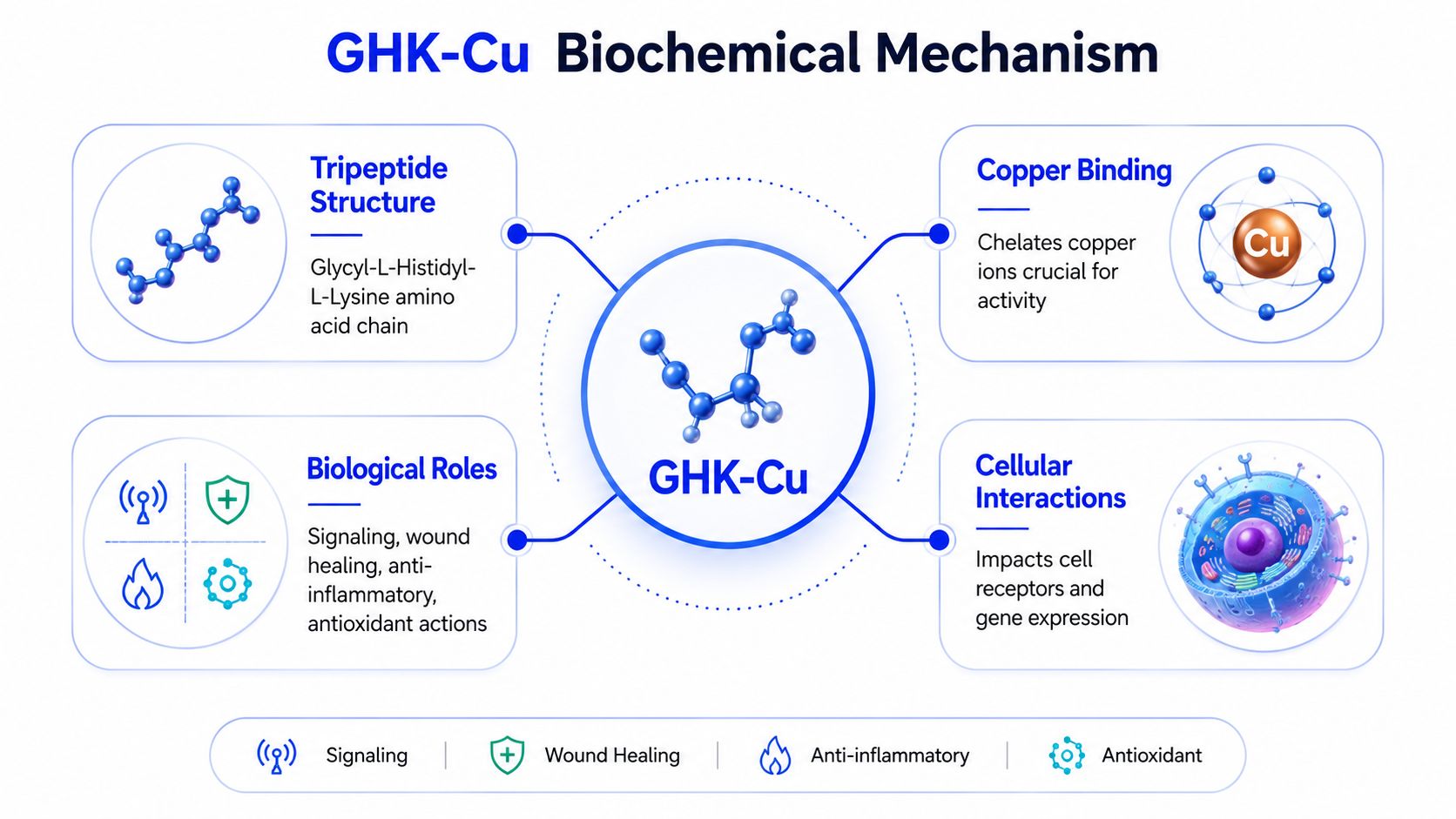
GHK-Cu begins with a short sequence, glycyl-L-histidyl-L-lysine, but the copper-bound form is where the biology becomes more informative. The peptide is not just a passive scaffold. Once it binds copper, it is associated with downstream signaling, tissue-repair activity, and shifts in transcriptional behavior, which is why the complex is treated differently from the free peptide in serious discussions of the literature (Peptides Institute overview).
The copper ion is not a decorative feature. In published work, the complexed form is linked to the peptide's activity, including repair-related signaling and modulation of inflammatory pathways. That distinction matters because GHK and GHK-Cu are often used interchangeably in casual writing, even though they are not interchangeable in a mechanistic setting.
For lab work, the practical issue is handling and state control. If the copper-binding status shifts during storage, reconstitution, or formulation, the material in your tube may no longer match the material described in the protocol. For mechanistic experiments, that can invalidate the interpretation before the assay even starts.
The gene-expression literature is the main reason GHK-Cu has stayed relevant. One major review reports that the peptide can up- or downregulate at least 4,000 genes, and 31.2% of human genes in one analysis changed by 50% or more (GHK-Cu gene expression review). Those figures do not mean every altered transcript has a clear biological consequence. They do show that the peptide can shift cellular behavior far beyond a narrow skin effect.
That pattern matters for study design. GHK-Cu appears to act upstream of multiple repair programs, then alters the transcriptional profile that supports those programs. That makes it relevant for fibroblast work, keratinocyte studies, extracellular matrix research, and injury models, but it also raises the bar for controls, matching, and endpoint selection.
Laboratory insight: broad transcriptional effects are useful only when the assay panel is narrow enough to separate signal from noise.
The biochemical picture also supports a multi-pathway repair role. Reviews describe anti-inflammatory, DNA-repair, and proteasome-activating activity alongside tissue repair (GHK-Cu regenerative review). In practical terms, the peptide is being studied not only for what it builds, but for what it helps cells clear, preserve, and reorganize.
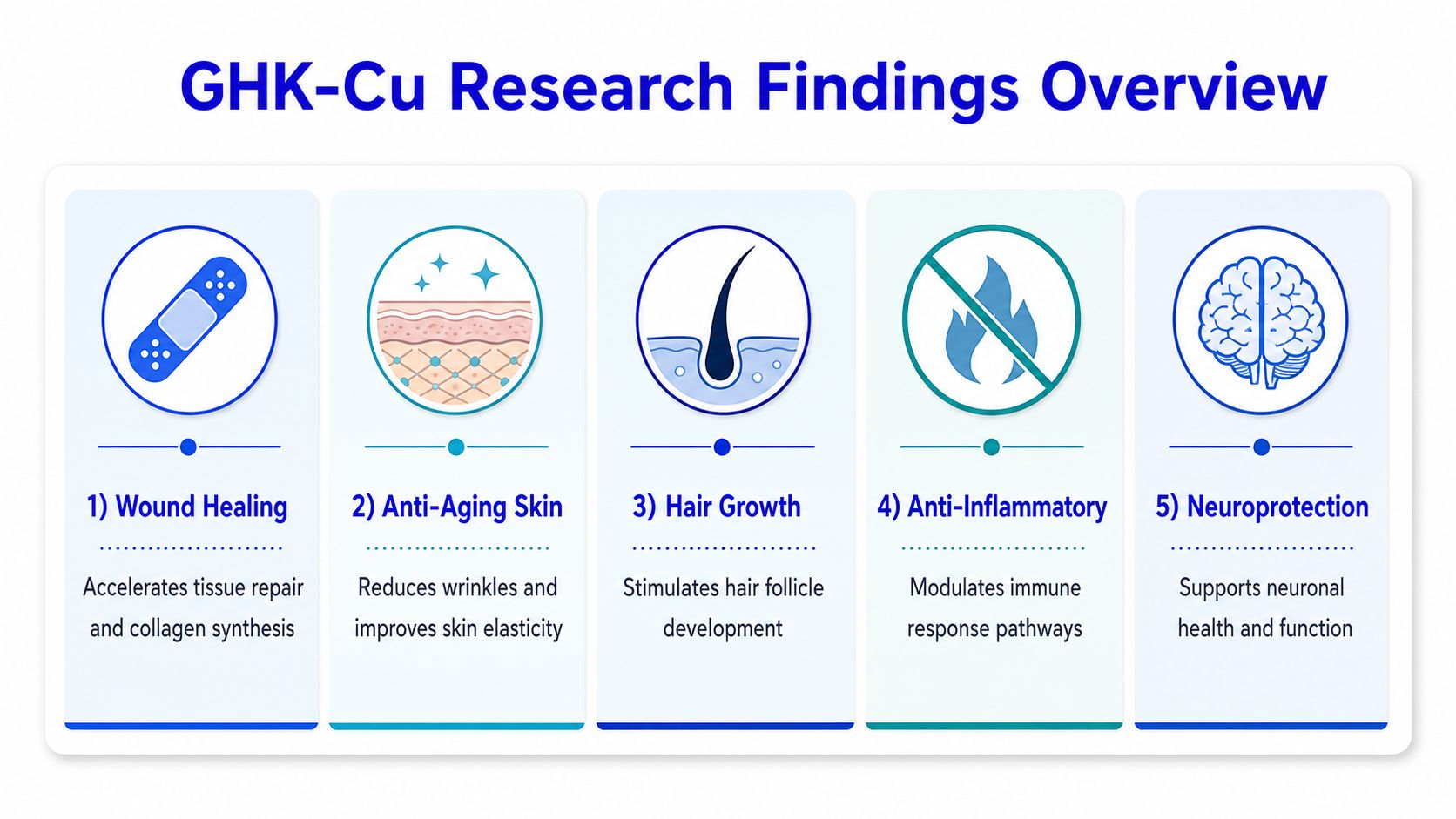
GHK-Cu sits in an unusual position in the literature. The signal is strong enough to keep researchers interested, yet uneven enough that every claim still needs to be separated by model, tissue, and endpoint. The most defensible evidence remains topical skin use, while other areas are still developing and should be treated with more caution (Peptide Journal review).
Skin biology is where the evidence base is most coherent. The peptide has been linked with collagen density, skin thickness, and wrinkle reduction in the research summary most often cited for its topical findings (Peptide Journal review). That does not validate every cosmetic formulation that includes the peptide. It does mean the mechanistic rationale and the published outcomes align more closely here than they do for many other peptide classes.
The wound-healing literature follows the same pattern. A major review describes regenerative effects in skin and other tissues, and the Biomolecules review highlights wound healing and skin remodeling in both in vitro and in vivo work (GHK-Cu regenerative review, Biomolecules review). For a lab team setting up a first-pass study, skin remains the most practical model because the readouts are familiar and the translational logic is easier to defend.
GHK-Cu also appears in discussions of inflammation because the peptide has been associated with anti-inflammatory activity, antioxidant effects, and DNA-repair signaling in major reviews (GHK-Cu regenerative review, Biomolecules review). Those observations matter, but they should not be treated as proof of a disease-specific therapeutic effect.
The practical approach is to define the question first. If the model is inflammation-driven, decide in advance whether the readout is cytokine output, migration, matrix deposition, or cell survival. GHK-Cu can plausibly influence each of those endpoints, which is exactly why the assay has to isolate the one that matters for the hypothesis.
The repair signal is broader than skin alone. A major peer-reviewed review reports regenerative findings in skin, lung connective tissue, bone, liver, and stomach lining (GHK-Cu regenerative review). That breadth is scientifically useful because it suggests the peptide is not restricted to one tissue class or one narrow repair program.
The trade-off is maturity. The research summary notes that lung disease, anti-cancer, and neuroprotection applications remain largely preclinical (Peptide Journal review). So the literature supports a wider exploratory program, but it does not support treating every tissue claim as equally advanced.
If the peptide is not pure, the experiment isn't clean. That sounds obvious, but GHK-Cu research is one of those areas where commercial enthusiasm can outpace documentation. A reputable supplier should make it easy to verify identity, purity, and batch consistency through a Certificate of Analysis, HPLC data, and, where available, third-party testing.
A useful COA should tell you more than a marketing page ever will. Look for the lot number, the stated purity, the analytical method used, and whether the document ties directly to the vial in hand. If the supplier can't connect those pieces, the material is hard to defend in a methods section.
A serious lab-facing supplier should give you enough data to answer a few basic questions:
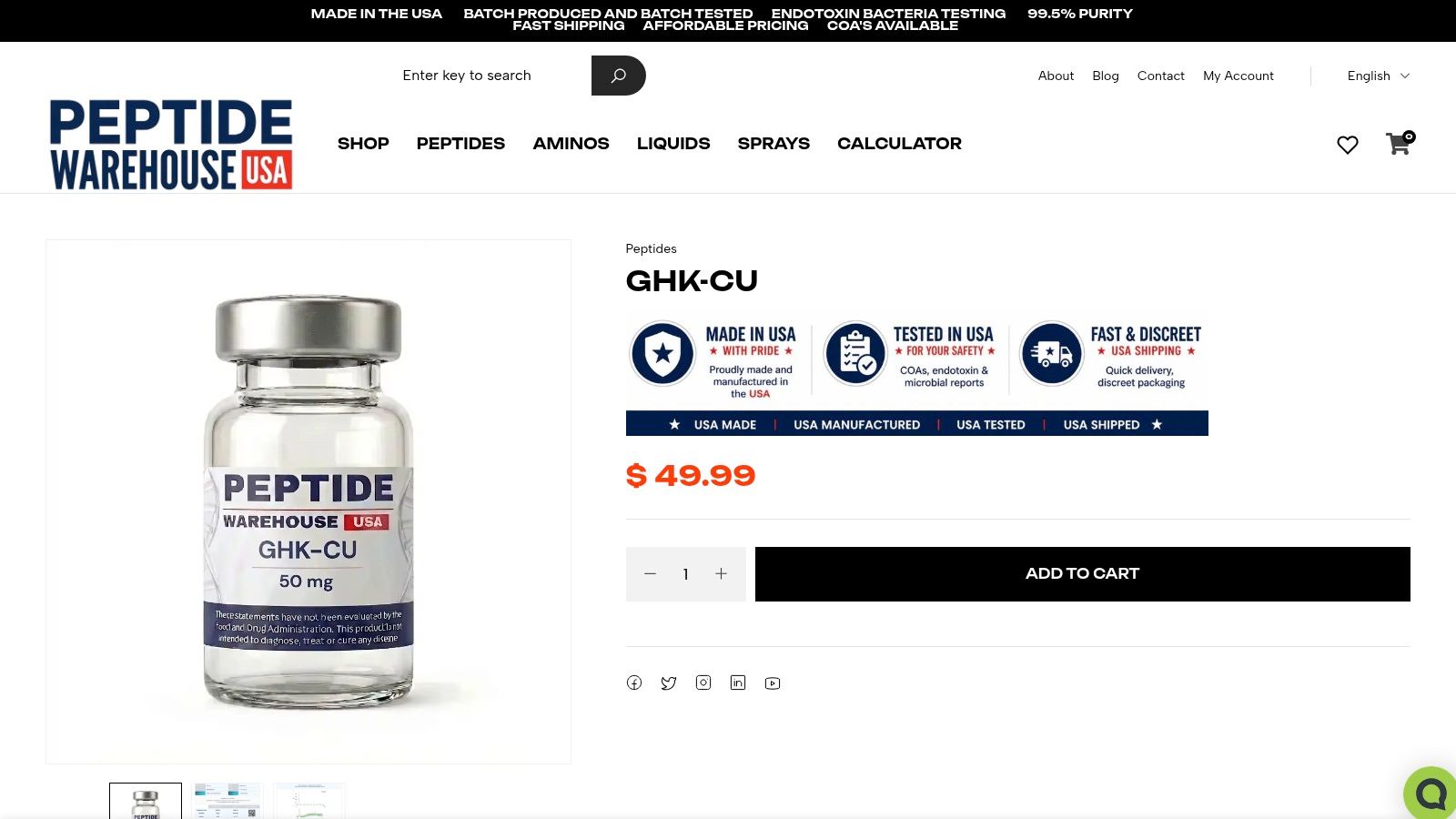
One practical option in the US research market is Peptide Warehouse USA, which presents batch-level documentation and research-only positioning alongside GHK-Cu product sourcing. The value here isn't hype, it's traceability, because traceability reduces avoidable ambiguity before the first assay starts.
After that, inspect storage and handling claims with the same skepticism. If a vendor overpromises stability or underexplains shipping conditions, assume you'll need to validate more on your side. That's normal in research procurement.
The video layer matters because procurement often fails at the handoff. A vial may arrive with good paperwork but poor packaging discipline, and that can still compromise reproducibility. For peptide work, the supplier's documentation and the lab's receiving workflow are part of the same quality system.
GHK-Cu is most useful when the model matches the question. For cellular repair and matrix biology, fibroblasts and keratinocytes are common starting points because they let you track migration, proliferation, and extracellular matrix output under controlled conditions. For broader signaling work, qPCR and protein-level assays give you a cleaner read on mechanism than morphology alone.
A straightforward design usually begins with a control group, a vehicle group, and one or more peptide-treated groups. Then the assay panel should match the endpoint, not the other way around.
The main trap is overstacking readouts without a hypothesis. If you run every assay available, you'll end up with a noisy data set and no clear mechanism. A better approach is to pick one functional endpoint and one molecular endpoint, then treat the rest as secondary.
For animal studies, the most common use case is some form of wound or tissue-injury model. Route of administration, dosing schedule, and sampling time points should be standardized before the study starts, because those choices can shape the result as much as the peptide itself.
Good lab habit: define the endpoint first, then pick the model that can answer it cleanly.
Tissue harvest should also be planned with the assay in mind. Histology, collagen-related staining, inflammatory markers, and repair-associated gene panels each answer a different question. GHK-Cu's broad biology makes it tempting to collect everything, but preclinical rigor usually improves when you collect less and interpret more carefully.
GHK-Cu is a naturally occurring human tripeptide, but it remains unapproved by the FDA for any therapeutic indication. It was investigated as a wound-healing drug, yet it never received FDA marketing approval. That distinction matters in the lab. Research-grade use is not the same thing as clinical use, so the compliance framework has to stay clear from the start.
For lab handling, keep the material in a cool, dry, dark place unless the supplier's documentation says otherwise. Reconstitution should be done with sterile technique, and the reconstituted material should be handled according to the stability guidance tied to that specific batch. PPE is standard, but the primary safeguard is procedural discipline, not just gloves and a lab coat. If the source material arrives without clear storage and handling instructions, treat that as a sourcing problem, not a minor inconvenience.
Ethically, the main issue is restraint in interpretation. A peptide with interesting preclinical data can tempt teams to write clinical narratives too early, especially when the same material is discussed across wound repair, connective tissue, and broader regenerative work. GHK-Cu has the strongest published support in topical and tissue-repair contexts, so broad human therapeutic claims should stay out of the protocol unless the data support them. The right wording in a protocol, poster, or manuscript keeps the science credible and keeps the experimental scope aligned with what the peptide can justify.

The next stage of GHK-Cu research is not about proving that the peptide has activity. The practical question is where that activity holds up once the model changes, the readout becomes stricter, or the tissue context moves away from the best-studied systems.
The most consistent signal still comes from topical skin use, especially in work tied to collagen density and wrinkle reduction. Lung disease and neuroprotection remain largely preclinical in the research history that is most often cited for the peptide's broader literature. That difference matters because it marks the boundary between a mature evidence base and a set of hypotheses that still need careful testing.
Three directions deserve attention:
Good next studies will be the ones that stay narrow. They will use high-purity material, define one primary endpoint, and keep topical evidence separate from systemic speculation. That approach gives GHK-Cu a better chance of being judged on reproducible biology rather than on broad but untested claims.
If you are setting up a new study, start with a documented batch, a focused hypothesis, and a model that fits the question. Then source research-grade material with traceable documentation and clear lot-level quality control, so the experiment begins with material you can defend at the bench.