No products in the cart.


The most popular buying advice for a GHK-Cu peptide vial is to chase the highest purity percentage on the page. That advice answers the wrong question first. A headline percentage does not tell you whether the copper is actually bound, whether the powder matches the lot on the paperwork, or how the material behaves after you open it.
A GHK-Cu peptide vial is a chemically sensitive copper complex sold for laboratory work. What follows maps the contents, the evidence, and three documents, the label, the certificate of analysis, and the storage record, to the specific question each one can answer.
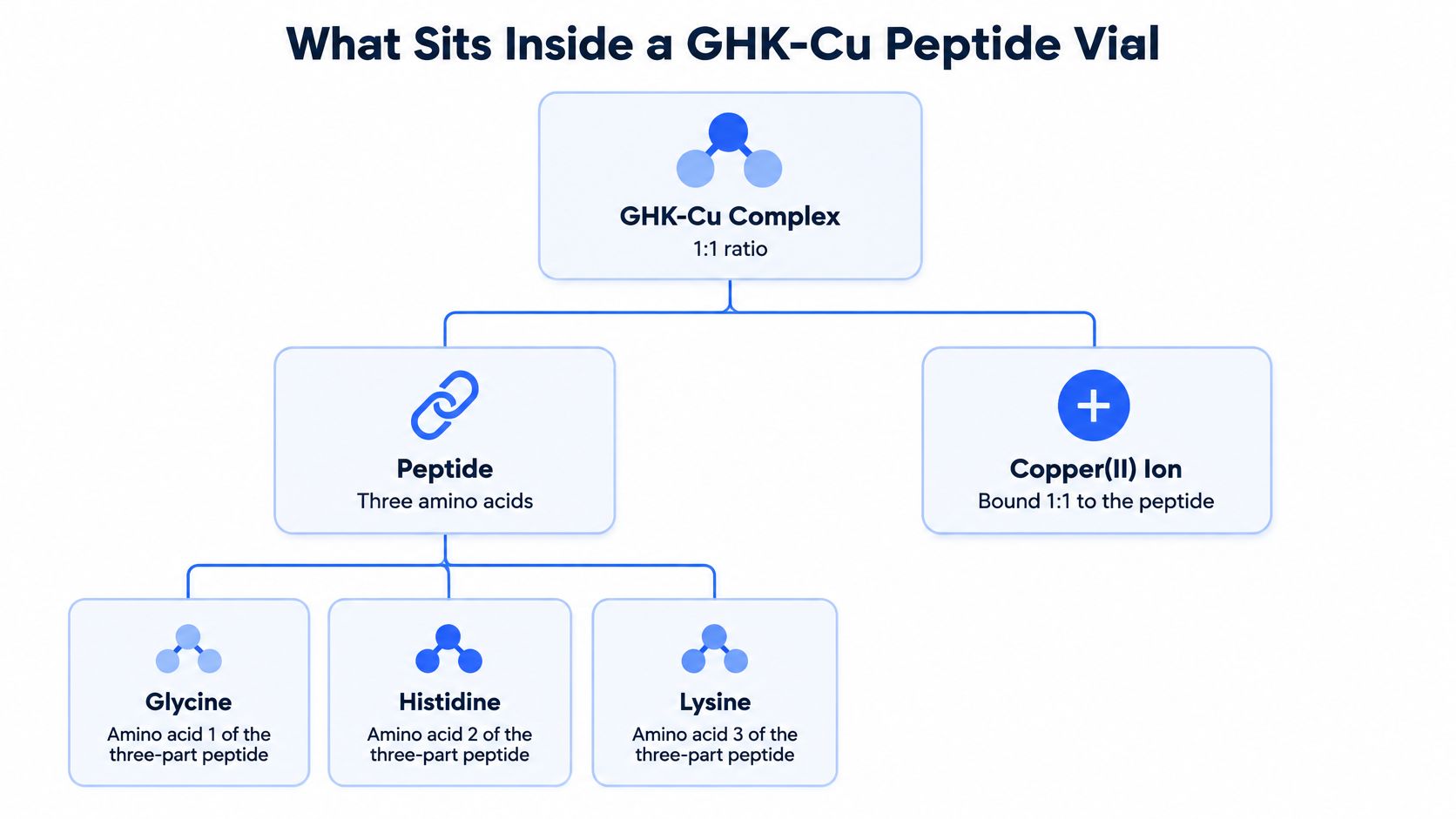
GHK-Cu is the copper-bound form of glycyl-L-histidyl-L-lysine, a short peptide of three amino acids, glycine, histidine, and lysine, bound to one copper(II) ion in a 1:1 ratio. A research vial usually holds that complex as a freeze-dried powder, not as a ready-to-use liquid.
Think of the peptide as the carrier and the copper as the passenger. The peptide holds the copper, and the copper changes how the complex behaves. Neither piece alone is what researchers mean by GHK-Cu.
The tripeptide was first identified in 1973 and occurs naturally in human plasma. A frequently cited measurement reported about 200 micrograms per liter in men aged 20 to 25, declining to about 80 micrograms per liter among adults aged 60 to 80, roughly a 60% decrease across those age groups, according to a review of GHK-Cu and tissue remodeling. That drop explains why researchers study the molecule. It does not show that a vial reverses aging. Plasma level, biological activity, and the amount in a labeled vial are separate questions.
These presentations look related in search results. They are not interchangeable.
| Element | What it is | What to check |
|---|---|---|
| GHK tripeptide | Glycyl-L-histidyl-L-lysine, the peptide part of the complex | Sequence named on the label |
| Copper(II) ion | Bound 1:1 to the peptide to form the GHK-Cu complex | Copper complex stated, not just the peptide |
| Lyophilized powder | Freeze-dried solid, the standard research vial format | Form stated, vial sealed, powder intact |
| Reconstituted solution | Powder dissolved in a specified solvent by the user | Solvent, pH, and date recorded |
| Labeled quantity | Amount per vial in mg, which may be gross weight or peptide content | Basis of the mg figure stated |
| Topical cream or spray | Cosmetic-style formulation with a different base | Not interchangeable with a research vial |
A vial is a chemical material, not a finished product. Identity and contents are the first things to verify.
A long research history can sound like settled proof. GHK-Cu is a more complicated case: results from cells, animals, and topical products answer different questions, and they do not establish what a research vial will do. A 2018 review of topical GHK-Cu studies summarizes several findings, while the human evidence remains uneven. The statements on the Peptide Warehouse USA website have not been evaluated by the U.S. Food and Drug Administration.
| Research area | Study type | Reported finding | Main limit |
|---|---|---|---|
| Skin collagen | 12-week human topical comparison | Collagen production improved in 70% of women using GHK-Cu, versus 50% using vitamin C cream and 40% using retinoic acid | Topical cosmetic formulation, not a vial |
| Wound healing | 2017 mouse scald-wound study | Liposomal GHK-Cu showed greater angiogenesis than free GHK-Cu | Animal model, no human effectiveness shown |
| Fibroblast activity | In-vitro cell culture | Treated cells doubled faster; irradiated fibroblasts produced more bFGF and VEGF | Cell culture, not a treatment result |
| Post-laser skin | Randomized clinical study, 13 completers | No significant difference in erythema or wrinkles; higher satisfaction reported | Very small sample, topical use |
The table groups results by model because the model changes what a finding can support. A topical cream can be compared with another cream; a mouse wound experiment can examine delivery in an animal; a cell culture can show how cells respond under laboratory conditions. None alone demonstrates that a vial is safe or effective for people.
The collagen comparison concerns one topical formulation over 12 weeks. It does not establish that the same result would follow from a different formulation or from a research vial. That distinction matters because a copper complex's performance can depend on how it is delivered, not only on its name.
In the mouse wound study, liposome-encapsulated GHK-Cu showed greater angiogenesis, with stronger CD31 and Ki67 signals, than free GHK-Cu. This is evidence about a delivery approach in an animal model, not proof of a human healing effect.
Cell experiments offer another kind of clue. In an in-vitro fibroblast study, treated normal and irradiated human fibroblasts doubled faster than untreated controls. Irradiated cells also produced more basic fibroblast growth factor and vascular endothelial growth factor early after exposure. These are measured laboratory responses, not clinical outcomes.
A satisfying user report and a measured clinical endpoint are not the same result.
The post-laser clinical study shows why that distinction matters. After CO2 laser resurfacing, 13 patients completed a randomized comparison of a topical copper tripeptide. Blinded evaluators found no significant difference in erythema, wrinkles, or overall skin quality at 12 weeks, although users of GHK-Cu reported greater satisfaction (P = .04). The small study examined topical use, so it does not resolve questions about other routes.
Taken together, these studies point to research questions, not an approved therapy for healing, fat loss, muscle growth, or antiaging. Human clinical data remain especially thin for injectable use and advanced delivery methods such as microneedles. For a researcher assessing a vial, study results and vial documentation answer separate questions: research findings describe observed effects in a particular model, while a label, certificate of analysis, and storage record address the identity and condition of the material. The term GHK-Cu also appears in cosmetic and research contexts, so readers comparing those uses can find GHK-Cu peptide information.
Read the label as a checklist, one field at a time. Each field answers one question, and each has a failure mode.
| Label field | What a complete label shows | Red flag |
|---|---|---|
| Product name | Full GHK-Cu identity, ideally naming the copper complex | Vague names such as "peptide blend" with no sequence |
| Quantity | Peptide amount in mg per vial, with the basis stated | A size with no mg figure or no basis |
| Form | Lyophilized powder or a defined solution | No form stated |
| Lot number | Unique batch code that matches the COA | Missing, or different from the COA |
| Manufacture and expiry dates | Dates tied to the specific lot | No dates, or an expiry far beyond the tested window |
| Research-use statement | "For laboratory research use only" | Any wording implying human use or dosing |
| Storage instruction | Temperature, light protection, and moisture guidance | No storage guidance at all |
A reasonable label names the sequence, states whether the milligrams are peptide content or gross powder, and carries a lot number. A weak label says only "10 mg peptide blend," with no sequence and no lot. Gross weight can include salts and water that are not peptide, so the peptide amount may be lower than the number on the glass.
The lot number is the bridge to the certificate of analysis. If the codes do not match, stop before you reconstitute anything.
Our products are made in the USA and are batch produced and batch tested. That is a claim to check against the lot documents in your hand, not a reason to skip them. Phrases such as "pharmaceutical grade" are marketing language, not a specification.
A certificate of analysis, or COA, answers questions about a tested batch. A purity percentage alone cannot tell you whether the number represents chromatographic area, peptide mass, or the copper complex. Read each document for the question it can answer: the label identifies the lot, the COA reports test results, and a storage record describes how the vial was kept.
For GHK-Cu, identity includes the 1:1 complex of one GHK tripeptide and one Cu(II) ion. Spectroscopy indicates copper coordination at nitrogen atoms from histidine's imidazole, the glycine alpha-amino group, and the deprotonated amide in the glycine-histidine bond. Independent work also reported the same ratio and oxidation state, as described in a structural study of the copper complex. GHK-Cu is highly hydrophilic, so oil-water partitioning alone does not predict how it will behave in a buffer.
| Test | What it confirms | Question to ask |
|---|---|---|
| Identity (RP-HPLC with mass spectrometry) | Whether the molecule matches GHK-Cu; may flag free GHK and degradation products | Which method and reference standard were used? |
| Purity (HPLC area %) | Share of the chromatographic signal from the main peak | Is this purity, or peptide content? |
| Peptide content | Net peptide mass in the powder | Is it reported separately from purity? |
| Copper content (elemental analysis) | Whether copper is present in a quantity consistent with the 1:1 ratio | Was copper quantified, or assumed? |
| Bacterial endotoxins | Pyrogen level in the lot | Which limit and method were used? |
| Microbial limits | Bacterial and fungal counts | Was this lot tested? |
| Residual solvents and water content | Process residues and moisture in the powder | Are values reported, or is the result only marked “pass”? |
| Stability data | Behavior under stated pH, temperature, and time conditions | Under what conditions was it measured? |
Each method answers a different question. Reversed-phase HPLC paired with mass spectrometry can distinguish intact GHK-Cu from free GHK, unbound copper, and breakdown products. HPLC area percentage describes the share of the chromatogram represented by the main peak. Peptide content gives the net peptide mass, while elemental copper analysis measures the metal rather than assuming its presence.
Two methods that agree are stronger than one impressive number.
Analysts call evidence from different methods orthogonal evidence. Peptide Warehouse USA provides high-purity research peptides backed by third-party testing, including COAs, endotoxin, and microbial reports. It works with established manufacturing partners and third-party laboratories to meet defined purity and identity specifications. Check the COA against the vial's lot number, then review the test date and methods. A COA does not establish sterility for injection or validate a human dose.
GHK-Cu is not an inert powder. It is a labile peptide-metal complex, and water, base, oxygen, light, and time all work on it.
A validated stability-indicating HPLC method found first-order hydrolytic degradation, faster under basic and oxidative conditions and slower under acidic stress. Mass spectrometry identified three principal degradation products, including histidine, which is a useful impurity marker. The same study reported stability in water and in pH 4.5 to 7.4 buffers for at least two weeks at 60 °C under its test conditions, as detailed in the HPLC stability method. That is a test result for those conditions, not a shelf life for every commercial lot or solvent.
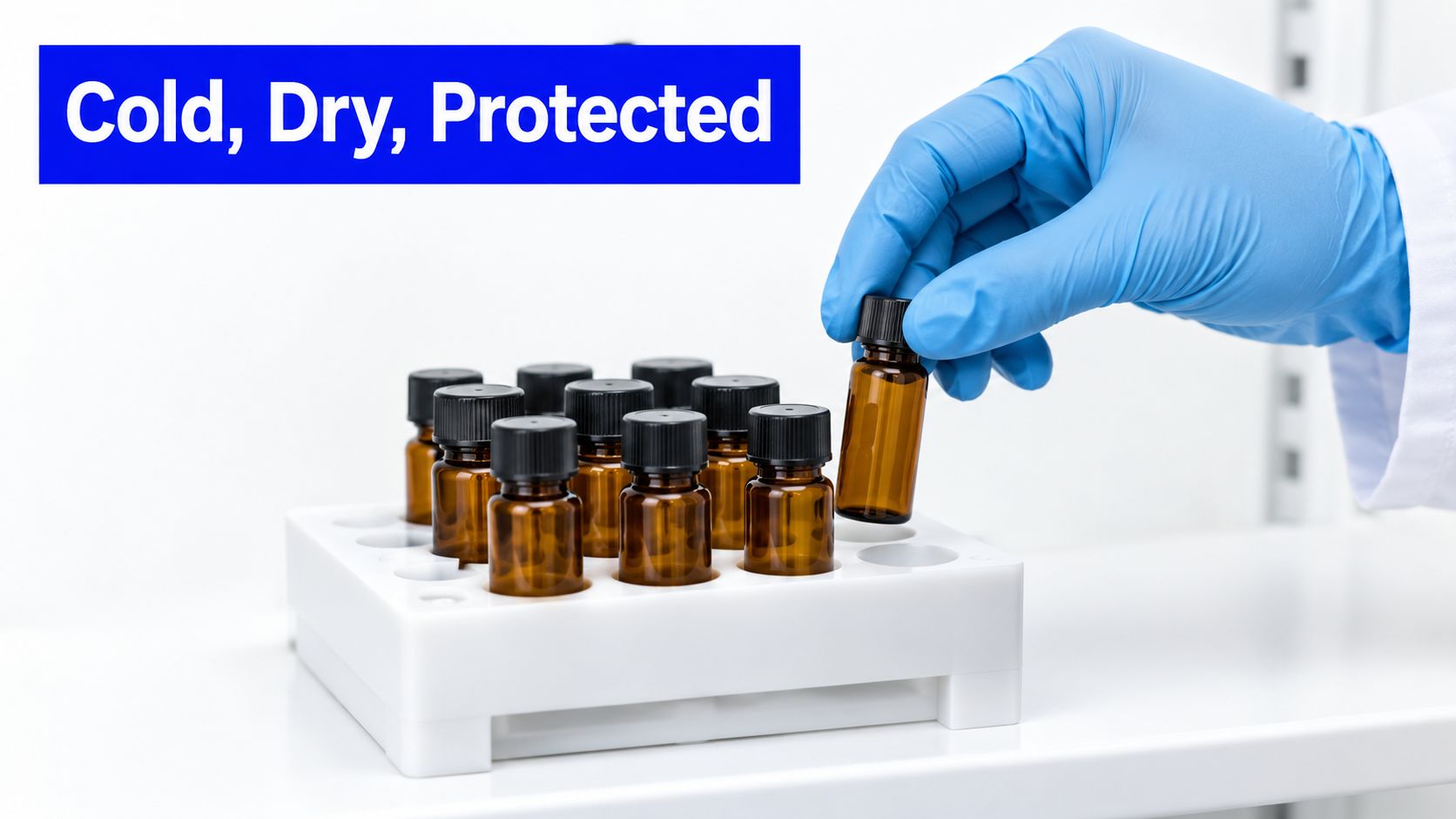
Follow the label temperature when it is stated. Where it is silent, many labs use 2–8 °C for short-term holding and −20 °C for longer storage of the unopened lyophilized vial.
| Stage | Recommended condition | Why it matters |
|---|---|---|
| Unopened lyophilized vial | Cool, dry, and dark; follow the label temperature, commonly 2–8 °C short term and −20 °C long term | Heat and moisture drive hydrolysis |
| Shipping and transit | Kept cool and sealed; inspect on arrival | Heat exposure before the vial reaches the lab |
| Reconstituted solution | Refrigerated and used within the stability window documented on the COA or in-house protocol | Hydrolysis is faster under basic or oxidative conditions |
| Aliquots | Divided into single-use portions, stored per protocol | Repeated freeze-thaw cycles add stress |
| Air and light exposure | Cap tightly and protect from light at every stage | Oxidation and light speed up degradation |
Document pH, oxygen exposure, light, moisture, and time after reconstitution in a vial-specific protocol. A nominal label concentration is not a substitute for that record.
A clear reconstituted solution is colorless to faintly blue and free of particles. Cloudiness, flakes, or a color shift you did not expect are reasons to stop, not to proceed.
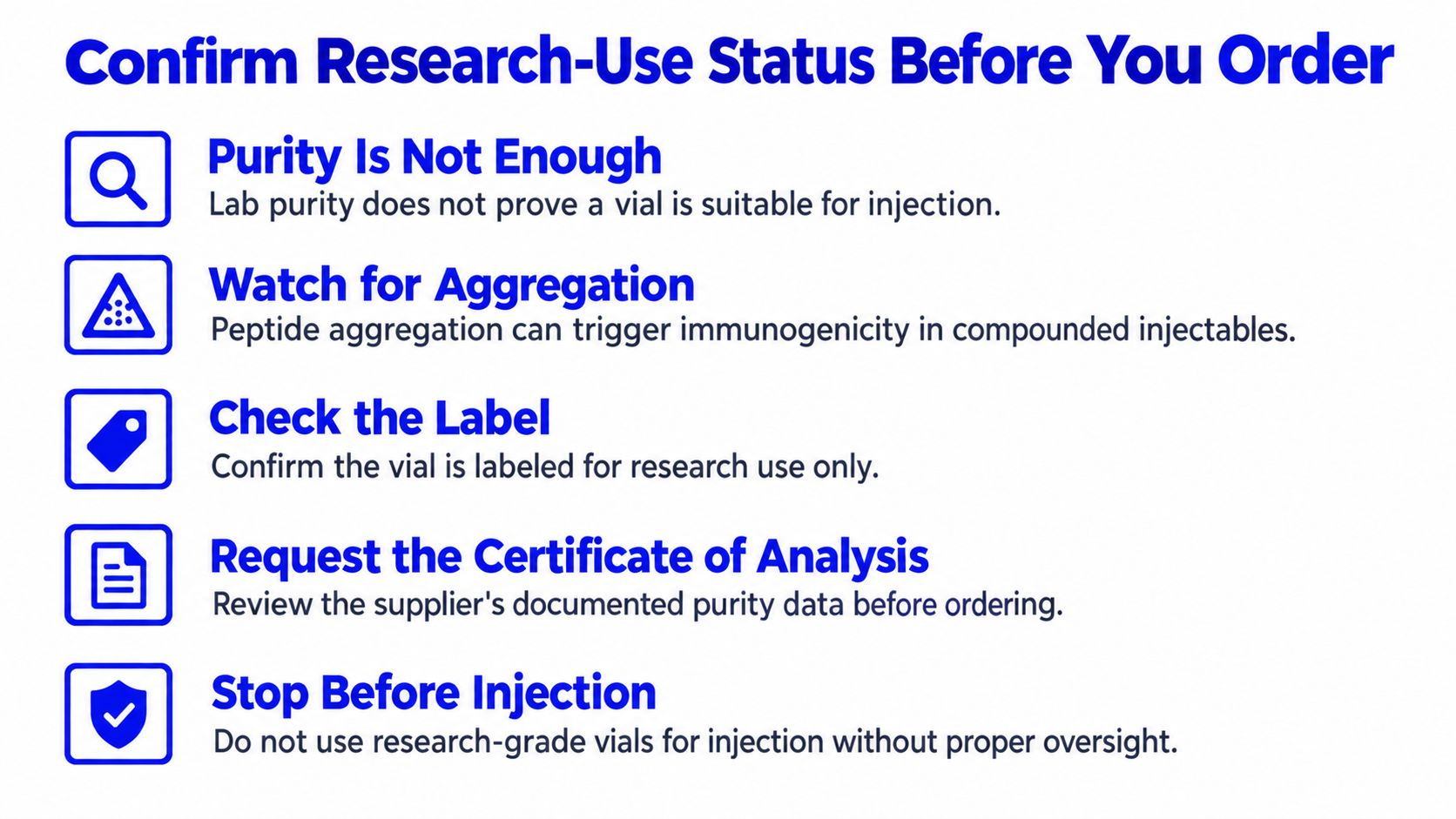
Laboratory purity and suitability for injection are different questions. Product pages often treat a high assay as proof of safety. FDA materials identify a separate risk: compounded injectable GHK-Cu may cause immunogenicity because of peptide aggregation and peptide-related impurities, while human safety data remain limited, as noted in FDA discussion of bulk substances used in compounding. A research-vial COA does not establish FDA approval, clinical efficacy, sterility for injection, or a validated human dose.
Products we sell are not intended for human or veterinary consumption. Peptide Warehouse USA is not a compounding pharmacy or compounding facility under Section 503A, nor an outsourcing facility under Section 503B, of the Federal Food, Drug, and Cosmetic Act. We do not provide medical advice or dosing guidance. We can answer non-medical questions about documentation, availability, and order status.
Is GHK-Cu the same as a cosmetic cream? No. A cream is a different formulation, studied in a different context, and it is not a substitute for a research vial.
Does a high purity number mean a vial is safe to inject? No. Purity does not establish sterility, freedom from aggregates, or safe injectable use.
How long does a reconstituted vial last? Only as long as the stability window on its COA or your in-house protocol allows. There is no universal clock.
Before you order, confirm four things in writing.
Learn more about how those documents are organized, and explore research peptide options, at peptidewarehouseusa.com once the research-use boundary is clear.
Peptide Warehouse USA supplies GHK-Cu as a research material with lot-level documentation, including certificates of analysis, so you can check identity, purity basis, and handling notes before a vial reaches the bench. If you are comparing labels, COAs, and storage records for laboratory work, visit Peptide Warehouse USA to review current research options and ask non-medical questions about documentation and availability.