No products in the cart.



GHK-Cu is a copper-binding tripeptide with decades of preclinical work behind it, plus a small set of human topical studies. It does not yet have a large clinical trial record, and there's no human pharmacokinetic data that defines systemic use.
GHK-Cu research has stayed interesting for one simple reason, it keeps showing biological activity where the evidence is easiest to measure, then stops short of proving the bigger marketing claims. That gap matters if you want signal over hype, especially when a compound shows clear laboratory effects but only modest human validation. The most useful way to read the literature is to split it into three tiers, mechanistic and preclinical findings, topical human evidence, and systemic evidence that's still missing.
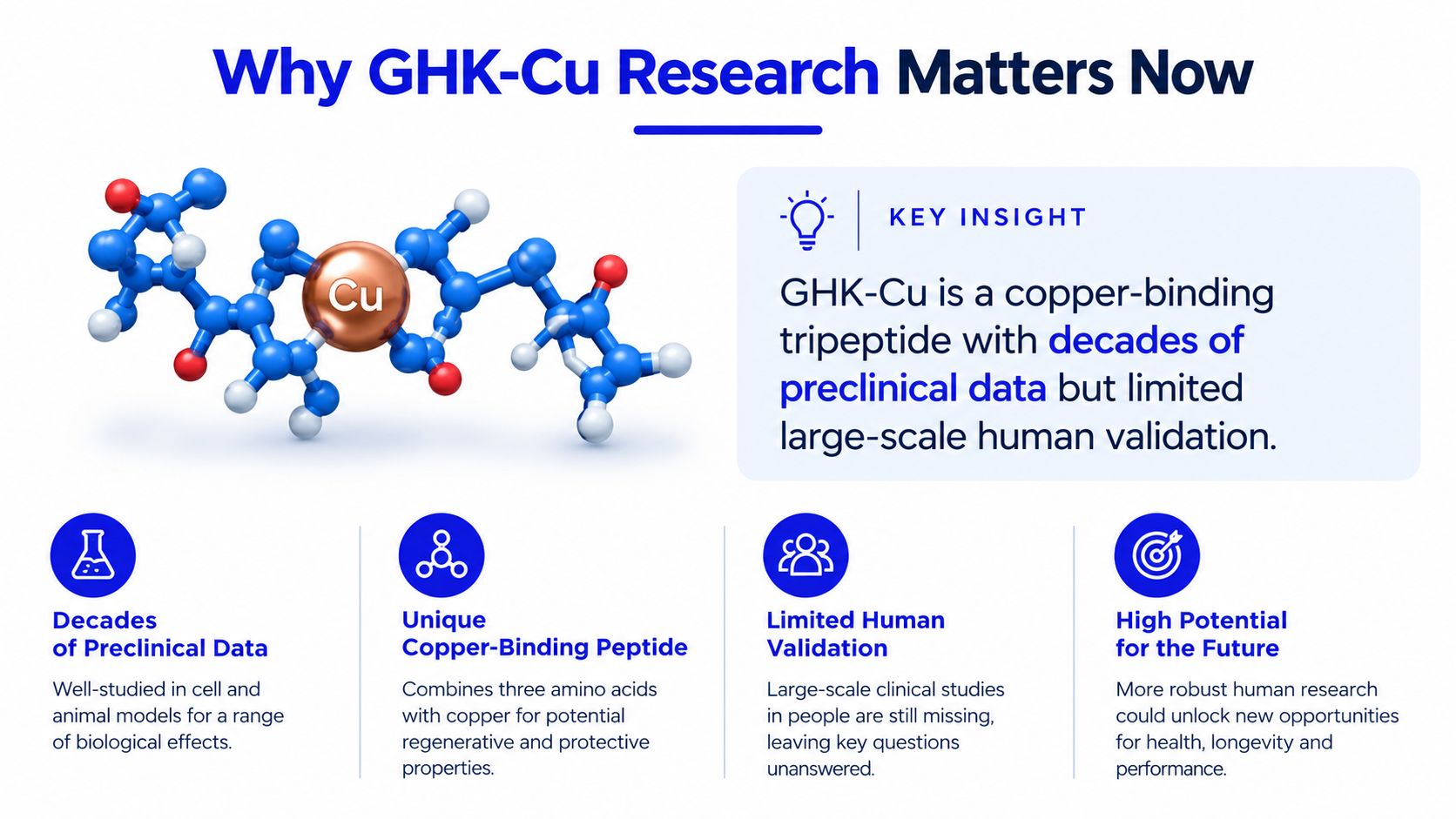
GHK-Cu sits in an unusual place in peptide science. It has a long literature trail, yet the strongest evidence still comes from cells, ex vivo skin, and animals rather than large human trials. A recent review places the compound in historical context, including a small comparative topical study from 1998, a cosmetic report from 2002, and a randomized post-CO2-laser study in which 13 participants completed follow-up without an objective advantage for GHK-Cu (academic review).
That history shapes how the field should read the signal. GHK-Cu remains a biologically active experimental metallopeptide, with a substantial preclinical base and only limited human confirmation. For researchers, formulators, and buyers, the key question is where each claim comes from, a fibroblast assay, a skin study, or actual systemic exposure.
The literature is most convincing when it stays close to the biology. Reviews describe GHK-Cu as influencing extracellular-matrix processes, dermal repair, inflammation, and tissue remodeling, while later work makes the route and model more important than a simple “does it work?” question. Topical skin data and lab assays cannot be treated as proof of injectable benefit, especially when there is no direct human pharmacokinetic study for a defined systemic formulation (systemic evidence gap review).
A practical way to read the literature is to separate three evidence tiers before trusting any claim.
The distinction is not academic. A strong cellular effect can coexist with weak clinical translation, and topical findings do not automatically generalize to systemic use. The clearest reading strategy is to ask three questions before accepting a claim.
Practical rule: If a paper does not identify the model and the route, the result is easy to overread.
For readers who want a broader skin-focused context, revitalize skin and hair is a useful starting point for how GHK-Cu is discussed in cosmetic research culture. The useful habit is to keep that discussion tied to the evidence tier, not the headline.
GHK-Cu is the copper complex of glycyl-L-histidyl-L-lysine, and the bound copper appears central to its activity. The molecule acts as a signaling modulator that influences how cells build, remodel, and respond to injury.
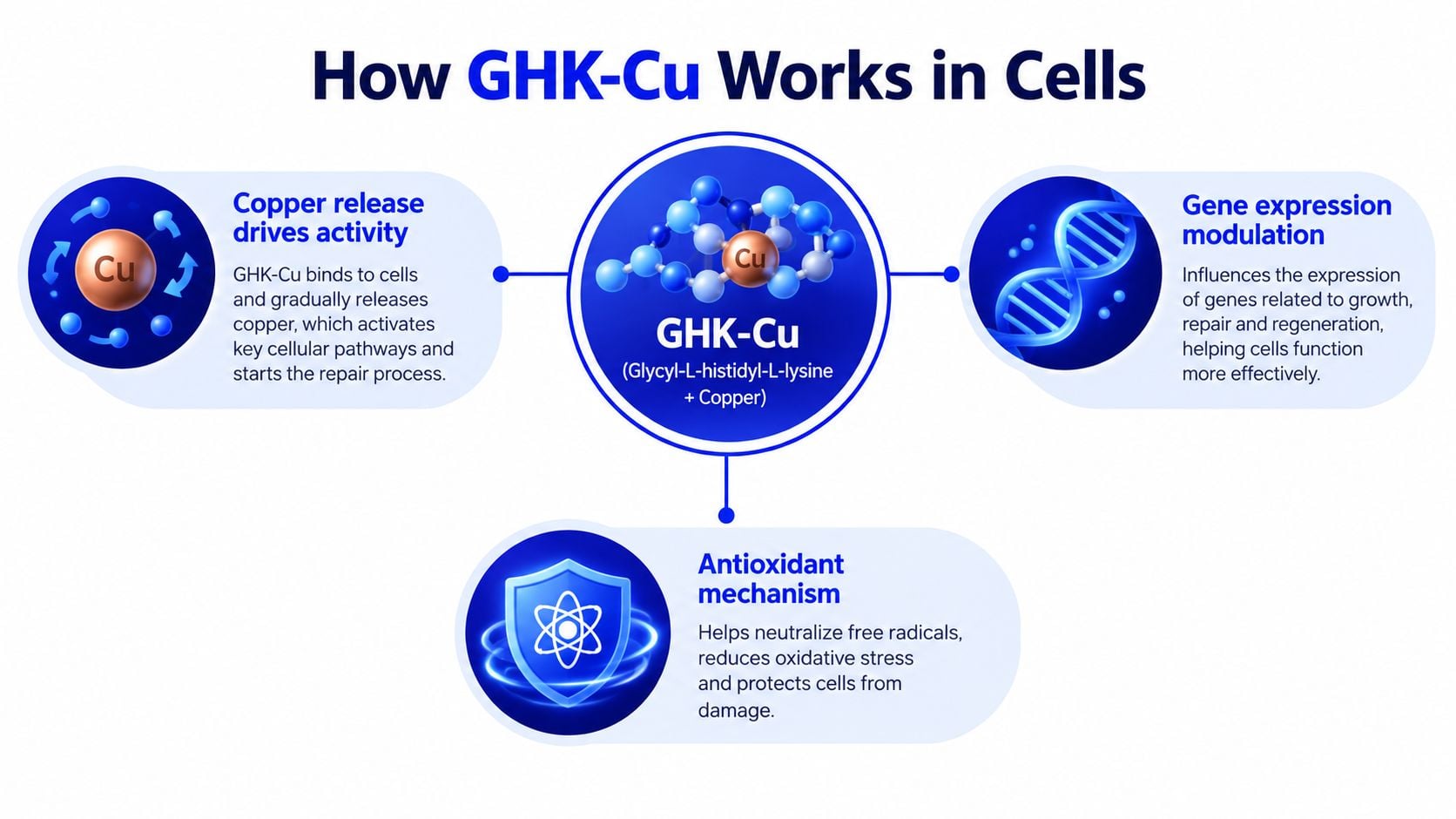
Fibroblast studies show a concentration-dependent profile. At about 1 to 10 nM, GHK-Cu stimulates collagen and glycosaminoglycan synthesis while modulating MMP-1, MMP-2, TIMP-1, and TIMP-2 (fibroblast model review). Other fibroblast experiments found that 0.01, 1, and 100 nM increased collagen and elastin production, while 0.01 nM increased MMP-1 and MMP-2 expression.
The practical reading is straightforward. Tissue remodeling depends on both matrix building and matrix turnover, so a peptide that shifts both sides of that balance is more informative than one that only pushes collagen upward. That is why GHK-Cu fits better as a signaling peptide than as a structural ingredient.
Dose matters, and the readout changes with it. More peptide is not automatically better, and results at one concentration cannot be treated as a rule for another. In this literature, the variables are the experiment.
For researchers, the main controls to keep visible are:
That is also why the strongest papers report conditions, not just “activity.” The broader discussion in cosmetic research often starts with phrases like revitalize skin and hair, but the useful habit is to keep that framing tied to the evidence tier, not the headline.
The wound-healing case for GHK-Cu is strongest in models that track more than one endpoint. Preclinical work reports higher expression of angiogenic mediators such as vascular endothelial growth factor and fibroblast growth factor, increased endothelial-cell proliferation, antioxidant support, and changes in NF-κB-linked inflammation and TGF-β-related remodeling pathways (wound mechanism review). Rabbit wound models also link GHK or GHK-Cu with better wound contraction, improved granulation tissue, higher antioxidant-enzyme activity, and new blood-vessel growth.
Those findings point in the same direction. A wound is not repaired by a single marker moving. Closure, tissue quality, inflammatory tone, and vascular support have to shift together. That is the main reason GHK-Cu reads more like a coordinated repair signal than a one-target ingredient.
The same logic applies to delivery. A 2019 in vitro and in vivo study tested a pH-sensitive polymer system carrying GHK-Cu. In the wound model, the GHK-Cu-loaded polymer produced 61.53% wound healing, compared with 42.30% for the polymer alone (2019 polymer study). The result matters because it shows that the measured outcome changes when the peptide is built into a defined carrier system.
Research takeaway: delivery format is part of the measured result and should be reported alongside the endpoint.
For readers comparing regeneration studies, what growth factors do for skin provides a useful parallel vocabulary. GHK-Cu is often discussed in the same repair-and-remodeling context, but it still belongs to the experimental tier, so endpoint design has to stay strict.
The broader reading is cautious. The preclinical record supports a plausible role in repair, but it also shows that wound type, delivery system, and tissue environment can change the outcome substantially.
GHK-Cu research becomes harder to interpret once the question shifts from cells to skin products, because formulation starts to matter as much as the peptide itself. A 2023 study of GHK-Cu combined with low-molecular-weight hyaluronic acid reported that a 1:9 ratio increased collagen-IV generation by 25.4-fold in a cell-based assay and by 2.03-fold in ex-vivo human skin (2023 HA combination study). In the same comparison, GHK-Cu alone was around 1.56-fold and hyaluronic acid alone around 1.49-fold, showing that the pair outperformed either ingredient by itself.
The pattern is more informative than the headline number. It suggests that ratio and delivery context are load-bearing variables, not cosmetic details. For anti-aging claims, that matters because a stronger readout in a lab or skin explant does not automatically translate into clinical rejuvenation in people.
| Condition | In-vitro fold change | Ex-vivo skin fold change |
|---|---|---|
| GHK-Cu + low-molecular-weight hyaluronic acid, 1:9 ratio | 25.4 | 2.03 |
| GHK-Cu alone | 1.56 | Not reported |
| Hyaluronic acid alone | 1.49 | Not reported |
For researchers, the table is the point. The combination result is useful mechanistic and formulation evidence, but it still sits below human clinical proof of anti-aging benefit. It does, however, explain why peptide products often rely on carrier systems rather than isolated ingredient claims.
Readers trying to place these findings in the aesthetics space can also consult the ProMD Health Bel Air collagen guide. The main distinction to keep in view is simple: visible skin improvement is not the same as evidence for systemic rejuvenation. GHK-Cu shows a plausible remodeling signal, but the strongest evidence here still comes from lab systems, not late-stage human trials.
Negative findings matter because they define where the signal stops. In an irradiated rat dorsal skin flap study, topical GHK-Cu gel was tested in 23 animals, with 13 treatment animals and 10 controls (rat flap study). The treated group had a mean ischemic area of 5.0 cm² with a standard deviation of 0.9, versus 3.8 cm² with a standard deviation of 1.1 in controls, and the comparison favored controls at P = .011.
The same study found no difference in flap ischemia-related measures, vessel number or area, or VEGF expression linked to GHK-Cu. That makes the result more than a statistical footnote. It shows that a repair signal in one injury context can fail in another.
GHK-Cu should be treated as model-specific: a positive repair signal in one injury model does not override a neutral or adverse result in another.
A wound model and an ischemic flap model do not answer the same biological question.
Strong GHK-Cu writing should keep mechanism separate from claim. The experimental record is broad enough to justify interest, but it does not support blanket statements across all tissue injuries or cosmetic outcomes.
The route of administration changes what GHK-Cu can legitimately claim. Topical studies speak to skin biology, local repair, and remodeling at the surface. Systemic claims ask a different question entirely, and that is where the evidence thins out fast.
The human record is still concentrated in topical use. That matters because a cream or gel can support observations about dermal response, while a skin outcome cannot be stretched into proof of body-wide exposure or distribution.
A topical endpoint such as dermal collagen density, re-epithelialization, or visible remodeling can support a local mechanism. It does not establish what happens after absorption, how long the compound remains in circulation, or whether target tissues outside the skin ever see meaningful exposure.
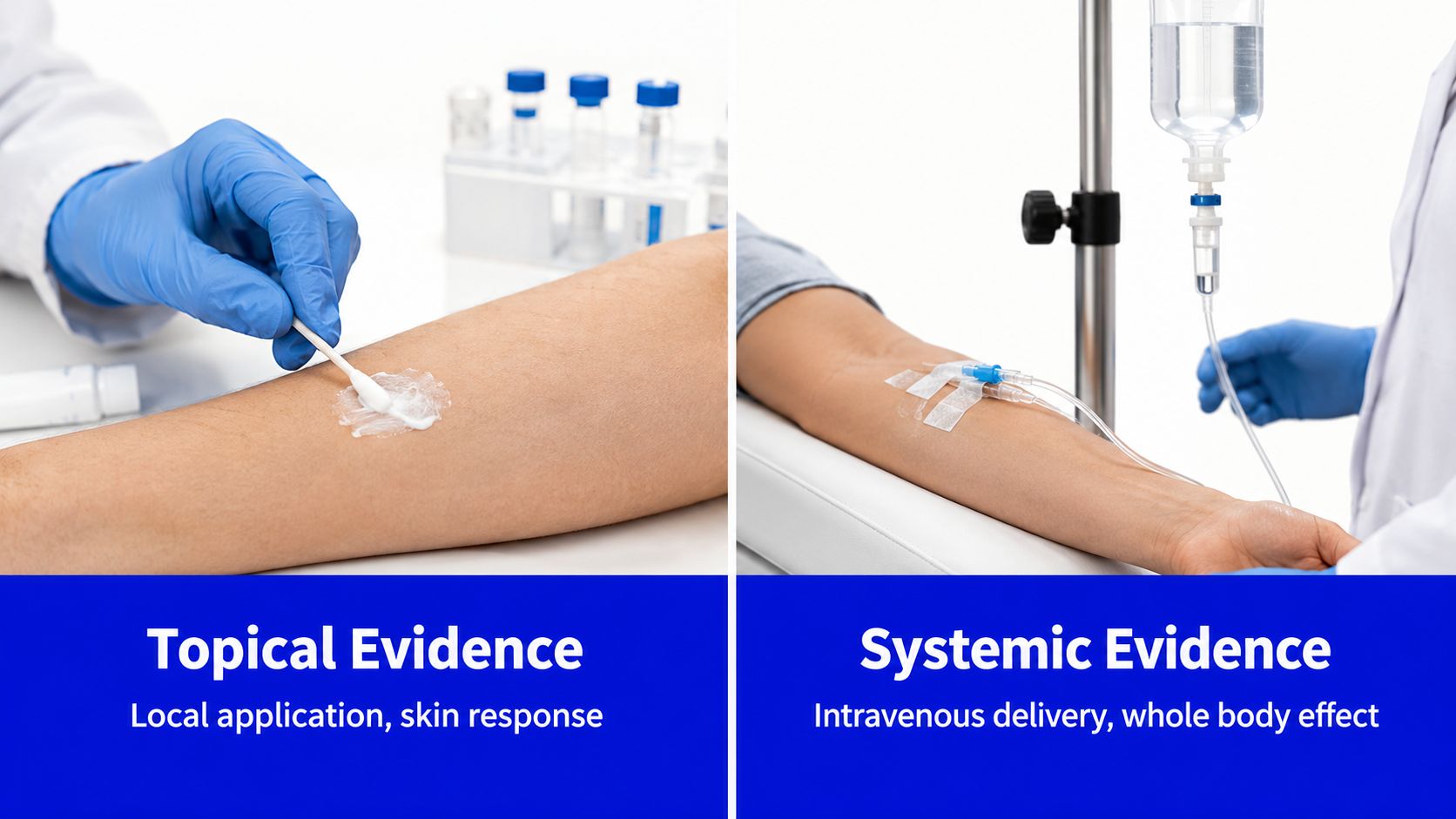
Systemic GHK-Cu claims require pharmacokinetic evidence, and that is the missing piece. Without human data on bioavailability, half-life, tissue distribution, or dose-response, injectable-style promises remain unsupported. As noted earlier, the evidence map is stronger for local skin and wound questions than for whole-body use.
That distinction has a practical consequence for researchers and readers. A topical signal can justify further work on barrier skin, healing, or cosmetic remodeling. It cannot be used to infer recovery, fat loss, muscle effects, or anti-aging effects across the body.
The cleanest reading is simple. Topical evidence supports local biology. Systemic evidence is still not established. Preclinical work is useful for mechanism, but it does not close the gap between a skin assay and a human dosing claim.
GHK-Cu papers are most useful when they separate mechanism from measurement. The first question is whether the assay captures local remodeling, cell signaling, or a broader delivery effect. For wound and tissue work, the most informative readouts are closure rate, hydroxyproline content, collagen content, MMP/TIMP activity, inflammatory cytokines, oxidative-stress markers, and vascular density.
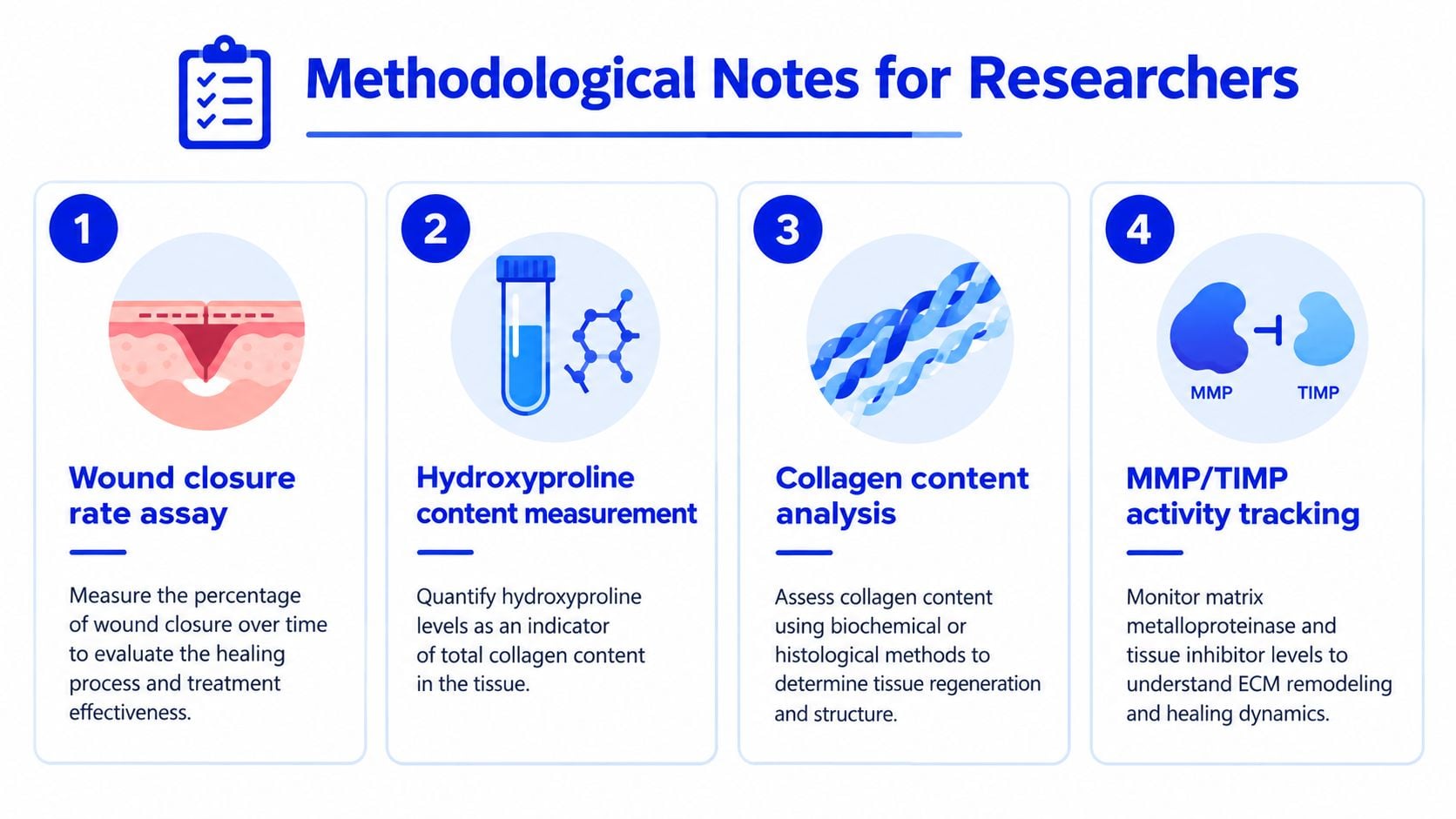
Comparability depends on the setup, not just the peptide. Concentration windows, exposure time, cell passage number, copper speciation, serum conditions, peptide purity, and delivery format all shift the apparent signal, as noted earlier for fibroblast work. Those variables should be fixed before comparative assays begin, then reported with enough detail for another lab to reproduce the same condition set.
A cleaner approach is to pre-register the formulation and the readout together. If a study is testing free peptide, a carrier, or a combination product, the delivery mode should be treated as a different experimental arm, not a minor protocol detail. If a formulation uses a defined ratio, that ratio belongs in the methods, because the ratio can be part of the biological effect rather than a background choice.
For combination studies, the clearest lesson is that the carrier is not neutral. The 1:9 GHK-Cu to hyaluronic acid result shows why formulation structure matters alongside the active ingredient. Without that context, a positive or negative result is hard to interpret across papers and even harder to compare across labs.
Batch documentation should sit inside the methods section, not in a file drawer. A certificate of analysis, lot traceability, and purity record do not prove efficacy, but they do make the assay easier to audit. Peptide Warehouse USA is one research-only source that states its products are manufactured in the USA with batch testing and COA documentation, which can help laboratories keep procurement records consistent.
GHK-Cu is easiest to interpret when the evidence is split into three tiers. At the mechanistic level, cell and tissue models support real biological activity in fibroblasts, wound repair, and remodeling pathways. At the topical human level, the signal exists but remains limited and inconsistent. At the systemic level, the evidence is still too thin to support confident dosing or body-wide claims.
That tiering matters because it prevents overreading the strongest laboratory findings as if they were human outcomes. GHK-Cu is worth continued study in skin biology, wound repair, and delivery design. It is not yet supported for broad injectable recovery, muscle, fat loss, or whole-body anti-aging claims in humans.
The next studies should be harder to confuse, not more dramatic. Randomized topical trials with placebo or vehicle control, objective dermal endpoints, prespecified formulation ratios, and clear blinding would do more to shift the field than another small exploratory series. Longer follow-up, adverse-event reporting, and direct comparisons between free peptide and carrier-bound formulations would also help separate peptide activity from delivery effects.
Researchers still need a clean line between local and systemic exposure. A topical benefit does not justify systemic inference, and the absence of pharmacokinetic data leaves that gap open. The most useful next papers will therefore ask a narrower question, which skin endpoint changes, under what formulation, and in which patients.
For controlled lab work, procurement still matters. Batch testing, documented purity, and a research-only supply chain make it easier to interpret whether a result reflects the compound or the material behind it.
If you are building a GHK-Cu study or reviewing formulations for preclinical work, Peptide Warehouse USA offers research-use compounds with batch documentation and US-based sourcing aligned to laboratory use only. Visit Peptide Warehouse USA to review research options, compare documentation, and match your material choice to the assay design.