No products in the cart.



You've just received a GHK-Cu vial. The label looks straightforward, perhaps a peptide name, a stated amount, and storage instructions. Then the practical questions begin. Is the material the copper-peptide complex, or only the peptide portion? Does the reported purity say anything about copper loading? Can the vial's stated amount be converted directly into a working concentration?
Those questions matter because GHK-Cu isn't a conventional single-chain peptide product. It's a coordination complex, and its identity, copper content, degradation profile, moisture, and storage history can all influence laboratory results. This guide explains what the vial contains, how to interpret its label and Certificate of Analysis, how to handle lyophilized and reconstituted material, and where the research-use boundary sits.
A new researcher often starts with the obvious checks. The outer package is intact, the vial is sealed, and the label appears to match the purchase order. The less obvious question is whether the documentation supports the label. Before opening anything, the vial should be treated as an analytical material that needs verification, not as a ready-to-use consumer or clinical product.
The first job is to build a mental checklist:
A vial marketed for laboratory, analytical, or preclinical research isn't automatically an approved medicine. It also isn't automatically a sterile injectable preparation. That distinction remains important even when a product page uses familiar language such as “reconstitution,” “dose,” or “injection.”
Practical rule: Read the label, inspect the vial, and review the lot-specific documentation before you decide how the material will be used.
The rest of the bench decision follows from those checks. You'll need to know whether the stated amount refers to the copper complex or peptide equivalent, what solvent and volume are appropriate for the planned assay, and whether the prepared solution will be tested immediately or held for later work. Those details affect reproducibility more than a prominent purity figure on the front of the vial.
This guide stays within a research-use framework. It doesn't provide medical advice, injection instructions for people, or support for self-administration. Its purpose is to help researchers and procurement teams evaluate a GHK-Cu vial with clearer analytical expectations.
GHK-Cu is the copper(II)-bound form of glycyl-L-histidyl-L-lysine, a naturally occurring tripeptide. The peptide backbone consists of three amino acids, while the copper ion forms a coordination relationship with available chemical groups on that backbone. The result is a metal-peptide complex, not merely a peptide powder with copper added as an unrelated ingredient.
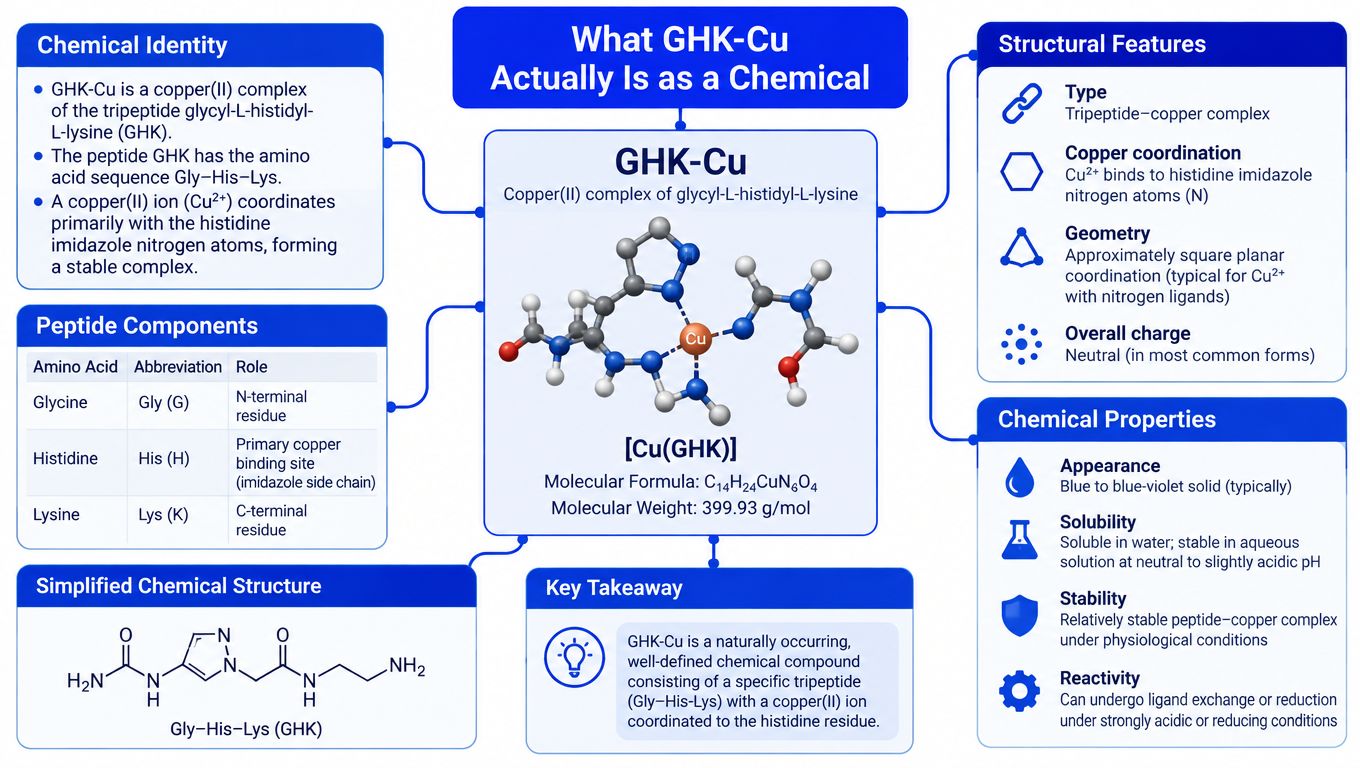
A useful analogy is a key and a lock. The peptide provides the key's shape, while copper is part of the coordination arrangement that gives the complex its chemical identity. If the peptide is intact but the copper is missing, loosely associated, or present in the wrong amount, the chromatogram may still look acceptable while the material no longer behaves like the intended complex.
The complex is commonly represented by C14H24CuN6O4 and has a reported molecular weight of approximately 403.92 g/mol, although the exact chemical species can depend on formulation and coordination conditions, as described in the foundational GHK-Cu literature. Those values can help with analytical calculations, but they shouldn't be treated as proof that every vial contains the same chemical form.
A supplier may report a strong peptide-related HPLC result. That result can indicate that the principal peptide peak is dominant, but it doesn't by itself establish how much copper is bound to the peptide. Peptide integrity and copper loading are different quality attributes.
For that reason, a meaningful characterization package should combine methods. Reversed-phase HPLC can assess the main peptide-related peak and related impurities, while a copper-specific technique such as ICP-MS or atomic-absorption analysis can measure total copper after digestion. Mass spectrometry or spectroscopy can add orthogonal confirmation of identity and coordination.
GHK-Cu research began in 1973, when growth-modulating activity was reported in a human-plasma fraction, and the peptide was subsequently identified as glycyl-histidyl-lysine in 1977. More than four decades of preclinical work have examined matrix remodeling, connective-tissue formation, inflammation, oxidative biology, angiogenesis, and tissue-repair mechanisms. That history explains why the compound attracts laboratory interest, but it doesn't validate a particular commercial lot or establish an approved clinical use.
Researchers who want broader context about cosmetic delivery should keep route and formulation separate from laboratory material. A general resource on skin injectables may help explain clinical terminology, but it shouldn't be used to infer that a research GHK-Cu vial is suitable for human administration.
A new vial arrives with a label showing several amounts. Before calculating anything, separate the container description from the material and the final solution. Vial size may describe the container or product configuration. Fill weight is the material placed inside. Working concentration is the amount per volume after reconstitution. The calculation is useful only when the label defines what each amount represents.
Working concentration = stated material amount ÷ reconstitution volume
The stated amount might refer to the GHK-Cu complex, peptide equivalent, or another reporting basis. If that basis is unclear, the arithmetic can be exact while the chemical meaning remains uncertain. This distinction matters because peptide purity and copper loading are separate quality attributes. A clean peptide result does not, by itself, prove that the expected amount of copper is coordinated to it.
Use the table as an arithmetic check, not as a list of verified commercial configurations. These are illustrative examples, not product specifications.
| Vial size | Example fill weight | Reconstitution volume | Working concentration |
|---|---|---|---|
| Small research vial | 5 mg | 1 mL | 5 mg/mL |
| Standard research vial | 10 mg | 2 mL | 5 mg/mL |
| Larger research vial | 20 mg | 4 mL | 5 mg/mL |
Before preparing a solution, document four points:
A vial label also cannot establish whether the chosen concentration suits a particular delivery route. A reconstituted research solution and a topical formulation may use the same compound while having different formulation controls and evidence. Route-specific human support for a reconstituted vial should therefore be assessed separately rather than inferred from topical information.
Handle the lyophilized material carefully. Let a cold vial reach room temperature before opening, reducing the chance that condensation adds moisture. Check the cake or powder for unexpected collapse, discoloration, or visible foreign matter. Record the lot, opening time, solvent, final volume, and operator in the laboratory record.
For a product-format reference, a listing for peptide product GHK-Cu shows how a supplier may present vial information. Use such a listing to compare label conventions, not as a substitute for lot-specific analytical documentation or copper measurement.
A new vial arrives with a polished label and a high purity value. Before accepting it, check what the Certificate of Analysis proves: what was tested, which method was used, which lot was examined, and whether the result met a defined specification. A large number without a lot identifier, test date, method, or identity confirmation offers limited support for reproducible work.
GHK-Cu is a copper-peptide complex, so the COA should identify both the peptide and the copper component. Mass spectrometry can support peptide identity, while spectroscopy or another orthogonal method may help characterize the complex. Reversed-phase HPLC can measure the main peptide-related peak and related impurities, but its area percentage alone does not establish complete complex quality.
The stability-indicating method described in the GHK-Cu degradation study combines reversed-phase HPLC with mass spectrometry. This pairing can separate the principal material from degradation products more effectively than a nominal purity value alone.
The COA should state whether copper was measured and name the method. ICP-MS or atomic-absorption analysis can quantify total copper after digestion, while the peptide chromatogram answers a different question. Peptide purity and copper loading can therefore disagree. Possible explanations include copper dissociation, incomplete complexation, formulation differences, or a documentation error.
Review the document for:
A missing field does not automatically show that a lot is unsuitable. It does show what remains unknown before the material enters a sensitive assay. A transparent COA reduces uncertainty. It does not turn research material into a clinical product.
The common shortcut is to report only HPLC purity. That result may be useful, yet it can hide copper-content variation, moisture differences, or degradation that changes the functional complex. An orthogonal package gives a clearer picture because each method examines a different part of the vial. Reconstituted-vial evidence also needs route-specific review, rather than being inferred from topical formulation data.
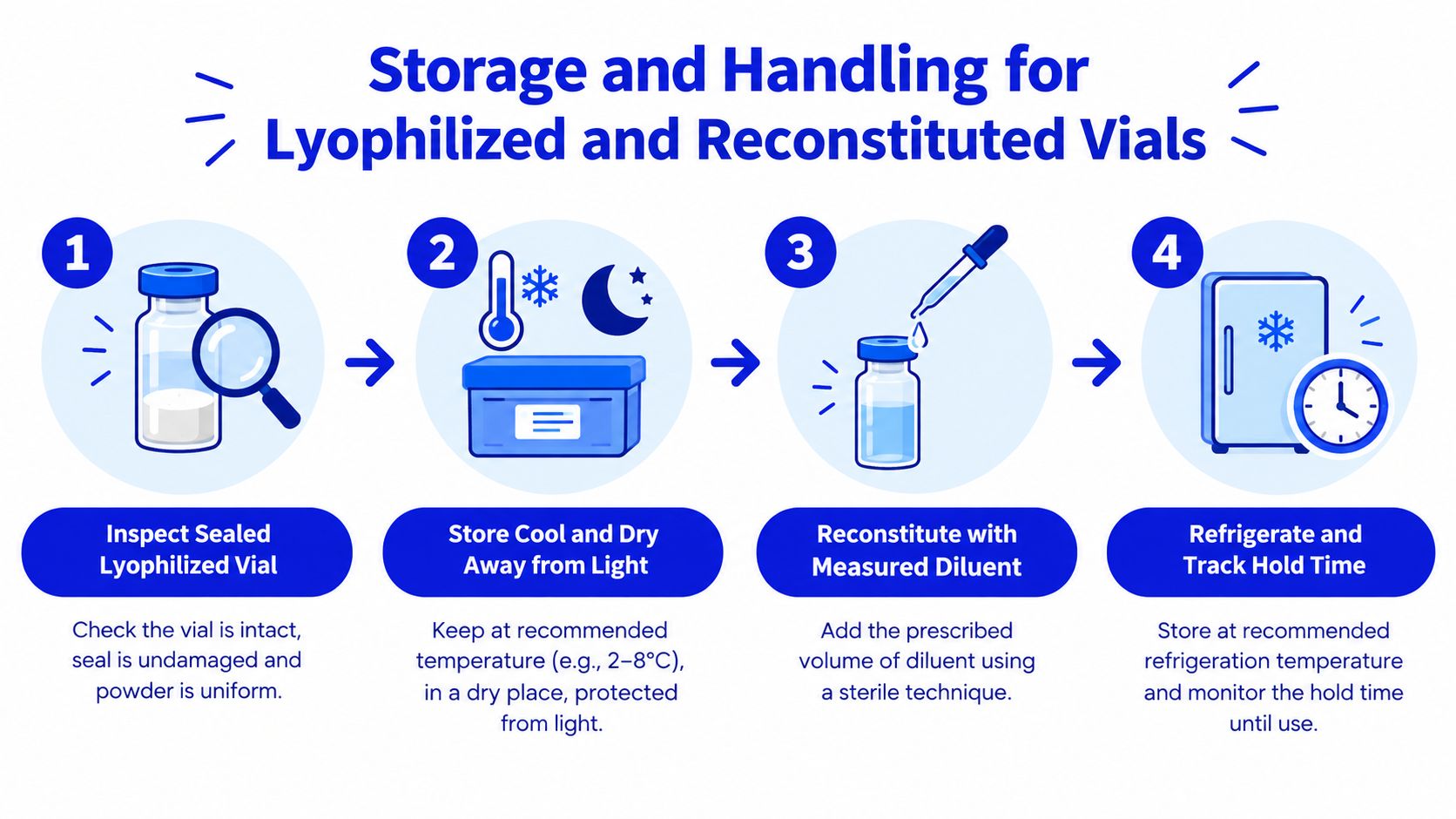
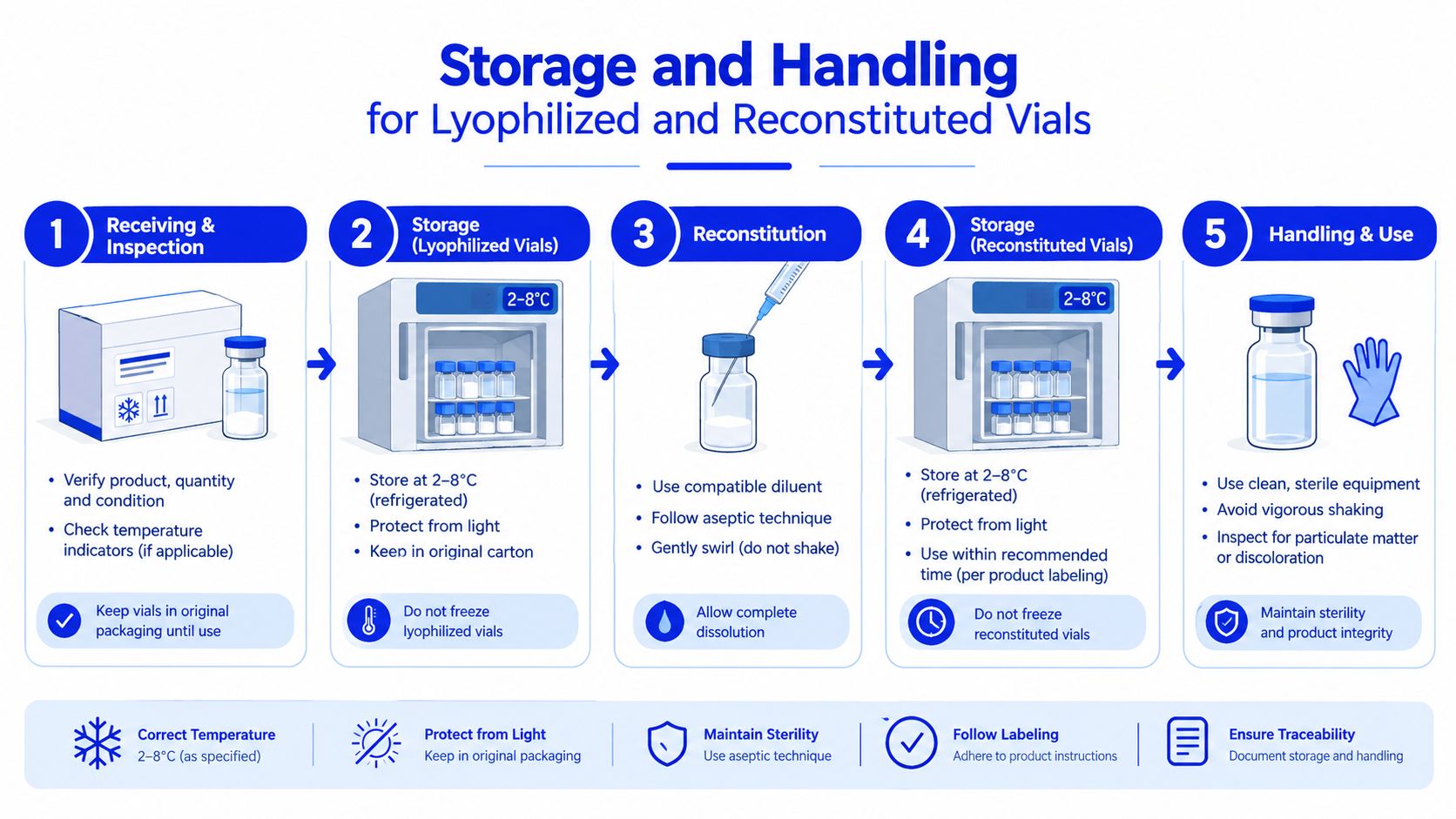
Storage should follow the supplier's validated instructions and the requirements of the planned experiment. For lyophilized GHK-Cu, researchers generally want a cool, dry, light-protected environment with minimal temperature fluctuation. The container closure matters because moisture can change the condition of a freeze-dried material before the vial is opened.
The documented stability behavior provides a useful reason for that caution. Under tested conditions, GHK-Cu underwent first-order degradation mainly through hydrolytic cleavage under basic conditions and oxidative stress. Histidine was identified among the principal degradation products. Those findings mean that pH, oxygen exposure, temperature, and hold time should be recorded rather than treated as incidental details.
Keep the vial sealed until the workspace and materials are ready. Avoid repeatedly moving the vial between cold and warm environments, and allow it to equilibrate before opening to limit condensation. Record visible appearance before use, including whether the lyophilized cake is intact and whether any unexpected color or particles are present.
A strong handling record includes:
The stability study found that GHK-Cu remained stable in water and in pH 4.5 to 7.4 buffers for at least two weeks at 60 °C under the tested conditions. That result shouldn't be converted into a universal storage claim. It describes a defined study environment, not every container, buffer, concentration, light condition, or laboratory workflow.
Aliquoting can reduce repeated opening and freeze-thaw exposure when the method permits it. Use compatible, clearly labeled containers, avoid unnecessary headspace and agitation, and define an internal hold time based on the experiment and available stability evidence. If a solution will be used in a cell or tissue model, microbial and endotoxin controls should match the sensitivity and requirements of that model.
Don't assume that a clear solution is chemically unchanged. A solution can look normal while its chromatographic profile or copper association has shifted. For that reason, stability-indicating HPLC, supported by identity and copper measurements where appropriate, is more reliable than visual inspection alone.
The phrase “GHK-Cu research” covers several very different evidence categories. Topical cosmetic formulations, cell studies, animal models, and reconstituted laboratory vials don't answer the same questions. Results from one route shouldn't be transferred automatically to another.
The available human literature is limited and fragmented. A recent systematic review identified 11 human studies, most involving cosmetic creams, and found no large randomized trial of GHK-Cu delivered by microneedles and no published phase III randomized trial for a human indication, as reported in the systematic review of human GHK-Cu evidence. Published human studies therefore don't establish the safety or effectiveness of injecting GHK-Cu from a reconstituted vial.
That distinction matters for common search terms such as antiaging, collagen, wound repair, inflammation, fat loss, and muscle recovery. Preclinical findings may make some biological mechanisms plausible, but plausibility isn't proof of a human outcome. A topical cream can have a different concentration, vehicle, exposure pattern, absorption profile, and manufacturing standard than a lyophilized research vial.
Under Section 503B of the Federal Food, Drug, and Cosmetic Act, an outsourcing facility is a facility at one geographic location that compounds sterile drugs, elects to register with the FDA as an outsourcing facility, and complies with Section 503B requirements. The FDA information on outsourcing facilities states that registered facilities must follow current good manufacturing practice requirements, undergo FDA inspection according to a risk-based schedule, report adverse events, and provide product information to the agency.
A research-chemical supplier isn't the same thing as a Section 503B outsourcing facility. A vial labeled for laboratory or analytical research isn't an FDA-approved drug, a prescription product, or a patient-specific compounded preparation.
Readers researching skin procedures may also find a general explanation of how microneedling improves skin texture useful for understanding the procedure itself. That information doesn't establish that a GHK-Cu research vial is appropriate for microneedling or any human route.
Evidence boundary: Topical human observations can inform research questions, but they can't validate systemic use of a reconstituted laboratory vial.
Before opening the next GHK-Cu vial, use a repeatable lot-verification routine. The goal isn't to collect paperwork for its own sake. The goal is to know which chemical attributes are supported, which remain uncertain, and whether the material fits the planned experiment.
Check the following:
If the supplier can't explain the chemical basis of the stated amount or provide meaningful lot documentation, pause the work and resolve that uncertainty before opening the vial. Researchers can learn more by reviewing documentation pages, comparing research-use options, and choosing suppliers that make analytical limitations clear.
Peptide Warehouse USA offers research peptides and related compounds for laboratory, analytical, and preclinical applications, with lot documentation that can support identity, purity, microbial, endotoxin, and traceability reviews. Visit Peptide Warehouse USA to explore research-use GHK-Cu vial options and compare the documentation available for your next lot.