No products in the cart.

The usual advice to find the lowest-priced vial gets glow peptide price comparisons backward. A vial is packaging, not a standardized unit of value. Before you can judge whether a quote is economical, you need to know which peptides it contains, how much material has been verified, and what documentation accompanies the batch.
For a laboratory buyer, the useful question isn't what the product costs. It's what the lab receives per dollar, whether that material fits the protocol, and what additional expense is required before researchers can use it confidently.
A supplier can put “glow” on a listing without giving you enough information to compare it with another supplier's product. The nickname doesn't establish a uniform formulation, quantity, or quality standard. Available coverage explicitly describes variations in ingredients and ratios, making composition-first comparison more useful than a headline-price ranking (explanation of GLOW formulation variability).
That makes this a procurement puzzle rather than a conventional shopping exercise. Buying laboratory material by vial alone resembles buying printer supplies by box: the package price tells you little until you know what's inside and whether it meets your requirements.
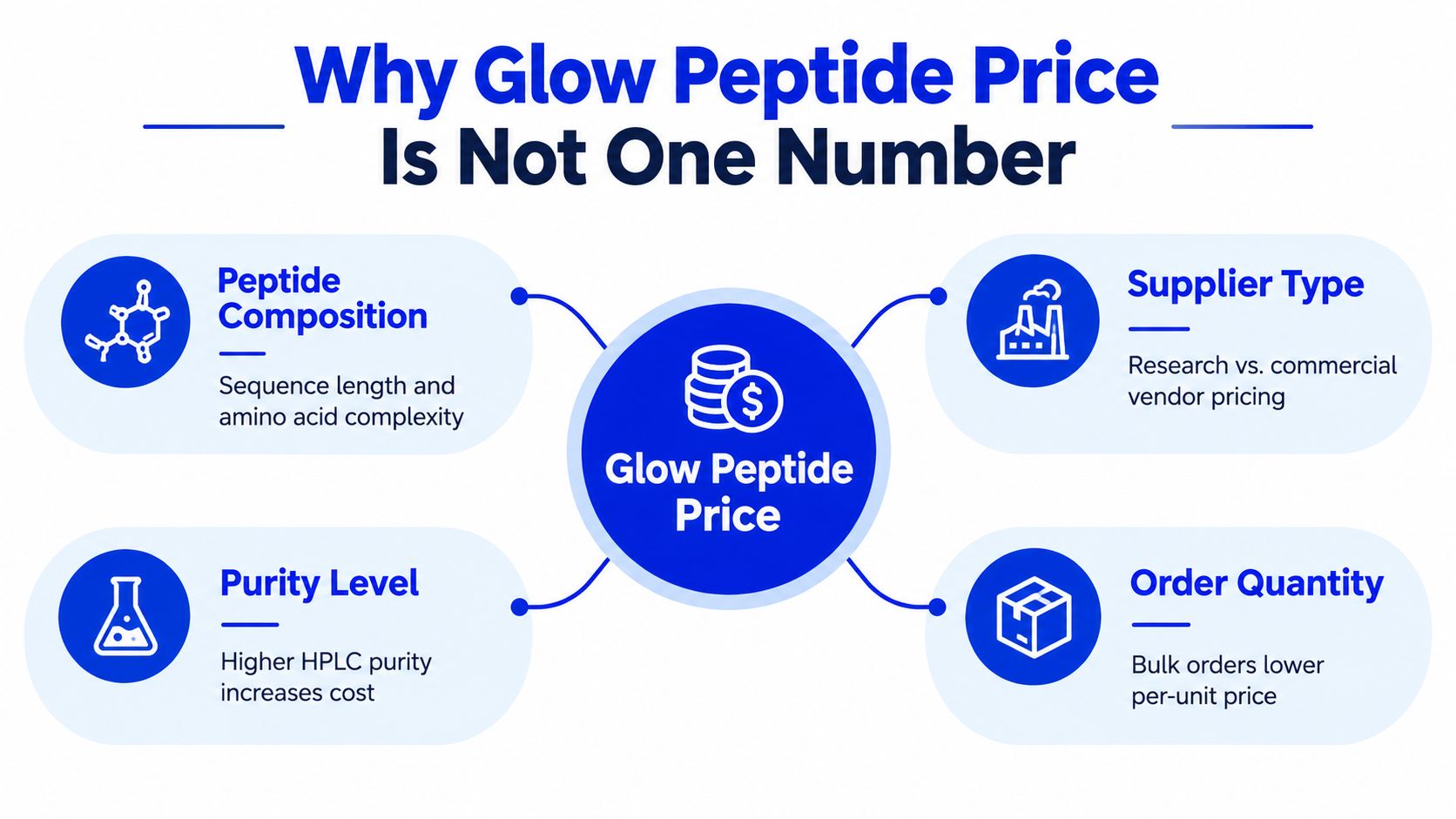
Several purchasing variables deserve separate attention:
The visual below organizes the main pricing inputs. Treat its purity and quantity descriptions as general purchasing considerations, not guarantees about any particular listing.
Start with a written description of the material your protocol requires. Include the component names, acceptable formulation, quantity basis, analytical requirements, and intended research application.
For readers also navigating supplement literature, the REVETIX breakdown of NMN study doses offers a separate resource to consult when examining study quantities. NMN isn't a pricing benchmark for GLOW, and supplement-dose discussions shouldn't substitute for a laboratory material specification.
Procurement principle: Compare defined materials, not matching product nicknames.
A useful supplier quote should answer your specification directly. If you still need to ask what the vial contains, the advertised price is only the beginning of the purchasing conversation.
GHK-Cu is the copper-binding peptide commonly associated with the “copper peptide” or “glow peptide” terminology. However, a GHK-Cu product and a multi-peptide GLOW blend are different purchases. Their shared marketing vocabulary doesn't make them chemically equivalent.
A commonly listed GLOW formulation contains 70 mg total material: 50 mg GHK-Cu, 10 mg BPC-157, and 10 mg TB-500; major-market catalog examples list approximately $70–$129 per vial, while a three-vial set has been listed at $159.95 (GLOW blend composition and catalog pricing). Those are listing examples, not a universal market price or a purchasing recommendation.
Think of GHK-Cu as a single ingredient and GLOW as a premixed cocktail. The cocktail may be convenient when its proportions match the intended experiment, but convenience doesn't make it a substitute for an isolated ingredient.
If researchers need to examine GHK-Cu independently, a blend introduces additional components. Conversely, a protocol designed around a fixed mixture requires documentation for the mixture rather than an assumption that the largest component tells the whole story.
Basic vocabulary helps prevent purchasing errors:
For cosmetic-context background, peptide insights from Skinsation Aesthetics, from Skinsation Aesthetics Inc., provide a separate reading resource. Keep skincare discussions separate from decisions about procuring research-grade material.
Historical investigation can explain buyer interest without validating a product's medical positioning. An evidence review identified 11 human clinical studies, representing 17.2% of its included literature, with eight using GHK-Cu as a comparator; it also describes an 86-person trial from 1992, a 13-participant laser-resurfacing study, and an 18-participant eyebrow study (GHK-Cu clinical evidence review).
In the laser-resurfacing study, objective assessments reportedly found no treatment-control difference, although participants' personal ratings favored GHK-Cu. The practical distinction is important: a premium associated with “glow” or antiaging positioning isn't evidence of a universally demonstrated clinical outcome.
A research vial's price begins upstream, with synthesis and purification, rather than at the checkout page. Peptide production involves repeated deprotection, amino-acid linking, washing, and reprocessing. Longer or more complex sequences generally involve more production steps.
Manufacturing scale changes the economics substantially. American Chemical Society industry reporting described estimated peptide costs of $300–$500 per gram at 300–500 gram quantities, $100–$200 per gram at the 1–2 kilogram scale, and $25–$50 per gram at the 50–100 kilogram scale, with costs potentially falling below $10 per gram at still larger volumes (Chemical & Engineering News reporting on peptide manufacturing scale).
Those figures describe manufacturing economics, not current retail GLOW quotes. They shouldn't be converted directly into a claim about what a packaged, tested research vial ought to cost.
A finished research listing can include costs beyond synthesis: purification, formulation, filling, packaging, analytical release, and distribution. A bulk manufacturing estimate and a delivered laboratory product therefore answer different purchasing questions.
The illustration below depicts the relationship between production complexity and cost. Its numerical purity-price bars and cycle counts are illustrative, not verified manufacturing benchmarks, and shouldn't be used to calculate a quote.
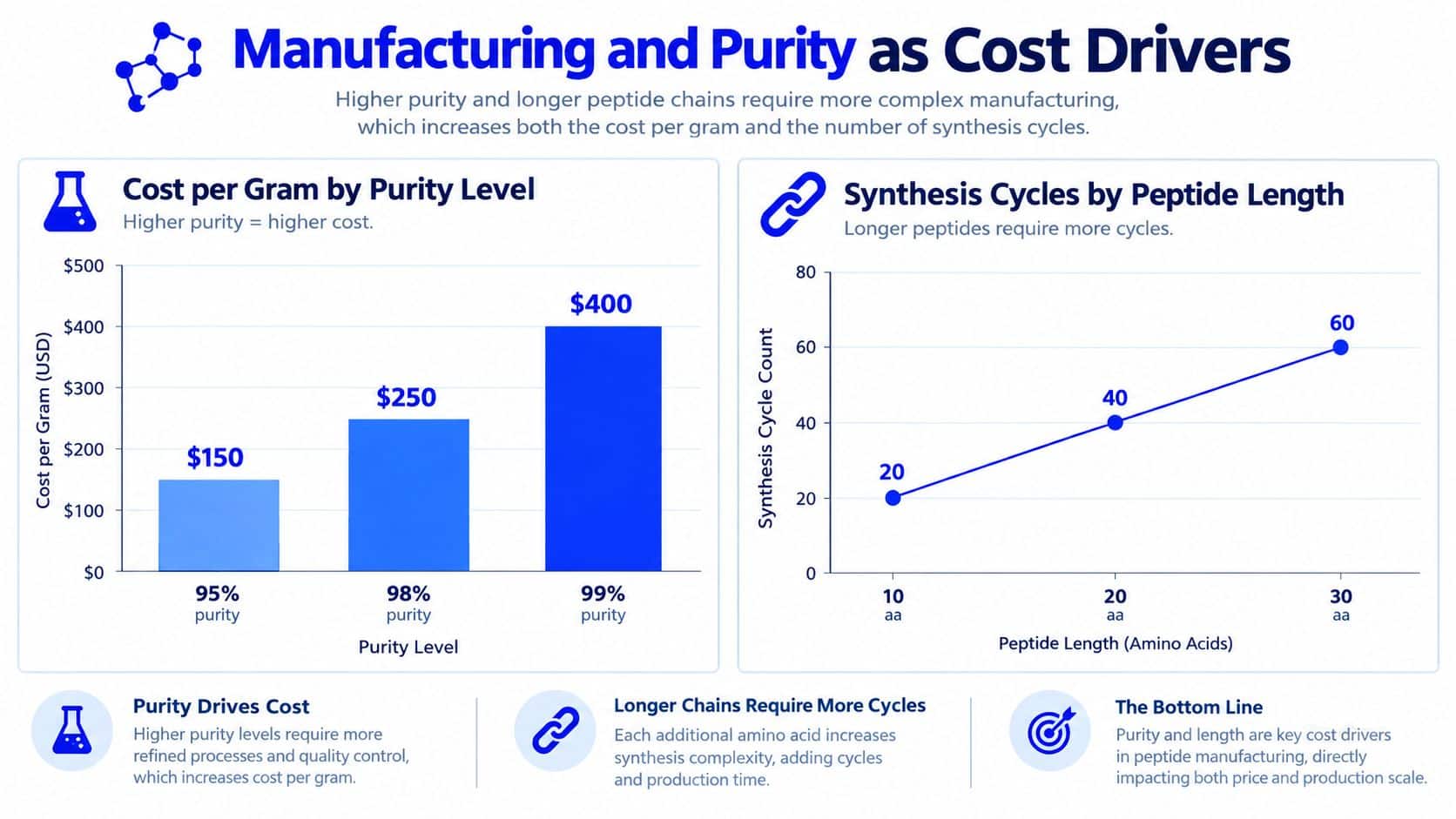
A tighter purification requirement can change the production work needed to release a batch. But you can't infer a fixed price premium from a purity percentage alone, nor assume that each incremental purity target requires an identical number of additional purification passes.
Ask the supplier to distinguish the catalog specification from the measured batch result. A specification describes what the supplier intends to accept; a batch report describes what was measured for the material offered.
Useful production-side questions include:
For an additional visual resource on peptide production, the video below can accompany the manufacturing discussion.
A low quote doesn't, by itself, prove poor manufacturing. Equally, a high quote doesn't prove superior material. The defensible comparison is between suppliers meeting the same specification, with comparable deliverables included.
Location is relevant to procurement, but a domestic address isn't a complete sourcing record. Ask separately where the material was manufactured, where it was tested, and where the order will ship from. Those answers are more useful than treating a seller's location as a quality rating.
For international or domestic comparisons, request a delivered-cost quote. Shipping arrangements, storage requirements, and any necessary temperature-controlled transport should be stated rather than assumed.
The following public comparison lists lot quantities, prices, and reported unit costs; its broader index covered 62 listings, with a median of $0.77 per milligram and a range of $0.31–$2.47 per milligram, approximately an eightfold spread (GHK-Cu lot comparison and unit-price index).
| Lot Size | Listed Price | Price per mg |
|---|---|---|
| 50 mg | $43 | $0.83 |
| 50 mg | $44.99 | $0.86 |
| Approximately 99 mg | $69.99 | $0.71 |
| Approximately 145 mg | $79 | $0.54 |
These unit costs are reported values, not simple calculations from every nominal pack size. Where the displayed price and quantity don't reproduce the reported unit rate exactly, request the measured lot-content basis before relying on the comparison.
The larger lot has a higher headline price but a lower reported unit cost. That illustrates why a smaller checkout total doesn't necessarily represent a cheaper purchase of comparable material.
A low vial price can mean a small amount of material, not a low cost for the quantity your experiment requires.
For a blend, divide by the component that matters to your purchasing decision, not automatically by total blend mass. The earlier blend catalog example illustrates this: at $108 per vial, the formulation costs about $1.54 per total milligram, but allocating the full purchase price to its GHK-Cu amount gives $2.16 per milligram of GHK-Cu.
That second figure is a purchasing allocation, not the supplier's standalone price for GHK-Cu. The buyer also receives the other constituents, which may be useful, unnecessary, or unsuitable for the planned experiment.
A practical comparison formula is:
Delivered product cost ÷ documented milligrams of the required component
Then account for analytical work the lab must purchase separately. Use the same denominator and the same included-cost categories across every quote.
The cheapest option depends on the experiment. A blend isn't economical merely because it provides additional peptides, and a bulk lot isn't economical if it exceeds the lab's usable requirement.
A Certificate of Analysis, or COA, is a report of specified tests. It isn't a blanket certification of every property a laboratory might care about.
Read it like a procurement document: identify the supplied lot, inspect the methods, examine the results, and determine what remains unmeasured. A polished PDF can't compensate for a missing connection between the report and the vial.
These analytical questions require different evidence. Standard reversed-phase HPLC and mass spectrometry are commonly used to assess peptide purity and identity; net content can be quantified through elemental or amino-acid analysis, with one analytical provider listing approximately $120 for elemental analysis and $150 for amino-acid analysis per sample; copper quantification requires an appropriate elemental method such as atomic-absorption spectroscopy or ICP-MS (GLOW analytical verification and testing-cost considerations).
The distinctions matter:
A copper result also needs interpretation against the peptide-content result and the intended specification. Detecting copper isn't the same as demonstrating that the material meets the required characterization.
The checklist illustration below highlights common documentation items. Its COA description should be read as a summary of possible report contents, not a claim that every COA verifies identity and purity.
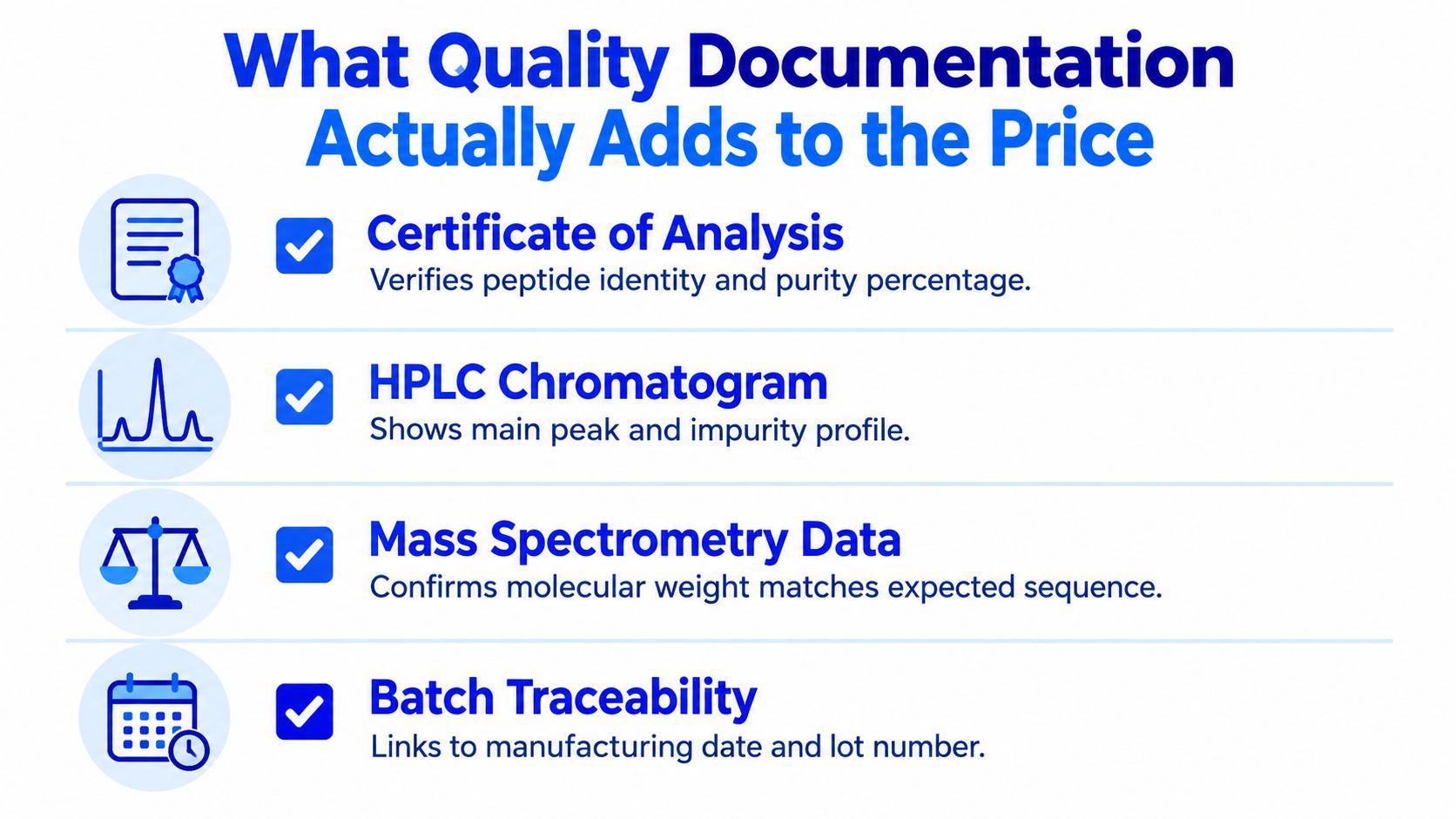
For a blend, request constituent-specific results rather than accepting an unexplained aggregate purity claim. Ask whether the report identifies the testing laboratory, methodology, acceptance criteria, and exact lot.
Microbial and endotoxin results should be evaluated against the laboratory protocol's requirements. An injectable-looking package doesn't establish sterility, and contamination-screening documents don't authorize human administration.
Budget check: Add the cost of missing required tests before deciding that an undocumented vial is cheaper.
Documentation supports traceability, but it doesn't convert research material into approved medicine. FDA materials likewise distinguish compounded drugs from FDA-approved products and explain that compounded drugs haven't undergone the standard premarket review for safety, effectiveness, and manufacturing quality (FDA explanation of compounded-drug approval status).
The buying objective isn't the thickest document bundle. It's sufficient, relevant evidence to support the material's intended laboratory use without purchasing unnecessary tests or overlooking necessary ones.
A comparison worksheet should make missing information visible before purchasing approval. Record the offered formulation, documented content, delivered cost, required tests, and unresolved questions in separate fields.
Don't allow an attractive discount to replace an unanswered specification. A quote can remain on the shortlist while the supplier supplies missing evidence.
The image below illustrates comparison-shopping behavior, rather than peptide testing or laboratory practice.
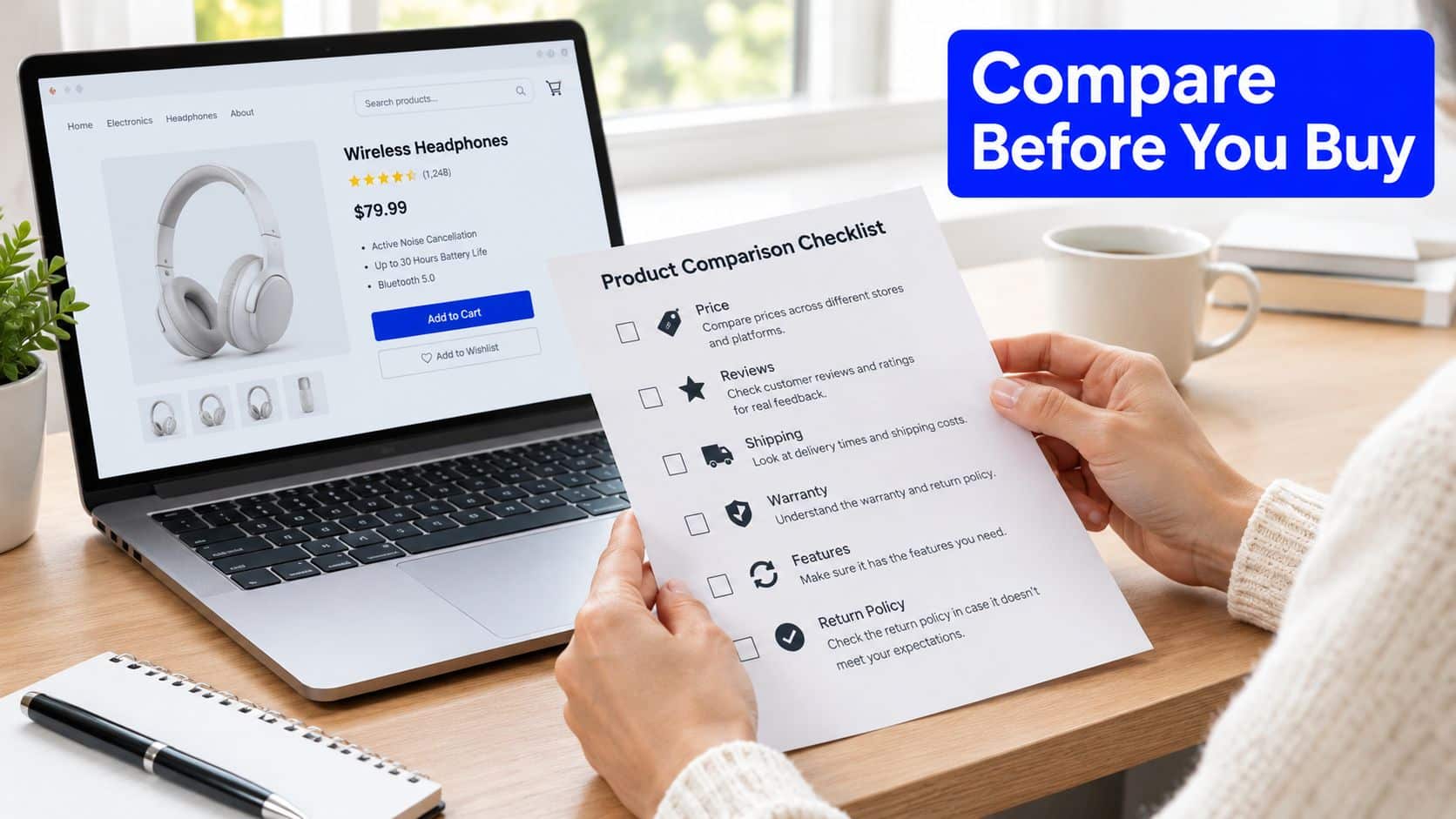
A clinic-led program and a research vial aren't like-for-like purchases. The former may include services and human-use decision-making, while the latter is a material-procurement transaction. Their prices shouldn't share a ranking column.
Similarly, assess supplier features individually. High stated purity, third-party COAs, microbial reports, endotoxin reports, domestic manufacture, and research-only wording answer different questions; none replaces all the others.
Request the current documentation package rather than assuming that every catalog item has identical supporting reports. Match those records to the lab's acceptance criteria.
The final decision should be explainable to another researcher without relying on brand familiarity. If you can show what was bought, how it was characterized, and why its delivered cost was appropriate, you've made a defensible procurement choice.
A research-only disclaimer isn't an automatic regulatory shield. FDA enforcement guidance explains that a “research use only” label may not control classification when a seller's surrounding marketing presents products as intended for human use (FDA warning letter to Summit Research Peptides).
For buyers, the implication is practical: review the supplier's treatment claims, dosing language, and injection guidance alongside the product label. A low price doesn't resolve inconsistent intended-use statements.
A research chemical purchase isn't equivalent to buying an FDA-approved medicine. Approved drugs undergo premarket review for safety, effectiveness, and manufacturing quality; laboratory materials shouldn't be presented as interchangeable with them.
Your purchasing record should identify the laboratory purpose and the material specifications supporting that purpose. Keep medical treatment decisions outside the research procurement process.
Ultimately, a useful glow peptide price is attached to a clearly defined, adequately characterized, appropriately marketed research material. The headline vial price matters only after those conditions are understood.
For laboratories comparing domestic research suppliers, Peptide Warehouse USA offers US-manufactured peptides and related compounds for laboratory, analytical, and preclinical applications, with third-party COAs, microbial and endotoxin reports, and stated purity levels up to 99.5%. Visit the catalog and request documentation for the exact offered lot so you can compare formulation, verified content, and delivered cost before ordering research-use-only material.