No products in the cart.


GLP-3 is not an FDA-approved drug name, and in current catalogs it usually points to investigational retatrutide supplied for laboratory research only. That single fact changes how you should read any GLP-3 peptide buy listing.
The popular advice is to shop by purity badge, price, and shipping speed. That's backwards. A high purity number can't tell you whether the vial contains the molecule you intended to order, whether the documents belong to that lot, or whether the listing crosses from research supply into drug claims. Start with identity, then documents, then price.
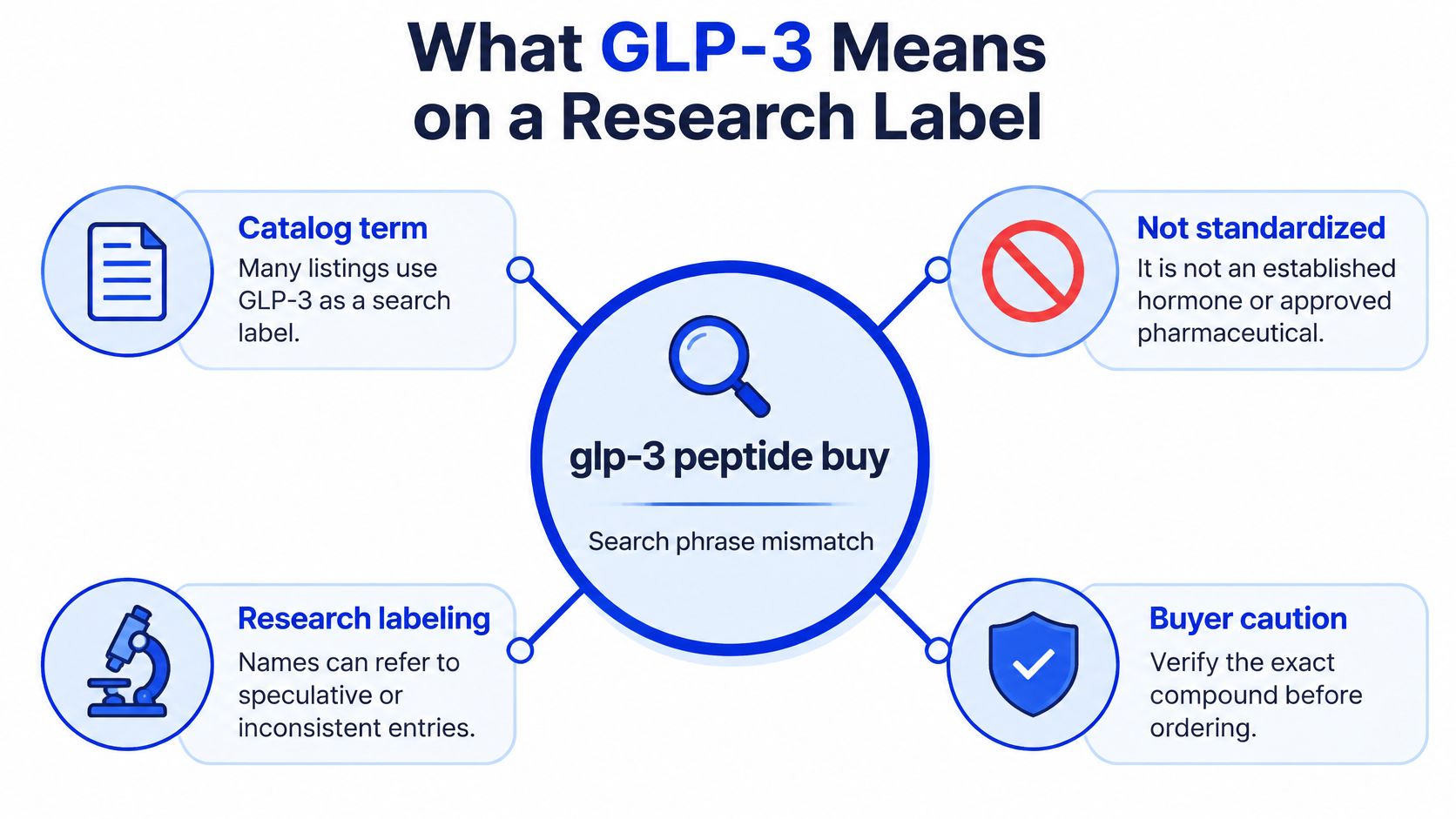
When you search for a GLP-3 peptide buy, you're usually searching with a nickname, not a molecule name. The FDA warning letter to Peak Performance Peptides reflects a key point for buyers. GLP-3 peptide is not an established physiological hormone or standardized pharmaceutical designation, and products marketed as GLP-3 or GLP-3R have been identified as unapproved new drugs when promoted beyond legitimate research contexts.
In current commercial usage, GLP-3 commonly refers to retatrutide (LY-3437943). It's an investigational synthetic peptide engineered to activate three receptors, GLP-1, GIP, and glucagon. That's why sellers call it a triple agonist, and why the shorthand GLP-3 stuck.
The design isn't three copies of the same signal. GLP-1 and GIP signaling can support glucose-dependent insulin secretion and appetite reduction in research models. Glucagon-receptor activity may increase energy expenditure, but it can also affect heart rate, gastrointestinal tolerance, and glycemic control.
That trade-off is exactly why a nickname isn't enough for lab work. If one listing's GLP-3 is retatrutide and another listing uses the same word for a different molecule, concentration, or formulation, you can't compare results across studies or normalize material between lots.
A name without a structure is not a specification.
The visual below maps the mismatch between the search phrase and the actual molecule.
| Label buyers see | What it usually means | What it is not |
|---|---|---|
| GLP-3 | Commercial nickname, often retatrutide | A standardized hormone or approved drug name |
| GLP-3 RT (Retatrutide) Research Peptide | Research-labeled marketing name for retatrutide | A separate FDA-approved medicine |
| Retatrutide (LY-3437943) | Investigational synthetic triple agonist | An approved treatment with an established human dose |
| Semaglutide-class GLP-1 medicines | Approved single-agonist drugs in branded forms | The same molecule as retatrutide |
| Tirzepatide-class GIP and GLP-1 medicines | Approved dual agonists in branded forms | A glucagon-receptor triple agonist |
Readers who want background on approved GLP-1 medicines, rather than research nicknames, can explore GLP-1 weight loss treatments for clinical context. That context doesn't transfer to a research vial. An approved, branded medicine has a defined molecule, manufacturing controls, and labeled use. A GLP-3 listing has whatever its documents prove, and nothing more.
So your first buying question isn't where to order. It's whether the name on the page resolves to retatrutide or LY-3437943, with sequence or structure, theoretical molecular mass, salt form, and lot-specific testing behind it. If it doesn't, you don't have a specification yet.
Retatrutide draws attention because early trial results were large. Large results still sit inside a specific trial design, with specific participants, controls, and endpoints. They don't describe a catalog product.
The graphic below summarizes the study context you need before reading any product page.
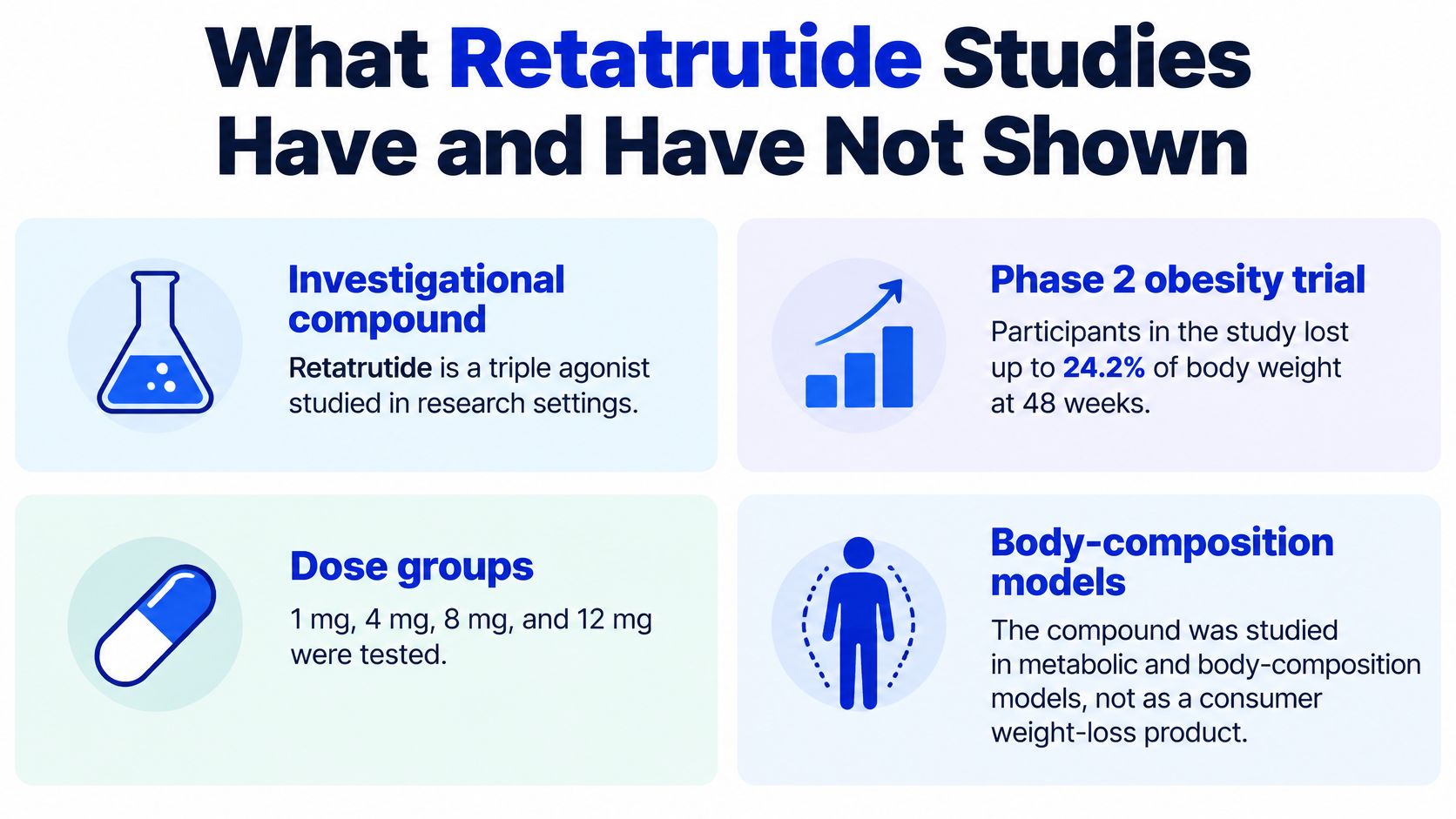
In the 338-person phase 2 obesity trial described in a peer-reviewed review in PubMed Central, the highest retatrutide dose produced mean weight loss of 24.2% at 48 weeks. Up to 26% of participants reached at least 30% weight loss. Those numbers explain the interest in triple agonists, and they're the numbers most product pages borrow.
Borrowing is the problem. That review treats phase 3 studies as still ongoing, which means evidence on durability, rare adverse events, cardiovascular outcomes, and broader populations remains incomplete. Promising phase 2 efficacy doesn't establish long-term safety, approved dosing, manufacturing equivalence, or suitability for human use.
Boundary to remember: A study endpoint is not a purchasing claim and not a dose.
Laboratory and clinical research around this class focuses on pathways, not consumer protocols. You'll see these themes in legitimate research descriptions:
None of those themes tells you what's in a specific vial for sale. Trial material is manufactured, verified, and dosed under a protocol. A research listing is only as trustworthy as its own identity and lot documents.
The video below gives additional background on how this compound class is discussed in research settings.
Treat trial results as a reason researchers study the molecule. Don't treat them as proof that any seller's material matches the studied molecule, or as a basis for personal use. That proof has to come from the lot packet, not the headline percentage.
Many buyers assume a research use only disclaimer settles the legal question. It doesn't. Regulators look at intended use, and intended use is shown by the whole listing, not one line in small print.
In the FDA warning letter to Gram Peptides, the agency stated that website evidence could establish intended human-drug use despite disclaimers saying products were not for human consumption. The cited indicators included disease-related marketing claims, dosing instructions, peptide calculators, reconstitution guidance, and the sale of bacteriostatic water alongside injectable peptides.
Apply that test to any GLP-3 peptide buy page you open. Ask what the page is really selling:
The second pattern is a warning sign, even if the footer says research only. Responsible research suppliers avoid human-use directions and provide laboratory documentation instead. If a seller gives you a protocol but can't give you a lot number, the priorities are reversed.
The FDA warning letter to NuScience Peptides LLC identifies products labeled GLP-3 RT (Retatrutide) Research Peptide as unapproved new drugs under section 505(a) of the Federal Food, Drug, and Cosmetic Act. That classification means the words research peptide don't create an FDA-approved medicine.
Buyers often get confused by the wider GLP-1 market. During past shortages, compounded copies of approved drugs filled gaps under temporary conditions. That history doesn't make a research peptide a substitute for an approved product, and it doesn't extend to an investigational molecule with no approved version at all. Lower price or easier availability doesn't change identity, legal status, or intended use.
Compounded products also show why boundaries matter. Problems in that separate category, including dosing errors from unclear labeling, are not a safety profile for retatrutide. They show what happens when people treat nonstandard products as if they were regulated medicines with tested instructions. Don't import that assumption into research purchasing.
Peptide Warehouse USA is a research chemical supplier. We are not a compounding pharmacy or compounding facility under Section 503A, nor an outsourcing facility under Section 503B, of the Federal Food, Drug, and Cosmetic Act.
Our products are not intended for human or veterinary consumption. We do not provide medical advice, dosing instructions, or treatment guidance of any kind. If your intended use is treatment, weight loss, diagnosis, or personal consumption, a research listing is the wrong product category, and you should speak with a clinician about approved options instead.
The buyer distinction is simple. Legitimate laboratory or analytical work needs documented material and clear restrictions. Any representation for treatment needs an approved drug and medical supervision. A disclaimer can't move a product from the second category into the first.
Price questions are easy to answer. Identity questions are the ones that determine whether your work is usable. The regulatory background explains why. In a Regulatory Review analysis of GLP-1 compounding after drug shortages, the FDA determined that the semaglutide shortage was resolved in February 2025, while the tirzepatide shortage had already been resolved in December 2024. Those decisions ended the temporary shortage-based rationale for broadly producing identical compounded copies.
That history leaves a procurement lesson. When legal status changes and impurity questions have emerged even in compounded GLP-1-related products, certificates and traceability should be assessed, not assumed. Build your order around jurisdiction, intended use, independent analytical documentation, chain of custody, storage requirements, and institutional compliance review where your lab requires it.
Use this table as your requirement list before you compare sellers. Every row should pass for the exact lot you're ordering.
| Required field | Why it matters | Pass standard |
|---|---|---|
| Exact identity | Stops a nickname from hiding a different molecule | Retatrutide or LY-3437943 on label and COA |
| Sequence or structure and theoretical mass | Confirms identity for cross-study comparison | Structure and mass method stated |
| Salt form and vial content | Lets the lab record mass, not a dose | 10 mg, 15 mg, or 30 mg matches the order |
| Purity method and result | A badge without a method is not data | Method named and result at or above the stated spec |
| Residual solvent, endotoxin, and microbial reports | Screens contaminants beyond a purity percent | Lot-specific reports attached |
| Lot number and COA date | Makes the vial traceable | Vial lot matches the PDF |
| Intended use and custody | Separates lab supply from treatment claims | Research-only statement and a filed supplier record |
We provide high-purity research peptides backed by third-party testing, including COAs, endotoxin, and microbial reports. Our products are advertised with 99.5% purity, are made in the USA, and are batch produced and batch tested. Those claims only help you if you tie them to the lot in your hand, so read the packet in order.
Say two listings both advertise the same purity percentage. One names retatrutide and LY-3437943, states the structure and theoretical mass, gives a salt form, and attaches lot-specific identity, endotoxin, and microbial reports. The other says GLP-3, shows a badge, and links to a generic certificate with no lot number.
Those aren't comparable offers at different prices. The second listing hasn't established what molecule it's selling. You can't normalize material between experiments, repeat a prior lot's conditions, or defend the purchase in a lab record if the identity field is missing.
Salt form and vial content matter for the same reason. Your lab records mass, solvent handling, and analytical conditions based on what's in the vial. A label that omits salt form or swaps package sizes without matching documents creates quiet errors that only show up when results don't repeat.
Procurement rule: If any required cell in the specification is missing, the listing is not comparable material.
Ask for the missing document before ordering, not after delivery. A supplier should be able to connect every claim on the product page to a dated, lot-specific file. If that connection breaks at any row of the table, pause the order and resolve the gap, choose a different lot, or choose a different supplier.
“GLP-3” is a nickname, not a complete procurement specification. Once the molecule and required lot documents are established, compare package sizes and prices as separate options, not as treatment choices.
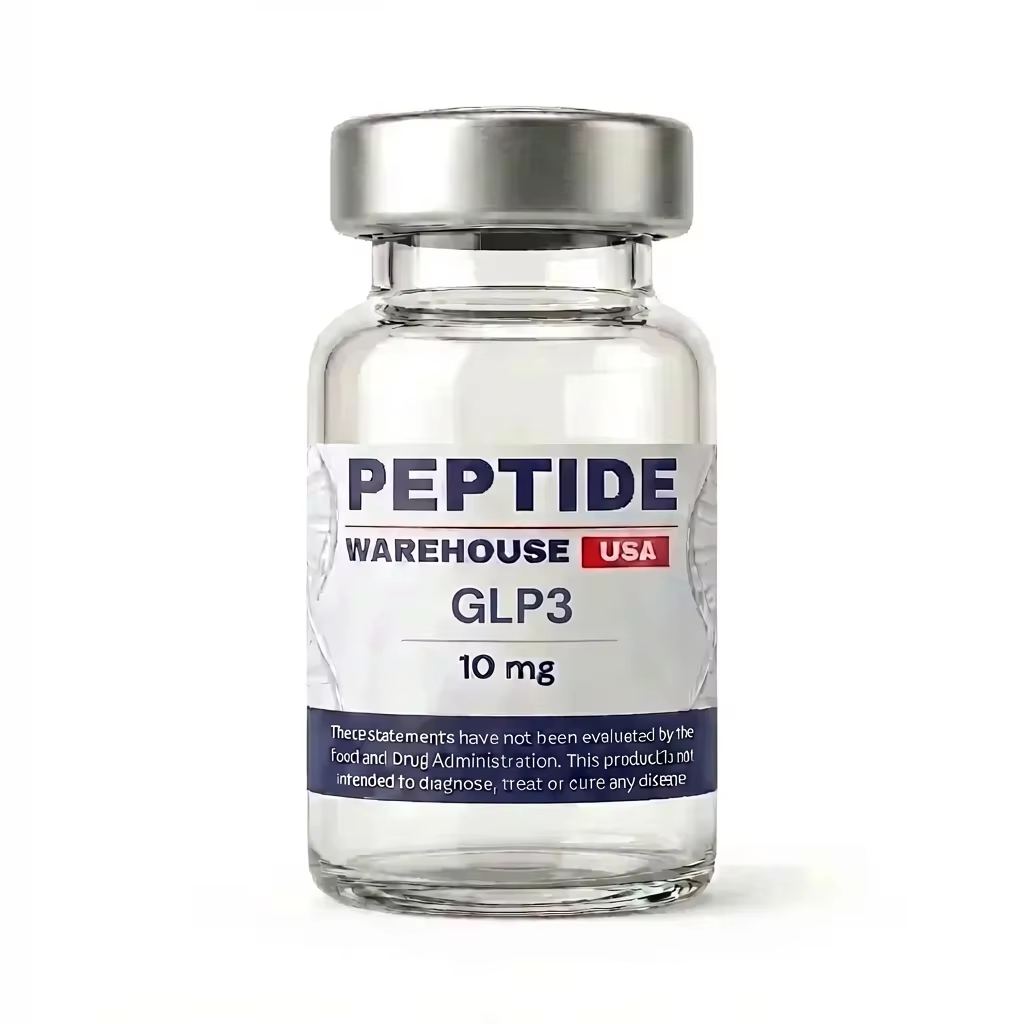
Peptide Warehouse USA lists GLP 3 RETATRUTIDE at $249.99 to $349.99, with package size filters for 10 mg, 15 mg, and 30 mg. Match the price to the selected size at checkout: the listed range covers different options, rather than one price for every package.
That price buys a stated-purity research peptide, with batch testing and lot documentation for laboratory use. Peptide Warehouse USA advertises products with purity up to 99.5% and provides third-party documentation, including COAs, endotoxin reports, and microbial reports. A purity figure is one part of the record; the molecule identity and lot-specific paperwork are what let a lab compare materials.
A price comparison only works when the packages and documentation are comparable. For each size:
A lower price is meaningful only after package size and documentation are matched. The amount of material changes with size; the evidence needed to identify the lot does not.
Peptide Warehouse USA ships to all 50 U.S. states and offers carrier and delivery options at checkout. Order tracking can help answer status questions after purchase. Check the product listing for current availability.
Storage and handling belong to the laboratory's procedures. Keep research material under the conditions specified for the product and your lab's handling process. The products are for research use, not human or veterinary consumption, and the supplier does not provide medical advice, dosing instructions, or treatment guidance.
Compare the available package sizes against the specification table before selecting an option. A price, vial image, or purity figure alone cannot establish that two lots are equivalent.
Usually, in current commercial usage, the nickname points to retatrutide (LY-3437943). Order by the exact molecule name and structure anyway, because a nickname can't confirm identity for lab records.
No. It's an investigational triple agonist, and phase 2 results don't equal regulatory approval. There's no approved human dose to copy from a trial headline or a product page.
No. A research use only label doesn't turn a peptide into a treatment, and our products aren't for human or veterinary consumption. Personal health questions belong with a clinician, who can also point you to everyday resources such as Gym Snack's guide to staying full for nutrition context that doesn't involve research chemicals.
It reports identity, purity, and test results for one lot only. If the lot number on the vial doesn't match the certificate, the document doesn't prove anything about your material.
Purity is one data point, not a safety finding. Identity confirmation and endotoxin and microbial reports matter for research quality, and none of them establish safety for human use.
Not by themselves, but price proves nothing about identity, contaminant control, or legal status. A low price with a complete lot packet can be evaluated. A low price with only a nickname and a badge can't.
Put the listing beside your specification and answer three yes-or-no questions. Don't average the answers. All three need to be yes.
First, does the name resolve to retatrutide or LY-3437943, with structure and theoretical mass, rather than GLP-3 alone? Second, do the certificate, endotoxin report, and microbial report match this vial's lot? Third, is the intended use limited to research, laboratory, or analytical work, with no dosing or treatment language attached?
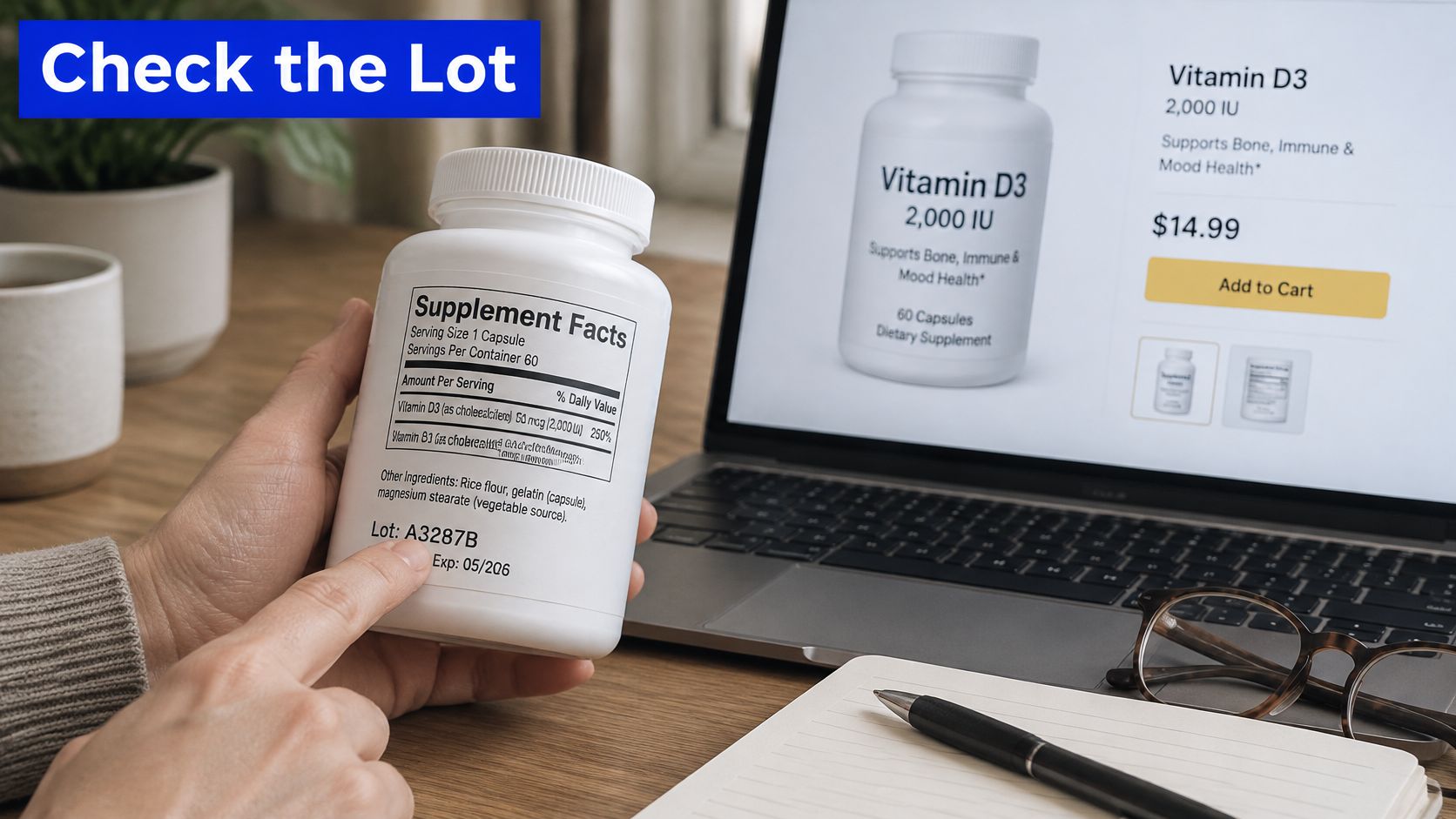
The photo below shows the habit to build. Check the identifier on the container against the documents before money changes hands.
If any answer is no, request the documentation or choose another lot. Don't fill the gap by inferring a human protocol from a trial, a calculator, or another product's label. Missing identity or custody information is a reason to stop, not a detail to work around.
If all three answers are yes, learn more from the attached COA on the Peptide Warehouse USA GLP-3 Retatrutide research listing before checkout. We work with established manufacturing partners and third-party laboratories to ensure our products meet defined purity and identity specifications. Our support assists with non-medical, non-clinical questions about product availability, documentation, and order status only.
Products are not for human or veterinary consumption, statements on our website have not been evaluated by the U.S. Food and Drug Administration, and nothing here is medical advice.
Buy the documented molecule, not the nickname.
Visit Peptide Warehouse USA to compare the GLP-3 Retatrutide research listing by vial size against its lot documentation, including COA, endotoxin, and microbial reports. Choose the documented lot that matches your laboratory specification, and contact support for non-medical help with availability, paperwork, or order status before you check out.