No products in the cart.

A purity percentage or a GMP label can look like a complete quality verdict, but neither tells you on its own whether a peptide is correctly identified, whether the tested batch is the one being delivered, or which facility and controls support the claim. When evaluating GMP-certified peptides, the better question isn't “How high is the purity?” It's “Can I follow the evidence from the manufacturer and facility to the lot in front of me?”
A lab buyer might find a product page that says “GMP,” “high purity,” and “COA verified,” then discover that it doesn't name the manufacturing facility, identify the scope of the claimed standard, or connect the certificate of analysis (COA) to a specific lot. Those gaps don't prove a product is poor quality, but they do limit what a buyer can verify.
This guide explains what GMP controls, how it differs from other quality claims, and how to review supplier documents without treating manufacturing quality as proof of human approval or effectiveness. The central principle is simple: quality is a chain of evidence, not a single number.
A prominent purity result can be useful, but it isn't a complete description of a peptide or the process used to produce it. A product might show a strong chromatographic result while leaving open basic procurement questions: Who manufactured it? Which facility and activities does the GMP claim cover? Does the COA identify the lot being offered, and does it show how the supplier reached a release decision?
The same caution applies to the phrase “GMP certified.” Buyers should establish what the statement refers to before using it to compare products. The claim might relate to a manufacturer's quality system, a particular facility, or defined manufacturing activities. Without scope and supporting documentation, the words alone don't establish that the specific product and delivered lot were made and released under the controls a buyer expects.
Consider a researcher preparing a purchase request. Two product listings describe a peptide as high purity and provide downloadable COAs. One listing identifies a manufacturer and facility, while the other gives no facility details; neither fact alone settles quality. The researcher still needs to match the lot, review the test methods and specifications, and understand how quality staff assessed the records before release.
Practical rule: Treat each quality statement as a claim that needs evidence. A COA, a purity result, and a manufacturing certification answer different questions.
A careful review helps buyers avoid two opposite mistakes. One is assuming that a GMP label proves every attribute they care about. The other is dismissing quality documentation because no single document answers everything. Instead, look for a traceable set of evidence that connects the supplier, manufacturing scope, specifications, tests, records, and actual lot.
That distinction matters for research procurement. GMP supports controlled manufacturing and quality practices. It doesn't, by itself, establish clinical effectiveness, approval for human use, or legal authorization in every market.
Think of a manufacturing line as a process in which each handoff needs to be controlled and documented. Workers, equipment, incoming materials, written procedures, production steps, laboratory tests, and records all affect whether the finished material meets its defined specifications. Good Manufacturing Practice (GMP) is the quality-assurance system that governs those connected activities, rather than a label attached to the peptide's chemical identity alone. The World Health Organization's GMP overview describes controls across starting materials, facilities, equipment, documented procedures, personnel, production, testing, and recordkeeping.
The analogy has limits. A controlled production line isn't automatically sterile, and the presence of GMP controls doesn't guarantee that a product is suitable for every experiment. GMP is about consistent production and control against defined specifications. The specifications and the testing used to assess a particular peptide still matter.
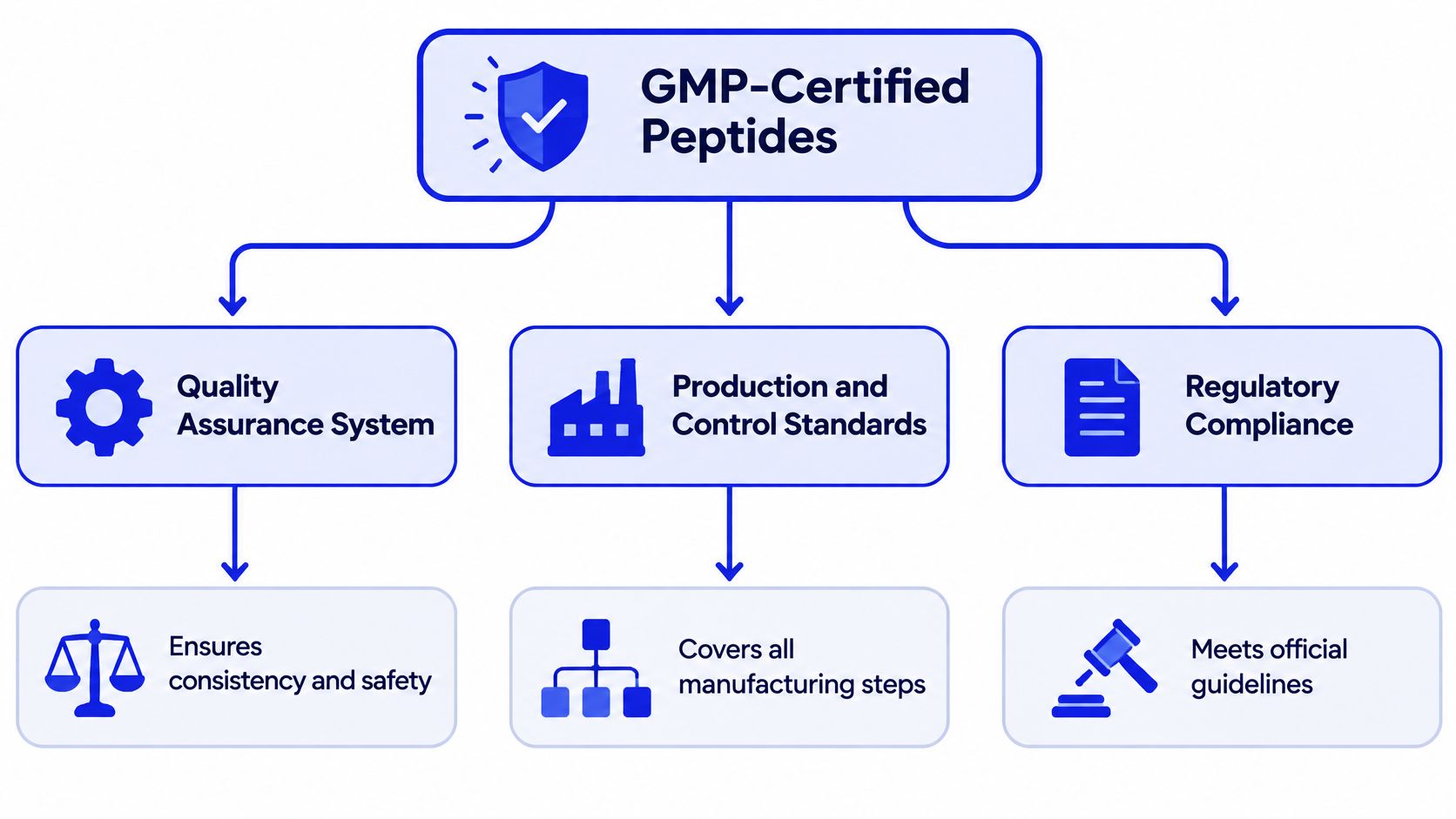
A useful GMP claim should point to something a buyer can inspect: the manufacturer, the facility, the activities or products covered, and documentation that connects the quality system to the lot under review. WHO guidance links GMP status with manufacturing authorization, inspections by competent authorities, and written procedures supported by records showing they were followed. The WHO Certification Scheme provisions provide context for why facility identity, scope, and inspection evidence matter.
“GMP-certified peptide” can therefore be imprecise if the seller doesn't explain what was certified or inspected. Ask whether the statement covers the site that made the peptide, the relevant manufacturing activities, and the quality controls applied to the product. A facility's quality status shouldn't be assumed to apply to every product or lot without evidence connecting them.
A finished-product test can provide important information, but it can't replace controls over incoming materials, equipment, procedures, personnel, production, and records. Quality systems are designed to manage the process that creates the product, not merely to inspect a sample at the end.
That's why a useful way to think about GMP-certified peptides is as products supported by a traceable manufacturing system. The strength of the claim depends on how clearly the evidence links the facility's controls to the product's defined requirements and the delivered lot.
Quality language on a product page often combines terms that sound similar but answer different questions. GMP concerns manufacturing controls. A COA reports selected analytical results. A purity value describes a result under a stated analytical method. Research-use labeling identifies intended use; it doesn't describe the whole quality system. Regulatory authorization is a separate question about a product's legal and market status.
| Quality Claim | What It Establishes | What It Does Not Establish |
|---|---|---|
| GMP | A manufacturing quality system and controlled processes, when supported by facility and scope documentation | That every quality attribute was tested, or that a product is approved for human use |
| Purity result | A measured result under the test method and specification reported | Identity, mass content, or other attributes not covered by that method |
| COA | Selected analytical results for the product or lot identified on the document | That the results match every buyer requirement or that the document represents a full quality system |
| ISO-style quality language | A quality-management claim whose meaning depends on the stated standard, scope, and evidence | GMP status for a drug-manufacturing activity or authorization for a specific product |
| Research-use-only label | The supplier's stated intended-use boundary | Product approval, clinical effectiveness, or quality-system conformity |
| Regulatory authorization | A product's status under the relevant regulatory framework | That all research users' analytical or experimental requirements are met |
A COA is useful only when you can interpret what it covers. It should identify the product and lot, show the reported results, and give enough method or specification context for a buyer to assess relevance. If a document states a purity result but omits the method, the buyer has less information about how to compare that result with another product or with an internal specification.
GMP also shouldn't be treated as shorthand for approval. WHO describes a framework connected to manufacturing authorization and inspection, not an automatic declaration that a peptide is clinically effective or authorized in every market. In the United States, FDA's overview of current good manufacturing practice regulations explains the manufacturing controls applied to regulated drug products. The applicable requirements depend on product status and context; a research-use label doesn't turn a product into an approved medicine.
“GMP” is a claim about how manufacturing is controlled. It isn't a substitute for checking what the product is, what was tested, or what the product is authorized to be used for.
A buyer can review a supplier's claims in a consistent order. Start with the organization and facility, then move to the documents and the delivered lot. This helps identify whether a claim is specific enough to verify before procurement moves forward.
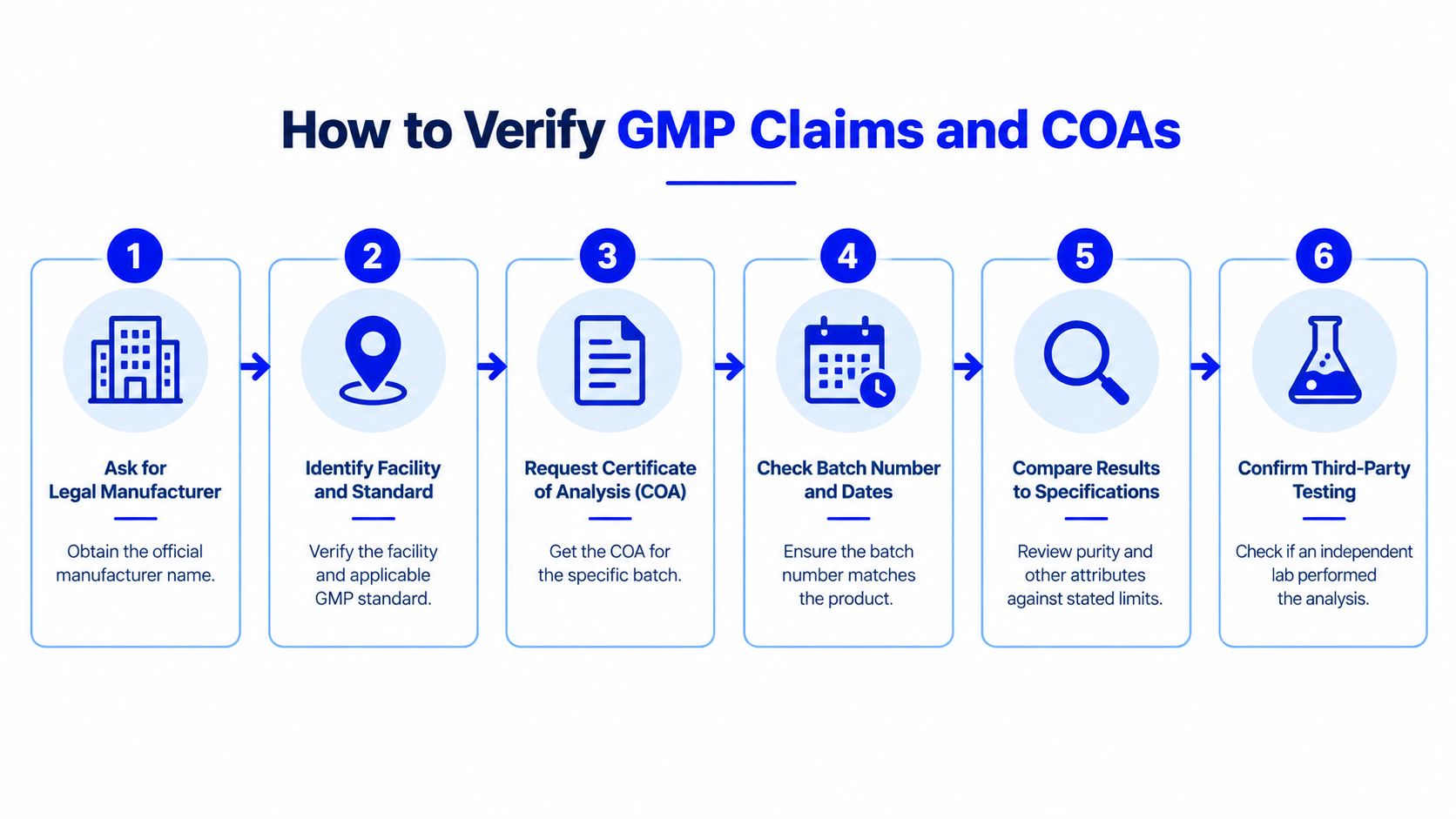
The FDA's ICH Q7 guidance for active pharmaceutical ingredients cautions that a raw-material supplier's COA may not match a buyer's specifications. Buyers should compare a report with written requirements, including identity and assay or content, as well as relevant impurity and composition limits. For help creating clear requirements to evaluate a supplier's documentation against, see how to craft actionable specs.
A single COA isn't proof of a complete GMP system. It may summarize selected results, but it doesn't necessarily show how incoming materials were controlled, how manufacturing records were reviewed, or how a quality unit made a release decision. If a report is incomplete, ask which lot it covers, what method produced each result, what limit applies, and whether missing records or tests can be provided. A vague answer is a reason to pause and clarify, not an invitation to assume that an unstated control exists.
For a visual overview of how documentation checks fit into procurement, see the verification steps above.
Chromatographic purity is one measurement, not a complete quality profile. It doesn't automatically answer whether the sample is the intended peptide, how much peptide is present by mass, or whether water, residual materials, counter-ions, or biological attributes are controlled. The EMA guideline on the development and manufacture of synthetic peptides describes peptide specifications as supporting quality, safety, and efficacy through multiple tests, rather than relying on a single purity result.
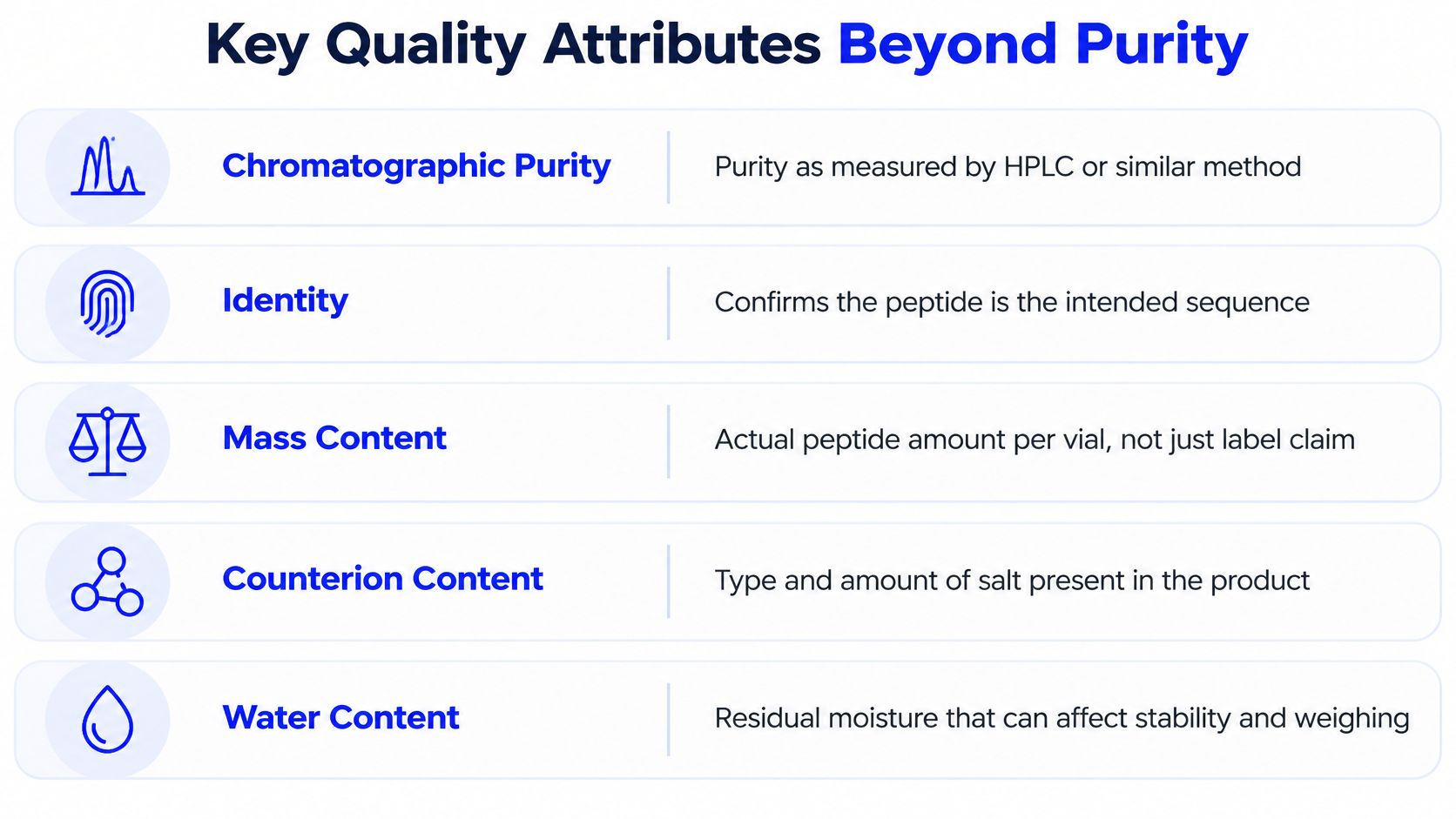
A peptide can show high chromatographic purity and still have incorrect mass content, excess water, residual reagents, or an unverified counter-ion composition. Those factors can affect weighing, dosing calculations, stability, and reproducibility. The result is a practical distinction: purity describes performance under a particular analysis; it doesn't answer every question about the material in the vial.
| Attribute | Buyer Question | Supporting Evidence |
|---|---|---|
| Identity | Does the material match the intended peptide? | A lot-linked identity test, method, and acceptance criteria |
| Chromatographic purity | What does the reported purity result measure? | Test method, chromatogram or report, specification, and lot match |
| Mass content or assay | How much peptide is present in the supplied material? | A defined assay or content result and its method |
| Sequence-related impurities | What related or unintended peptide species were assessed? | Impurity profile, method, and stated limits |
| Residual solvents or reagents | Were process-related residues evaluated where relevant? | Applicable test results and specifications |
| Water content | How much moisture is present, and could it affect weighing or stability? | A water-content result with method and limit |
| Counter-ion composition | What counter-ion is present, and is its amount defined? | A composition result and written specification |
| Aggregation | Was aggregation assessed where relevant to the research use? | A suitable method and reported result |
| Microbial quality and endotoxins | Are relevant biological attributes documented for the intended work? | Applicable microbial and endotoxin reports |
| Stability | Is there evidence about how the material holds up under defined conditions? | Stability information relevant to storage and handling |
Not every laboratory needs the same tests for every project. Decide which attributes matter to the experiment, define them in the purchasing specification, and ask whether the supplier's reports address those requirements. These checks support research quality assessment. They don't guarantee safety, clinical benefit, suitability for every experiment, or authorization for human consumption.
Consider a fictional laboratory buyer comparing two documentation packages for the same named peptide. The examples illustrate how to review records; they don't describe or certify any actual supplier.
Package A includes a product page with a prominent purity figure and a downloadable COA. The report doesn't identify the analytical method or give enough information to establish whether the lot number matches the product offered. It also provides no facility scope or explanation of how testing connects to release.
That package offers a starting point, but it leaves follow-up questions: Who made the peptide? Which facility and manufacturing activities does the GMP claim cover? Does the COA apply to the lot being shipped? Which written specification defines acceptable results? What review supports final disposition?

Package B identifies the manufacturer and facility scope, provides a COA matching the lot under consideration, and supplies relevant specifications and test reports. It also explains how quality review connects test results and production records to the batch disposition.
The buyer still needs to check whether the methods and specifications fit the intended research, and whether any relevant test reports are available. A fuller package improves traceability, but it doesn't establish human approval or clinical effectiveness. In regulated drug manufacturing, 21 CFR 211.22 assigns the quality control unit authority to approve or reject materials and products and to review production records, including follow-up on errors and investigations.
In practice: A document package is useful when its parts connect. A test result without lot identity, a specification without a method, or a GMP statement without facility scope leaves an evidence gap.
Buyers can apply the same questions to any supplier without assuming that a product's marketing language proves a certification claim. If you're comparing research supplies, review relevant product and laboratory-resource information carefully, and assess each offering against your own documented requirements.
Before placing an order, use a checklist that follows the evidence from supplier to lot. GMP documentation is most useful when it answers questions that matter to your laboratory, rather than repeating a general quality statement.
A strong documentation package connects the product name and lot number to specifications, analytical results, relevant deviations or investigations, and final disposition. A COA without lot matching, method details, or controlled recordkeeping provides limited evidence of a complete quality system. For broader advice on comparing suppliers and purchasing decisions, tips for smarter procurement can help frame a consistent process.
When essential information is missing, pause and request clarification before purchasing. Your laboratory's own quality requirements should determine which evidence is necessary, and the supplier's answers should be specific enough for your team to document its decision. Controlled manufacturing, transparent lot records, and clear research-use boundaries matter more than an impressive purity number.
Peptide Warehouse USA offers research peptides and related compounds for laboratory, analytical, and preclinical applications, with product and sourcing information for buyers to review. Explore the catalog and learn more about its research-use focus at Peptide Warehouse USA.