No products in the cart.



If you’re reading this, there’s a good chance you’ve already had a peptide order arrive with a polished product page, a bold purity claim, and just enough documentation to look credible. Then the experiment underperforms, a repeat run drifts, or one lot behaves differently from the last. At that point, “high quality peptides” stops being a marketing phrase and becomes a procurement problem.
In research settings, failed materials waste more than budget. They consume staff time, distort comparisons, and force teams to troubleshoot biology when the issue may be chemistry, formulation, or documentation. The practical question isn’t whether a vendor says a peptide is high quality. The question is whether the batch file proves it.
A reliable peptide has to clear three checks at once. It must be the right molecule, sufficiently clean, and documented in a way that supports reproducibility. Consider it similar to accepting a reference standard into the lab. A clean-looking vial means very little if identity isn’t confirmed, net content isn’t clear, or the batch record is generic.
The labs that source well usually don’t rely on a single number. They read the COA, inspect the chromatogram, verify mass data, and ask whether the supplier can trace the lot from manufacture to release. That’s where most quality gaps show up.
A peptide order arrives on time, the vial is labeled cleanly, and the product page promised high purity. Then the experiment drifts. The signal is weaker than expected, the replicate set spreads, and the only paperwork in the box is a one-page summary with no clear batch tie-out. That is usually where buyers learn the difference between marketed quality and documented quality.
High quality peptides are defined by evidence attached to the specific lot in hand. The standard starts with the material itself, but procurement decisions should center on verification. A reliable batch has traceable documentation for identity, purity, composition, and contamination control, with records that match the vial you received.
The practical question is simple. Can you verify the batch, or are you being asked to trust a claim?
I use three filters when reviewing peptide quality:
Only the third filter supports reproducible work.
Peptide quality gets reduced to a chemistry talking point because a single purity number is easy to sell. Procurement risk is broader than that. If a supplier cannot show what was tested, when it was tested, and which lot produced the result, the buyer has no way to judge whether the certificate describes the vial on the bench or a template copied from a prior run.
That problem shows up in routine orders as often as in custom synthesis. A peptide can be suitable for one screening application and still be a poor choice for quantitative work, assay development, or any study where low-level impurities or inconsistent salt content will affect the readout. The more sensitive the method, the less tolerance there is for missing documentation.
High quality peptides are defined by what the paperwork can support.
That standard is stricter than many product pages suggest. In practice, a useful review starts with a batch-specific COA, then moves to the underlying chromatogram and mass data, then to traceability details such as lot number, test date, and storage or shipment conditions. Buyers who stop at the advertised purity percentage miss the part that determines whether the material is defensible in a lab record and repeatable in a second order.
Quality, then, is not a branding term. It is a verification framework.
The first thing most buyers see is a purity percentage. That’s fine as a starting point, but it doesn’t tell the full story. You need to know how that number was generated and whether the same batch was independently identified.
In peptide QC, HPLC is the routine standard because it separates the components in a sample and allows relative quantification of the target peptide against related impurities. Industry guidance describes modern peptide quality control as anchored in chromatography-based verification, with HPLC used for purity assessment and MS used for identity confirmation. The same guidance states that high-quality research-grade peptides are expected to be 98% pure or higher as determined by HPLC (JPT peptide purity guidance).
That matters because “pure” in a practical sense means the target peak dominates the chromatogram. If the report gives you only a single percentage and no chromatogram, you can’t see peak shape, nearby impurities, or whether the integration looks plausible.
A chromatogram is easier to read than commonly believed. You are mainly looking for:
Purity without identity is incomplete. A clean sample of the wrong material is still the wrong material.
Mass spectrometry gives you the molecular weight signature needed to confirm that the target peptide is present. A simple way to explain the division of labor is this: HPLC separates the sample into components, while MS confirms whether the main component matches the expected mass of the intended peptide.
Practical rule: If a supplier shows HPLC but cannot produce mass confirmation for the same lot, treat the batch as insufficiently verified.
For more demanding workflows, buyers may also want sequence-supporting data or amino acid analysis when relevant. The point isn’t to demand every possible test on every purchase. The point is to make sure the data package matches the risk of the experiment.
A vendor can advertise a high purity number while leaving important questions unanswered:
| Question | Why it matters |
|---|---|
| Was purity measured by HPLC on this exact batch? | Generic figures don’t verify the vial you received |
| Was identity confirmed by MS? | Purity does not prove correct molecular identity |
| Is the analytical file batch-specific? | Shared or template reports reduce traceability |
| Is there enough method detail to interpret the result? | Results without context are hard to audit |
That is why experienced buyers treat purity and identity as paired requirements, not interchangeable ones.
A strong COA should answer basic questions quickly. What is this material, which lot is it, when was it tested, and what analytical evidence supports release? If you have to infer those answers, the document is weak.
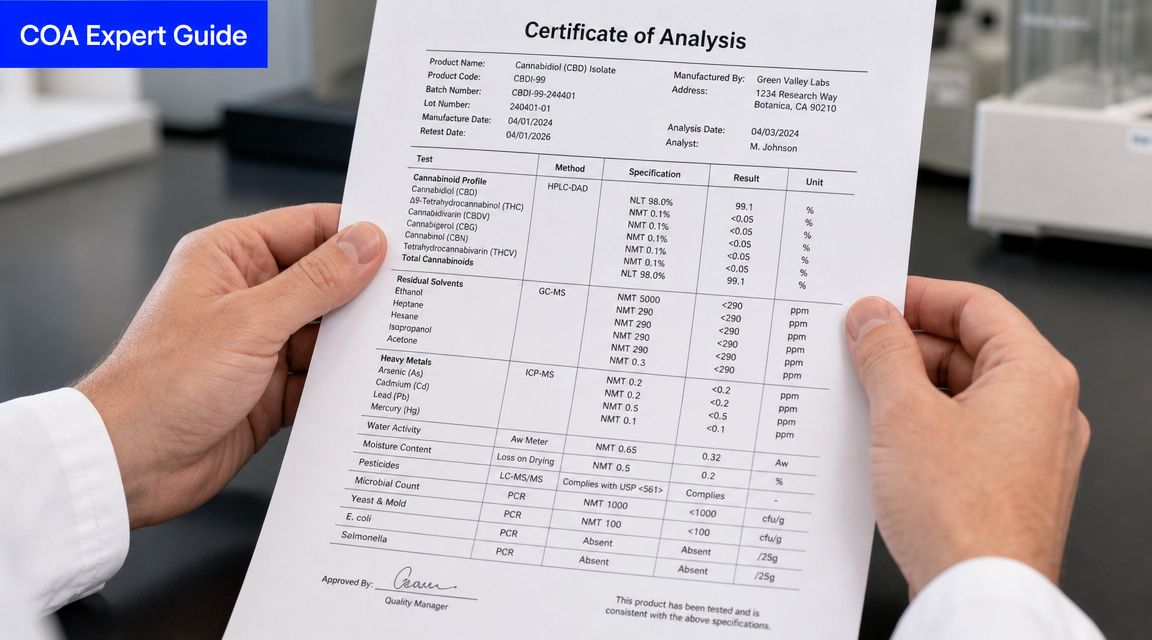
Before reading any result, verify the header section.
Look for the product name, lot or batch number, date of manufacture or testing, and a clear connection between the document and the vial label. A generic “sample COA” can be useful for format preview, but it should never substitute for a batch-specific release document.
If you’re training a new buyer, tell them to read the top third of the COA before the bottom two-thirds. That’s where traceability starts.
Use this quick screen:
Many buyers get tripped up on this point: Purity and net peptide content are not the same thing.
Industry guidance notes that peptides sold for research are typically greater than 95% pure by HPLC, but the solid material often contains only 70–90% peptide content because counterions and residual salts add weight without representing active peptide. That means vial weight alone does not equal active peptide amount, and net content verification becomes important for reproducible dosing and reconstitution (Bachem care and handling of peptides).
Here is the practical consequence. A vial can be analytically clean and still deliver less actual peptide than its gross weight suggests. If your team compares lots by vial weight alone, you may introduce dosing variation without realizing it.
When experiments drift between lots, one of the first things I check is whether the team treated labeled weight as active content.
This is not unique to peptides. Any testing market that leans too hard on simplified certificates creates the same problem. A useful parallel appears in ImuPro Australia’s discussion of the pitfalls of cheap food sensitivity tests, where the core issue is similar: buyers often get a report that looks authoritative but lacks the depth needed for reliable interpretation.
Not every imperfect document is disqualifying. Some are. These usually warrant follow-up before funds leave the lab.
A good COA is not necessarily long. It is specific. It lets a buyer confirm the batch, review the core analytical claims, and decide whether the material is fit for the intended use.
That is the standard to hold.
A peptide can look acceptable on paper and still create avoidable problems in the lab if the supplier cannot trace that vial back to a controlled batch release. I have seen this show up as repeat orders that perform differently, missing supporting files after purchase, or lot numbers on shipping labels that do not match the documentation sent to procurement.
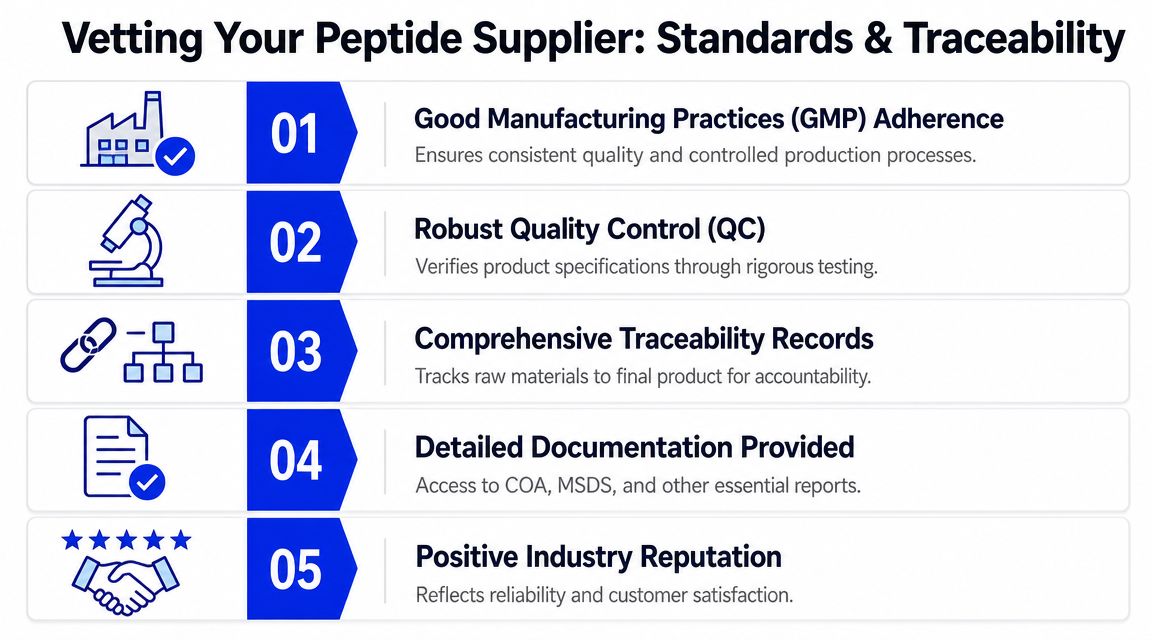
Supplier review should answer a practical question. Can this company prove what it made, how it tested the batch, and how it kept that batch identifiable through shipment?
That standard is more useful than product-page claims about purity or speed. An independent peptide vendor comparison guide notes that researchers often run into lot-to-lot consistency issues, residual solvent concerns, and endotoxin risk that affect experimental outcomes more directly than a headline purity claim alone (independent peptide vendor comparison guide).
In procurement terms, transparency means the supplier can produce records without delay and those records agree with each other. The lot number on the vial, the COA, the chromatogram, the MS report, and the packing record should point to the same batch. If those identifiers drift, confidence drops fast.
Traceability is an operating discipline, not a sales phrase. Buyers should expect a repeatable release package and a clear chain from manufacturing to fulfillment.
Use this framework during qualification:
| Supplier question | What the answer tells you |
|---|---|
| Can you send the batch-specific COA before purchase? | Whether release data are organized before the sale, not assembled afterward |
| Do the lot number on the vial, COA, and analytical reports match exactly? | Whether batch identity is preserved through packaging and fulfillment |
| Can you provide supporting HPLC and MS files for that same batch? | Whether the supplier keeps underlying analytical records, not just summary claims |
| Do you maintain shipment-level traceability for relabeled or split lots? | Whether the batch shipped is still traceable after internal handling |
| Are endotoxin and microbial reports available when the use case requires them? | Whether the supplier understands biological-use controls, not just chemical release |
Strong suppliers usually answer these questions directly. Weak ones answer with general policy language, sample documents, or promises to share records after payment.
Short lead times can help a project recover from a delay. They can also expose weak release discipline if the documentation package gets thinner as turnaround gets faster. GenScript states that custom peptides can be delivered in as fast as 5 days, which shows how quickly some vendors can manufacture material (GenScript peptide synthesis page).
The buying decision is not just fast versus slow. The trade-off is fast with batch control versus fast with incomplete records. For screening work, some labs may accept a shorter documentation set if the risk is low and the material will be qualified internally. For comparative assays, method development, or any study where repeatability matters, I would hold the line on lot-specific records before issuing the PO.
Peptide Warehouse USA is one example of a supplier that states it provides research peptides with third-party documentation, including COAs and microbial and endotoxin reports. The useful takeaway is the model, not the name. Ask whether the supplier can show batch control, traceability through fulfillment, and supporting records at the time of purchase. If the answer is vague, keep looking.
A peptide arrives with a clean HPLC trace, the mass matches, and the COA looks fine at first glance. Then the cell assay shifts, background inflammation rises, or an animal study shows noise that does not fit the mechanism. In many labs, that failure gets blamed on biology first. I check contamination records before I trust that conclusion.
Chemical purity and identity answer only part of the question. For biological work, endotoxin status and microbial status can decide whether a lot is usable at all.
Endotoxins are bacterial byproducts, not live organisms. A peptide can look chemically acceptable and still carry enough endotoxin to alter cytokine release, stress immune-sensitive cell systems, or distort potency readouts. If the study involves macrophages, PBMCs, epithelial models, or any inflammation-linked endpoint, that risk is not theoretical.
Microbial testing covers a different failure mode. It addresses whether viable bacteria, fungi, or related contamination entered during production, filling, or post-production handling. A lot can pass one screen and fail the other. Buyers who treat endotoxin and microbial testing as interchangeable miss that distinction.
This is the practical rule. If the peptide will touch a biological system, contamination testing belongs in the release package.
Many guides stop at “ask for the report.” That is not enough. The report has to be readable, lot-specific, and tied to the material in your hand.
Ask for:
I also look for one simple sign of process control. The supplier should be able to explain whether these tests are performed on every lot, by risk category, or only on request. Each approach has trade-offs. Routine lot testing gives stronger batch confidence but can add cost and lead time. On-request testing may be acceptable for low-risk screening work, but only if the lab knowingly accepts that gap.
A usable endotoxin or microbial report should connect to the rest of the batch file. The lot number should align across the COA, analytical data, vial label, and shipping paperwork. Dates should make sense. Methods should be named. Specifications should be stated in a form your team can review internally.
Watch for weak documentation patterns:
Older peptide quality frameworks treated documentation as part of material quality, not as a marketing extra. That same standard should apply here. A peptide intended for biological use needs contamination records that are specific enough to verify, not just reassuring enough to read.
The most common procurement mistake is accepting contamination claims at the product-page level and assuming they apply to the shipped lot. They may not. Another is requesting these records only after an assay behaves unexpectedly. By then, the experiment has already absorbed the risk.
For in vitro and preclinical workflows, the cleaner approach is straightforward. If endotoxin or microbial status could affect interpretation, require the lot-specific documentation before release and review it with the same discipline you use for HPLC and MS.
Even well-documented peptides can lose value if they are stored badly, reconstituted carelessly, or shipped without enough control. Procurement doesn’t end at checkout. It ends when the material reaches the bench in usable condition.
Lyophilized peptides generally benefit from cool, dry, dark storage and minimal handling before use. Teams often create problems by opening vials repeatedly, leaving material exposed to moisture, or using informal reconstitution practices across different users.
A few habits reduce that risk:
Good procurement can be undone by sloppy bench handling in a single afternoon.
Shipping is easy to ignore because it happens outside the lab. It still affects the result. Heat-sensitive material, long transit windows, and unclear packaging controls all increase uncertainty before the vial is ever logged in.
When comparing suppliers, ask practical questions:
| Shipping question | Why it matters |
|---|---|
| Is the shipping method matched to product sensitivity? | Reduces avoidable transit stress |
| Are handling instructions included on receipt? | Helps staff preserve material immediately |
| Is the lot traceable through fulfillment? | Prevents mix-ups between release and delivery |
| Does support respond quickly to shipment issues? | Delays matter when material needs controlled storage |
High quality peptides stay high quality only when the chain from manufacture to bench is controlled. Buyers should treat storage and shipping as part of QC, not as a separate logistics issue.
Most peptide buying mistakes happen because the review process is too loose. A quick scan of the product page, a glance at the purity number, and the order goes through. A better system is to apply the same short checklist every time.
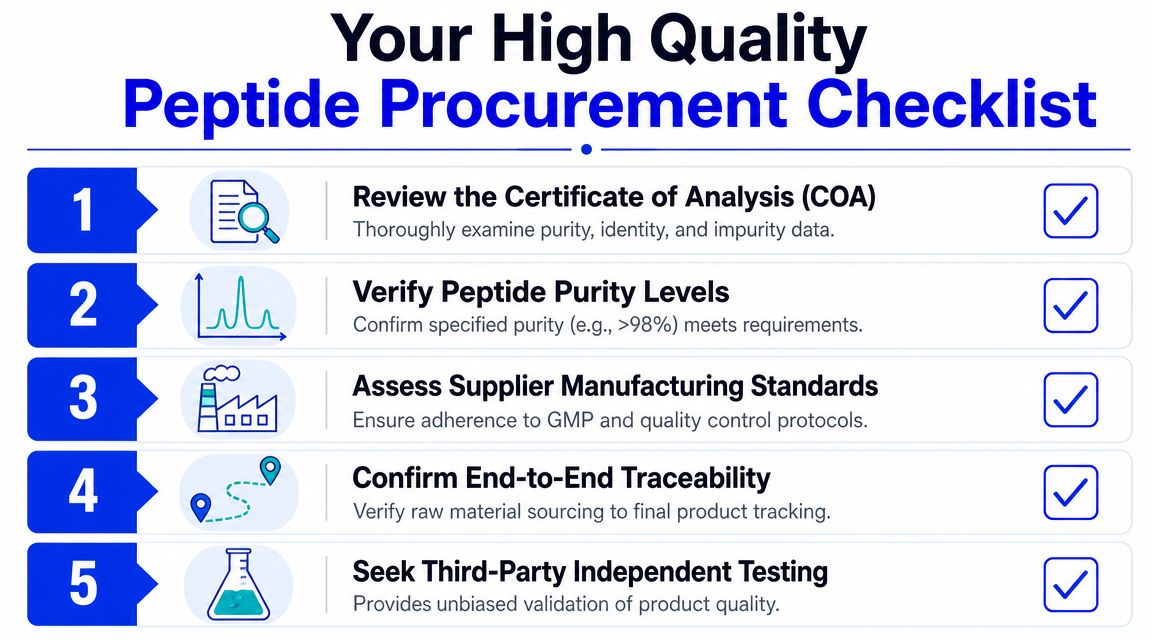
Use this before approving a vendor or reordering a lot:
A strong procurement workflow doesn’t need to be complicated. It needs to be repeatable.
Here is a practical model:
The labs that consistently get reliable results from high quality peptides usually aren’t lucky. They buy with discipline. They treat documentation as part of the reagent, and they reject vague claims no matter how attractive the price looks.
If you’re sourcing research peptides and want a supplier that publishes lot-specific quality documentation as part of the buying process, explore Peptide Warehouse USA. Review the available catalog, compare the supporting records for the products relevant to your work, and use the same verification framework outlined above before placing an order.