No products in the cart.


The popular answer to how long do peptides last is often “about 28 to 30 days in the refrigerator.” That answer sounds convenient, but it collapses two different questions into one. A peptide can remain active in the body for only minutes while the same compound, in a properly stored dry vial, remains chemically usable for years.
This guide separates those two clocks. You'll learn how pharmacokinetic half-life differs from chemical shelf life, why sequence and formulation change peptide duration, what happens after reconstitution, and how to evaluate a Certificate of Analysis before buying or using research material. The practical goal is simple: match the storage decision, assay plan, and procurement evidence to the specific peptide in front of you.
A researcher can open a fresh vial in the morning and ask, “How long will this material remain stable?” Later, while planning an experiment, the same person may ask, “How long will the compound remain measurable after administration?” Those questions sound similar, but they refer to different processes.
The first is chemical shelf life outside the body. It concerns whether the peptide remains intact in a vial, solution, or other preparation under defined conditions. The second is biological duration inside a living system, usually described with pharmacokinetic terms such as plasma half-life.

The body clock is controlled by enzymes, renal clearance, tissue distribution, receptor binding, molecular size, and chemical modifications. It helps determine sampling windows and how frequently a research protocol may need observations.
The bench clock is controlled by sequence chemistry and the environment around the molecule. Temperature, water, pH, oxygen, light, container surfaces, and freeze-thaw history can all influence whether a stored peptide remains chemically intact. A dry lyophilized material and a reconstituted solution therefore shouldn't be treated as equivalent products.
Practical rule: Never convert an in-body half-life into a storage expiration date. They measure different clocks.
Most online explanations fail because they offer one universal number. A claim such as “peptides last 28 days refrigerated” may describe a particular preparation, but it can't stand in for compound-specific stability evidence. Researchers need separate answers for biological duration, unopened shelf life, and post-reconstitution hold time.
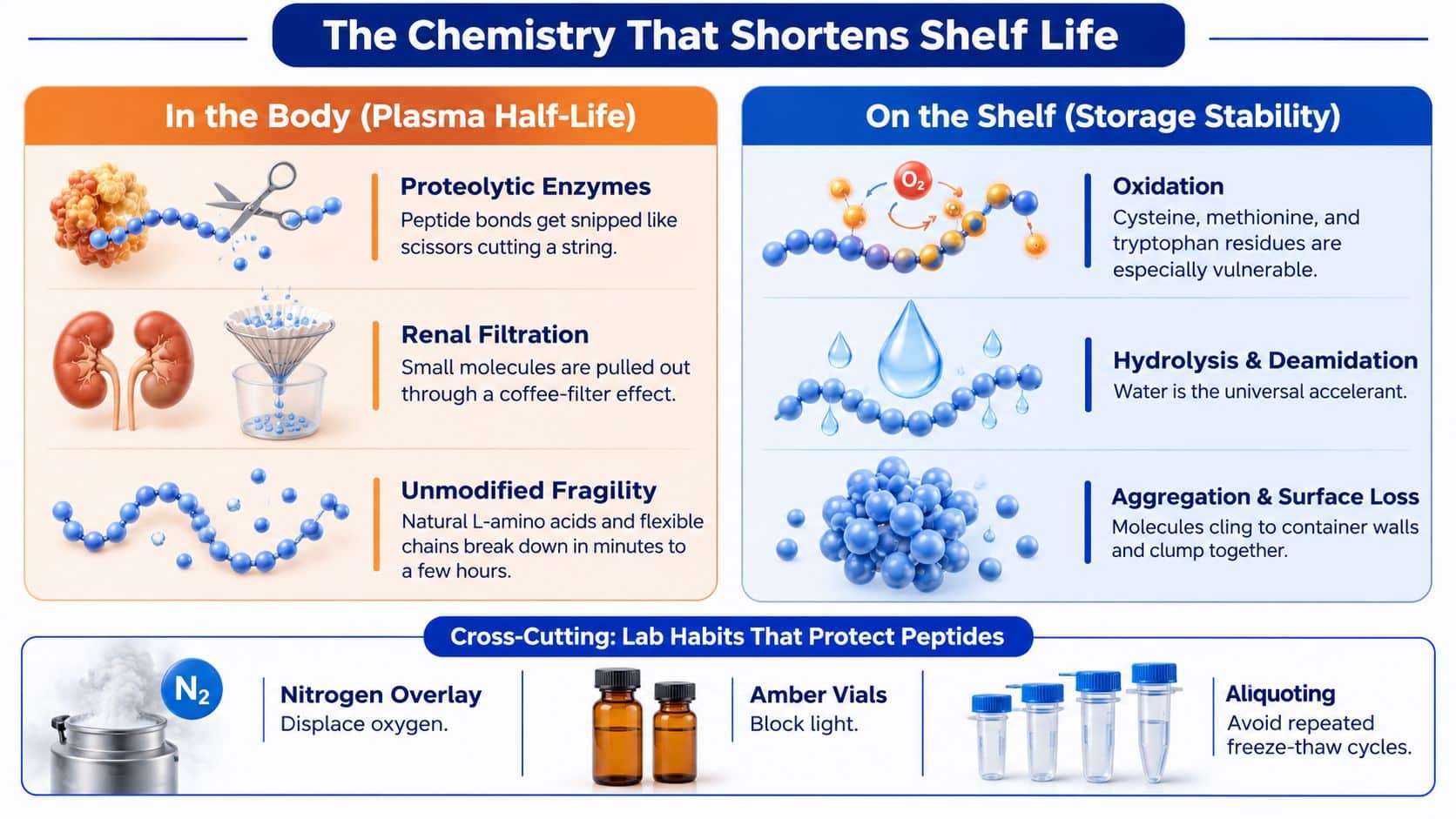
Many unmodified peptides leave the bloodstream quickly because two clearance systems work at the same time. Proteolytic enzymes cut peptide bonds, much like scissors snipping a flexible string. The kidneys then filter small molecules from plasma, creating a second route out of circulation.
Flexible peptide chains are especially exposed to enzymatic attack. Natural amino-acid sequences often contain bonds that enzymes can recognize and cleave, while a small molecular size makes renal filtration more efficient. Together, those mechanisms explain why many unmodified peptides have a minute-scale to hour-scale presence in circulation, rather than a fixed duration shared by every peptide.
A review of peptide conjugates reports that peptides without stabilizing modifications often remain in the bloodstream for only minutes to a few hours. Across modified peptide compounds, reported half-lives range from approximately 6 minutes to nearly 36 hours, showing why a universal answer is misleading (review of peptide conjugates and pharmacokinetics).
Suppose a researcher expects a compound to remain measurable for a full day but the unmodified molecule clears much sooner. The sampling plan may miss the relevant exposure window entirely. Conversely, a highly modified or long-circulating compound may require a longer observation period than a protocol designed around a fragile native peptide.
The useful questions are therefore specific:
Half-life is a measurement of concentration decline, not a promise that every biological effect ends at the same moment. Researchers should define the endpoint before interpreting a duration claim.
“How long do peptides last?” has two answers here. The first clock measures how long a molecule remains in the body. The second measures how long its chemical structure remains usable in a vial. Sequence, molecular design, and delivery method can shift the first clock substantially.
Native GLP-1 has an estimated half-life of approximately 1–2 minutes. Exenatide lasts approximately 26 minutes, while octreotide has a human half-life of about 100 minutes (peptide pharmacokinetic review). These comparisons show why a single rule for peptide duration fails.
A lipidated compound can bind plasma proteins and create a temporary circulating reservoir. Liraglutide, for example, is reported to have more than 99% plasma-protein binding and a plasma half-life of approximately 13 hours after subcutaneous administration (review of modified peptide pharmacokinetics). Its attached fatty-acid group supports reversible albumin binding, which slows renal removal and keeps the molecule in circulation longer.
Researchers can extend exposure through several design choices:
Each choice changes more than half-life. It may also affect solubility, tissue distribution, receptor activity, immunogenicity, or storage behavior. A peptide that persists longer in plasma may therefore require separate testing for biological performance and chemical stability.
Leuprolide shows how these clocks can diverge. Its active peptide has a half-life of only about 16 minutes, yet depot formulations can release it gradually and support dosing schedules of one, three, four, or six months.
The practical point is simple: plasma half-life is not the same as total clinical or functional duration. Route of administration, tissue distribution, receptor binding, and controlled-release design can extend an effect after the unformulated molecule leaves plasma quickly. A COA or stability record answers a different question, namely whether the material remains chemically acceptable during storage.
A peptide can vanish from plasma within minutes yet remain stable as a dry powder for years. The two clocks measure different failures. Biological clearance tracks what happens inside the body, while chemical shelf life tracks whether the stored molecule still meets its quality requirements. A clear reconstituted solution can therefore be less reliable than unopened lyophilized material, even when no visible change appears.
Oxidation is one major pathway. Cysteine, methionine, and tryptophan residues are particularly vulnerable. Light, oxygen, higher pH, and repeated temperature changes can accelerate the process. A review of peptide stability and storage reports that many lyophilized peptides can remain stable for several years at approximately −20 °C when protected from light. Oxidation-sensitive sequences still need sequence-specific handling and documentation.
Hydrolysis uses water in chemical bond breakdown. Deamidation alters susceptible side chains and can produce related impurities. Both become more relevant after a dry powder is dissolved, because water surrounds the peptide and supports reactions that are limited in the dry state.
Aggregation joins peptide molecules into larger structures. Molecules can also adsorb to container walls, closures, tubing, or other surfaces. These losses may reduce the material available to an assay without causing cloudiness or particles.
pH and ionic strength change charge, solubility, conformation, and reaction rates. Impurities can add reactive species or surfaces that encourage aggregation. Freeze-thaw cycling adds physical stress, particularly in water-based formulations, where temperature changes can create concentration gradients.
Match the storage routine to the likely failure mode:
A clear solution does not prove unchanged potency. Chemical degradation can begin before cloudiness, particles, or a color change becomes visible.
Lyophilized powder and reconstituted liquid run on different storage clocks. Removing most free water slows reactions that depend on water, so a dry peptide generally keeps longer under suitable conditions. Adding solvent changes the risk profile immediately. Hydrolysis, oxidation, aggregation, and microbial growth become more relevant, and the stated hold time must match the formulation and evidence.
The KPV examples below show how sharply the two forms can differ:
| Form | Reported Storage Window | Recommended Conditions |
|---|---|---|
| Lyophilized KPV free base | Up to 3 years at −20 °C, up to 2 years at 4 °C, and up to 3 months at 15 °C | Tightly closed container, protected from moisture and light |
| Reconstituted KPV free base | Up to 6 months at −80 °C, about 1 month near −2 °C, and roughly 1 week at 10 °C | Use validated conditions and minimize temperature cycling |
| Lyophilized research material generally | Several years may be possible for many sequences at approximately −20 °C | Follow sequence-specific and lot-specific documentation |
| Reconstituted research material generally | Often substantially shorter than the dry form | Follow the stated solvent, temperature, container, and hold-time evidence |
The KPV values come from FDA peptide stability briefing materials. They illustrate a storage principle, not a universal expiration rule.
At approximately −20 °C, a well-sealed dry vial may support long-term storage when the sequence and its documentation allow it. At 2–8 °C, refrigeration may suit shorter-term access or material with validated cold stability. Ambient storage requires caution because humidity, light, and temperature excursions can vary widely.
Water activity explains part of the difference. The stability review cited earlier associates water activity below 0.6 with less free water available for biochemical reactions and microbial activity. That threshold does not replace a stability study, but it helps explain why low-moisture powders generally tolerate storage better than liquids.
Transport belongs in the same record as storage. Temperature exposure during shipment can shorten the usable window before a vial reaches the lab. Researchers comparing cold-chain practices can consult this guide to GLP-1 delivery. For any lot, the COA and stability documentation should take priority over a generic refrigerated rule.
Reconstitution changes the handling problem immediately. Water enables hydrolysis, deamidation, oxidation, aggregation, and microbial growth. Repeated freeze-thaw cycles can accelerate physical degradation even when the solution still appears unchanged (review of peptide storage and reconstitution).
A repeatable workflow protects both the sample and the study:
A preparation without an appropriate preservative or microbial-control system deserves particular caution. The practical hold time must come from validated documentation, not from appearance alone or from a generic refrigerated rule.
A Certificate of Analysis should help you answer two questions. First, did the supplier identify and characterize the material correctly? Second, does the available evidence support the stated storage conditions for that specific lot or formulation?
Look for documentation that identifies the analytical methods and the tested material. Useful records may include:
A statement such as “most peptides last 28 days refrigerated” doesn't identify the sequence, concentration, solvent, container, assay method, or degradation products. It may be a handling convention for one preparation, but it isn't a defensible universal shelf-life claim.
FDA stability principles connect a labeled storage statement to demonstrated stability for the specific drug product. That means real-time, condition-specific evidence matters more than a broad internet rule (discussion of peptide stability guidance and labeled storage claims).
For readers who want a broader explanation of what a Certificate of Analysis should contain, this GutRx supplement verification guide offers useful context. For peptide procurement, ask the supplier direct questions:
A supplier that can't answer these questions may still provide a usable research material, but the uncertainty should be reflected in your experimental design.
The answer to how long do peptides last depends on which clock you're reading. Plasma half-life may be measured in minutes, hours, or longer for engineered compounds, while a dry, protected material may remain stable far longer than its in-body activity. A liquid preparation has a different risk profile from the original powder, and every storage claim should connect to the exact form and conditions tested.
A freezer-door checklist can stay short:
Supplier selection is therefore a research decision, not only a price decision. Peptide Warehouse USA offers US-manufactured research peptides and related compounds with batch production, third-party documentation, Certificates of Analysis, and microbial and endotoxin reports. Its products are sold for research, laboratory, or analytical use only, not for human consumption.
Peptide Warehouse USA gives researchers a catalog of peptides, liquids, aminos, and nasal-spray formats supported by lot-specific documentation, making it easier to match a material to its storage and testing requirements. Visit Peptide Warehouse USA to explore options and review the available product and COA information before planning your next experiment.