
No products in the cart.


A reconstituted peptide kept at 2–8°C in bacteriostatic water is typically usable for about 28 days. Sterile-water preparations may need to be used within 24–48 hours, while carefully aliquoted frozen material can last considerably longer, depending on the peptide and formulation.
You've probably pulled a vial from the refrigerator and wondered whether the date on the label is a firm cutoff or just a conservative suggestion. The honest answer is that there isn't one universal shelf-life number. The diluent, temperature, exposure to light, number of stopper punctures, peptide sequence, and freeze-thaw history all influence the usable window.
This guide breaks down how long reconstituted peptides last by storage regime and diluent, then turns the information into a practical handling protocol. The focus is research use, not human administration. If your product documentation or institutional procedure gives a shorter window, follow that requirement.
The familiar baseline is straightforward: keep a reconstituted peptide at 2–8°C and, when using bacteriostatic water, plan around a 28-day refrigerated window. Several storage references converge on a routine range of 14–30 days, with 28 days commonly used as the operational benchmark for multi-dose handling. The Peptoro's storage recommendations provide another practical reference for distinguishing refrigerated handling from longer-term storage.
That number is a starting point, not a guarantee of molecular stability. Once a lyophilized peptide becomes a liquid, hydrolysis and aggregation risks increase, and the solution generally becomes less stable than the dry powder. The 28-day convention also assumes a controlled workflow: sterile reconstitution, immediate refrigeration, limited bench exposure, and careful access each time the vial is used.
A refrigerated benchmark works best when the vial is treated as a controlled research material rather than casual inventory. The usual assumptions include:
The peptide itself still matters. Sequence, concentration, pH, solvent compatibility, light sensitivity, and freeze-thaw exposure can move the practical window in either direction. A short peptide with a reliable formulation may behave differently from a sequence that is sensitive to oxidation or aggregation.
| Condition | Assumption | Real-World Risk |
|---|---|---|
| Refrigerated at 2–8°C | The vial stays cold between draws | Door storage, transport, or power interruptions create temperature excursions |
| Bacteriostatic water | Preservative supports repeated access | Contamination risk rises with poor technique or excessive punctures |
| One controlled reconstitution | The solution is mixed once and left undisturbed | Repeated transfers and agitation can increase instability |
| Short warm exposures | The vial returns to refrigeration promptly | Cumulative time warm can shorten usable life |
| Clear, intact vial | Appearance and container remain unchanged | Cloudiness, particles, damaged seals, or precipitate call for discard |
Practical rule: Treat 28 days as a conservative planning ceiling for routine refrigerated, bacteriostatic-water use, not as proof that every peptide remains unchanged until the final day.
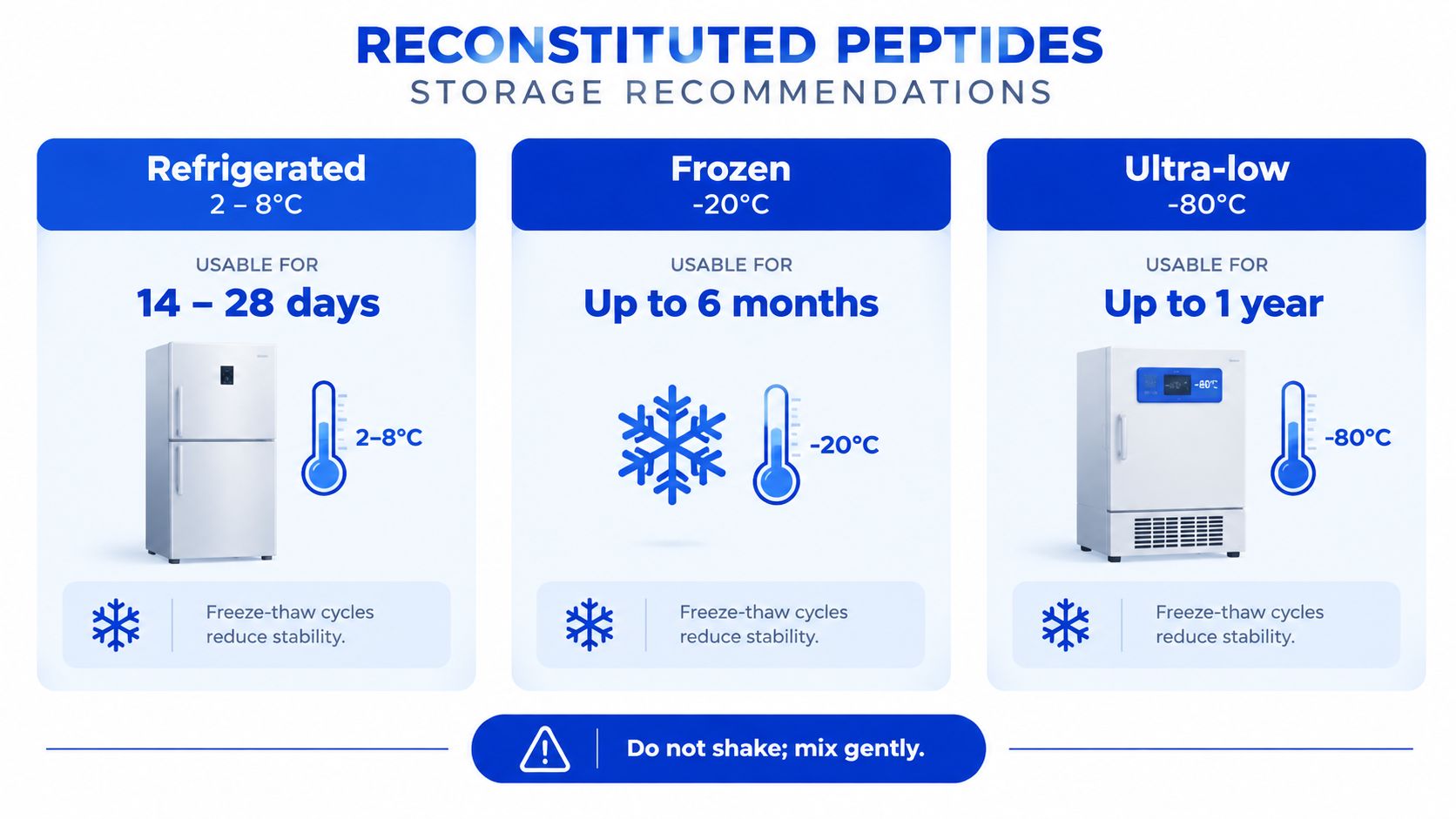
Temperature should be treated as a set of separate storage regimes, not averaged into one convenient answer. Refrigeration is the normal short-term option, freezing is a longer-retention strategy that requires aliquoting, and room temperature is mainly for brief working periods.
For bacteriostatic-water preparations, the common refrigerated window is 14–30 days, with many operational guides using approximately 28 days for routine multi-dose use (ChemVerify's storage guide). Sterile-water mixtures may require much shorter handling because they lack preservative support. Refrigeration slows hydrolysis, aggregation, oxidation, and microbial growth, but it doesn't stop those processes.
Store the vial in a stable part of the refrigerator, protect it from light, and return it promptly after each draw. The refrigerator door is a poor choice because it experiences more temperature movement than the main compartment.
Freezing can extend retention from weeks into months, depending on the sequence and formulation. Research-facing storage guidance describes frozen aliquots at −20°C as potentially suitable for a 2–8 week or even multi-month range, while some protocols use −80°C for longer-term preservation (Path to Peptides storage guidance).
The distinction is between frozen aliquots and repeatedly frozen and thawed vials. Divide the solution before freezing, thaw only the amount needed for the working period, and never refreeze a thawed aliquot. Ice-crystal formation and repeated phase changes can damage conformation or accelerate aggregation.
Room-temperature exposure should generally be limited to hours, not days. A vial held at ordinary room temperature is exposed to faster chemical degradation and a less forgiving microbial environment, so it shouldn't be treated as long-term storage. Use a working aliquot for the immediate task, minimize time on the bench, and return the remaining material to the selected storage regime.
Light and transport also deserve attention. Keep vials in their protective packaging where possible, use a validated cold-chain process for shipment, and avoid allowing a chilled vial to sit warm while paperwork, sampling, or bench setup takes place.
The vial you pulled from the refrigerator may have a very different usable window depending on what was added during reconstitution. Bacteriostatic water, sterile water, and saline aren't interchangeable, even when they produce the same peptide concentration. The diluent affects microbial control, compatibility, and how forgiving repeated access will be.
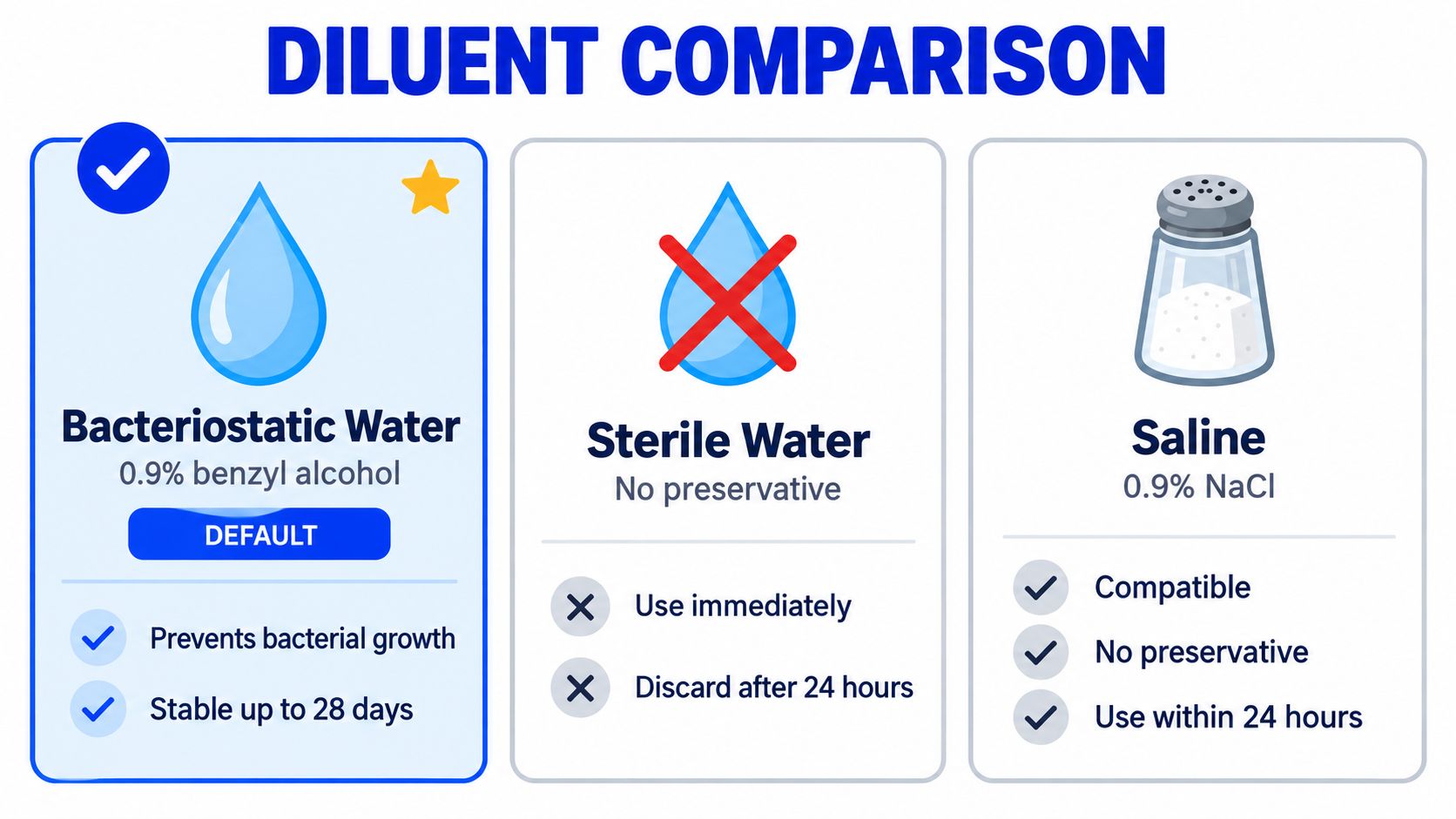
Bacteriostatic water commonly contains 0.9% benzyl alcohol, which helps suppress microbial growth after the vial is accessed repeatedly. Under refrigeration, preparation guidance commonly places bacteriostatic-water formulations near the 28–30 day range (Peptide Nerds' storage overview).
That makes it the practical choice for a refrigerated, multi-dose research vial. The preservative does not make the vial sterile after every puncture. Each stopper entry can introduce contamination, and benzyl alcohol provides a measure of control rather than a guarantee of safe extended storage.
Sterile water contains no preservative. The sealed diluent may be sterile, but access changes the risk profile immediately. Depending on the workflow and handling controls, guidance can range from 24–48 hours to roughly 1–2 weeks at 2–8°C. For the article's full shelf-life guidance, see AminoCore Research's shelf-life guidance.
Use sterile water for a single draw or a short, controlled assay window unless the specific protocol supports a longer period. It is poorly suited to repeated access over several weeks because every puncture adds exposure without preservative support.
Saline fits protocols that require a saline-compatible matrix, but it should not be treated as a preserved diluent. Its ionic strength can influence solubility, conformation, or aggregation for some sequences. Confirm compatibility for the specific peptide before choosing it.
| Diluent | Best fit | Main trade-off |
|---|---|---|
| Bacteriostatic water | Multi-dose refrigerated workflows | Preservative does not prevent contamination or sequence-specific instability |
| Sterile water | Immediate or short-window use | No preservative, so repeated access is less forgiving |
| Saline | A protocol requiring saline compatibility | Ionic effects and limited preservation support |
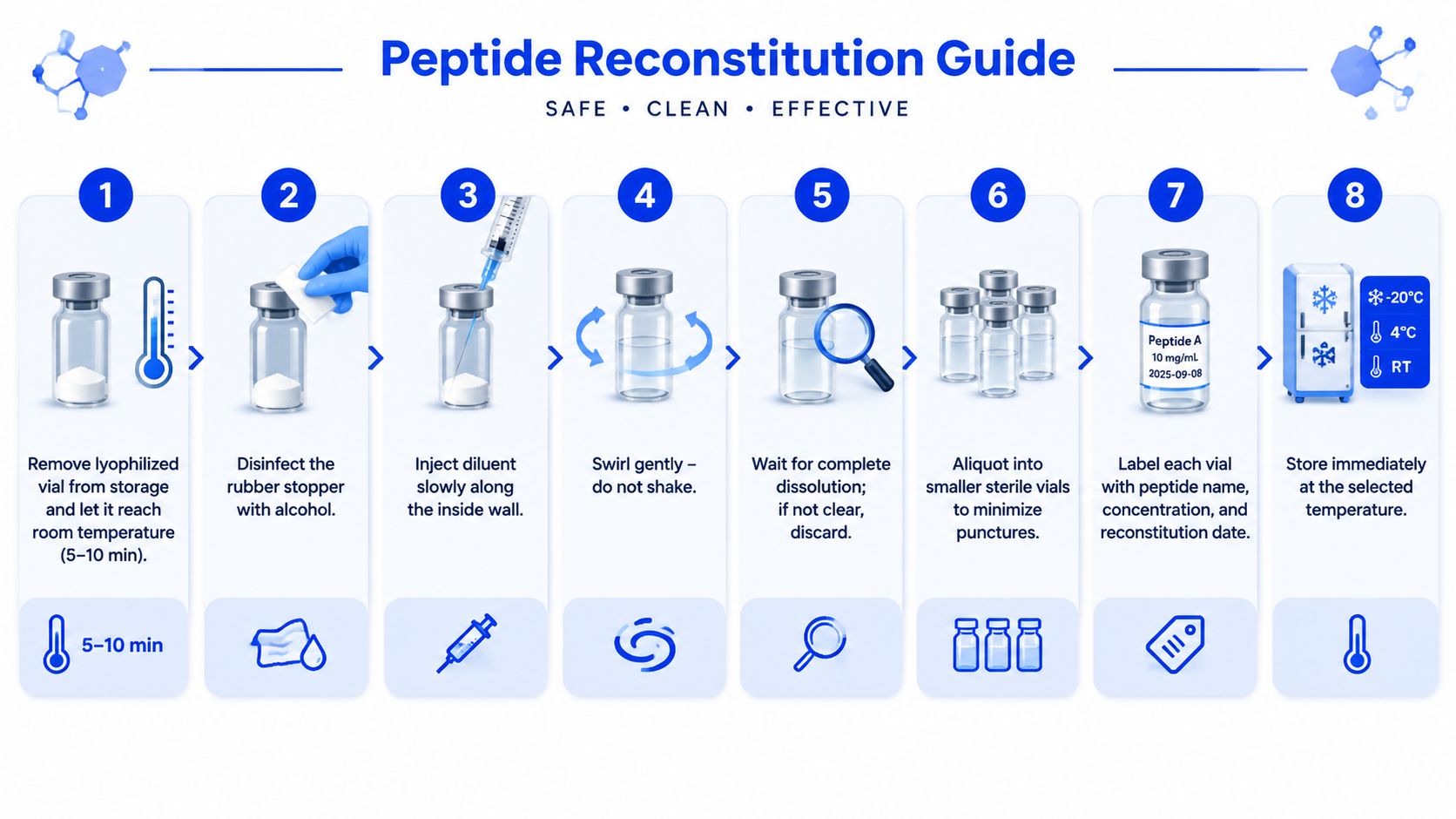
Good storage begins before the vial enters the refrigerator. A controlled sequence reduces contamination, limits mechanical stress, and gives you a reliable date trail when you need to decide whether material is still suitable for a research workflow.
Let a lyophilized vial reach room temperature before opening the seal. This helps reduce condensation and makes the powder easier to inspect before reconstitution. Disinfect the stopper with 70% isopropyl alcohol, allow it to dry, and use a new sterile syringe for every transfer.
Bench discipline matters: “Time spent warm is cumulative.” A series of short exposures can be more damaging to a multi-dose workflow than one carefully controlled draw.
Avoid transferring material between containers unless the receiving vial and the entire procedure are validated for sterility. A cracked vial, soft stopper, or residue around the seal is a reason to stop and assess the container, not a reason to keep drawing.
A vial pulled from the refrigerator is not automatically usable for a fixed number of days. The familiar universal 30-day rule fails because the diluent, storage regime, formulation, and handling history all affect the usable window. A bacteriostatic-water preparation kept at 2–8°C is commonly managed around 28 days. Sterile-water preparations may have a much shorter window, ranging from 24–48 hours to approximately 1–2 weeks, depending on the protocol and handling conditions. Frozen aliquots follow a separate regime, and the peptide itself still determines the outcome.
Freezing also does not make a liquid peptide permanent. Correct aliquoting can extend retention, while every thaw changes the physical environment. Repeated freeze-thaw cycles can reduce stability, so a vial that has been thawed should not be returned to the freezer.
Appearance provides useful evidence, not a complete release decision. Cold-induced precipitation or incomplete dissolution can resemble contamination, while chemical or microbial problems may leave a solution looking clear. If gentle swirling and brief equilibration do not restore clarity, set the vial aside for investigation rather than forcing it into use.
A vial can still look fine after its planned window and remain a poor choice for a research run. Cumulative warm exposure, repeated punctures, and invisible degradation are not resolved by visual inspection. A conservative discard policy protects assay consistency and prevents one questionable vial from affecting the entire run.
The discard decision usually happens at the bench, often while a researcher is preparing a run. Start with the solution itself, then inspect the vial and review its storage history. If the evidence is mixed, the lower-risk choice for research quality is to discard the material and prepare a fresh vial.
A solution that is cloudy, hazy, or persistently turbid should be set aside. Gentle swirling and brief equilibration can help distinguish incomplete dissolution from a persistent change, but don't use heat, vigorous shaking, or aggressive manipulation to force clarity.
Look for:
Sterility can be compromised even when the liquid appears normal. A soft or punctured stopper, cracked vial crimp, dried residue around the seal, or damaged container should move the vial into the discard category.
| Warning Sign | Likely Cause | Recommended Action |
|---|---|---|
| Cloudy or hazy solution | Aggregation, precipitation, or microbial growth | Discard if it doesn't clear with gentle handling |
| Particles or flakes | Contamination or denaturation | Do not use; document the observation |
| Color change | Oxidation or formulation change | Discard and investigate the lot |
| Unusual odor | Chemical or microbial change | Discard without further handling |
| Damaged stopper or seal | Loss of container integrity | Discard regardless of date |
| Repeated thawing | Physical and chemical instability | Do not refreeze or continue the cycle |
| Past the planned window | Increased uncertainty and contamination risk | Reconstitute a fresh vial |
Bacteriostatic water doesn't make a vial acceptable after 28 days, and sterile-water preparations shouldn't be stretched because they remain visually clear. When in doubt, protect the downstream assay and replace the material.
A useful storage protocol should fit on a freezer-door label or in a lab notebook. The decision is simple: choose the diluent based on the workflow, choose the temperature based on the retention period, aliquot before freezing, and document every change that could affect stability.
Frozen storage can extend use from weeks into months, but the exact result depends on the peptide, solvent, concentration, and freezer conditions. Don't treat a freezer setpoint as a substitute for stability data.
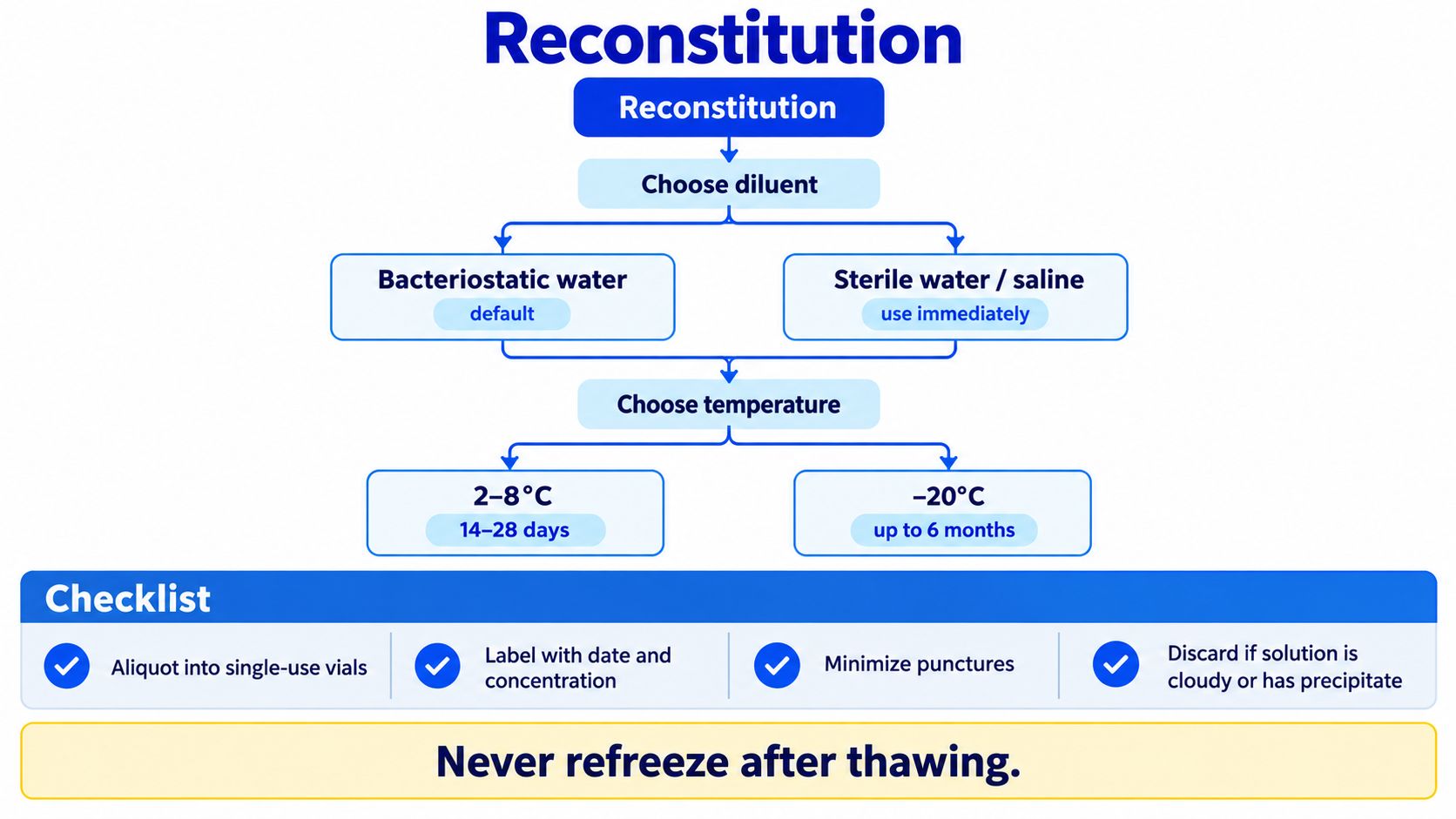
For teams building repeatable procedures, a standardized job aid blueprint can help turn these decisions into a visible checklist without burying critical handling details in a long document.
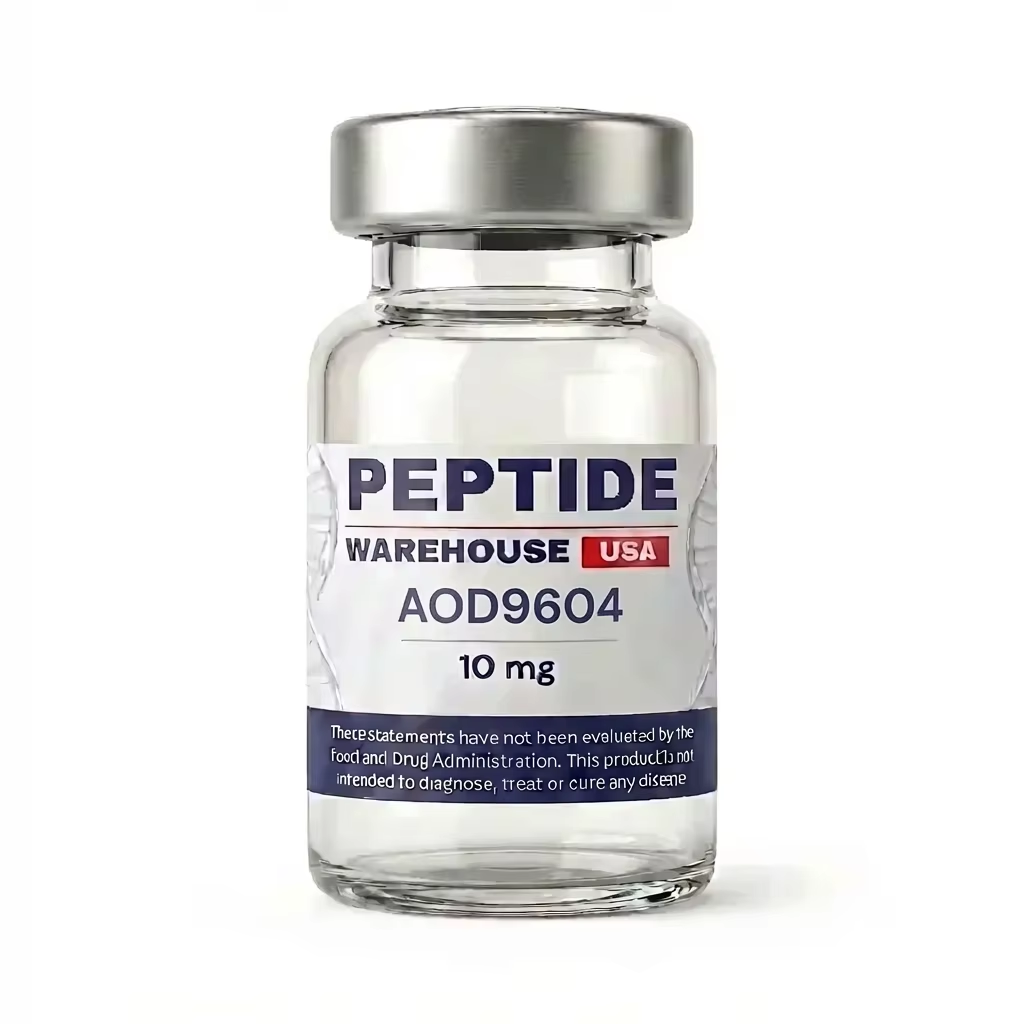
Sourcing consistency matters before storage begins. US-manufactured research peptides supported by batch-specific Certificates of Analysis, microbial and endotoxin documentation, and transparent purity records give a lab more information for comparing lots and investigating unexpected results. Peptide Warehouse USA supplies research, laboratory, and analytical materials, including peptides, liquids, aminos, and nasal sprays, with product documentation intended to support traceability. These products aren't for human consumption, and researchers should match every purchase and storage procedure to their institutional requirements.
If you need a more traceable starting point for your next storage cycle, visit Peptide Warehouse USA to explore US-made research peptides and related compounds with batch documentation. Choose the product and diluent that fit your workflow, then label and store the material from the moment it's reconstituted.
Leave a comment