No products in the cart.


A research-grade BPC-157 vial commonly costs roughly the low tens of dollars for a 5 mg to 10 mg vial, but the more useful figure is the cost per milligram. Depending on vendor, packaging, discounts, and purchasing channel, normalized pricing can range from about $1.80 to $13.80 per mg. Current market listings illustrate why the vial price alone can mislead first-time buyers.
You may be comparing two listings right now, perhaps one at $40 and another at $90, and wondering whether the higher-priced option is overpriced. That conclusion can be wrong in either direction. The vials may contain different amounts, carry different testing documentation, ship from different locations, or reflect very different volume discounts.
This guide treats the question, how much is BPC-157, as a procurement problem rather than a simple shopping question. You'll learn how to normalize prices, identify hidden line items, distinguish research-grade from compounded offerings, and evaluate whether a lower sticker price gives you better value. BPC-157 remains an experimental, unapproved substance for human clinical use, so the discussion stays within research purchasing and product evaluation.
Suppose two research listings look similar, yet one costs $40 and the other $90. The cheaper vial may contain less peptide, include weaker documentation, or carry higher shipping and handling charges. Compare cost per milligram first, then check what you receive for that amount.
A product page foregrounds the vial price, which shows what leaves your account at checkout. It does not show the quantity in the container, whether testing applies to the current lot, or the final landed cost after shipping and handling. Cost per milligram works like a common ruler: it puts different package sizes on the same scale.
Current listings illustrate the spread. One supplier shows $20.99 for 5 mg, $27.99 for 10 mg, and $167.99 for a wholesale pack of ten 5 mg units. These examples come from current BPC-157 product listings. The larger package lowers the listed cost per milligram, but only if the quantity, documentation, and purchasing terms fit your laboratory needs.
A $20.99 vial is not automatically cheaper than a $27.99 vial. Divide each price by its peptide content, add shipping and handling, and then compare equivalent testing records. Two products can have different sticker prices but similar effective costs per milligram. A lower-priced vial can also become more expensive per unit when it contains less material or lacks documentation required for a serious laboratory workflow.
Practical rule: Compare dollars per milligram only after confirming comparable quantity, delivery costs, and lot-specific documentation.
BPC-157 is a synthetic pentadecapeptide, meaning it contains fifteen amino acids. Laboratory and animal research has examined it in connection with tissue-repair mechanisms, gastrointestinal models, vascular signaling, and other biological questions. A 2025 PubMed-indexed review of BPC-157 research noted that only three pilot studies had examined the peptide in humans, covering intraarticular knee pain, interstitial cystitis, and intravenous safety or pharmacokinetics. Most of the literature remains preclinical.
That distinction matters for procurement. BPC-157 isn't an FDA-approved drug for human clinical use, and it doesn't have an established validated dosing regimen or completed Phase II clinical trial. A 2026 narrative review reported that the peptide still has no approved formulation, validated dosing regimen, or completed Phase II trial.
A research-only product moves through a narrower market than an approved pharmaceutical ingredient. Specialist suppliers serve laboratory, analytical, and preclinical buyers rather than a broad prescription network. Smaller production runs, specialized testing, restricted advertising, and handling requirements can all affect the final price.
The molecule itself also isn't the only cost driver. Suppliers may pay for synthesis, purification, lyophilization, vialing, lot testing, packaging, customer support, and shipping materials. If a supplier produces smaller batches, those fixed costs are distributed across fewer units.
The U.S. regulatory position adds another layer of uncertainty. In 2026 FDA materials, the agency stated that BPC-157 has no USP or NF monograph, neither the free base nor acetate form is a component of an FDA-approved drug, and neither form is included in the relevant pharmacopeial references. The FDA also proposed that both forms not be included on the 503A Bulks List and identified limited safety information for proposed routes of administration.
For readers who want broader background on how peptide products differ from conventional medicines and clinical services, the ProMD Health peptide therapy guide offers useful general context. It shouldn't be treated as evidence that BPC-157 is approved or clinically established.
Demand from research communities interested in longevity, gut biology, injury models, and tissue repair can influence availability and pricing even when synthesis costs stay similar. The label, regulatory position, batch scale, and audience all shape the price signal attached to the vial.
Suppose two BPC-157 listings show similar vial prices, yet one contains twice as much material. The checkout total alone cannot explain which option costs less. Compare the cost per milligram, then examine the four factors that move that figure: analytical specifications, lot documentation, fulfillment overhead, and purchase volume.
A higher stated purity may reflect additional purification, greater material loss, and more analytical work. Those inputs can raise the supplier's cost and, in turn, the effective price per milligram.
The percentage on the product page is only one part of the comparison. Check whether the result applies to the exact lot, identify the method used, and look for separate confirmation of molecular identity. A purity figure without traceable supporting records gives you little basis for comparing value.
Direction: Higher documented purity and broader analytical verification generally raise the cost per milligram.
Testing may include HPLC purity analysis, mass spectrometry identity confirmation, microbial testing, and endotoxin reporting. A current, independent report tied to a specific lot adds laboratory and documentation costs. A generic COA or self-reported result may help explain a lower listing price, but it offers less procurement evidence.
Match the report to the material being considered. An undated file, a document for another batch, or a report without a matching lot identifier does not provide the same traceability as current lot-specific documentation.
Direction: Stronger, current, lot-specific testing generally raises the price while improving traceability.
A domestic supplier may include local labor, warehousing, customer support, testing coordination, and domestic shipping in its price. An overseas listing may show a lower base figure, while introducing longer transit, customs paperwork, temperature exposure, or delivery uncertainty.
Those logistics can change the effective cost per milligram after checkout. Compare the delivered amount and the documentation package, not only the number shown beside the vial.
Direction: Domestic fulfillment often raises the listed price while reducing some logistics friction.
A single vial carries a larger share of fixed production, testing, vialing, labeling, and fulfillment costs. Larger kits distribute those costs across more material, which can lower the per-milligram figure.
Market-tracking data covering 85 listings from 30 vendors found normalized pricing from roughly $1.80 to $13.80 per mg, with one discounted offer reaching $1.62 per mg. Tracked BPC-157 listings also show the contrast between a 10 mg vial at $29.97 and a 5 mg vial at $49.99. The larger vial has the lower effective unit cost.
| Pricing Factor | Typical Effect on Per-Mg Cost | Direction |
|---|---|---|
| Higher documented purity | Adds purification and verification expense | Raises |
| Independent lot testing | Adds analytical and documentation cost | Raises |
| Domestic fulfillment | Adds local operating and shipping overhead | Often raises |
| Larger vial or bulk tier | Spreads fixed costs across more material | Lowers |
Bulk pricing can improve the arithmetic, but a lower cost per milligram does not replace verification. Before choosing the cheaper tier, confirm the lot identity, testing records, storage requirements, and supplier terms.
The basic formula is simple:
Total product price ÷ declared milligrams = cost per milligram
Take a 10 mg vial priced at $36. Divide $36 by 10 mg, and the effective price is $3.60 per mg. A 5 mg vial priced at $28 costs $5.60 per mg, even though its checkout total is lower.
This comparison changes the question from “Which vial costs less?” to “Which listing gives me more material for each dollar?” That is the right starting point for comparing different fill sizes.
| Purchase Option | Total Amount | Sticker Price | Effective Cost Per Mg |
|---|---|---|---|
| Smaller vial | 5 mg | $28 | $5.60 per mg |
| Larger vial | 10 mg | $36 | $3.60 per mg |
The same method works for kits. Add the total milligrams across every vial, then divide the complete product price by that total. Don't divide by the number of vials, because vial count doesn't measure how much peptide you receive.
A multi-vial package may also reduce the impact of shared overhead. Lyophilization, vialing, labeling, COA preparation, and order handling can apply to the package as a whole. When those costs are spread across more material, the marginal cost per milligram can fall sharply.
A procurement comparison should use the landed cost, not only the catalog price. Add shipping and any clearly disclosed fees before comparing two suppliers. If one vendor includes shipping and another adds it at checkout, their visible prices aren't directly comparable.
The same rule applies to a 5 mg vial and a larger bulk pack. A product that appears more expensive can be cheaper per milligram once you normalize the quantity. A bulk purchase only makes sense when the amount fits a legitimate research plan, storage capacity, and applicable jurisdictional requirements.
A vial price answers what you pay for the container. Cost per milligram answers what you pay for the declared research material.
Don't treat cost per milligram as a substitute for quality control. It helps you compare quantity, but it can't validate identity, sterility, purity, or suitability for a particular experiment.
BPC-157 pricing makes more sense when you map the purchasing channel first. A domestic research-chemical supplier, an overseas peptide laboratory, a compounded pharmacy, and an academic or third-party reseller may all use similar product language while operating under different quality systems, fulfillment models, and regulatory expectations.
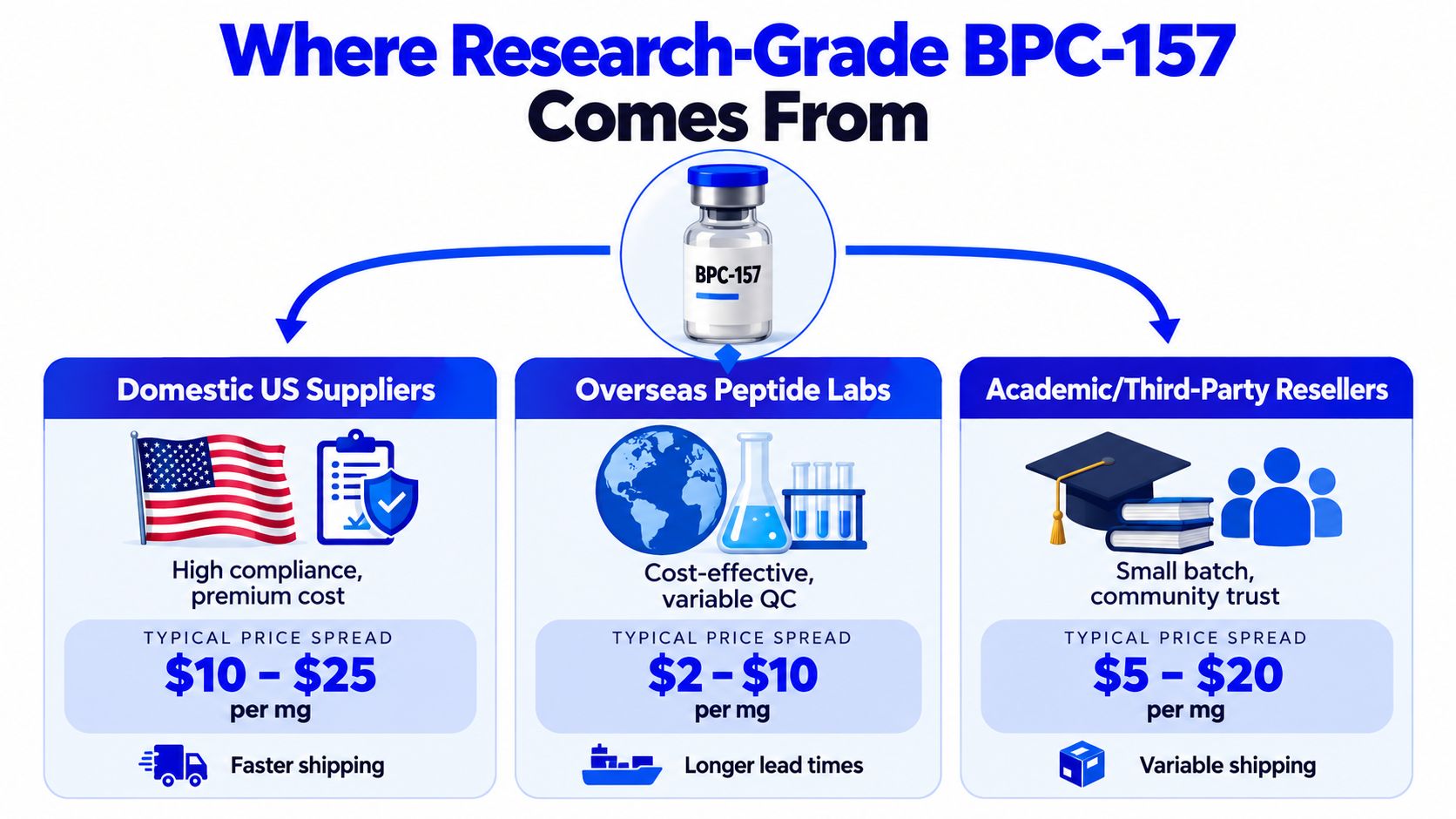
U.S.-based research suppliers commonly price above overseas sources because the quoted price may include domestic fulfillment, local labor, customer support, and third-party testing coordination. The tradeoff is a shorter shipping route and less exposure to customs-related uncertainty.
That premium isn't automatically justified. Compare the actual COA, lot number, stated purity, storage instructions, shipping method, and return terms. A domestic address by itself doesn't establish product quality.
Overseas suppliers may advertise lower base prices, especially at larger volumes. Buyers still need to account for longer lead times, international shipping conditions, import requirements, and the possibility that a low product price doesn't include all delivery costs.
A lower per-milligram number can be attractive for a validated laboratory workflow, but only if the supplier provides documentation that meets your purchasing standard. If verification is difficult, the apparent savings may not represent useful value.
Compounded BPC-157 is priced differently from research-grade vials because the quote may include pharmacy operations, prescription processing, professional services, formulation, and dispensing. Recent market coverage describes compounded offerings at $150 to $350 per month, while research-grade vials are often advertised around $25 to $120 for 5 mg to 10 mg. This comparison of BPC-157 costs and alternatives highlights why a monthly quote and a vial quote aren't interchangeable.
The FDA has separately raised concerns about BPC-157 safety information and compounding eligibility. FDA briefing materials describe BPC-157 as an unapproved 15-amino-acid peptide and identify potential immunogenicity concerns associated with parenteral or nasal routes, particularly where aggregation or impurities may be present.
For general context on how medical providers discuss IV services and related clinic pricing structures, readers may find Sunridge Medical's information on IV vitamin C useful. It concerns a different service and shouldn't be used as a BPC-157 price comparison.
| Channel | Common Pricing Pattern | Main Comparison Issue |
|---|---|---|
| Domestic research supplier | Higher listed price | Verify testing and included services |
| Overseas peptide laboratory | Lower base price may appear | Include shipping and import uncertainty |
| Compounded channel | Monthly or dispensing-based quote | Not directly comparable to research vials |
| Academic or third-party reseller | Variable and often small-batch | Confirm provenance and lot documentation |
The lowest price tier deserves the closest inspection. Before ordering, verify what you're buying, who produced it, which lot was tested, and whether the declared use is consistent with your research purpose.
A low price can reflect efficient packaging, or it can reflect missing safeguards. The difference becomes clearer when you inspect the documents and logistics behind the listing.
Start with the Certificate of Analysis. A useful COA should identify the product and lot, report analytical findings, and make it possible to connect the document to the vial or package you receive. HPLC purity and mass spectrometry identity confirmation answer different questions, so one should not be treated as a substitute for the other.
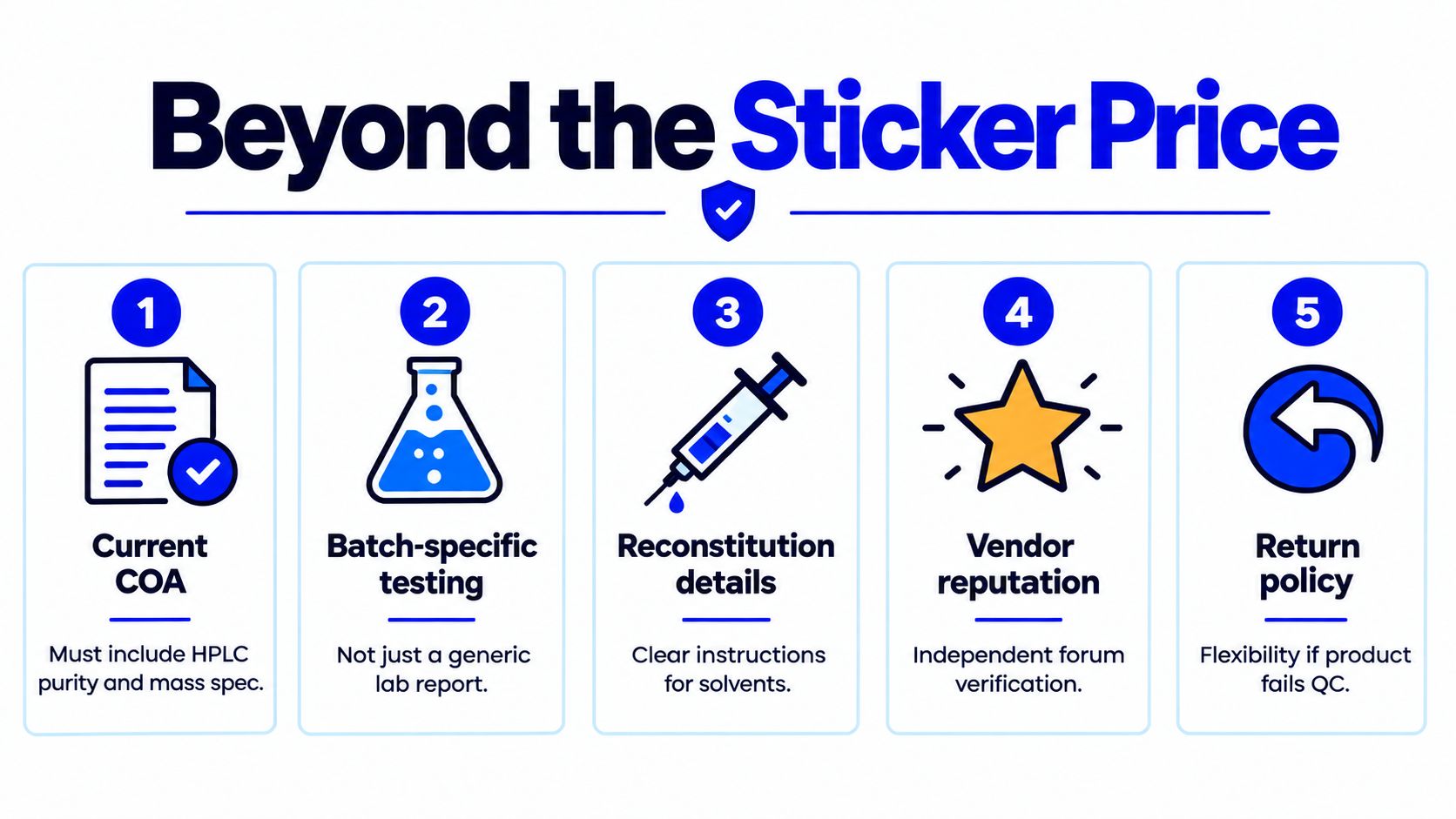
Shipping conditions can also change the true cost of ownership. Insulated packaging, temperature-conscious handling, tracking, and appropriate storage guidance may raise the order total while reducing avoidable handling risk. A buyer should understand whether the material arrives lyophilized, how the supplier says it should be stored, and what conditions apply after reconstitution.
Manufacturing claims require the same scrutiny. Terms such as cGMP or ISO-aligned should be supported by meaningful documentation, not used as decoration on a product page. Ask who performed the testing and whether the supplier can provide traceability for the relevant lot.
For a broader visual explanation of how vendor evaluation fits into research purchasing, review the checklist above before you compare price tiers.
The following video can provide additional general background for readers who want a visual introduction to peptide purchasing considerations.
A reliable comparison therefore has two columns: cost per milligram and evidence supporting the material. A low number in the first column doesn't compensate for an unanswered question in the second.
Use a procurement sequence instead of choosing the first low-priced listing you find.
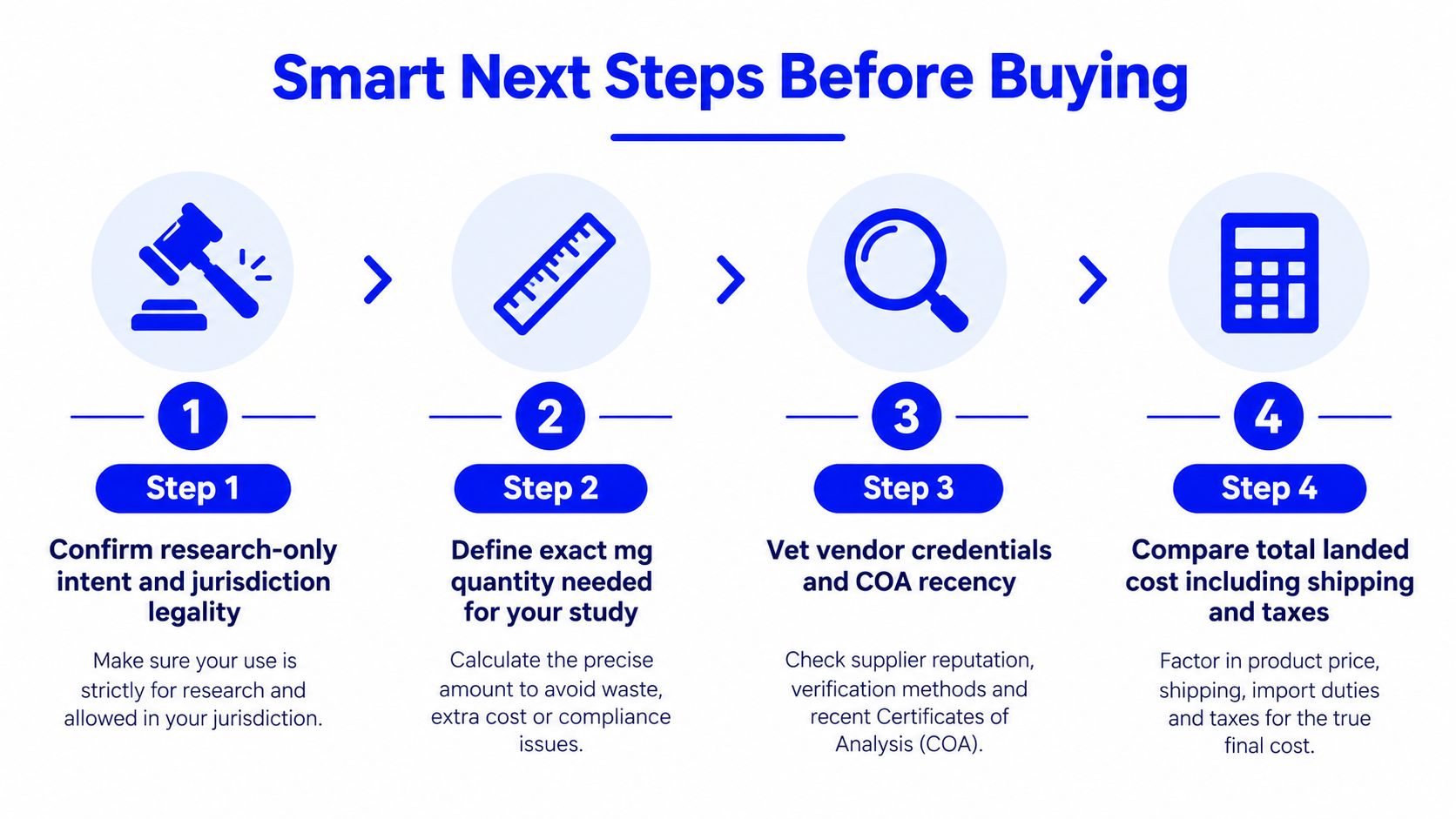
BPC-157's regulatory and evidence profile makes a careful procurement process more important than a headline discount. The FDA's 2026 advisory information describes a changing compounding environment, while the available human research remains limited.
Bookmark a few COA examples, record your target cost-per-milligram range, and revisit vendor quotes as research-peptide pricing changes. If you need a U.S.-based research supplier to evaluate alongside other options, Peptide Warehouse USA lists BPC-157 and related research compounds with batch documentation, stated purity information, and research-only labeling. Compare its product details with other suppliers using the same cost-per-milligram and verification checklist.