No products in the cart.


A polished product page can make injectable peptides for sale look straightforward: a named compound, a purity percentage, and a downloadable certificate. But those details don't tell you whether the listing is for a research reagent, a compounded preparation, or an approved prescription medicine, and they don't prove that a product is sterile or suitable for human use.
Injectable dosage forms represent approximately 78% of approved peptide administration routes, in part because many peptides can break down in the gastrointestinal tract when taken orally, according to a peer-reviewed review of peptide medicines. That history makes injection a scientific and safety consideration, not just a product feature. A research peptide is closer to a laboratory reagent than a prescription: its paperwork describes a particular lot and specific test results, not an approved medicine.
The practical path is to understand what peptides are, distinguish research materials from medicines, and check the legal limits and quality documents before ordering. The benefits of peptides discussed here refer to research interests and investigated mechanisms, not guaranteed results. You'll come away with a repeatable way to assess whether a listing and its lot-level paperwork deserve your trust.
A peptide listing may use language that resembles a pharmacy page, while selling a product strictly for laboratory work. The label, product description, seller's role, and available documentation all matter. Similar wording across websites doesn't make their products or legal status equivalent.
Peptides are short chains of amino acids. Researchers investigate how particular sequences interact with receptors, affect cell signaling, or behave in laboratory and preclinical models. A finding in a cell or animal model describes what happened under those experimental conditions, not what a person should expect. The benefits discussed in peptide research should be distinguished from established human outcomes.
A certificate of analysis, or COA, can help identify and trace a tested lot. It may report identity, purity, or other measurements, but a headline purity result doesn't establish sterility, clinical safety, or regulatory approval. A lot-specific document is useful precisely because it identifies what was tested and what the result can support.
A sensible review asks, in sequence: What category is being sold? What does the paperwork measure? Does the lot number match the material being offered? Are the claims consistent with the product's stated research purpose? Then consider storage and shipping records, since handling history is part of interpreting a research material's condition.
The point isn't to treat a research product as a treatment option. It's to decide whether the listing, documentation, and handling information are adequate for a defined laboratory, analytical, or preclinical purpose. If they aren't, pause rather than treating a confident product page as a substitute for evidence.
Peptides are short chains of amino acids, the same building blocks that form larger proteins. "Injectable" describes the form and route under study: the material is typically supplied as a freeze-dried powder that a laboratory reconstitutes before use. That format raises the stakes for a buyer, because a material intended for injection in a research model must meet sterility and endotoxin expectations that a purity percentage alone cannot answer.
Sequence and structure shape the questions researchers ask about each compound. One peptide may be studied for receptor binding in a cell assay, another for signaling in an animal model of tissue repair. Research interest varies because the evidence base varies: some compounds sit on a large body of published literature, while others attract attention mainly through search volume and buyer demand. A popular name in a catalog signals demand rather than depth of evidence.
BPC-157, TB-500, GHK-Cu, Selank, Semax, and GHRP-2 appear often in buyer searches. Each carries a different research profile and a different level of regulatory attention, so the questions worth asking stay the same while the answers change compound by compound. Availability in a research catalog establishes that a supplier stocks the material. It establishes nothing about approval, human safety, or efficacy.
For any named compound, work through four questions in order:
Clinical interest and research supply are different conversations. A provider's page on therapy, such as this overview where you can explore peptide therapy benefits and risks, describes treatment from a clinical service perspective. Reading it can clarify the vocabulary used around peptide therapy, yet it cannot speak to the sterility, identity, or lot documentation of a research-grade material in a supplier's catalog.
| Factor | Research-grade peptide | Approved or prescribed medicine | Compounded preparation |
|---|---|---|---|
| Regulatory status | Not FDA-approved; sold for laboratory or analytical research | FDA-approved drug or prescription product | Not FDA-approved; not reviewed before marketing |
| Intended use | Laboratory, analytical, or preclinical research | Diagnosis, treatment, or prevention under medical supervision | Individual prescription by a licensed prescriber |
| Manufacturing oversight | Supplier practices differ; no FDA pre-market review of safety or effectiveness | Manufacturing and pre-market review apply to approved products | Subject to compounding rules; poor practices can create quality problems |
| Documentation | Lot COA; endotoxin and microbial reports may also be available | Product labeling, package information, and clinical evidence | Prescription and pharmacy records; quality documentation differs |
| Who may supply | Research chemical suppliers selling for research purposes | Authorized manufacturers and licensed pharmacies | Licensed compounding pharmacies or outsourcing facilities |
| Human use | Not for human consumption | Used as labeled and prescribed | Only under a valid prescription and applicable rules |
The FDA has approved approximately 100 peptide therapeutics since injectable insulin entered clinical use, according to the American Medical Association's overview of injectable peptides. That history shows why approval is compound-specific. It doesn't transfer to every item described as a peptide. The AMA also notes that non-FDA-approved injectable products can raise concerns about contamination, uncertain sourcing, and inaccurate dosing, while risks for many newer compounds remain incompletely known.
A laboratory team sourcing a reagent for an analytical study is looking at a research-grade product. Its procurement checks should focus on the intended research use, the supplier, and documentation for the specific lot.
A patient asking about a prescription is asking a clinician about an approved medicine or, where legally appropriate, a compounded preparation. An online research listing doesn't become a prescription because it uses similar product language.
A shopper who sees the same compound on a research catalog, a telehealth page, and a pharmacy site shouldn't assume the listings are interchangeable. The seller's role and the product's actual status matter more than familiar wording.
Compounded drugs form a separate category. The FDA says they're not FDA-approved and aren't reviewed before marketing for safety, effectiveness, or quality. They shouldn't be described as generic versions of, or equivalent to, FDA-approved drugs. A COA or U.S. manufacturing claim doesn't change a research product's category. Peptide Warehouse USA is a research chemical supplier, not a compounding pharmacy or a compounding facility under Section 503A, or an outsourcing facility under Section 503B, of the Federal Food, Drug, and Cosmetic Act.
A “research use only” label doesn't settle every question about how a product is being marketed. In a 2026 FDA warning letter, the FDA said products labeled “Research Use Only” and “not intended for human consumption, medical use, or veterinary use” were still considered unapproved new drugs after the agency reviewed the company's website. The agency considered the broader marketing, not just the wording on a label.
That makes consistency important. A disclaimer can conflict with a page that promises healing, gives an injection schedule, uses patient testimonials, or directs buyers seeking treatment to a research product. The label and the surrounding sales material need to say the same thing.
The FTC's health products compliance guidance says health-related advertising must be truthful, not misleading, and supported by adequate substantiation. Health-benefit and safety claims generally require competent and reliable scientific evidence relevant to the specific claim. Claims that a peptide causes fat loss, speeds healing, builds muscle, or reverses aging shouldn't be presented as established outcomes without appropriate evidence for the product, formulation, route, and intended use.
Peptide Warehouse USA states that its products are sold for research, laboratory, or analytical purposes only and aren't for human consumption. That stated purpose doesn't make a research chemical appropriate for personal use.
Before a research purchase, make sure the intended work and procurement process are appropriate:
A supplier that isn't a licensed compounding pharmacy or outsourcing facility isn't offering a compounded prescription. Keep those categories distinct, and don't use a research listing as a substitute for clinical care or an approved medicine.
A vial can return a strong purity number and still carry living microbes, or the residue they leave behind. Neither shows up in a percentage.
Injection bypasses the skin and gastrointestinal defenses that normally limit what enters the body. That makes sterility-related controls a separate question from whether the intended peptide is present or appears pure, and it is the first distinction worth fixing in mind before you read any supplier paperwork.

USP General Chapter <797> identifies five major hazards in sterile preparations: microbial contamination, excessive bacterial endotoxins, excessive strength variability, unintended chemical or physical contaminants, and poor-quality ingredients, as described in the USP chapter on sterile preparations. Read that list carefully and the limits of a headline purity figure become obvious. A purity percentage says nothing about whether living microbes or endotoxins are present, whether strength is consistent, or whether the container and preparation suit a given use.
Endotoxins explain the trap most clearly. They are structural components of certain bacteria, and they behave like debris: the fragments can persist in a sample after the organisms themselves are dead, so a test that addresses viable microbes can pass while endotoxin remains. Endotoxins introduced into the bloodstream can cause fever and inflammatory reactions, with severe outcomes including septic shock. A plain-language overview of what bacterial endotoxin is and why it matters for preventing severe foodborne illness covers the same underlying biology in a different context.
| Test | What it indicates | What it does not prove |
|---|---|---|
| Identity by mass spectrometry | The expected peptide is present in the tested lot | Quantity, sterility, or safety for injection |
| Purity by HPLC | Share of the main peak relative to other detected peaks | Absence of endotoxins, microbes, or aggregates |
| Peptide content | Actual amount of peptide by weight in the vial | Sterility or immunogenic risk |
| Bacterial endotoxin test | Endotoxin level measured against a stated limit | Absence of living microbes or suitability for injection |
| Microbial and sterility testing | Presence or absence of viable microbes in the tested sample | Endotoxin levels, stability, or dosing suitability |
| Aggregation and impurity profile | Presence of aggregates and peptide-related impurities | Clinical safety or absence of immune responses |
Work down the table row by row and a pattern emerges: each test answers one question and stays silent on the rest. A supplier quoting one strong result has answered one question, no more.
The stakes also differ by route. The FDA states that subcutaneous, intravenous, intramuscular, and intradermal administration carry greater immunogenic risk than oral routes, and that peptide immunogenicity can cause serious reactions, including anaphylaxis, in its compounding safety information on certain bulk drug substances. Its advisory material identifies concerns for compounded GHRP-2 in injectable and nasal forms. Aggregation and peptide-related impurities can affect that risk picture, which a high purity result alone cannot settle.
The practical lesson for research procurement: request lot-specific identity and purity testing, and ask for separate sterility, microbial, and endotoxin documentation where it is relevant to the work. A COA supports traceability for the material in hand. It does not establish sterility, and it does not establish suitability for human administration.
A COA is most useful when you can connect it to the exact material in hand. FDA briefing materials on injectable TB-500 acetate note that tests for impurities, aggregates, microbial contamination, and bacterial endotoxins weren't publicly available or submitted, and raise concern that aggregation and peptide-related impurities could contribute to immunogenicity in certain formulations. The FDA briefing materials on TB-500 acetate illustrate why an identity or purity result alone can't describe every relevant quality question.
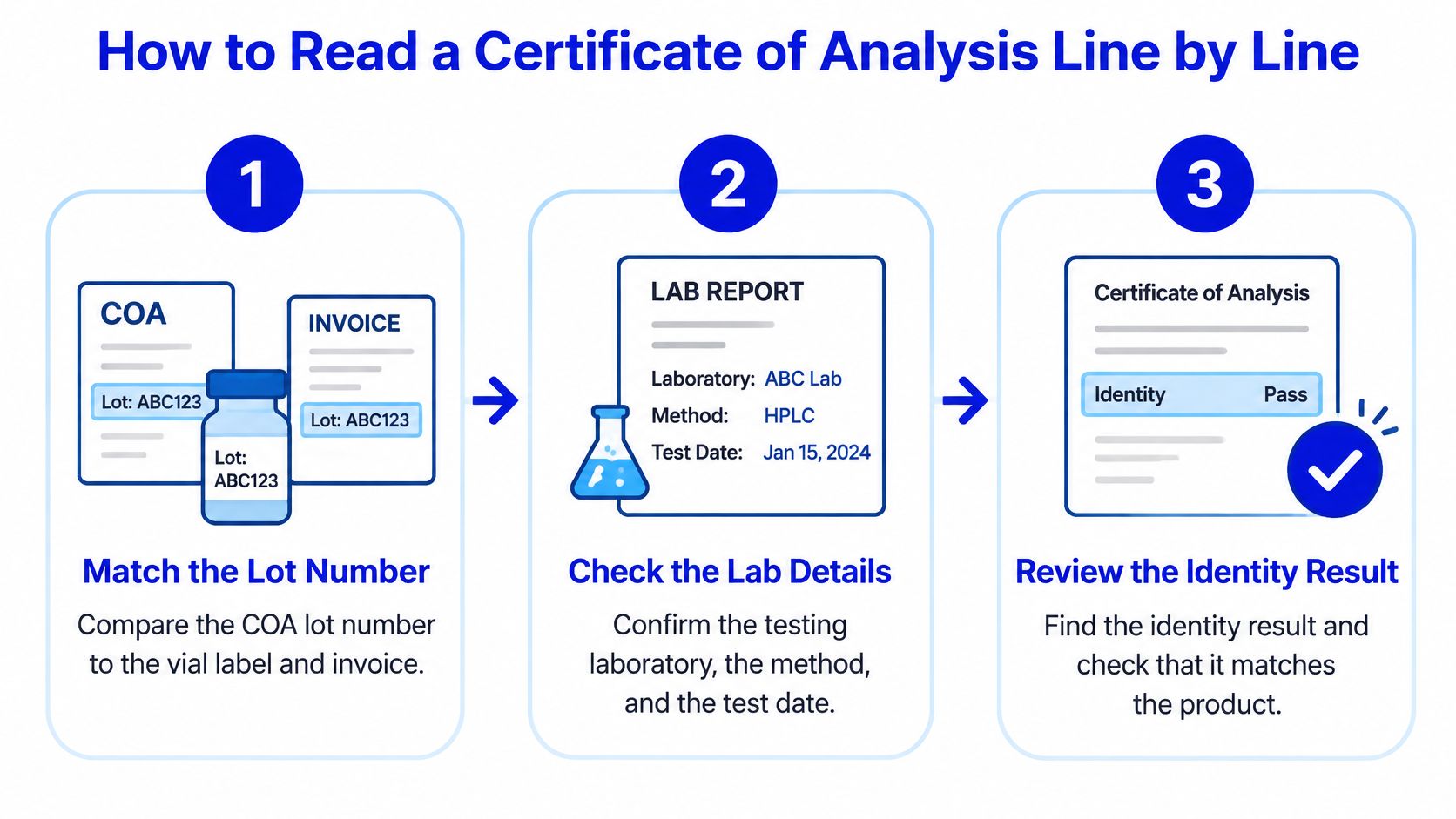
Match the lot number. Compare the COA's lot number with the vial label and invoice. If any one differs, ask for an explanation before treating the document as evidence for that material.
Check the laboratory details. The report should identify the testing laboratory, the methods used, and the test date. Without those details, it's difficult to assess what was tested or how to interpret the result.
Review identity. Find the identity result and check that it corresponds to the peptide named on the label. For consequential downstream work, orthogonal identity confirmation, such as mass spectrometry, can add useful information alongside chromatographic testing.
Read the purity method. Note the reported chromatographic purity and how it was calculated. A percentage without a named method or explanation doesn't tell you enough to compare reports meaningfully.
Compare purity with peptide content. Purity describes the relative signal for the target versus other detected peaks; peptide content addresses the amount of material by weight. A high purity figure doesn't, by itself, say how much peptide is in the vial.
Check microbial and endotoxin results. Look for separate results and stated acceptance limits. One result doesn't stand in for the other, so a report that addresses microbes alone leaves endotoxin unanswered.
Review storage and container notes. Look for storage conditions, shipping temperature, and container information. These details help you assess whether the lot's handling and use in a defined research protocol are documented.
Confirm the document is lot-specific. Check its date and signatory, and make sure it refers to the production lot being offered rather than a generic template. A report from another production run doesn't establish the properties of this lot.
Ask about missing fields in writing. If a result or method is absent, request clarification before using the material. A written answer gives your records a clear account of what the supplier did and didn't document.
Watch for a dated report tied to a different production run, a purity result with no method named, or a salt form on the COA that doesn't match the label. Define acceptance criteria before testing begins, and treat every result as limited to the lot tested. A complete document doesn't mean a material is safe to inject; it means the lot can be traced and its reported results can be assessed.
A polished website and a COA aren't enough to authenticate a product. Packaging and documents can be copied, and a genuine result may apply only to one lot. The supplier guidance on peptide safety and falsified products discusses reports of falsified GLP-1 receptor agonists linked with shortages, including products sold through unregulated outlets such as social media. That makes supply-chain verification as important as reviewing a product page.
Before placing an order, check whether the seller can provide:
Peptide Warehouse USA works with established manufacturing partners and third-party laboratories to define purity and identity specifications. It provides third-party testing documentation, including COAs, endotoxin reports, and microbial reports. Those records are useful to review as lot-level documentation, not as proof of clinical approval or suitability for injection.
Treat guaranteed weight-loss or healing claims, human-use testimonials, dosing charts, injection schedules, unexplained low prices, missing vial lot numbers, or unreachable contact details as reasons to stop and investigate. A research label paired with treatment marketing is another warning sign.
Don't score a seller by the polish of its site. Ask whether the records correspond to the exact lot and whether the supplier can explain the test methods, limits, and handling information in writing. If it can't answer those lot-level questions, don't proceed.
Storage instructions need to fit the specific peptide, formulation, lot, and laboratory protocol. Lyophilized powder and reconstituted solution aren't interchangeable states: solution may degrade faster, so use the timeframe set by the lot documentation or approved lab protocol rather than assuming a universal window.
| Physical state | Typical storage | Time frame | Handling note |
|---|---|---|---|
| Lyophilized powder, long term | Follow the lot-specific COA or product sheet | Months to years, per COA | Keep sealed, dry, and protected from light |
| Lyophilized powder, short term | Refrigerated, around 2–8°C | Days to weeks, per COA | Return to cold storage promptly after opening |
| Reconstituted solution | Refrigerated, around 2–8°C | Sequence-specific; follow the COA or protocol | Avoid repeated freeze-thaw cycles |
| Transit | Cold packs or controlled packaging, per supplier | Hours to a few days | Check for temperature indicators and excursion notes |
| On receipt | Inspect immediately | Same day | Compare lot number and seal with the COA; log damage |
These are general handling considerations, not a universal storage specification. Find the long-term storage temperature and usable window on the COA or product sheet for the specific lot. If the document doesn't state them, seek written clarification before adding the material to a study.
Keep vials sealed until needed, protect them from light, and store them dry. Avoid repeated freeze-thaw cycles, and record the time and temperature whenever the material moves between storage locations or is handled under different conditions. For reconstituted material, document preparation conditions as required by the lab protocol, without treating research guidance as instructions for human administration.
Peptide Warehouse USA ships orders using trusted carriers and offers multiple delivery options at checkout, with shipping available to all 50 U.S. states. Delivery options don't eliminate the possibility of delays, weekend holds, or temperature excursions. When a shipment arrives, inspect the seal and labeling, check any temperature indicator, compare the lot number to the COA, and record damage or delay. Keep that record with the lot file so storage and transit history remain traceable.
A certificate of analysis is lot-level evidence. It shows identity, purity, endotoxin, and microbial results for one specific batch, so it can only support a purchase when two things line up: the paperwork matches the lot in your cart, and the work itself is laboratory, analytical, or preclinical. No document converts a research peptide into a sterile injectable product, and no purity headline replaces the underlying test records.
Run this go-or-no-go checklist before submitting an order:
If any item is unchecked, wait. A purity figure on a product page describes the catalog as a whole. The COA describes one lot, and gaps in that lot's documentation can't be filled with assumptions about quality or intended use. A research-use statement also doesn't substitute for your organization's own review or applicable rules.
When the listing passes every check, review the supplier's documentation against your stated purpose before ordering. Customers can create an account on the Peptide Warehouse USA website to manage order information, and its help desk handles non-medical questions about product availability, documentation, and order status. Those conversations stay on the procurement side of the line.
Peptide Warehouse USA supplies research peptides and related compounds with third-party documentation, including COAs, endotoxin reports, and microbial reports, sold for laboratory, analytical, or preclinical purposes only and not for human consumption. Review the paperwork and stated research-use limits before you order, then contact Peptide Warehouse USA through its help desk to learn about available options or to ask non-medical questions about documentation and order status.