No products in the cart.


What if the core question behind integrity research BPC 157 isn't whether the peptide sounds promising, but whether the lot in your hand can survive an audit? Buyers usually start with healing claims, then discover the harder issue is documentation, identity, and whether the batch was made and tested in a way that supports reproducible research.
BPC-157 still sits on a weak human foundation. A 2025 systematic review found 544 records from 1993 to 2024, but only 36 studies met inclusion criteria, and those were 35 preclinical animal studies plus 1 clinical study; the same review found no completed controlled human efficacy trials (systematic review). That matters for procurement, because when the clinical record is this thin, the burden shifts to the supplier to prove the lot is what it says it is.
Integrity Research BPC 157 should be treated as a sourcing decision, not a therapeutic conclusion. In buyer terms, the product's value lives or dies on whether the batch documentation can defend downstream work, because the compound's modern reputation is still built mainly on preclinical evidence and sparse human data.
A defensible research lot starts with four questions. Was the peptide identity confirmed, was purity measured correctly, were impurities characterized, and was the batch screened for microbiological risk? Those are not marketing extras. They are the difference between a vial that supports publication-grade work and one that only looks credible on a product page.
Practical rule: if a supplier can't show you the methods, not just the conclusion, assume the lot is fit for screening at best.
The evidence base is too limited to let packaging do the heavy lifting. Human development has been sparse and discontinuous, with a cancelled Phase I trial and only a small number of pilot studies in the public record, which means buyers can't lean on clinical maturity to offset weak documentation (clinical trial landscape summary). The result is simple, if uncomfortable. For BPC-157, lab integrity is part of the product, not an afterthought.
That's why a procurement-minded review starts with the four pillars that matter operationally. HPLC purity tells you how clean the batch looks. Mass spectrometry tells you whether the peptide is the right sequence. Impurity profiling tells you what else came along for the ride. Microbiological and endotoxin testing tells you whether the lot is suitable for sensitive research handling.
BPC-157 entered the research conversation as a gastric-derived protective peptide, then earned its modern reputation through preclinical work rather than large human programs. That historical pattern matters because suppliers now sell into a market where buyers often know the name before they know the evidence shape.
The biggest continuity in the literature is not clinical adoption, it's persistence in animal and laboratory work. A 2025 review summarized in a peer-reviewed source screened 544 papers and found only 36 eligible studies, with 35 animal studies and 1 clinical study (review summary). Another registry-focused summary reports only two registered BPC-157 studies, one active Phase 2 hamstring trial with a 120-participant target and one completed-but-unresulted Phase 1 pilot in Mexico with 42 healthy volunteers (ClinicalTrials.gov summary).
That means the market's confidence is not grounded in a mature human dataset. It's grounded in years of mechanistic and animal data, plus a handful of small human signals that never matured into a decisive trial program. For a buyer, that gap changes the risk calculus immediately.
When human evidence is limited, batch quality has to carry more weight. If you're buying a peptide for cell work, assay development, or exploratory preclinical use, the lot can't be treated like a commodity powder. You need chain-of-custody logic, method transparency, and lot-specific data that lets you trace the material back to a defined analytical profile.
The thinner the clinical record, the more every COA has to function like a lab notebook page, not a brochure.
That's especially true for integrity research BPC 157 comparisons. A vendor can't borrow credibility from the literature when the literature itself is still largely investigational. Buyers should read supplier documentation as an extension of the evidence base, because in this category, the paper trail is often the only part that can be audited before purchase.
The preclinical story is strongest when you separate mechanism from marketing. BPC-157 is discussed in relation to angiogenesis signaling, tendon and ligament repair, gastrointestinal mucosal protection, and nitric oxide pathway interactions, but those signals only matter to procurement if the material can survive handling and route-specific formulation choices.
A recent review describes BPC-157 as unusually resistant in gastric conditions, with intact peptide recoverable after exposure to gastric pH 1 to 2 and pepsin, a behavior tied to conformational rigidity from an N-terminal polyproline II helix (gastric stability review). That doesn't make the compound clinically established. It does tell buyers why oral-formulation discussions exist at all, and why storage and reconstitution choices matter.
The pharmacokinetic picture is less forgiving. A 2022 pharmacokinetic study reported a plasma elimination half-life of less than 30 minutes after single IV or IM administration in rats and beagle dogs, with linear pharmacokinetics across the tested doses (Frontiers pharmacokinetic study). For research buyers, that's a reminder that assay timing and handling protocols have to match the material's behavior, not a vendor's simplified description.
Short half-life and gastric resilience point in different operational directions. Oral handling may be plausible in some experimental designs, while parenteral studies need tighter attention to solution stability, freeze-thaw exposure, and time from reconstitution to use. If your downstream work depends on consistent exposure, the supplier's documentation should tell you far more than “research use only” and a purity number.
Key procurement implications include:
The practical insight is simple. Preclinical promise can justify research interest, but it doesn't justify weak lot control. That's why a supplier's testing stack matters as much as the peptide itself.
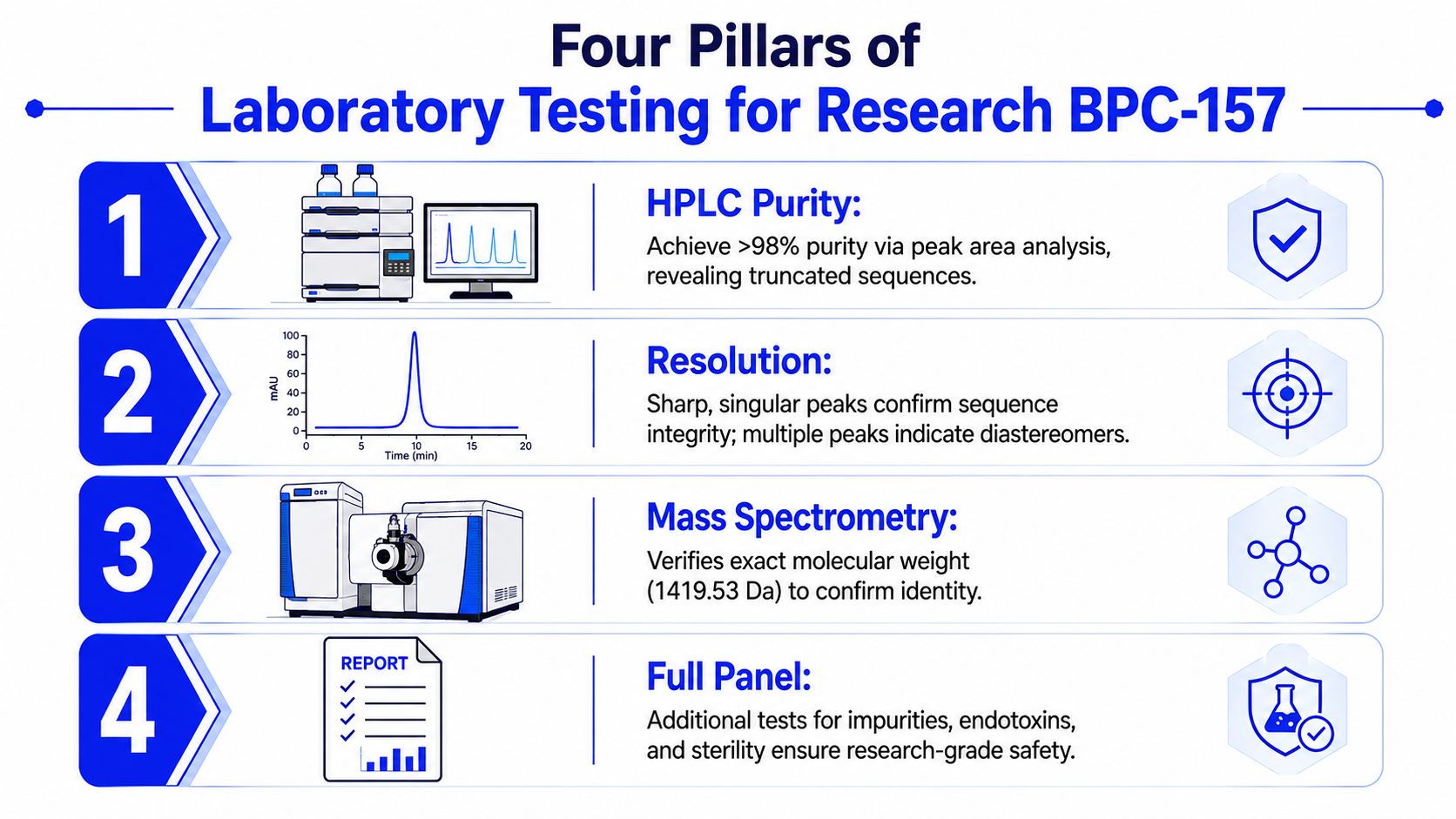
The most defensible research lots are the ones that answer four separate questions with four different methods. A single purity claim doesn't prove identity, and a single mass readout doesn't prove cleanliness. Buyers should look for all four pillars together, not as optional add-ons.
Reversed-phase HPLC is the standard starting point for purity assessment. High-quality research material is commonly expected to show a dominant main peak with impurities controlled below about 0.5% each and total impurity near 1% to 2%, while the intact molecular mass is reported around 1419.53 Da (testing overview). That said, HPLC can still mislead if the batch includes species that separate poorly or look clean under UV area alone.
MS, especially LC/ESI-MS or MS/MS, is what tells you whether the sequence is correct. It can detect truncations, deletions, or misassembled peptide material that may still look “pure” on a chromatogram. For buyers, that distinction is operational, not academic. A lot can pass a basic purity check and still be the wrong molecule.
Impurity panels matter because residual solvents, heavy metals, and counter-ions can change how a peptide handles in solution and how reproducible a protocol becomes. For injectable or parenteral-adjacent research, microbiological and endotoxin testing also matter. A defensible lot should show testing aligned with USP <61>, USP <62>, and USP <85> methods, because contaminated material can ruin cell work, animal studies, or any assay sensitive to pyrogenic interference.
Operational takeaway: HPLC says the batch looks clean, MS says it is the right peptide, and impurity plus endotoxin testing tell you whether the lot is actually defensible for research use.
For readers evaluating third-party verification more broadly, a useful companion resource is why third party testing matters. The core point is the same here, if the supplier controls the test story, the buyer is left trusting a summary instead of the underlying data.
A COA should behave like a working document, not marketing collateral. If it doesn't let you trace the lot, interpret the methods, and understand the limits of the result, it's too thin for serious procurement.
At minimum, the document should identify the lot number, manufacture date, expiry or retest date, storage conditions, analytical method details, and a clear reviewer or analyst sign-off. Without those fields, a buyer can't connect the paper to the vial, and that breaks traceability.
The methods matter just as much as the result. A COA that says “99.9% pure” without chromatograms, instrument conditions, or method references gives you a number with no context. That's where lot risk hides.
Buyer rule: if the method isn't visible, the result isn't really auditable.
Watch for patterns that look polished but don't withstand scrutiny:
The net peptide content should make sense relative to vial weight and the counter-ion assumption. If the stated content and the physical fill look out of step, ask how the calculation was done and what salt form was used. That check often exposes the gap between a neat label and the chemistry beneath it.
A COA audit for integrity research BPC 157 should also look for marketing mismatches. If the product page makes broad claims but the lab data only shows a purity percentage and a single assay type, you don't have a complete quality story. You have a partial one.
| COA Field Audit Checklist for Research Peptides | Required for Defensible Lot | Why It Matters |
|---|---|---|
| Lot number | Yes | Links vial, COA, and manufacturing record |
| Manufacture date | Yes | Helps verify batch freshness and traceability |
| Expiry or retest date | Yes | Frames usable window for research handling |
| Storage conditions | Yes | Reduces degradation risk after receipt |
| Analytical method details | Yes | Lets the buyer evaluate whether the result is meaningful |
| Chromatograms | Yes | Shows whether the purity claim is supported by data |
| Analyst or reviewer signature | Yes | Confirms the report was actually reviewed |
| MS identity data | Yes | Confirms the peptide is the intended sequence |
| Impurity panel | Yes | Reveals non-peptide material that affects reliability |
| Endotoxin or microbial screen | Yes | Supports safer handling in sensitive research workflows |
Documentation transparency is the cleanest way to compare suppliers without getting lost in price talk. For BPC-157, the buyer usually isn't choosing between identical products, but between different levels of proof.
Use the same questions on every supplier. Do they publish batch-specific analytical data, do they show third-party documentation, do they explain US manufacturing status, and do they disclose a purity range that can be checked against the COA? One example often used in supplier comparison is Peptide Warehouse USA, which publicly describes USA-based manufacturing, batch production and batch testing protocols, third-party COAs, microbial and endotoxin reports, and stated purity levels up to 99.5%. For buyers, that creates a clear baseline for evaluating whether another vendor is revealing the same level of detail.
That doesn't mean every supplier needs the same catalog or packaging style. It does mean the data structure should be comparable. If one supplier gives you a lot number, method details, and supporting reports while another gives you a product photo and a percentage, the first one is easier to defend in a research file.
| Evaluation Criteria | Integrity Research BPC-157 | Peptide Warehouse USA | Industry Benchmark |
|---|---|---|---|
| Batch-specific COA availability | Varies by seller and lot | Publicly supported, lot-specific documentation described | Lot-level documentation expected |
| Third-party analytical evidence | Often inconsistent across the market | Third-party COAs and supporting reports described | Independent verification preferred |
| US manufacturing transparency | Frequently unclear in the category | USA-based manufacturing stated | Source location should be disclosed |
| Purity disclosure | Often only a headline claim | Stated purity levels up to 99.5% described | Purity should be method-backed |
| Microbial and endotoxin reports | Not always published | Described as included | Strongly preferred for sensitive research |
| Shipping and handling clarity | Variable | Fast shipping and order tracking described | Handling conditions should be explicit |
| Technical support | Marketing-first support is common | Responsive help desk described | Clear pre-purchase support is valuable |
The procurement lesson is straightforward. If the supplier won't explain how the lot was made and checked, you're buying trust instead of material. That's a weak position for any lab.
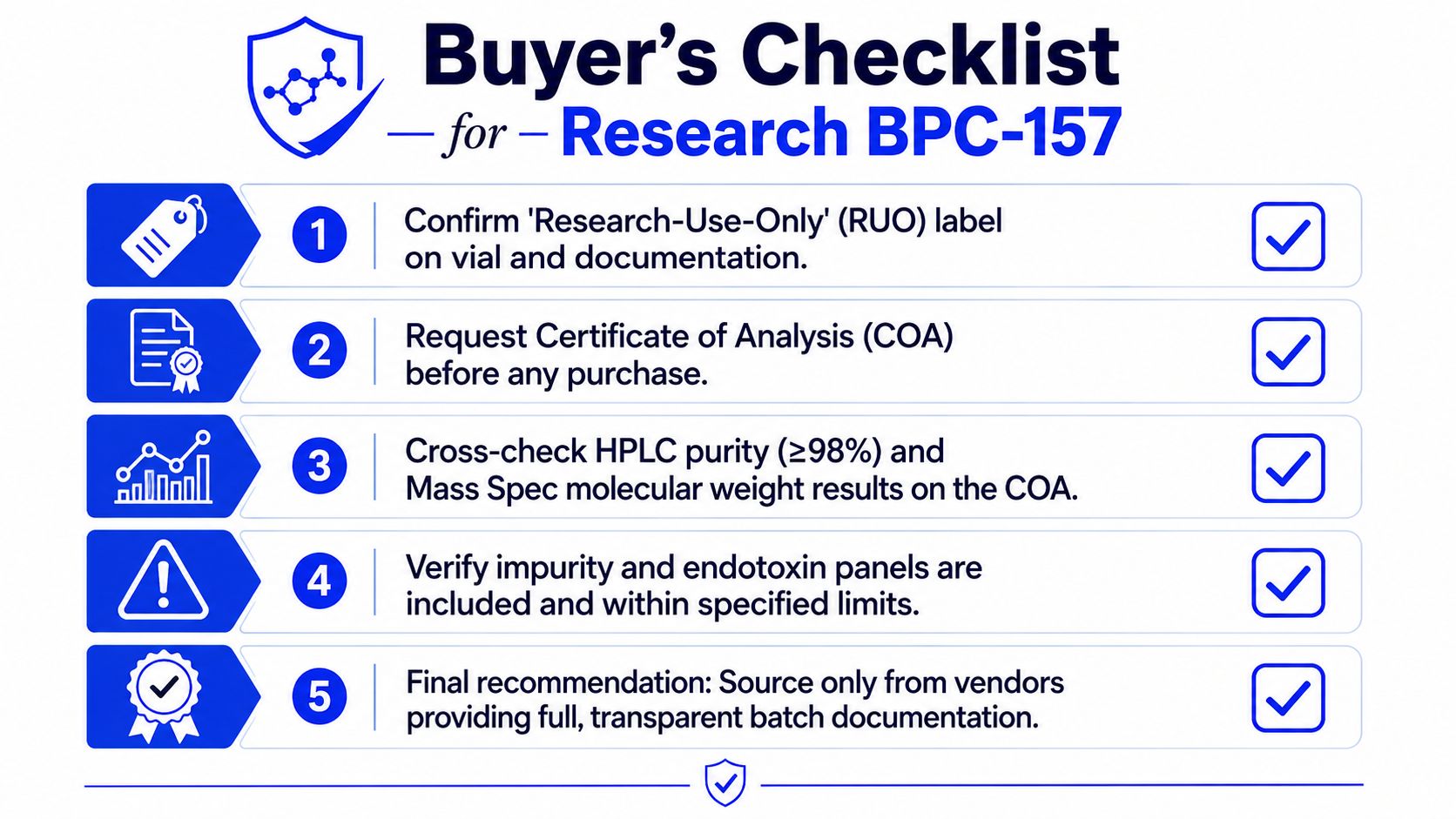
A smart sourcing sequence reduces avoidable risk before money changes hands. Start with the research-use-only label, request the COA before purchase, verify the analytical methods, and compare the lab data against the lot description. If anything is missing, treat that as a signal, not a minor omission.
The FDA has also raised broader concerns around BPC-157, including lack of evidence for effectiveness in ulcerative colitis and concerns tied to immunogenicity, aggregation, and peptide-related impurities (FDA briefing materials). That makes documentation quality even more central, because the buyer can't rely on clinical confidence to cover manufacturing uncertainty.
A practical supplier choice favors transparent, US-manufactured options that publish third-party COAs and batch-specific testing, especially when the research question depends on reproducibility. If you're comparing integrity research BPC 157 alternatives, use the paperwork first and the product page second.
For buyers who want a more document-forward sourcing path, Peptide Warehouse USA offers US-manufactured research peptides with batch-specific COAs and supporting reports that fit the kind of audit trail this category demands. If your lab needs to compare options on documentation instead of marketing, review their lot-level materials and see whether their BPC-157 offering matches your research standards.