No products in the cart.



What should an 80 mg KLOW vial cost, and does a higher KLOW peptide price indicate better research value? That assumption causes many procurement mistakes. KLOW isn't a single standardized pharmaceutical product. It refers to proprietary blends that may contain the same four named peptides but differ in total mass, ingredient ratios, documentation, testing, shipping, and promotional terms.
For laboratory buyers, the useful question isn't merely “Which vial is cheapest?” It's “What exactly is in the vial, what evidence supports its identity and quality, and what will the usable material cost after all procurement factors are included?” The distinctions matter even more because KLOW products are generally labeled for laboratory or research use, not human or veterinary use. Retail pricing shouldn't be treated as approved treatment cost or proof of clinical effectiveness.
KLOW is commonly described as a four-peptide research blend containing GHK-Cu, BPC-157, TB-500 or thymosin-beta-4, and KPV. However, the name doesn't guarantee one universal formulation. One listing describes an 80 mg blend with 50 mg of GHK-Cu and 10 mg each of BPC-157, TB-500, and KPV, while another describes a 70 mg version containing 42 mg of GHK-Cu and 10 mg of each remaining peptide. These differences are documented in the KLOW product listing.
That means two products can share the KLOW label while offering different total mass and constituent ratios. A vial price alone can't reveal whether you're comparing equivalent material. The difference resembles comparing two analytical reagents by bottle price while ignoring concentration, assay documentation, and usable quantity.

Practical rule: Treat “KLOW” as a formulation description, not as a guarantee of identical composition across suppliers.
Start a comparison by recording the following:
The most important mindset shift is simple. Price is an input to procurement, not a measure of therapeutic benefit. KLOW lacks direct controlled-trial evidence as a four-peptide blend, and its advertised price can't establish that one formulation produces better human outcomes than another. For a lab manager, value comes from identity, traceability, consistency, and relevance to the experiment.
The typical 80 mg KLOW formulation assigns most of its labeled mass to GHK-Cu. A commonly listed breakdown contains 50 mg of GHK-Cu, alongside 10 mg each of BPC-157, TB-500, and KPV. The composition is documented in product information from Evolve BioPeptides. On a mass basis, GHK-Cu accounts for 62.5% of the vial, while each of the other three peptides accounts for 12.5%.
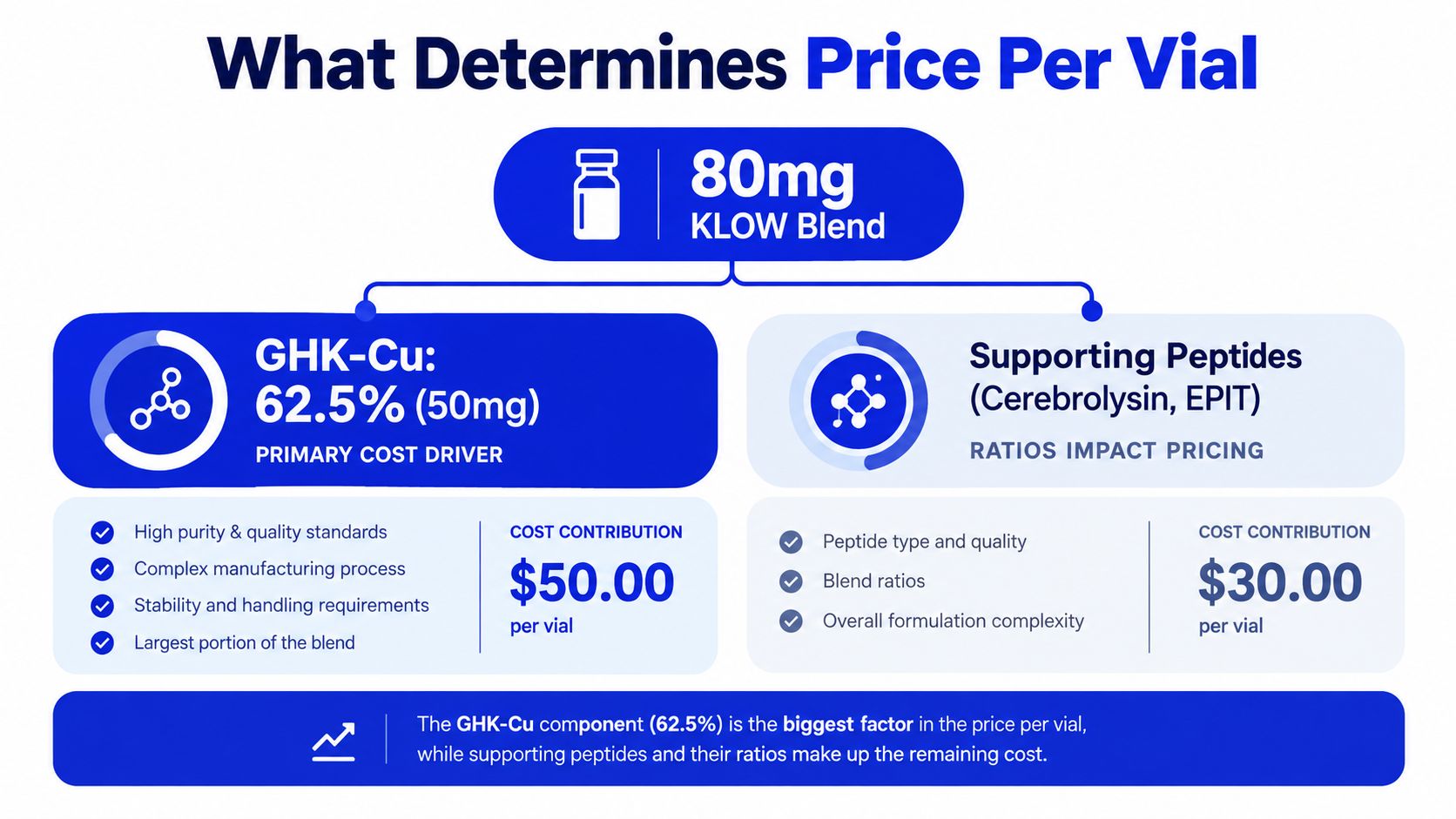
That ratio affects how you interpret a low KLOW peptide price. If one supplier offers a cheaper vial but uses a different formulation, the lower headline price may reflect less total material or a different allocation among the components. A nominal cost per milligram can help, but it still doesn't tell you whether the ingredient distribution matches your protocol.
Use the following calculation for the total-content comparison:
Price per total milligram = vial price ÷ labeled total milligrams
For constituent-level analysis, use a second calculation:
Price per constituent milligram = vial price ÷ labeled milligrams of that constituent
The second calculation matters when your study depends primarily on one component. An 80 mg vial containing 50 mg of GHK-Cu isn't equivalent to a different vial with a lower GHK-Cu allocation, even if both products carry the same KLOW name.
A procurement sheet should include:
| Comparison field | Why it matters |
|---|---|
| Total vial mass | Establishes the denominator for nominal cost |
| GHK-Cu quantity | Often represents the largest share of the blend |
| BPC-157 quantity | Identifies the amount assigned to that component |
| TB-500 quantity | Distinguishes the stated thymosin-related content |
| KPV quantity | Shows whether the inflammatory-research component is included at the expected level |
| Lot documentation | Connects the material to a specific testing record |
| Shipping and terms | Converts advertised price into actual purchase cost |
The blend format can create convenience because a researcher receives multiple named compounds in one vial. It can also create analytical complications. If an experiment needs independent dose-response work for each component, a pre-mixed vial removes some flexibility compared with purchasing single-compound materials.
Don't confuse a multi-peptide label with a standardized stack. The KLOW blend product information describes the common 80 mg structure, but procurement still requires verification of the specific lot and supplier documentation.
Observed online prices for an 80 mg KLOW research blend show substantial dispersion. The displayed prices are $51.95, $89.98, $122, $123.99, $144.99, $145, $153, and $160 per vial, based on the market snapshot documented by Bulk GLP. Those listings produce a simple range of $108.05, an arithmetic mean of approximately $123.86, and a median of about $133.99.
The figures are useful for setting expectations, but they aren't a regulated market index. Some listings include discounts, memberships, free-product offers, or different shipping conditions. A displayed price may therefore represent a promotional acquisition cost rather than the ordinary price a lab will pay for repeat purchasing.
On a nominal total-content basis, the observed prices span roughly $0.65 per mg at $51.95 to $2.00 per mg at $160. One listing calculates $1.81 per labeled milligram for a $144.99, 80 mg vial, while another reports $1.91 per nominal milligram for a $153 vial. These calculations are derived from advertised prices and labeled mass, not verified manufacturing costs.
A side-by-side review should look like this:
A lower nominal price isn't automatically the lower total cost if the material doesn't provide the documentation or composition your protocol requires.
Shipping can change the result, particularly when a lab orders small quantities. Record the delivered cost, not only the product page price. Also record the date, since online listings can change and promotional terms may expire.
Searchers sometimes compare research material with supervised clinical services or broader wellness programs. Those are different purchasing categories with different overhead and regulatory contexts. For general context on how service-based healthcare pricing can include costs beyond the headline amount, review this explanation of concierge medicine hidden expenses. It shouldn't be used to price a research vial, but it illustrates why a single displayed amount rarely captures the full cost structure.
The practical benchmark is therefore a documented, date-stamped comparison. Put the vial mass, ratios, price, shipping, testing records, and commercial terms in one sheet. Only then can you tell whether the apparent bargain survives normalization.
A higher KLOW peptide price can be reasonable when it reflects evidence that the material is more traceable and suitable for the intended laboratory workflow. It isn't reasonable merely because a product page uses stronger language about purity or benefits. The buyer needs documentation tied to the actual lot.
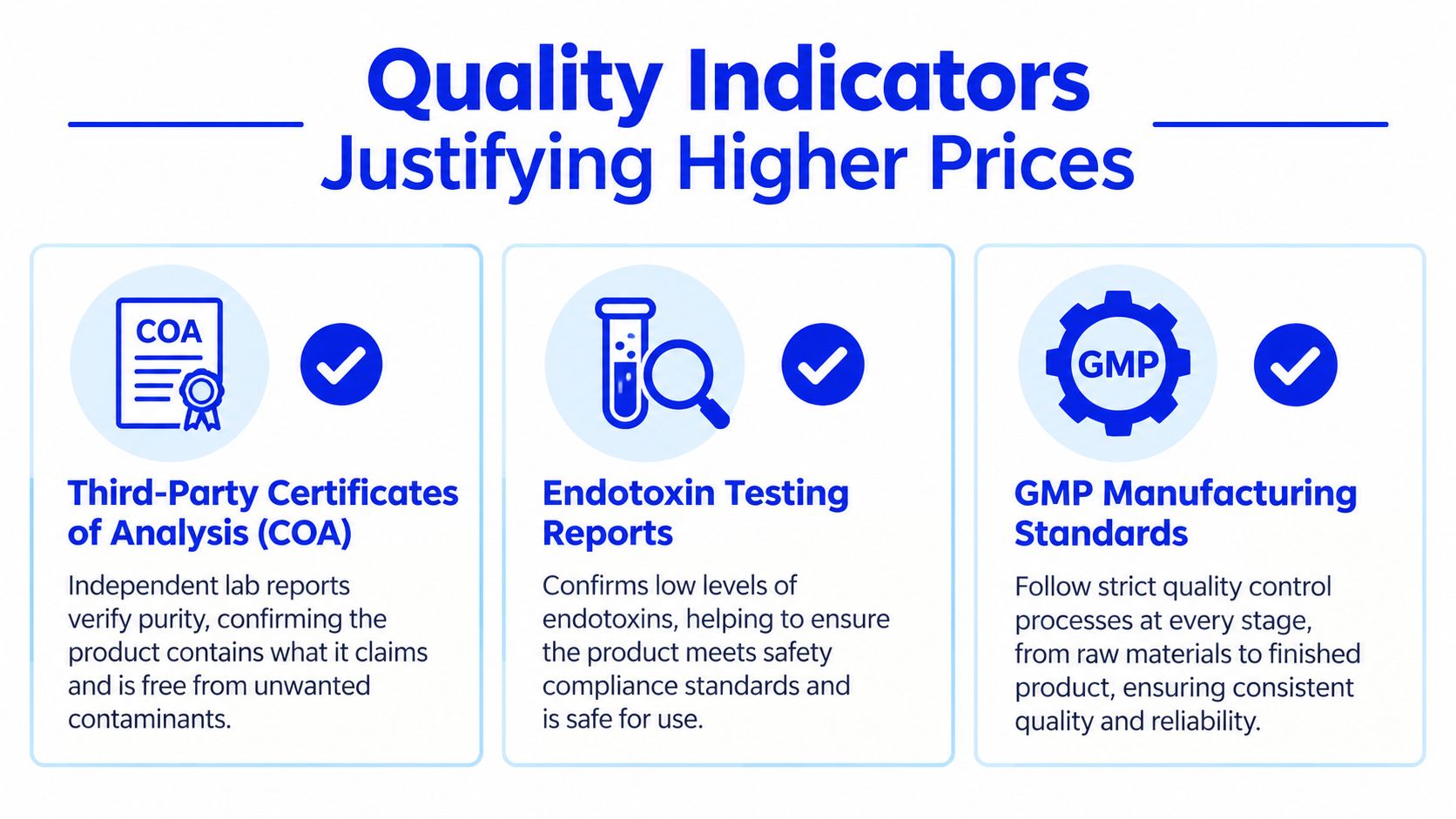
A COA should identify the product or lot and show what was tested. Look for assay or purity information, analytical methods, testing dates, and a connection between the document and the material being purchased. A generic file with no clear lot relationship has less procurement value than a document that allows the lab to trace the vial back to a defined batch.
Testing should answer practical questions:
Endotoxin and microbial reports may matter for workflows where contamination control affects the research design. They don't turn a research product into an approved medicine, and they don't establish human safety. Manufacturing controls can improve consistency, but a quality label alone isn't a substitute for reviewing the underlying records.
Researchers should also ask whether the supplier can explain storage, handling, replacement, and documentation procedures. A responsive support channel has practical value when a lab needs to reconcile a lot number or investigate a delivery issue.
For broader safety context, this overview of safe peptide protocols explained is useful as a reminder that research materials and human-use products shouldn't be treated as interchangeable. The relevant lesson for procurement is boundary control. A well-documented vial can support laboratory planning, but it doesn't justify self-administration or clinical claims.
Documentation test: Pay more only when the premium buys information you can use, verify, and retain in your laboratory records.
A supplier's manufacturing claims should be assessed alongside actual test reports. Purity, residual solvents, sterility, endotoxin status, and microbial results can all affect usable value, but the buyer shouldn't assume any of them from a product title alone.
The central pricing mistake is treating KLOW as though it has a proven therapeutic value that can be compared across brands. The four-peptide blend lacks direct controlled-trial evidence testing it against each individual component, pairwise combinations, or related blends. The absence of that evidence means a higher price can't be defended as proof of greater clinical effectiveness.
The distinction matters because consumer searches often connect KLOW with weight loss, healing, antiaging, or muscle recovery. Those interests don't supply the evidence needed to assign a health-related price premium. A laboratory buyer should separate three forms of value:

None of the four components is FDA-approved for human use, and chronic exposure to the blend hasn't been adequately characterized in human studies, as summarized in the KLOW FAQ. Regulatory developments also require careful reading. A change involving withdrawn nominations for BPC-157 and TB-500 doesn't equal approval, and the cited review states that the compounds hadn't been placed on the FDA 503A bulk list as of its 2026 review.
That regulatory nuance protects buyers from a common error. A supplier's price, purity claim, or four-peptide formulation doesn't establish that KLOW is an approved treatment or that it delivers the benefits associated with consumer search language. The appropriate use of pricing information is narrower. It helps a researcher budget for laboratory material after verifying composition and documentation.
Use a repeatable quote sheet before ordering. Record the date, vial mass, ingredient ratios, lot number, purity documentation, microbial and endotoxin reports, shipping charges, and promotional conditions. Then calculate both price per total milligram and, when relevant, price per milligram of each named constituent.
Reject comparisons that rely only on the vial headline. A cheaper product may have a different formulation, weaker documentation, or higher delivered cost. A more expensive product may be justified if its records improve traceability and reduce uncertainty for the experiment.
Peptide Warehouse USA lists an 80 mg KLOW Blend containing BPC-157, GHK-Cu, TB-500, and KPV, with research-use positioning and supporting product documentation. Researchers can explore Peptide Warehouse USA alongside other suppliers, then compare its specific lot records and delivered terms using the same framework.
Final procurement check: Buy the material that best matches the protocol and documentation requirements, not the product with the most persuasive price badge.
The KLOW peptide price becomes meaningful only after you normalize the blend, inspect the evidence, and calculate the actual acquisition cost. Visit Peptide Warehouse USA to review its research catalog and compare the KLOW offering against your laboratory's composition and documentation requirements. Use the supplier's product information as one input in a documented, lot-specific procurement decision.